
Le’Veon Bell’s reported child-support arrest began in a place that had nothing visibly to do with a Michigan family-court file: Belden Village Mall in Canton, Ohio. Canton police arrested Bell on July 19, 2026, on what was described as a “courtesy hold for another agency,” and he was booked into the Stark County Jail while awaiting extradition to Michigan as of July 21, 2026.[1]
That phrasing matters. A courtesy hold is not Ohio deciding the support case. It is Ohio acting as the place where the person was found, held, and processed because another jurisdiction says it has a warrant and wants the person returned. In Bell’s case, the reported requesting jurisdiction is Michigan: the Michigan Attorney General’s Office sought extradition on July 15, 2026, after Kent County records reportedly showed $112,522.89 in child-support arrears as of February 3, 2026, with three felony counts tied to the matter.[1]
The useful question raised by Bell’s arrest is therefore not whether a former NFL running back was embarrassed in public. It is why an Ohio jail can become the temporary holding point for a Michigan support order, and what that says about interstate child-support enforcement under UIFSA, the Uniform Interstate Family Support Act.
This is legal-procedure analysis, not legal advice and not a prediction about Bell’s guilt, innocence, defenses, payment history, or ultimate outcome. The public record described in the available reporting stops at the arrest, the Michigan warrant and extradition request, the reported arrears figure, the reported felony counts, and Bell’s pending extradition status as of July 21.
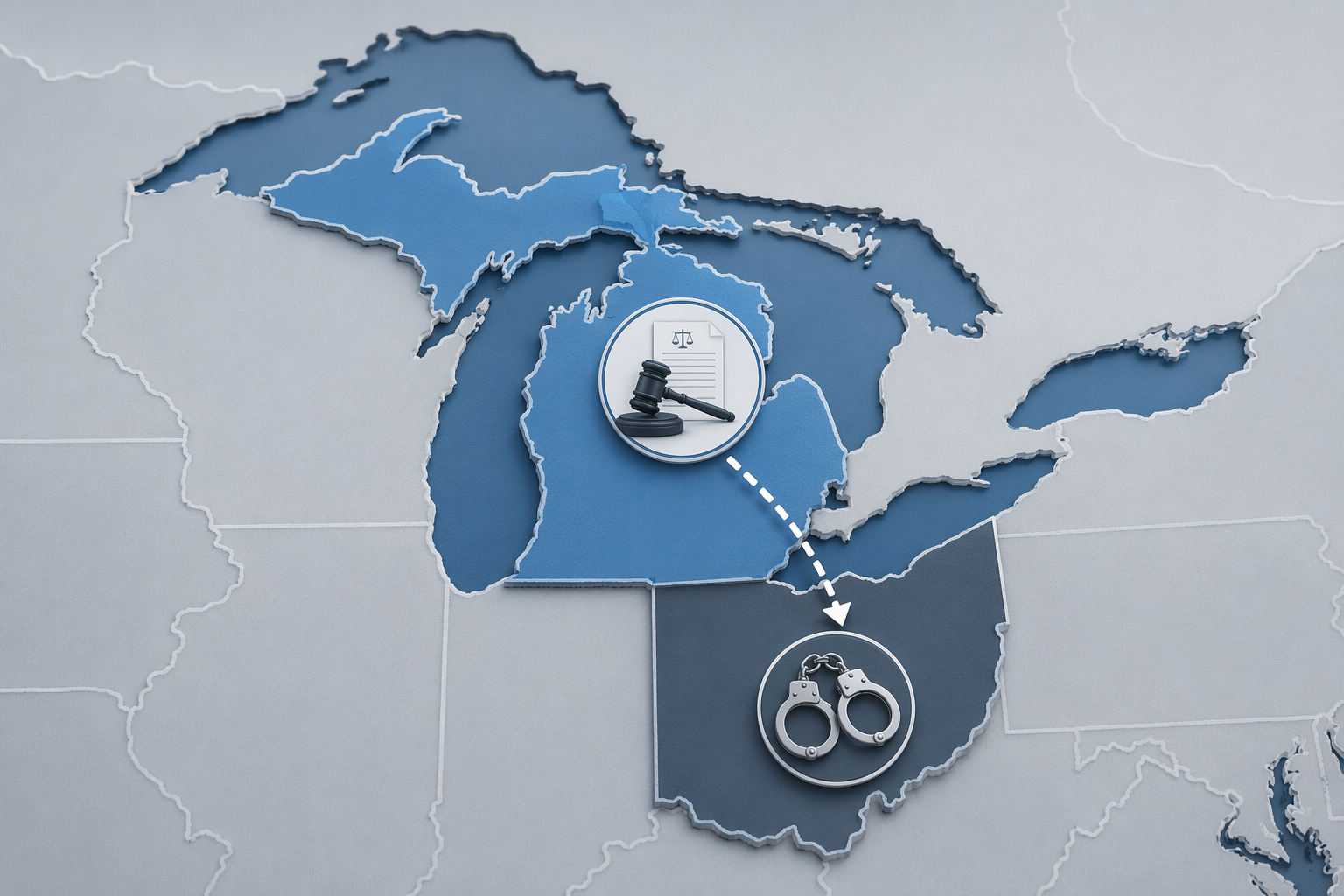
The case turns on handoffs, not headlines
Stripped to its procedural parts, the reported sequence is compact:
- A Michigan child-support matter existed, with Kent County records reportedly listing $112,522.89 in arrears as of February 3, 2026.[1]
- Michigan authorities treated the case as serious enough to support three felony counts and an extradition request from the Michigan Attorney General’s Office dated July 15, 2026.[1]
- Bell was arrested in Canton, Ohio, on July 19, 2026, at Belden Village Mall on a courtesy hold for another agency.[1]
- He was booked into the Stark County Jail and remained there pending extradition as of July 21, 2026.[1]
Each handoff answers a different question. Michigan supplies the support case and the alleged criminal non-support theory. Ohio supplies the physical arrest location and temporary custody. Extradition is the bridge between the two. None of that requires Ohio to become the state that recalculates the support obligation, reweighs Michigan’s support history, or turns a Michigan order into an Ohio order merely because the arrest happened in Canton.
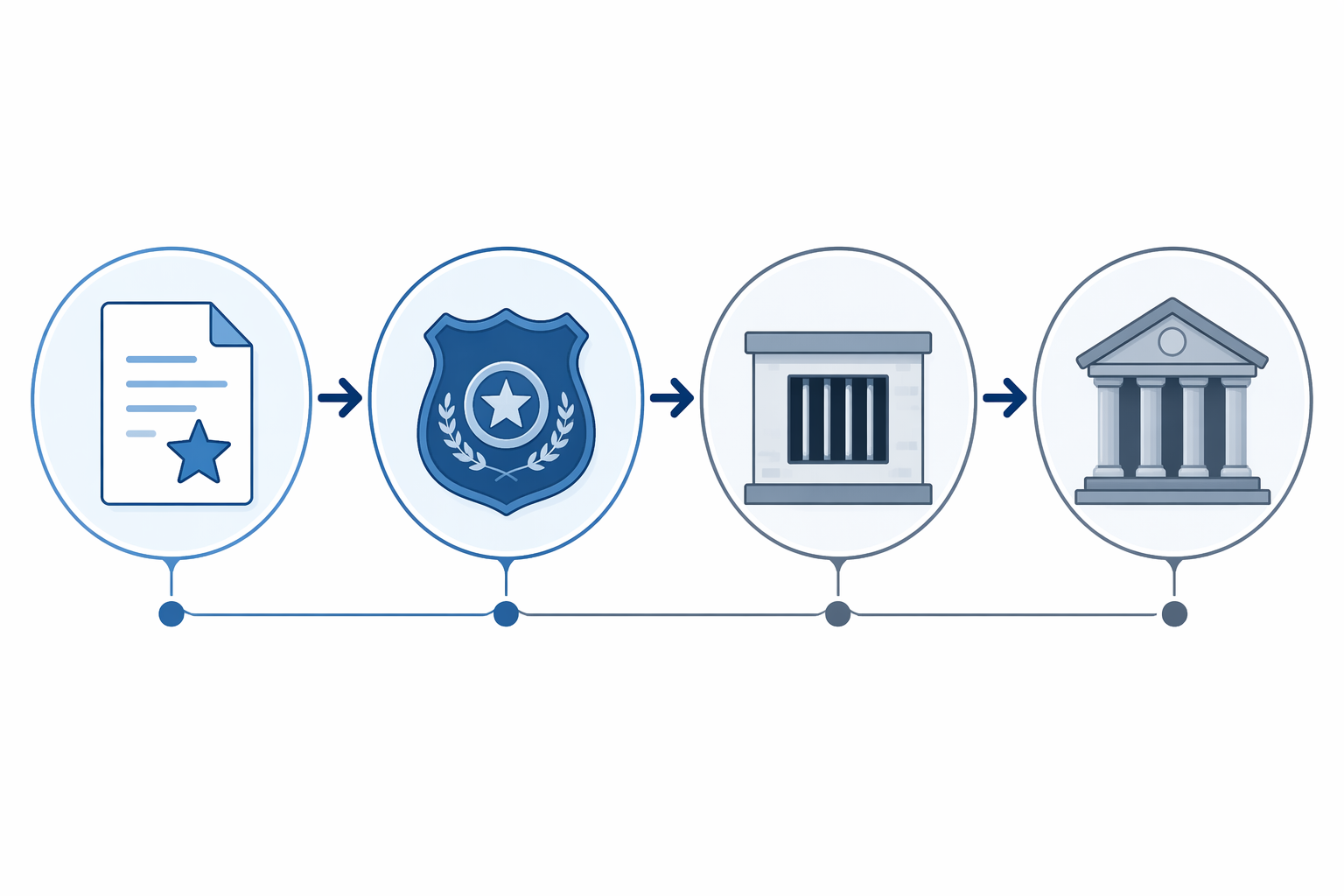
Why Michigan remains the center of gravity
UIFSA exists because families, jobs, residences, and orders do not always stay in the same state. Without a uniform interstate framework, a support order could become practically weaker whenever an obligor crossed a state line, or it could splinter into competing orders from multiple courts. The point is to preserve an enforceable order while controlling which state has authority to modify it.
Michigan Legal Help explains the basic division in Michigan terms: child support is generally part of a court order, and enforcement can involve government support agencies when payment is not made as ordered.[2] Cohen Seglias’ UIFSA explanation states the jurisdictional principle more directly for interstate cases: the state that issued the order generally keeps continuing, exclusive jurisdiction while the child or one of the parties continues to reside there, meaning another state may assist with enforcement without taking over modification authority.[3]
That distinction is easy to miss in arrest coverage. “Ohio arrest” sounds like an Ohio case. Procedurally, the reported facts point in the opposite direction. Ohio was the enforcement location because Bell was found there. Michigan remained the requesting state because the reported support order, arrears records, warrant, felony counts, and extradition request were tied to Michigan.[1]
Continuing exclusive jurisdiction is not a decorative phrase. It decides where the controlling order lives. If the issuing state retains that authority, the enforcing state’s role is narrower: locate, hold, process, garnish, register, or otherwise assist through the channels available under interstate enforcement law. The enforcing state does not become a second family court invited to restart the dispute from the beginning.
| Question | Reported answer in Bell’s case | Procedural significance |
|---|---|---|
| Which state is tied to the support matter? | Michigan, through Kent County records and the Michigan Attorney General’s extradition request | Michigan is the jurisdictional center of the reported support enforcement action |
| Where was Bell found and held? | Canton, Ohio, with booking into the Stark County Jail | Ohio functioned as the physical enforcement location |
| What connected Ohio custody back to Michigan? | A Michigan warrant and pending extradition | Extradition, not Ohio family-court modification, is the immediate procedural bridge |
| What remains unresolved publicly? | Bond or release information, quoted charging documents, and any pre-arrest modification efforts | The available record does not support broader conclusions about defenses or final liability |
The reported arrears figure is why this is more than a missed-payment story
The $112,522.89 figure reported from Kent County records is the number that changes the procedural temperature of the case.[1] A support-enforcement file can contain many ordinary problems: late payments, partial payments, employer transitions, accounting disputes, income changes, missed notices, or failed modification attempts. The public reporting does not tell us which, if any, of those issues exist here. But it does tell us the alleged arrears amount, and that amount explains why the case is being reported in felony terms rather than as a routine administrative collection problem.
Michigan’s felony non-support boundary is not vague. Under the Michigan framework summarized by the cited source, arrears of more than $5,000 can support felony non-support exposure under MCL 750.165, with potential punishment of up to four years and/or a $2,000 fine.[4] The reported arrears figure in Bell’s case is far above that threshold, which helps explain the Michigan warrant and extradition request as procedural consequences rather than tabloid embellishments.[1][4]
Precision is important here. The available reporting identifies three felony counts and connects the matter to child-support arrears, but it does not quote the charging documents. That means the statute should be treated as the relevant Michigan felony non-support framework, not as a publicly verified quotation from Bell’s charging instrument. The legal boundary is clear; the exact charging language in this particular file has not been supplied in the reporting available for this analysis.
What a courtesy hold does, and what it does not do
A courtesy hold is a custody mechanism. It is not a merits ruling on the underlying support case. When Canton police held Bell for another agency, Ohio’s immediate job was to honor the warrant process and keep custody available for the requesting jurisdiction. In the reported chronology, that requesting jurisdiction was Michigan, and the next identified procedural stage was extradition.[1]
That is why the phrase “pending extradition” carries more weight than most casual arrest stories give it. Extradition is the mechanism by which Michigan seeks to bring the person before the Michigan process that issued or is enforcing the warrant. Until that happens, the Ohio jail booking is a holding point, not the place where the Michigan support obligation is finally litigated.
This matters for ordinary interstate support cases as much as for a celebrity file. A parent who owes support in one state cannot assume the order loses force because the parent is physically present in another state. At the same time, the enforcing state’s involvement does not erase the limits of jurisdiction. UIFSA’s structure is meant to make enforcement portable while keeping modification authority from scattering among every state where a person may be found.
Arrest is not conviction, and enforcement is not a full factual record
The available facts support a narrow, useful conclusion: Bell was reportedly arrested in Ohio on a Michigan child-support warrant, jailed in Stark County, and held pending extradition after Michigan authorities sought his return in connection with a large reported arrears balance and three felony counts.[1] They do not support a conclusion that he has been convicted, that every dollar is uncontested, or that no procedural defenses exist.
They also do not show whether Bell sought a support modification before the arrest. That absence matters. In support practice, a person’s ability to pay, changes in income, notice, accounting, and modification history can matter a great deal. But those issues have to be raised in the proper forum and supported by a record. Nothing in the available materials establishes those facts one way or the other.
The public reporting also leaves practical jail-status questions unanswered. As of July 21, Bell remained in the Stark County Jail pending extradition, and the reporting cited here does not provide bond, release, waiver-of-extradition, or transfer information.[1] Those details could change the next procedural step without changing the underlying jurisdictional lesson.
The procedural lesson from the Bell arrest
Bell’s name draws attention, but the machinery on display is ordinary in concept: one state has the support order and enforcement interest; another state has the person; the warrant and extradition process connect them. UIFSA supplies the jurisdictional logic that keeps the order anchored while allowing enforcement to move across state lines.
The current record remains narrower than the public attention around it. If Michigan retains continuing exclusive jurisdiction because the child or a party remains connected to the issuing state, Ohio’s role remains limited to enforcement and custody processing unless some separate jurisdictional fact changes. If Michigan prosecutes felony non-support, the reported arrears figure and statutory threshold explain why the case has moved beyond routine collection. And if Bell contests the allegations, seeks release, waives or fights extradition, or raises modification and payment issues, those will belong to later stages of the record—not to the fact of the Ohio booking itself.
Comments
Join the discussion with an anonymous comment.