
The Bell default judgment can pull attention toward celebrity, accusation, and dollar amount. The litigation lesson is narrower and more useful: a civil defendant can face an enormous judgment before ever litigating the merits if the docket reflects service, the answer deadline passes, and default procedures keep moving.
In Bell's Ohio civil case, the sequence matters more than the headline. A complaint was filed in March 2024. Neither Bell nor his brother La'Vonte Bell responded within Ohio's 28-day answer window. Default was entered in October 2024. A damages trial followed in February 2025, producing a $25 million award against Le'Veon Bell and a separate $11 million award against La'Vonte Bell in a civil sexual-abuse case that included compensatory and punitive damages.[1]
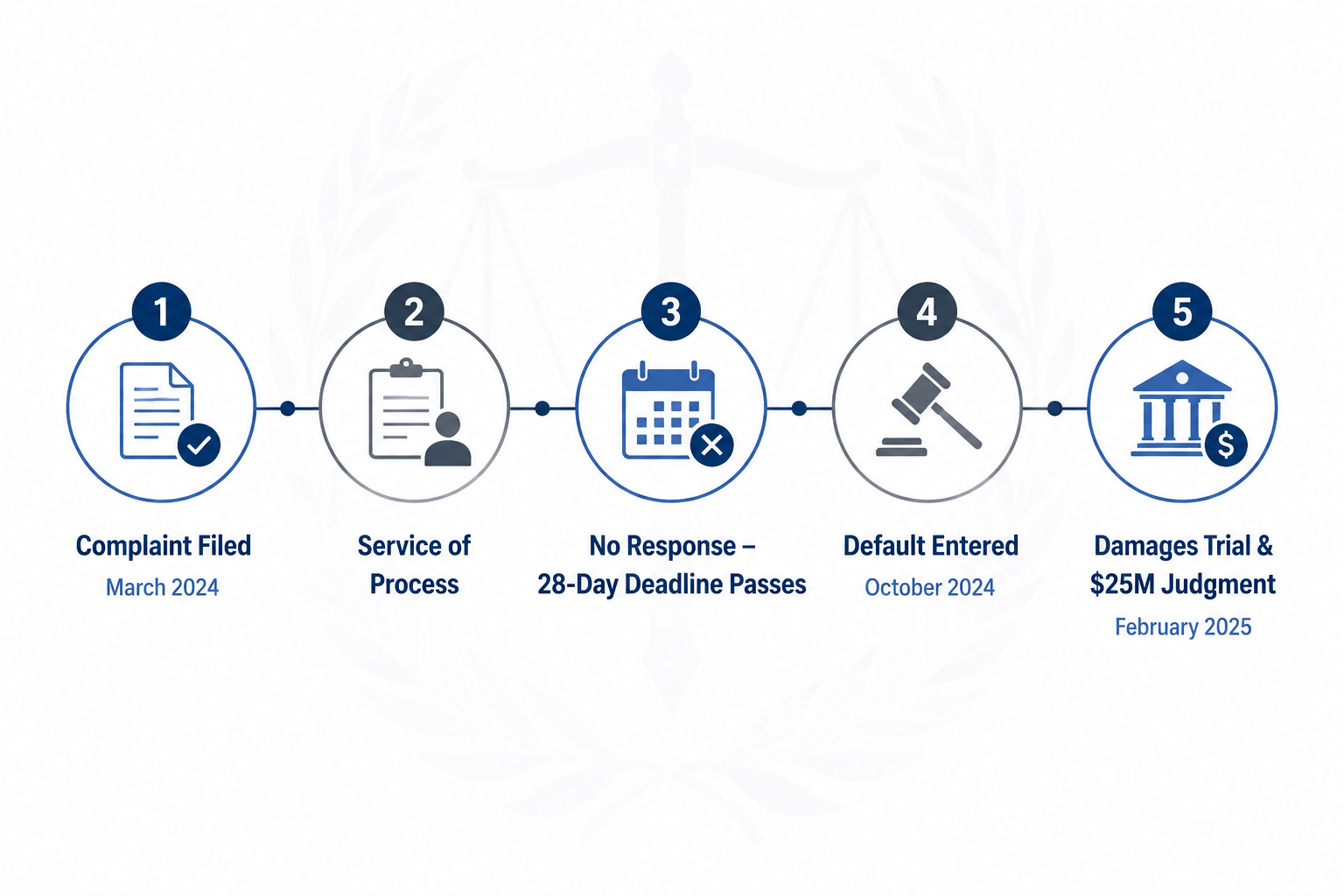
That is how a default judgment becomes real. The court does not need a defendant's participation to reach the next procedural step once the conditions for default are met. The clerk's file, the service return, the expired response period, and the plaintiff's request for default can do the work that contested pleadings otherwise would have done.
The judgment did not begin with the damages number
The civil claims are serious; the procedural posture is separate. The reported award followed a default, not a merits defense by Bell and not a liability finding after his side presented evidence. That distinction does not erase the plaintiff's judgment. It does change what lawyers should be watching.
Default operates on missed participation. Once a defendant fails to plead or otherwise defend after being served, Ohio Civ.R. 55 supplies the mechanism for entry of default judgment. In practical terms, the first lost event is not the damages hearing. It is the answer deadline. After that, the defendant is no longer shaping the pleadings, narrowing issues, preserving defenses in the ordinary way, or forcing the plaintiff to prove liability in an adversarial posture.
The Bell timeline shows the compounding effect. The March 2024 complaint created the need for a timely response. The missed 28-day response period opened the door to default. The October 2024 default changed the litigation from a contested case into a damages-focused proceeding. By February 2025, the court could address monetary relief with the defendants already procedurally absent.[1]
| Event | Procedural consequence |
|---|---|
| Complaint filed in March 2024 | A defendant who has been properly served must calculate the response deadline. |
| No response within Ohio's 28-day answer window | The plaintiff may seek default if the defendant has failed to plead or otherwise defend. |
| Default entered in October 2024 | Liability posture changes; the defendant's absence can carry consequences without merits participation. |
| Damages trial in February 2025 | The court can determine damages after default, resulting here in awards of $25 million and $11 million. |
There is a reason courthouse staff care about envelopes, addresses, receipts, returned mail, and docket codes. They are not decorative facts. They are the foundation for whether the court can treat silence as default rather than non-notice.
The service dispute is the hinge
Bell's public position is not just that the result is harsh. His attorney reportedly said the summons was left at an address where Bell "does not live" and stated that Bell intended to file a motion to vacate the judgment.[2] If that factual claim is supported, it points to notice and due process, not merely regret over missing a deadline.
The plaintiff's side gives the opposite procedural account. Plaintiff's attorney told the New York Post that Ohio service requirements were satisfied and that the documents were never returned undelivered.[2] That matters too. A docket that shows completed service and no returned mail is not the same thing as an informal allegation that papers never arrived.
Neither assertion resolves the question. A motion to vacate may require the court to look at the service method, the address used, who received or accepted documents if anyone did, whether the service return complied with Ohio practice, whether documents came back undelivered, and whether the defendant's claim of nonreceipt is credible in light of the record. Practitioners should verify the current text of Ohio Civ.R. 4 through 4.6 rather than relying on shorthand descriptions of service rules.
This is the uncomfortable part of default practice. A defendant's statement that he never knew about the suit is important, but it is not self-proving. A plaintiff's statement that service complied with the rules is also important, but it is not immune from challenge. The court needs facts that can be tested against the rules and the docket.
Ohio default practice turns silence into risk
Ohio's 28-day answer period is short enough that ordinary client delay can become litigation failure. A complaint lands at a business address, a former residence, a relative's house, a mailroom, or a place the plaintiff believes is valid. Someone assumes someone else will handle it. The deadline passes. By the time a lawyer is called, the first issue may no longer be how to answer the complaint. It may be how to undo a default.
That posture changes the lawyer's job. Instead of drafting denials and affirmative defenses in the usual sequence, counsel has to reconstruct notice: where the summons went, what address records existed, what the docket showed, whether certified mail or another method was used, whether anything was returned, and when the defendant first learned of the case. The merits may matter later, but the immediate fight is procedural access.
Bell's case illustrates the scale of that risk because the damages phase was not small. CBS Sports reported a $25 million award against Le'Veon Bell and an $11 million award against La'Vonte Bell after the February 2025 damages trial.[1] The size of the award is attention-grabbing, but the procedural warning is that the court reached that stage after a missed response and default entry.
For plaintiffs, the lesson is not to treat default as a paperwork shortcut. The larger the judgment, the more important the service record becomes. A plaintiff who expects to preserve a default judgment needs a clean path from complaint to service to deadline to default to damages. Loose address work can become the defendant's best post-judgment argument.
Vacating default is a remedy, not a reset button
Ohio Civ.R. 60(B) is the likely relief path once default judgment has been entered. Secondary Ohio practice commentary describes the rule as allowing relief for grounds that include mistake, inadvertence, surprise, excusable neglect, and due process problems tied to lack of proper notice. It also emphasizes timing: a motion must be brought within a reasonable time, and grounds based on mistake or neglect are subject to a one-year limit.[3]

The distinction between excusable neglect and lack of proper notice is not academic. If Bell's argument is that service was left at a place where he did not live, the strongest version of the motion would press notice and due process. If the record shows service was proper and the problem was internal delay, inattention, or failure to act after notice, the argument starts to look more like excusable neglect. Those are different showings.
Excusable neglect is not the same as being busy, embarrassed, hard to reach, or surprised by the dollar amount after judgment. Courts typically look for a reason the failure to respond should be forgiven, not just a reason the consequences now feel severe. A defendant seeking relief has to supply evidence, not mood.
Lack of proper notice has a different center of gravity. If a defendant was never properly served, the problem is not merely that the defendant missed a deadline. It is that the deadline may never have been lawfully triggered in a way that supports default. That is why the address dispute in Bell's case is so consequential. The factual question of where the summons was left may control the legal question of whether the judgment can stand.
Timing still matters. The reported damages judgment came in February 2025, and Bell's attorney reportedly said he intended to move to vacate after denying the allegations publicly in March 2025.[2] As of July 20, 2026, the practical question is not simply whether a motion was emotionally understandable. It is whether the asserted ground fits Ohio Civ.R. 60(B), whether the filing was made within a reasonable time, and whether any mistake-or-neglect theory falls within the one-year limit described in Ohio practice commentary.[3]
What the motion would have to make concrete
- The address used for service and why that address was or was not valid for Bell at the relevant time.
- The service method, the return status, and whether the documents were ever returned undelivered.
- The date Bell first learned of the lawsuit or judgment, supported by evidence rather than assertion alone.
- The reason no answer or appearance was filed within Ohio's 28-day response period.
- The specific Civ.R. 60(B) ground invoked, including whether the theory is lack of notice, excusable neglect, mistake, or another recognized basis.
A lawyer handling the post-default file would also want the damages record. Even if the court agrees to reopen default, relief may not unfold as a clean rewind in every respect. The motion's requested remedy, the scope of reopening, and the procedural consequences of any prior damages hearing all need to be addressed directly.
The Florida comparison is useful only up to a point
A Florida practitioner note discussing Bell's judgment uses the case as a warning about ignoring lawsuits and compares post-default relief under Florida Rule 1.540(b) with the kind of relief available under Ohio practice.[4] That comparison is helpful because default-relief doctrines share a family resemblance: courts care about notice, neglect, timing, and whether the movant has acted promptly.
It is not a substitute for local rule work. A Florida rule does not answer whether Ohio service was valid, whether an Ohio default was properly entered, or whether an Ohio Civ.R. 60(B) motion satisfies the applicable time limits. The comparison is best used as a reminder that default is dangerous everywhere, while the path out of default is jurisdiction-specific.
Where the case stands for procedural purposes
The cleanest way to describe the posture is also the least sensational: Bell is reported to be subject to a $25 million civil default judgment, while his attorney has disputed service and indicated an intent to seek vacatur.[1][2] The plaintiff's attorney maintains that Ohio service requirements were met and that the documents were not returned.[2] Those positions frame the dispute; they do not decide it.
That distinction matters for anyone advising defendants after a complaint arrives, or allegedly fails to arrive. A default judgment can become enormous without merits participation. Vacating it requires more than saying the result is unfair. The defendant must fit the facts into a recognized relief ground, act within the required time, and prove the notice or neglect problem with enough specificity for the court to disturb the judgment.
The practical lesson is not limited to former athletes or high-profile defendants. Service records, address verification, returned-mail status, and prompt response to pleadings are liability facts. Months later, when the judgment number is already on the docket, those supposedly clerical details may decide whether the case reopens or the judgment stands.
References
- Jury orders ex-NFL player Le'Veon Bell to pay $25 million in damages in sexual abuse case, CBS Sports
- Le'Veon Bell denies sexual abuse allegations after $25M civil suit judgment, New York Post
- Beating a Default Judgment in Ohio, N.P. Weiss Law
- What Happens If You Ignore a Lawsuit? Lessons from Le'Veon Bell's $25M Judgment, Flanagan & Bodenheimer
Comments
Join the discussion with an anonymous comment.