
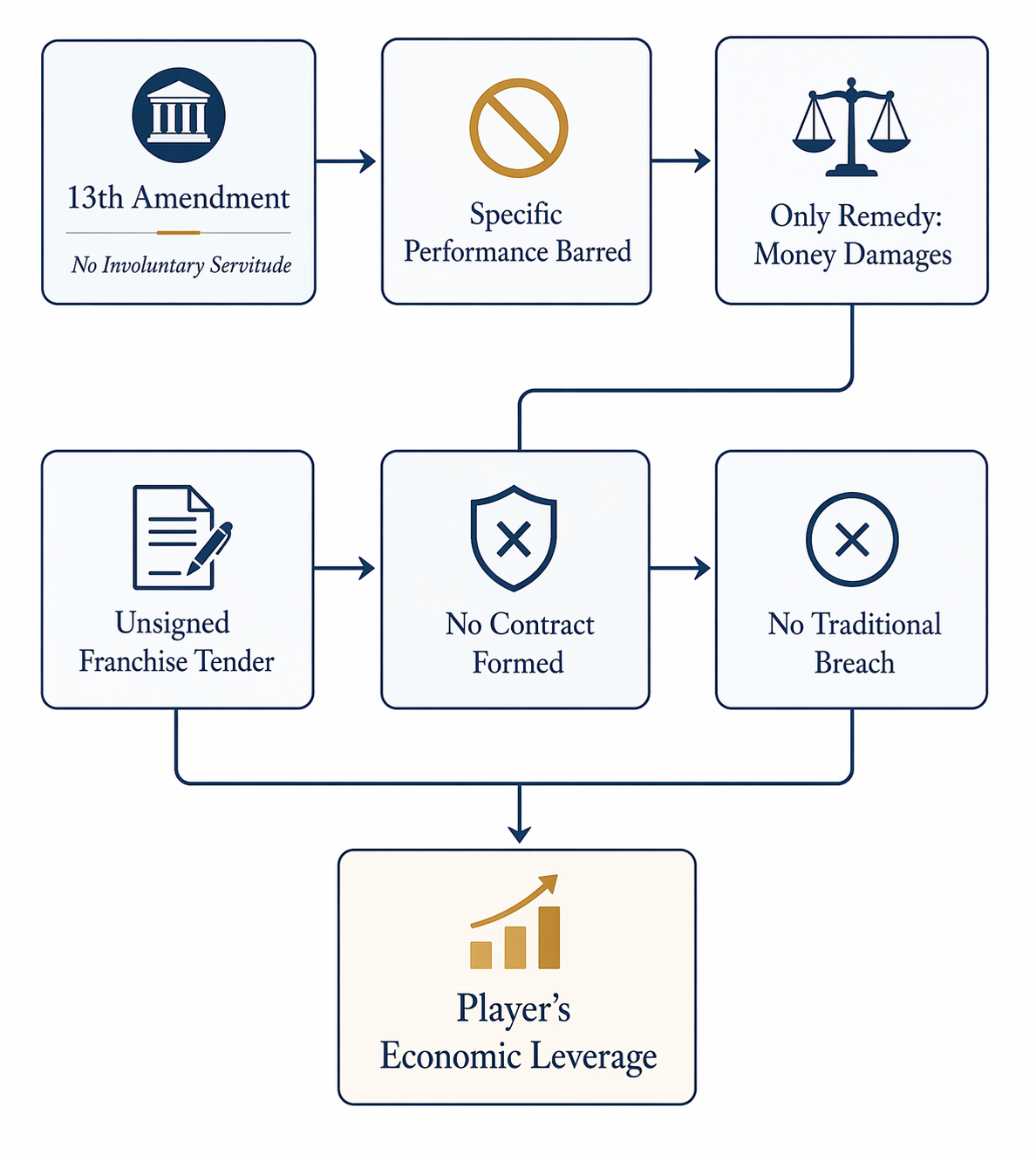
The first remedy to take off the table is the one most casual commentary assumes without saying it. A court could not order Le'Veon Bell to play running back for the Pittsburgh Steelers. It could not order him to report, practice, take handoffs, pass protect, or perform any other personal service for the club. The 13th Amendment problem is not decorative here; it is the reason specific performance is unavailable when the promised performance is labor by a human being.
That is the cleanest starting point for Bell's holdout, because it separates legal compulsion from economic pressure. The Steelers had collective-bargaining tools. They had the franchise-tag system. They had the ability to wait Bell out, decline to negotiate, and structure future decisions around cost. What they did not have was a judicial path to make him play football.

The harder question is whether Bell's refusal exposed him to ordinary contract damages. Even there, the answer is narrower than the public argument often allowed. Bell did not sign the Steelers' 2018 franchise tender, and without that signature he was not under the one-year franchise-tag contract for that season. A lawyer's analysis published by Behind the Steel Curtain made both points central: specific performance was barred, and the absence of a signed tender meant the Steelers were not dealing with a conventional breach of an existing player contract.[1] NFL.com separately reported that Bell did not sign the tag by the deadline in November 2018.[2]
The wrong remedy explains the case
Specific performance is attractive to sports fans because the injury looks non-monetary. A team does not merely lose an interchangeable unit of labor when a star running back stays away. It loses a roster plan, a play-calling premise, and whatever competitive advantage it expected from that player's body at that moment in that season. Money damages can feel like an after-the-fact accounting entry for an injury that happened on Sundays.
Contract law still does not turn that frustration into compelled work. The line is especially firm for personal services. Courts may enforce negative covenants in some settings, award damages, or recognize bargained-for consequences. They do not draft the marshal into supervising performance by an unwilling worker. In Bell's situation, the 13th Amendment limit mattered before the football-specific machinery even entered the analysis.[1]
That does not mean a player can ignore every legal or contractual consequence. It means the permissible consequences have to be financial, contractual, or collectively bargained. If there is a signed contract, the team may look to fines, forfeiture, bonus recoupment, tolling provisions, salary withholding, grievance procedures, or damages depending on the governing documents. The missing remedy is the order to perform.
The distinction matters because it prevents two opposite errors. Bell was not a worker whom the legal system could command back onto the field. Nor was he outside all pressure. He was operating in a labor market where the employer's most useful weapons were designed less like a civil complaint and more like a price schedule.
No signed tender, no ordinary breach
The franchise tag is often described as if it automatically places the player under contract. That shorthand obscures the operative step. The club tenders a one-year offer at a salary determined by the CBA's formula. The player can sign it, play under it, and become bound to that one-year deal. Bell did not take that step in 2018.[1][2]
Once that is clear, the word "breach" has to do less work. A breach presupposes a contract duty. If Bell never signed the tender, the Steelers' problem was not that he promised to render services in 2018 and then violated that promise. Their problem was that the CBA gave them an exclusive negotiating and tender mechanism that Bell declined to convert into a playing contract.
That distinction is not a technicality in the pejorative sense. It changes the team's remedial posture. Without a signed 2018 tender, there was no ordinary player contract for the Steelers to enforce as a breached agreement, and the Behind the Steel Curtain analysis concluded that the club could not fine Bell or pursue punitive remedies on that basis.[1]
The consequence Bell accepted was simpler and more severe: he did not earn the 2018 franchise-tag salary. Yahoo Sports described the amount Bell forfeited as $14.5 million.[3] That is not a small doctrinal footnote. It is the cost that made his legal position credible. A worker who has no signed duty to perform may avoid breach liability, but the market does not pay him for labor he withholds.
Why the NFL contract structure made the tender decisive
NFL player contracts do not behave like the simple employment contracts imagined in much public debate. The Behind the Steel Curtain lawyer's account emphasized that NFL contracts function more like option agreements, with clubs holding year-to-year rights that allow them to continue or terminate the relationship under the contract's terms.[1] That structure is one reason holdout analysis in football cannot be imported wholesale from a standard guaranteed-term employment agreement.
The asymmetry is familiar to labor lawyers even if the football packaging is distinctive. A player signs a multi-year document, but the economic security may depend heavily on guarantees, bonus treatment, vesting dates, and club options. The club may preserve flexibility across seasons. The player, especially after outperforming an existing deal or facing injury risk, looks for a mechanism to force renegotiation before the club has to surrender that flexibility.
The franchise tag sits inside that architecture. It is not a judicial remedy. It is a collectively bargained restraint that lets a club keep a player from ordinary free agency for another season if the club is willing to pay the required tender amount. The exclusive and non-exclusive versions differ in their market effects, but both operate by replacing immediate open-market movement with a CBA-governed tender process.[4][5]
| Issue | Bell's 2018 posture | Legal consequence |
|---|---|---|
| Specific performance | Bell refused to report and play | A court could not compel personal services |
| Contract formation | Bell did not sign the 2018 franchise tender | No ordinary 2018 player contract existed to breach |
| Team leverage | Steelers retained CBA tools and the tender framework | Pressure operated through economics, not an order to work |
| Player cost | Bell sat out the season | He forfeited the offered 2018 compensation |
This is why Bell's case is better understood as a remedies problem than a morality play. The Steelers did not lack leverage because courts were powerless in every sense. They lacked the particular form of leverage many observers implicitly assumed: the ability to say that a judge could make the player provide the bargained-for athletic performance.
The consecutive-tag formula turned refusal into leverage
Bell's legal freedom to stay away would have meant much less if the Steelers could simply repeat the same tender at a manageable price. The CBA's consecutive-tag formula made that difficult. Available explainers describe a progression in which a second tag and third tag become increasingly expensive, including a third-tag figure tied to 144% of the prior salary or the average of the top five salaries at the player's position.[3][4][5]
Yahoo Sports' Charles Robinson identified that third-tag cost as the practical hinge in Bell's holdout. For a running back in Bell's position, a third franchise tag would have pushed the Steelers toward quarterback-level compensation, described as roughly $25 million or more.[3] The player who did not sign in 2018 therefore did more than skip a season. He changed the club's price for keeping him off the open market again.
That is the part of the holdout that is easy to overstate and too important to ignore. Bell did not defeat the franchise tag as a legal institution. He exploited the cost curve of repeated tags by absorbing a year of nonpayment. The Steelers could still use the tag system; they just faced an escalating price that made another tag economically unattractive.
In remedial terms, the mechanism was elegant and brutal. Bell did not need a court to validate his absence. The Steelers did not need a court to withhold the tender salary he never earned. The CBA allocated pressure through deadlines and escalating costs, and each side decided how much pain it could bear.
What the third tag did not prove
The fact that Bell reached free agency after refusing to sign does not prove that season-long holdouts are generally rational for elite players. It proves a narrower proposition: in a particular CBA structure, with a second franchise tag already used and a third-tag price looming, a player could convert nonperformance into free-agency leverage by forfeiting a very large salary.
That narrower formulation matters because Bell's strategy drew substantial criticism. Bleacher Report framed the episode as a historic disaster, while Slate questioned the broader player-solidarity narrative around the holdout.[9][10] Those critiques do not undo the contract-law point. They do caution against turning a remedies boundary into a success story about bargaining strategy.
When the player is already under contract, the analysis changes
Bell's unsigned-tender posture should not be confused with the posture of a player who is already under an active contract and then refuses to report. In that setting, contract formation is not the issue. The player has signed. The question moves to the remedies and sanctions allowed by the contract, the CBA, and any applicable grievance procedures.
The 2020 CBA fine structure illustrates the difference. CBS Sports' Agent's Take column reported that players under active contracts who miss training camp after the 2020 CBA face mandatory $50,000-per-day fines, and that teams can recoup up to 25% of a prorated signing bonus during camp plus an additional 25% after the first missed regular-season game.[6]
Those fines still are not specific performance. They do not make a court order the player to practice. They make absence expensive for a player who has already accepted contractual obligations. That is a different legal category from Bell's refusal to sign the 2018 tender in the first place.
The practical result is that modern holdout advice often begins with status. Is the player under contract, under a tag he has signed, under a tag he has not signed, or outside both? The answer determines whether the club is withholding unearned salary, imposing bargained-for fines, seeking recoupment, or merely watching a player decline an offer.
Bell's legacy moved toward the hold-in
One lesson later players appear to have drawn is that disappearing entirely can be too expensive. The alternative is the hold-in: report to the club, avoid the harshest daily fines where possible, but limit participation enough to preserve leverage. A Pittsburgh Post-Gazette article dated July 17, 2026, described the hold-in as the ploy of choice for Steelers players with stalled contract talks and tied that evolution to lessons from Bell's sit-out, though the available material confirms that trend mainly through the article's title and date rather than usable quoted text.[7]
That development is best treated as a legacy, not as proof that Bell's exact tactic became the template. The hold-in preserves the insight that players need leverage before the club voluntarily renegotiates. It also reflects the cost of learning that a full holdout can transfer too much economic pain to the player.
For lawyers, the shift is unsurprising. Once the CBA makes absence expensive for contracted players, counsel looks for conduct that applies pressure without triggering the most punitive consequences. That does not make the conduct risk-free. It means the battleground moves from "Can they make him play?" to questions about reporting, participation, injury designations, fines, bonus language, and grievance risk.
Reform arguments belong to labor policy, not breach doctrine
Criticism of the franchise tag usually attacks the labor-market restraint itself. Sports Litigation Alert has described the negative impact of the NFL franchise tag as "undeniable" and identified reform proposals including limiting the tag to one-time use or abolishing it.[8] Those arguments address whether the CBA should continue to let clubs restrict a player's free agency through the tender mechanism.
They are separate from the narrower contract-law question. One can believe the franchise tag is too restrictive and still recognize that Bell did not breach a 2018 contract he never signed. One can believe Bell's holdout was financially unwise and still recognize that the Steelers could not compel his personal services. The legal analysis does not require making either side morally tidy.
The available materials also leave some boundaries in place. Several academic law-review articles and ESPN pieces that may discuss holdout deterrence, breach theory, or the anatomy of later holdouts were not directly available for verification here. Their possible arguments should not be laundered into certainty. The analysis above rests on the accessible accounts identified in the references, and it is legal analysis rather than legal advice.
The practical boundary Bell exposed
Bell's holdout is still useful because it forces precision. The Steelers could tender. They could decline to improve their offer. They could let the deadline arrive. They could refuse to pay salary Bell did not earn. They could evaluate whether a third tag made economic sense. In other factual settings, teams can fine, recoup, toll, and arbitrate under the CBA.
What they cannot do is convert a football labor dispute into an order to play. American contract law can price refusal, allocate losses, enforce collectively bargained consequences, and leave parties with bad options. It does not turn an NFL contract, much less an unsigned franchise tender, into compelled personal service.
References
- A lawyer's-eye view of the Le'Veon Bell and Antonio Brown situations, Behind the Steel Curtain, Feb. 25, 2019.
- Le'Veon Bell did not sign the tag by the deadline, NFL.com, Nov. 13, 2018.
- Le'Veon Bell's holdout could have lasting impact on the NFL, Yahoo Sports.
- Franchise Tag Explainer, Colts.com.
- Franchise tag, Wikipedia.
- Agent's Take, CBS Sports.
- How the hold-in has become the ploy of choice for Steelers with stalled contract talks, Pittsburgh Post-Gazette, July 17, 2026.
- The Negative Impact of the NFL Franchise Tag Is 'Undeniable', Sports Litigation Alert.
- Le'Veon Bell's holdout was a historic disaster, Bleacher Report.
- Slate article questioning player solidarity around Bell's holdout, Slate.
Comments
Join the discussion with an anonymous comment.