
Le'Veon Moss's new arrest is legally serious for reasons that are easy to flatten in a sports headline. WBRZ reported that the former Texas A&M running back was arrested in Baton Rouge on July 21, 2026, after his 2-year-old son allegedly accessed a loaded firearm and shot himself; the report quotes affidavit language saying that, “due to Moss' negligence, a child under the age of seventeen suffered unjustifiable pain.”[1] That is not a conviction, and the full affidavit has not been independently reviewed here. It is still enough to identify the legal problem: Louisiana prosecutors are not treating the case as a narrow firearm-storage misdemeanor. They are proceeding through the state's general cruelty-to-juveniles statute.
That distinction matters because Louisiana Revised Statutes 14:93 defines cruelty to juveniles to include intentional or criminally negligent mistreatment or neglect of a child under 17 that causes unjustifiable pain or suffering. When the victim is under eight years old, the statute authorizes imprisonment at hard labor for up to 20 years.[2] The legal exposure therefore comes not only from the alleged facts, but from the charging architecture available to prosecutors.

A dismissed arrest is not the same thing as no record
The earlier Moss arrest was far smaller as a legal event. In July 2025, KBTX reported that the College Station city attorney had dismissed a disorderly conduct charge against Moss and declined prosecution; his attorney said he would seek expungement.[3] CBS Sports had described the arrest context as an allegation that Moss assumed “a fighting posture,” and identified the charge as a Class C misdemeanor.[4]
The favorable disposition should not be treated as a hidden conviction. A dismissal means the charge did not proceed to guilt. But it also does not guarantee practical disappearance, especially for a public athlete whose arrest was already reported by local and national sports outlets. Even when a court record is later sealed or expunged, published stories, cached summaries, background memos, and ordinary search results can continue to attach the incident to the person's name.
That is where public discussion often becomes legally sloppy. One mistake is to say the 2025 dismissal proves Moss is being unfairly targeted now. Another is to imply the 2025 arrest shows a pattern of guilt. Neither follows. The narrower point is more useful: a dismissed arrest can still shape the environment in which a later felony is negotiated, evaluated, and reported. Prosecutors, probation officers, defense counsel, journalists, and athletic compliance personnel may all see the prior headline even if the prior case ended favorably.
Why the Louisiana charge carries so much weight
The core statutory issue is not whether leaving a loaded firearm accessible to a toddler is trivial. It is not. A child is the person at the center of the alleged harm. The question is why the legal pathway in Louisiana appears to run through a broad child-cruelty felony carrying up to 20 years, rather than a specialized child-access firearm offense calibrated to unsafe gun storage.
Giffords Law Center states that Louisiana has no child access prevention law, commonly called a CAP law.[5] Everytown Research counts 26 states with secure-storage or child access prevention requirements.[6] Those laws vary, and the existence of a CAP statute does not prove a particular prosecution would be mild or successful. But the presence of a narrower offense can change the charging conversation. It gives prosecutors a statutory box labeled for the conduct: an adult's failure to secure a firearm from a child.
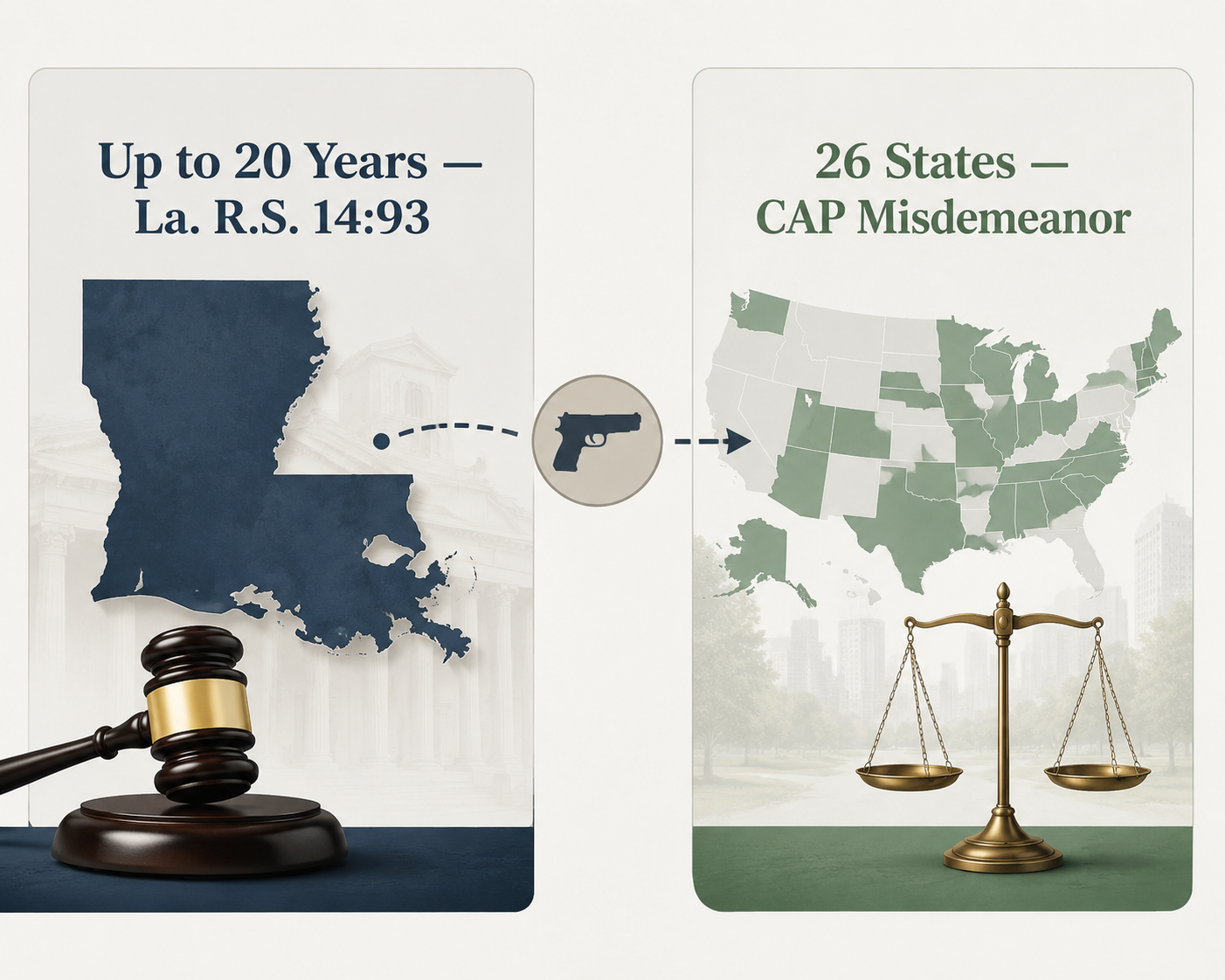
Without that box, Louisiana prosecutors looking at an injured toddler and an allegedly accessible loaded gun have to work with more general statutes. Revised Statutes 14:93 can fit because it reaches criminally negligent mistreatment or neglect that causes unjustifiable pain or suffering to a child under 17.[2] Once the child is under eight, subsection D(2) raises the sentencing ceiling to 20 years at hard labor.[2] That enhancement is doing much of the work in Moss's exposure.
| Legal frame | What it emphasizes | Why it matters in Moss's case |
|---|---|---|
| General cruelty-to-juveniles statute | Mistreatment or neglect causing unjustifiable pain or suffering to a child | Louisiana's statute can reach the alleged conduct and carries up to 20 years when the child is under eight |
| Child access prevention or safe-storage statute | Failure to prevent a child from accessing a firearm | In states with such laws, the charging label can be narrower and more directly tied to firearm storage |
| Prior dismissed misdemeanor arrest | A resolved allegation, not a conviction | It may still appear in public reporting and case evaluation after a later felony filing |
The difference is not merely semantic. A child-cruelty felony puts the case in a moral and legal category associated with direct harm to children. A safe-storage offense, where available, frames the same general type of alleged failure around firearm access prevention. The facts may be grave in both settings. The available statutory label still affects leverage, plea posture, media language, and the defendant's risk calculation.
The failed safe-storage debate is part of the legal backdrop
Louisiana's lack of a CAP law was not simply an overlooked drafting gap in 2026. KALB reported that a Louisiana bill, HB 586, which would have held adults responsible if children accessed loaded guns, failed in committee on a 6-3 vote.[7] The Louisiana Illuminator also covered the safe-storage proposal's failure, placing it within a broader state debate over gun regulation and responsibility for child access.[8]
Those legislative reports do not decide Moss's case. They do explain why prosecutors may reach for an older, broader child-welfare statute when an allegedly unsecured loaded firearm injures a young child. The legal system still has to respond to the child. The available response, however, may be more severe than the conduct category would suggest in states that have enacted a specific firearm-access offense.
This is the point at which proportionality becomes a real issue rather than a defense slogan. If Louisiana had a child-access statute, prosecutors might still file a serious case depending on the facts, injury, prior warnings, or other aggravating evidence. The current public record does not establish those details. But in the absence of that narrower statute, the felony child-cruelty charge becomes the visible vehicle, and the victim-under-eight enhancement supplies the high ceiling.
The athlete profile amplifies the record, not the elements
Moss's football résumé explains why this case travels farther than a routine local docket item. SI.com reported the 2026 arrest in the context of his former Texas A&M career and noted his brief Miami Dolphins timeline: signing as an undrafted player, then retiring shortly afterward.[9] Publicly available career summaries identify him as an All-SEC running back with 1,767 career rushing yards and 22 rushing touchdowns, and report a Dolphins deal with $258,000 guaranteed before his retirement four days later.[10]
Those facts do not make the cruelty-to-juveniles elements easier or harder to prove. They do make the case more likely to be summarized quickly, often through the most searchable sequence: former SEC running back, prior arrest, child-cruelty felony. That sequence can become sticky before any plea, evidentiary hearing, or trial record clarifies what happened inside the home, how the firearm was stored, what Moss knew, and what the child's medical condition became.
Athlete defendants also face institutional audiences that ordinary defendants may not. Agents, compliance departments, teams, insurers, sponsors, and future employers may all read the same public fragments. A dismissal in the first case may matter formally, while the existence of the first headline still matters practically. That is not a claim that prosecutors will punish Moss for a dismissed 2025 misdemeanor. It is a recognition that public-profile defendants rarely move through a cleanly separated sequence of events.
What can and cannot be concluded now
The available record supports a limited legal analysis, not a verdict. The 2026 reporting establishes that Moss was arrested and that WBRZ attributed specific negligence language to an affidavit.[1] The Louisiana statute establishes the possible felony exposure when the alleged victim is under eight.[2] The 2025 reporting establishes that the earlier College Station disorderly conduct charge was dismissed and that counsel sought expungement.[3] The statutory-policy sources establish that Louisiana lacks a CAP law while many other states have some form of child-access or secure-storage requirement.[5][6]
Several important facts are still not established in the cited materials: the child's current medical condition, the exact wound details, Moss's plea status, the full probable-cause affidavit, any custody or child-protection proceedings, and the depth of Louisiana case law applying criminally negligent mistreatment to firearm-access scenarios. A full defense analysis would require the complete court file and jurisdiction-specific case-law research, not just media summaries and statutory text.
Moss's case therefore should not be read as proof that a dismissed arrest will be used against him, or as legal advice about what his defense should be. It does show how quickly exposure can compound once a public defendant with a prior dismissed arrest faces a new felony in a state without a more tailored child-access firearm statute. The legal map is sharper than the headline: dismissed does not mean invisible, charged does not mean convicted, and a broad child-cruelty statute can carry consequences far beyond what a storage-specific misdemeanor framework would suggest.
References
- Former Istrouma, Texas A&M running back arrested after 2-year-old son accidentally shoots himself, WBRZ, July 21, 2026
- RS 14:93. Cruelty to juveniles, Louisiana State Legislature
- Attorney: City of College Station dismisses disorderly conduct charge against Le'Veon Moss, KBTX, July 17, 2025
- Texas A&M RB Le'Veon Moss arrested: One of SEC's top returning rushers facing disorderly conduct charge, CBS Sports
- Child Access Prevention and Safe Storage in Louisiana, Giffords Law Center
- Secure Storage or Child Access Prevention Required, Everytown Research
- Louisiana bill to hold adults responsible if children access loaded guns rejected, KALB, April 30, 2026
- Safe gun storage requirement holstered, Louisiana Illuminator, April 8, 2026
- Former Texas A&M RB Le'Veon Moss Arrested in Louisiana, SI.com
- Le'Veon Moss, Wikipedia
Comments
Join the discussion with an anonymous comment.