
The viral formula is neat enough to travel: multa por colgar bandera en balcón ley propiedad horizontal, 3,000€, World Cup, Spanish flag. It sounds like the kind of rule a community administrator might enforce and the kind of number a headline can repeat without pausing over who would actually impose it.
The correction is equally direct, but it needs more than a one-word fact check. Spain’s Ley de Propiedad Horizontal does not contain a 3,000€ fine for hanging a Spanish flag from a balcony. It does not contain an administrative fine schedule for that conduct at all. The LPH regulates relations inside communities of owners; when it reaches serious prohibited activity, its principal remedy is a civil action brought through a court, not a ticket issued by the community.

The claim collapses three different legal questions into one. First, what does the LPH say about alterations to private and common elements? Second, what may a community’s statutes or internal rules say about the building’s exterior appearance? Third, can a municipality, particularly in a protected-building or heritage area, impose a separate penalty under local rules? The answer to the viral claim is found by keeping those questions apart.
What the LPH Actually Regulates
The load-bearing text is Article 7 of the Ley de Propiedad Horizontal. Article 7.1 allows an owner to modify architectural elements, installations, or services inside the owner’s apartment or premises, but only where the works do not impair or alter the building’s safety, general structure, configuration, exterior state, or the rights of another owner. The owner must also give prior notice to the community representative before carrying out the works.[1]
That provision is about alterations, not every visible object. The distinction matters. A temporary flag tied to, placed inside, or hung from a balcony is not automatically a structural intervention in the building. The Ministry of Housing’s public response to the rumor put the point plainly: a flag is difficult to treat as an alteration of the facade because it is not a structural element. That does not make every possible display immune from legal challenge, but it does puncture the premise that Article 7.1 itself creates a flag fine.
Article 7.2 is the provision more often misunderstood in these claims. It prohibits the owner or occupant from carrying out activities in the property or in the rest of the building that are prohibited by the statutes, harmful to the property, or contrary to general rules on activities that are annoying, unhealthy, harmful, dangerous, or unlawful. But the mechanism it creates is not an administrative sanction. It is an acción de cesación: a civil cessation action with procedural steps before any court-ordered consequence can follow.[1]

| Stage | What the LPH requires | Why it matters for the viral claim |
|---|---|---|
| Notice | The community president, on the initiative of the president or any owner or occupant, must require the person carrying out the prohibited activity to stop. | The process starts with a cessation demand, not a fine. |
| Warning | The demand must warn that legal action may follow if the conduct continues. | The LPH expects escalation, not immediate punishment by the community. |
| Community authorization | If the conduct persists, the president may bring a cessation action only with prior authorization from the owners’ meeting. | A single neighbor or administrator cannot convert the rumor into an enforceable penalty. |
| Court proceeding | The matter proceeds before a court under the statutory action. | The consequence depends on judicial assessment, not on a schedule of balcony fines. |
| Possible judgment | The court may order cessation, damages, and deprivation of use of the dwelling or premises for up to three years in serious cases. | The harsh remedy is deprivation of use, not a 3,000€ administrative fine. |
The deprivation-of-use remedy is real and should not be trivialized. Article 7.2 allows a judgment, depending on the gravity and harm caused, to deprive the owner of use of the dwelling or premises for up to three years. If the infringer is not the owner, the judgment may also extinguish the person’s rights relating to the property and order immediate eviction.[1]
That is a demanding civil route for serious conduct. It is not the same thing as a community of owners issuing a 3,000€ fine because a flag appeared during a match. The procedural difference is not technical garnish; it is the difference between a legal consequence that exists in the statute and one that has been invented by a viral post.
The Balcony Is Not One Legal Surface
Balcony disputes often become confused because everyday language treats the balcony as a single place. Property law does not always do that. The interior usable area of a balcony may be treated differently from the exterior facade, railings, coverings, awnings, or other visible elements that affect the building’s common appearance.
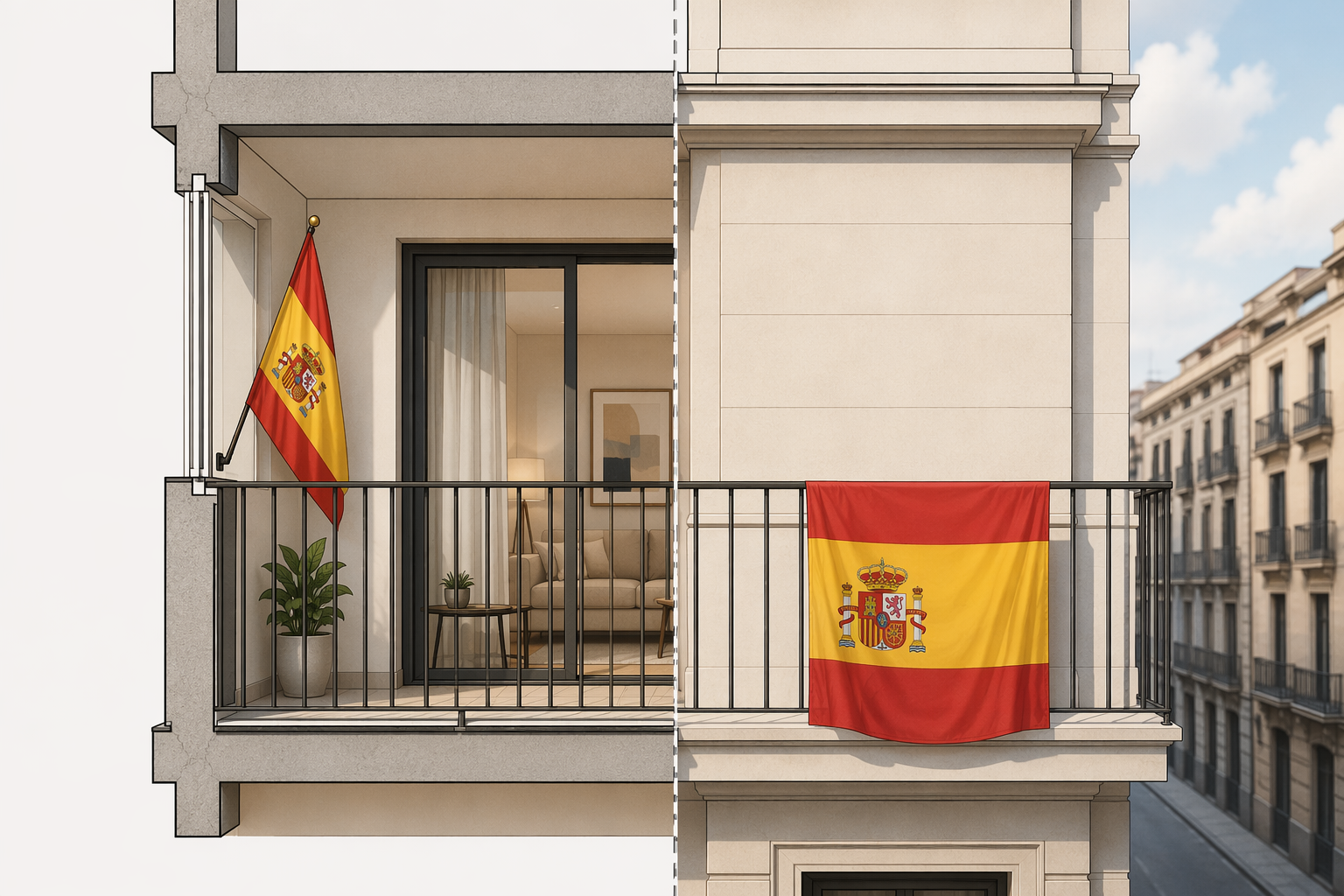
That distinction is the practical caveat missing from many quick denials of the hoax. A flag placed inside the balcony, without altering the exterior facade or affecting other owners’ rights, is not the same problem as an object fixed to or draped over the exterior common facade in a way the community’s rules address. The legal analysis changes again if the building is protected, if the object creates a safety risk, or if the display is part of broader conduct that can credibly be characterized as harmful or prohibited.
Communities may regulate aspects of the building’s appearance through statutes or internal rules, especially where they use objective and neutral criteria. A rule about uniform awnings, exterior installations, or facade aesthetics is easier to defend than a rule that discriminates among ideological, political, religious, or national symbols. But even a valid community rule does not, by itself, give the community a free-standing power to invent monetary penalties under the LPH.
Where the 3,000€ Number Likely Entered
The figure has the feel of legality because it resembles the upper end of some local sanction ranges reported in the context of facade and heritage protection. That is a different body of law. Municipal rules may regulate protected buildings, historic facades, public space, or exterior installations. In those settings, reported penalty ranges can reach 1,500€ to 3,000€ for serious heritage-protection infringements, and higher amounts may appear in severe heritage cases.
But laundering that local heritage number into a national LPH penalty changes both the authority and the conduct. A municipal fine would have to come from a locally applicable ordinance, enforced by the competent administration, for conduct covered by that ordinance. It would not be an LPH sanction imposed by a community of owners simply because a Spanish flag was hung from a balcony.
Madrid, Barcelona, and Bilbao were reported as confirming that they had no specific ordinance penalizing the act of hanging a Spanish flag as such. That is useful, but it is not universal verification for Spain’s 8,131 municipalities. The careful conclusion is narrower: the checked municipalities did not support the viral claim, and any real monetary penalty elsewhere would have to be traced to a separate local rule, not to the Ley de Propiedad Horizontal.
Why the Hoax Keeps Returning
The same claim has resurfaced around moments when flags are more visible: the 2022 Qatar World Cup, the 2025 Día de la Hispanidad, and the 2026 World Cup. Its durability is not hard to understand. It combines a familiar neighborhood setting, a politically charged object, a legal acronym, and a precise number. That is enough for social platforms, scraped summaries, and low-quality automated content to reproduce the claim faster than the statute can be checked.
For legal professionals, the lesson is not that balcony flag disputes are impossible. It is that a legal claim should identify its authority. Who fines? Under what article? Through which procedure? Against what conduct? With what available remedy? The viral version fails those questions. It names the LPH, borrows a number from somewhere else, and skips the court process the statute actually provides.
There is one additional statutory distraction worth setting aside. The consolidated LPH includes a newer paragraph on tourist-rental restrictions, introduced by Ley Orgánica 1/2025 and effective in 2025. That provision concerns short-term rental activity and community approval thresholds; it has no bearing on whether a balcony flag generates a fine.[1]
The Clean Legal Distinction
There is no 3,000€ fine in the Ley de Propiedad Horizontal for hanging the Spanish flag from a balcony. Communities of owners cannot manufacture that fine by internal decision. Article 7.1 concerns alterations and prejudice to the building or other owners; Article 7.2 supplies a civil cessation action for serious prohibited or harmful activity, with notice, community authorization, and judicial proceedings before the most severe remedies can be imposed.[1]
A real monetary penalty would have to come from another legal source: for example, a municipal ordinance governing protected facades, public-space safety, or heritage conservation. That source would need to be identified on its own terms. Without it, the 3,000€ World Cup balcony-flag claim is not Spanish property law. It is a legal-looking fragment with the statute missing.
References
- Ley 49/1960, de 21 de julio, sobre propiedad horizontal — Boletín Oficial del Estado, consolidated version updated 21/03/2026 — https://www.boe.es/buscar/act.php?id=BOE-A-1960-10906
Comments
Join the discussion with an anonymous comment.