
This article provides general legal information, not legal advice. Port-entry decisions, passenger claims, cruise contracts, insurance coverage, and diplomatic options depend on the vessel, flag, itinerary, passenger nationality, governing contract terms, and the state involved.
The question behind legal rights for an LGBTQ cruise denied entry to Turkey or Egypt is uncomfortable because the legal injury is easier to recognize than the remedy is to secure. In July 2026, Virgin Voyages’ Scarlet Lady, chartered by Atlantis Events for an LGBTQ cruise, was blocked from docking in Turkey after local authorities cited “moral standards,” according to CNN’s reporting.[1] Days later, Egypt also refused the ship entry, with reports saying the vessel had previously received approval and was turned away only hours before arrival.[2]
Atlantis said this was the first time in its 36-year history that a ship had been denied port access “because of who we are,” and the company’s chief executive described the Egypt refusal as coming after prior visits to Egypt and Turkey without similar incident.[3] That matters legally only to a point. A record of prior calls can show why the operator expected access. It does not, by itself, create a right to berth in a foreign port.

The legal analysis begins there: not with whether the exclusion was offensive, but with who can compel a sovereign to reverse a port decision after the ship is already approaching.
Port Access Starts With Sovereign Control
Foreign cruise ships do not enjoy a general, automatic right to enter another state’s ports. Coastal states retain broad discretion over port admission, especially for non-distress commercial calls. Cruise itineraries may make port visits feel routine, and travel marketing may make them feel promised, but the legal baseline is still state permission.
That baseline is why the Scarlet Lady incident is not solved by saying the passengers had booked and paid for an itinerary. The passengers’ strongest immediate claims may run against the contractual chain they paid into, depending on ticket terms and governing law. But the operator’s inability to dock may have resulted from a sovereign act outside the operator’s control. That is usually where cruise contracts, force-majeure language, itinerary-change clauses, and insurance exclusions become more important than the passenger’s moral claim against the destination state.
The hard question is whether a state’s discretion narrows when the reported reason for exclusion is that the passengers are LGBTQ. It does. But “narrows” is not the same as “creates a fast, private remedy.”
The Human Rights Hook Is Real
Turkey and Egypt are both parties to the International Covenant on Civil and Political Rights. Article 26 protects equality before the law and prohibits discrimination on listed grounds including sex and on “other status.” Human rights authorities have treated sexual orientation discrimination as falling within that kind of protected status; Toonen v. Australia is the standard reference point for that proposition.[4]
For Turkey, there is an additional European human-rights layer. Turkey is bound by the European Convention on Human Rights, and the European Court of Human Rights has held in Bayev and Others v. Russia that differences in treatment based on sexual orientation require “particularly serious reasons” by way of justification under Article 14.[5] Turkey has also ratified Protocol No. 12, which contains a broader freestanding non-discrimination guarantee than Article 14’s accessory protection.[5]
Those legal hooks are not fanciful. If a state excludes a cruise because the passengers are LGBTQ, the discrimination theory is recognizable under human-rights law. A government cannot make the issue disappear by using the language of public morality instead of naming sexual orientation. The more candidly the decision is tied to who the passengers are, the easier it is to see the equality problem.
But there are two constraints that matter immediately. First, Egypt did not publicly give a detailed official explanation for its refusal, and Atlantis’s view that Egypt may have acted because Turkey had already acted remains an inference rather than a confirmed state admission.[3] Second, even when discrimination is legally cognizable, cruise passengers still need a forum, jurisdiction, standing, admissible evidence, and a remedy that can matter after the missed port call.
Recognition Is Not the Same as Recourse
The ICCPR does not operate like a consumer-protection statute that lets stranded passengers sue a foreign port authority in a convenient court for missed excursions, humiliation, or rerouting costs. It creates state obligations. Individuals may be able to bring communications under certain treaty mechanisms only when the relevant procedural conditions are met, and those processes are slow compared with a cruise schedule.
The European system is more developed, but it still does not give passengers a practical emergency injunction at the pier as a matter of course. An application to the European Court of Human Rights generally requires exhaustion of domestic remedies and turns on admissibility rules, jurisdiction, evidence, and the relationship between the applicant and the state conduct. For a cruise passenger already rerouted at sea, that machinery is poorly matched to the injury.
| Legal source | What it can support | Why it may not solve the cruise problem |
|---|---|---|
| Customary port-access rules | A state’s broad control over admission to its ports | The baseline favors sovereign discretion, not a passenger right to dock |
| ICCPR Article 26 | An equality claim if exclusion is based on sexual orientation | It is a state obligation, not a fast private damages remedy for a missed port |
| ECHR Article 14 and Protocol No. 12 for Turkey | A stronger European non-discrimination framework | Admissibility, jurisdiction, exhaustion, and timing remain major barriers |
| Cruise contract and insurance terms | Possible refunds, credits, substitutions, or coverage depending on wording | They usually address the operator-passenger relationship, not direct compulsion against a foreign state |
This is the remedy gap. A passenger may be the person most visibly harmed, but the state action is directed at the vessel’s access to port. The operator may have the operational relationship with agents, port authorities, and ministries, but it may not have a private-law claim capable of forcing admission. The flag state, the passengers’ home governments, and diplomatic officials may have leverage, but leverage is discretionary.
The 2000 Kuşadası Episode Shows What Leverage Can Do
The most useful comparison is not another 2026 outrage cycle. It is the 2000 Kuşadası episode. The Advocate reported that when a gay cruise was initially barred from docking in Turkey in 2000, the U.S. State Department publicly said it was “dismayed” and raised the issue with Turkish officials; the next day, Turkish authorities reversed course and welcomed the passengers with a public display of hospitality.[6]
That reversal should not be mistaken for a legal entitlement. It is better understood as a practical precedent: public diplomatic pressure changed the cost-benefit calculation for the host government quickly enough to matter. The ship did not need a final judgment from an international tribunal. It needed a state with enough interest and willingness to press the issue before the itinerary collapsed.
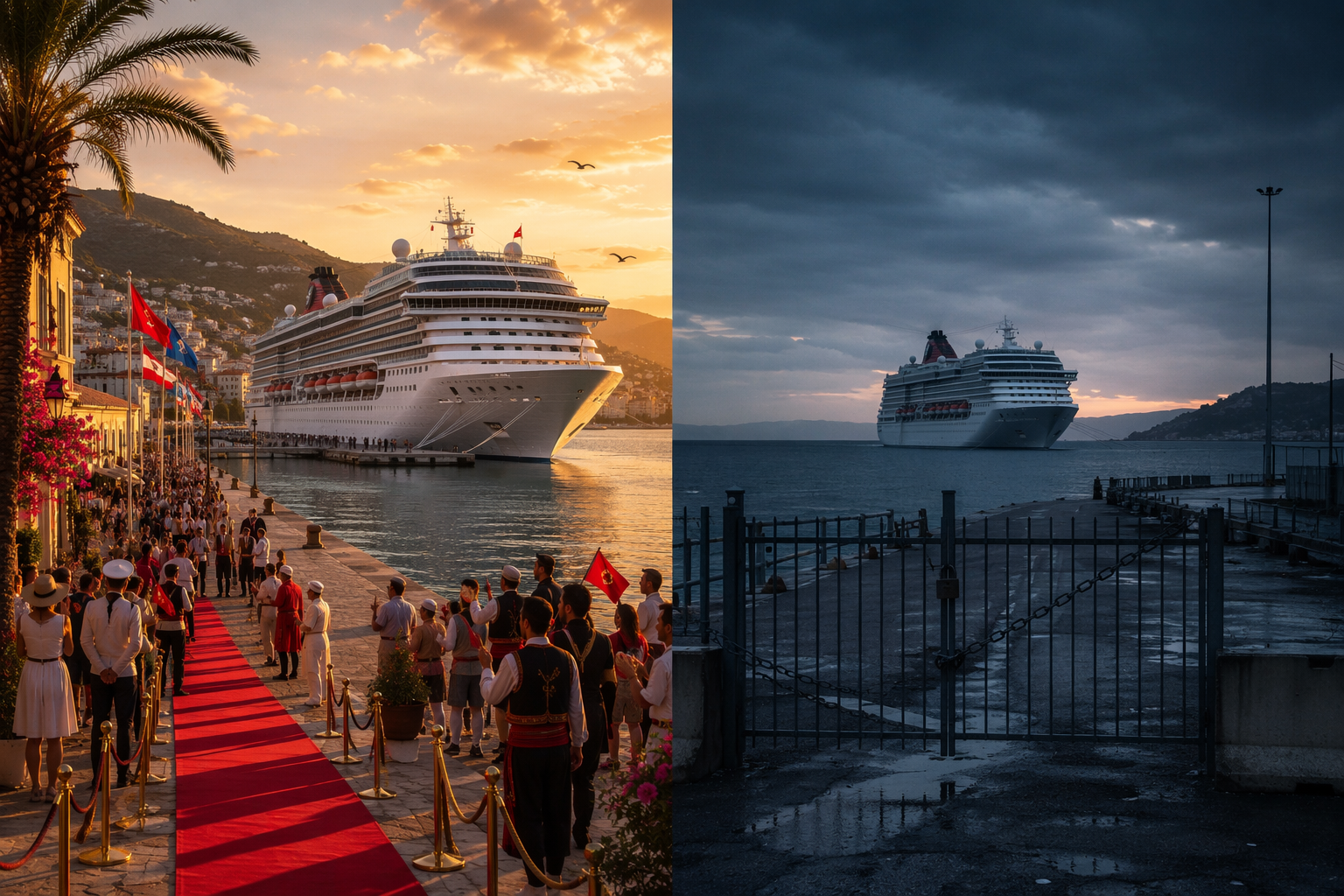
The 2026 response looks different. According to The Advocate, when asked about the Scarlet Lady denials, the White House and State Department routed inquiries toward general travel-advisory information and declined substantive comment.[6] The treaty landscape did not become irrelevant in those 26 years. The diplomatic posture changed the usable remedy.
Turkey and Egypt Present Different Risk Contexts
The same itinerary problem sits inside different domestic legal environments. Turkey does not have the same formal criminalization framework as Egypt, but Human Rights Watch reported in October 2025 that a leaked draft of Turkey’s 11th Judicial Package would criminalize “attitudes or behaviors contrary to biological sex and general morality,” with penalties of up to three years’ imprisonment.[7] The proposal remained a draft, not enacted law, as of the relevant reporting window, so it is risk context rather than current criminal liability.
Egypt’s context is more openly coercive in practice even without an express anti-homosexuality statute. Human Rights Watch’s World Report 2026 states that Egyptian authorities use vague and abusive penal-code provisions to criminalize consensual same-sex conduct.[8] Human Dignity Trust’s Egypt profile identifies public-decency, public-indecency, and “debauchery” provisions as tools used in prosecutions, including Law 10/1961 and Penal Code provisions.[4]
Those country conditions do not prove why a specific port denial occurred. They do, however, affect what a prudent operator should ask before selling an LGBTQ-chartered itinerary: not only whether a port has accepted similar ships before, but whether the domestic political and enforcement environment has shifted since the last call.
What Passengers Can Realistically Invoke
Passengers are not without rights in the human-rights sense. If a port denial is based on sexual orientation, it engages equality norms under the ICCPR and, for Turkey, the European Convention framework. But the immediate tools available to passengers are usually less grand than the legal principle.
- Contract review: passengers can examine ticket terms for itinerary-change rights, refund language, onboard-credit provisions, dispute forums, class-action waivers, and force-majeure clauses.
- Insurance review: travelers can check whether missed-port, trip-interruption, political-event, or government-action coverage applies, while expecting exclusions and documentation requirements.
- Consular escalation: passengers can contact their embassy or consulate, but consular assistance does not guarantee a foreign state will admit a ship.
- Documentation: passengers and operators should preserve notices, itinerary updates, official statements, port-agent communications, receipts, and contemporaneous accounts.
- Public-pressure channels: media and advocacy attention can matter, as the 2000 Turkey reversal suggests, but it is political leverage rather than an enforceable passenger remedy.
One passenger described the 2026 experience to CNN as “being a political football kicked around the Mediterranean.”[3] The phrase is legally imprecise and operationally accurate. The passengers were the people waiting for answers, but the decisive conversations were likely among the operator, port agents, government officials, and diplomats.
What Operators Can Do Before the Gangway Is Closed
For cruise operators and charter companies, the practical lesson is not that litigation is useless. It is that litigation is usually too late to protect the sailing itself. The protective work happens before departure, when the operator still has routing leverage, passenger-communication options, and time to escalate assurances.
A serious pre-sailing review for an LGBTQ-chartered cruise should not stop at whether the port has accepted prior calls. Prior access is evidence of feasibility, not a binding commitment. The review should ask whether the charter identity has been disclosed to port authorities, whether written approval is conditional or revocable, whether local agents have identified political objections, whether embassies are aware of the itinerary, and whether the contract permits rerouting without leaving passengers in the dark.
Advance assurances are useful only if they are specific. “The vessel is approved” is weaker than approval that acknowledges the charter, date, passenger profile, security expectations, and any local restrictions the port intends to impose. Even then, approval may be withdrawn. That is why contingency routing and passenger disclosures belong in the same risk file as the port clearance.
Insurance deserves the same caution. A policy may respond to some itinerary disruption costs and still exclude losses caused by government action, discrimination, political decisions, or known risks. The relevant question is not whether the denial was unfair. It is whether the policy wording attaches to that kind of denial, for that insured party, after that kind of notice.
The Narrow Answer
LGBTQ cruise passengers denied entry to Turkey or Egypt on discriminatory grounds have a plausible human-rights claim in principle. Article 26 of the ICCPR matters for both states. The European Convention framework matters for Turkey. The discrimination analysis is not the weak part.
The weak part is enforcement. Port access begins from sovereign control. Treaty claims move slowly. Cruise contracts usually allocate disruption risk between passenger and operator rather than commanding a foreign state. Consular pressure may help, but the contrast between the 2000 Kuşadası reversal and the 2026 silence shows that diplomacy is a choice, not a passenger entitlement.
For travelers and operators, the most realistic protection is therefore prospective: jurisdiction-specific risk assessment, written and specific port assurances, early diplomatic awareness, contingency routing, insurance review, and clear passenger communication before the ship is close enough to be turned away.
References
- CNN — Turkey blocks American LGBTQ+ cruise from docking, citing 'moral standards', 2026-07-02
- The Guardian — LGBTQ+ cruise ship refused entry to Egypt days after Turkey turned it away, 2026-07-09
- CNN — Twice-rejected American cruise puts spotlight on rollback of LGBTQ rights, 2026-07-11
- Human Dignity Trust — Country profiles: Egypt
- European Court of Human Rights — Bayev and Others v. Russia, 2017
- The Advocate — Turkey barred a cruise with gay travelers before Egypt turned it away. The Trump admin stayed silent
- Human Rights Watch — Türkiye: Draft Law Threatens LGBT People with Prison, 2025-10-29
- Human Rights Watch — World Report 2026: Egypt
Comments
Join the discussion with an anonymous comment.