
New Jersey’s 2017 lottery-for-pensions law was not a routine earmark. The state did not simply tell budget officials to send annual lottery receipts to a retirement fund. It transferred the lottery enterprise itself, for a defined period, to three underfunded public pension systems and treated the resulting asset as part of the pension-funding architecture. That design is what makes the case useful for anyone evaluating lottery funding pension system legal implications: the question is not whether lottery money can be politically popular, but whether this kind of dedication creates reliable, enforceable security for beneficiaries.
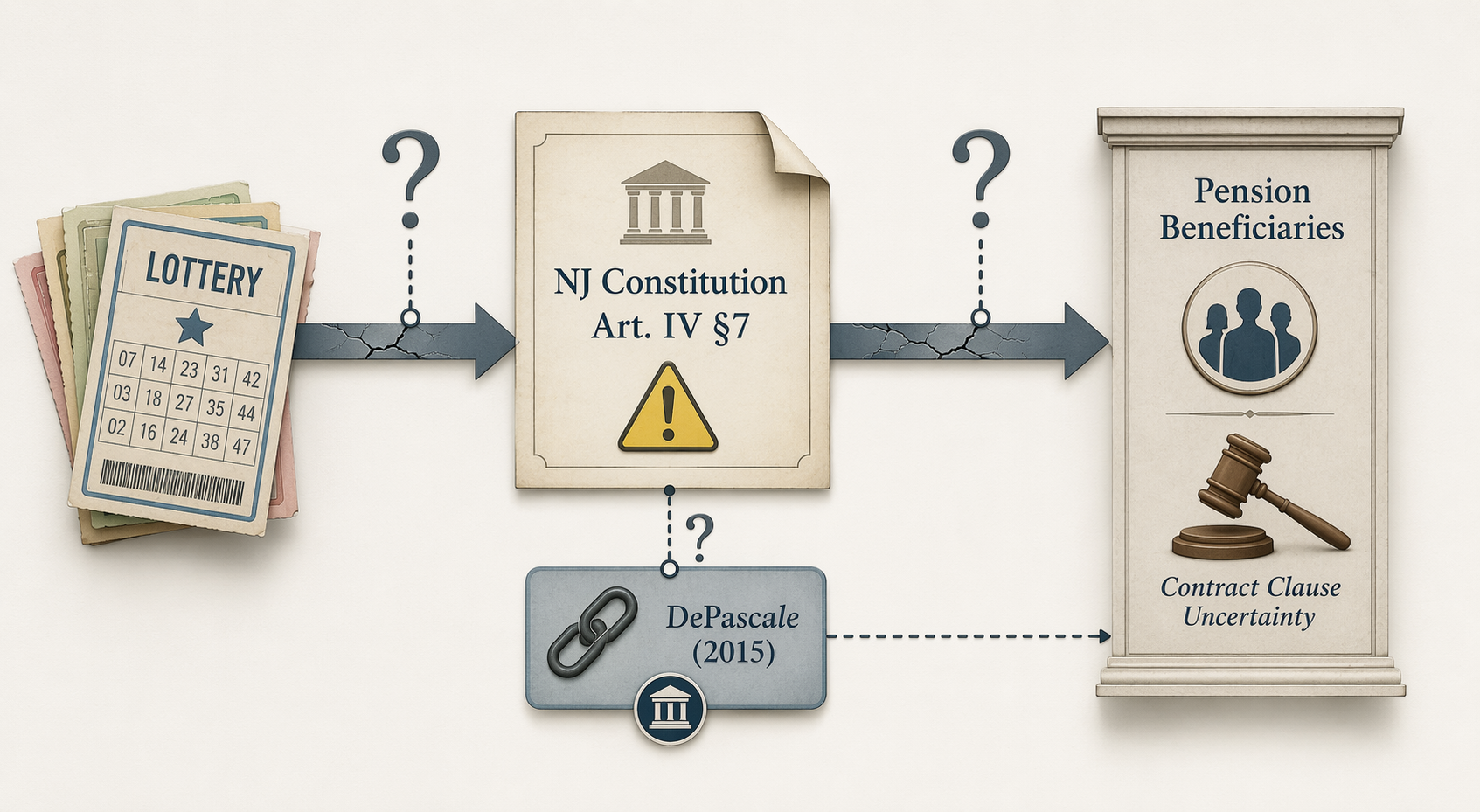
The state’s own legal assurance was notably qualified. New Jersey’s attorney general, as summarized in contemporaneous coverage, could not say with “absolute certainty” how a reviewing court would decide whether the arrangement complied with Article IV, Section 7 of the New Jersey Constitution, which limits lottery proceeds to “State institutions and State aid for education.”[1] That is not a finding of invalidity. It is also not the clean bill of constitutional health that a pension system would prefer when it is being asked to rely on a new revenue stream.

Why New Jersey’s Design Was Legally Different
A state can use lottery revenue in many ways. It can deposit proceeds in a general fund, dedicate them by statute to education, or appropriate them annually to selected programs. New Jersey chose a more ambitious structure: it moved the lottery asset into the pension system, with the apparent goal of improving reported pension funding while supplying a dedicated stream of revenue.
That distinction matters because an annual appropriation and an asset transfer ask different legal questions. An appropriation raises the familiar problem of whether future legislatures will continue to make payments. An asset transfer raises a harder set of questions: whether the state had constitutional authority to redirect the lottery enterprise in that way, whether the transfer evaded debt-limit doctrine, and whether beneficiaries obtained rights they could enforce if the revenue stream or political commitment weakened.
The attraction is obvious enough. Pension contributions compete every year with schools, transportation, health care, tax relief, and every other claim on a state budget. A dedicated lottery stream gives lawmakers something that looks more durable than an annual promise. It also gives actuarial reports an identifiable asset to count. The difficulty is that public finance does not become legally secure merely because the funding source has a label.
Article IV, Section 7 Is the First Pressure Point
New Jersey’s lottery clause is not open-ended. Article IV, Section 7 authorizes lottery proceeds for “State institutions and State aid for education.” The pension law therefore depended on a legal theory connecting pension funding to constitutionally permitted uses. That theory may be defensible. It was not, on the record available from secondary sources, treated as beyond serious challenge.
The attorney general’s qualified language is important precisely because it is restrained. The office did not reportedly announce that the lottery transfer violated the constitution. It acknowledged uncertainty over how a reviewing court would treat the dedication of lottery proceeds to pension systems under the text of Article IV, Section 7.[1] For lawyers advising another state, that is the operative lesson: constitutional lottery clauses are not interchangeable revenue permissions. Their wording may decide whether a pension dedication is routine, contestable, or unavailable.
If a state constitution says lottery proceeds must support education, senior services, property-tax relief, or other specified public purposes, a pension dedication has to pass through that language before it reaches any actuarial spreadsheet. A pension fund can serve public purposes in a broad sense. That does not mean every lottery clause authorizes every pension-financing structure. The narrower the constitutional dedication, the more work the legal theory must do.
The DePascale Shadow
The second pressure point is New Jersey’s debt-limitation doctrine. In 2015, the New Jersey Supreme Court’s DePascale decision struck down the statutory funding commitment known as Chapter 78 on the ground that it violated the 1844 Debt Limitation Clause.[2] The decision did not concern lottery proceeds. Its significance lies in what it said about legislative attempts to bind future budgets without satisfying constitutional debt requirements.
The lottery-pension law appears to have been designed with that precedent in mind. By structuring the measure as an asset transfer rather than a bare statutory promise to make future pension contributions, New Jersey tried to place the arrangement outside the line of attack that succeeded in DePascale. That is a serious design choice, not a cosmetic one. But it does not erase the underlying issue: when a state converts expected future public revenue into pension-system value, courts may still ask whether the arrangement creates obligations or constraints that the constitution regulates.
This is where easy descriptions become misleading. Calling the lottery transfer an “asset” makes the arrangement sound settled. Calling it an “accounting shuffle” makes it sound obviously invalid. Neither label answers the constitutional question. The point is more technical and less satisfying: New Jersey moved from one tested problem, an enforceable statutory funding promise after DePascale, into a less tested structure built around ownership of a revenue-producing enterprise.
For other states, the DePascale lesson is not that a lottery asset transfer is prohibited. It is that the legal form of the promise matters. If a legislature wants pension systems to treat lottery revenue as durable support, counsel has to examine debt clauses, anti-dedication provisions, balanced-budget rules, appropriation requirements, and any constitutional text governing public enterprises. Avoiding one precedent may simply relocate the fight.
A Dedicated Stream Is Not Automatically a Beneficiary Right
The pension-rights problem is more consequential than the accounting treatment. Public employees and retirees care whether the money will be there. Lawyers have to ask a narrower question first: if the state later changes, suspends, monetizes, or redirects the lottery stream, who has a legal claim?
State pension protections vary substantially. A 2025 50-state review by NCPERS and Williams & Jensen identified 41 states that recognize some form of contract-rights protection for pension benefits, with differences between explicit and implied protections.[3] That does not mean all pension-funding mechanisms become contract rights. A protected retirement benefit, a required contribution, and a dedicated revenue source can occupy different legal categories.
Under federal Contract Clause doctrine, the analysis would not stop at the existence of a statute. The familiar Energy Reserves Group framework asks whether a contractual relationship exists, whether a later state action substantially impairs that relationship, and whether the impairment is reasonable and necessary to serve an important public purpose. U.S. Trust Co. v. New Jersey remains the warning case for state impairment of its own financial commitments, while later doctrine has often been described as more deferential and balancing-oriented.[4]
That framework leaves awkward questions for a lottery-funded pension design. Did beneficiaries receive a contractual right to the lottery stream itself, or only to pension benefits calculated under separate law? Did the asset transfer create enforceable expectations for pension boards but not individual retirees? If the state retained power to alter lottery operations, change game rules, or restructure public gaming policy, how much of the future revenue stream was ever promised? The research materials do not show a final court answer to those questions in New Jersey.
That uncertainty cuts both ways. Pension advocates should not assume the dedication is legally hollow. A carefully drafted transfer could create institutional rights, fiduciary duties, or statutory constraints that matter in litigation. States should not assume the dedication is freely reversible either. But beneficiaries should also be wary of treating a dedicated lottery source as equivalent to a constitutional guarantee of payment. The more attenuated the link between the revenue stream and the individual benefit, the harder the Contract Clause claim may become.
The Fiscal Gain Was Real but Limited
The fiscal effect also needs proportion. Moody’s characterized New Jersey’s lottery-pension law as “slightly positive,” not transformative, because the lottery contribution floor of roughly $1.13 billion in 2023 covered about 25% of the state’s annual required contribution.[5] That is meaningful budget relief. It is not a full pension-funding solution.
Reason Foundation’s critique focused on the risk of treating future lottery revenues as though they solved a current funding problem, an “accounting shuffle” concern that becomes more serious when policymakers present the asset transfer as a substitute for sustained contributions.[1] The critique should not be stretched too far. Counting a revenue-producing asset is not automatically improper. The problem is overstatement: a partial revenue stream does not eliminate contribution discipline, investment risk, demographic pressure, or the possibility that lottery performance will disappoint.
Current national pension data reinforce the point without needing to turn New Jersey into every state. Equable Institute’s 2025 state pension analysis reported that public pension funding remains sensitive to market performance and contribution policy, with recent data and projections still subject to volatility.[6] Pew’s 2025 work likewise frames pension stability around sustained funding practices rather than one-time fiscal maneuvers.[7] A lottery dedication can help a budget absorb part of the annual payment. It does not change the basic arithmetic of liabilities, investment returns, and required contributions.
| Legal or fiscal question | Why it matters for lottery-funded pensions |
|---|---|
| Lottery-clause authority | A constitution may restrict lottery proceeds to specified uses, making pension dedication text-dependent. |
| Debt-limitation rules | An asset-transfer structure may avoid one funding-promise problem while raising another constitutional constraint. |
| Beneficiary rights | A dedicated stream does not necessarily give retirees a direct contractual right to that stream. |
| Revenue volatility | Lottery proceeds can reduce annual pressure but may not match pension contribution needs. |
| Scale | A partial contribution source can improve funding optics without resolving structural underfunding. |
Other States Should Treat New Jersey as a Warning Template
New Jersey remains the main large-scale U.S. example of this particular lottery asset-transfer model. That limits direct comparison. NASRA’s database of dedicated funding sources shows that states use dedicated revenues in varied ways to support retirement systems, but those mechanisms are not all equivalent to transferring a lottery enterprise into pension funds.[8] A smaller statutory earmark, a supplemental contribution trigger, and an enterprise transfer can pose different legal risks.
Older federal background material is still useful for framing the stakes. CRS Report R41736, published before New Jersey’s lottery law and before DePascale, described the legal and fiscal stress around state and local pension plans, including the difficulty of altering public pension obligations once legal protections attach.[9] But it cannot answer the New Jersey-specific questions created after 2015 and 2017. Those questions have to be analyzed under the state constitution, the asset-transfer documents, and later pension-law developments.
A state considering the model should start with the constitution, not the revenue estimate. The first review is the lottery clause: who may receive proceeds, for what purposes, and through what legal vehicle. The second is the debt and appropriation framework: whether the arrangement binds future legislatures or creates a public obligation in a form the constitution regulates. The third is the pension-rights analysis: whether employees, retirees, pension boards, or bondholders can enforce the dedication. The fourth is operational: who controls lottery policy if pension systems depend on lottery performance.
None of that means lottery revenue is off limits. Legislatures often need politically durable funding sources, and pension systems benefit when contributions become harder to skip. The legal risk arises when durability is assumed rather than built. A lottery stream can be dedicated by statute, valued by actuaries, praised in a budget message, and still leave open the question that matters most in a crisis: what happens if the state later wants out?
The Narrow Lesson
New Jersey’s lottery-pension law should not be described as unconstitutional unless a court says so. It also should not be described as a pension rescue. The better reading is narrower: the law created a politically attractive and fiscally useful structure whose constitutional and contractual consequences were not fully settled.
For legal professionals, the case is valuable because it exposes the questions that a revenue-first debate tends to hide. Lottery funding may provide temporary budget relief and may strengthen pension funding if paired with disciplined contributions. It does not supply a shortcut around constitutional text, debt limits, beneficiary-rights doctrine, revenue volatility, or the partial scale of the fix.
References
- New Jersey’s lottery pension plan is an accounting gimmick, Reason Foundation
- Wake Forest Law Review pension law analysis, Wake Forest Law Review, 2026
- 2025 NCPERS 50-State Review of Public Employee Retirement Systems, NCPERS and Williams & Jensen, 2025
- Contract Clause analysis, Reason Foundation
- Moody’s analysis of New Jersey lottery pension law, Moody’s
- State of Pensions 2025, Equable Institute, 2025
- State Pension Funding Stability analysis, The Pew Charitable Trusts, 2025
- Dedicated Funding Sources for State Retirement Plans, NASRA
- Public Pension Plans: Issues in State and Local Government Finance, Congressional Research Service
Comments
Join the discussion with an anonymous comment.