
The clean legal answer is narrower than the public scandal around it: Ludwika Paleta was not charged in the NXIVM case, was not reported to have been a NXIVM member, was not reported to have taken Executive Success Programs courses, and was not reported to have had a direct relationship with Keith Raniere. Her connection to the matter, on the available record, runs through her marriage to Emiliano Salinas, not through alleged conduct of her own.[1][2]
That distinction matters because public searches about Paleta and NXIVM tend to pull two different questions into one headline. One question is whether NXIVM was a serious criminal enterprise. It was. Another is whether Paleta personally faced criminal jeopardy because her husband was publicly linked to it. On the known record, she did not.
Paleta’s own public comments, reported in Spanish-language entertainment and news coverage, have been consistent on the point that matters legally: she has denied belonging to the organization and has said she did not know the extent of its activities.[1][2] Those statements do not decide anyone else’s liability. They do, however, sit alongside an important absence in the public record: no indictment, arrest warrant, plea, trial evidence, or civil allegation identified in the available materials places Paleta inside NXIVM’s operations.

This article is legal information and analysis, not legal advice. It also is not a claim that proximity to NXIVM had no reputational consequences. It plainly did. The point is more confined: reputational association, even painful and durable association, is not the same thing as criminal exposure.
What would have made Paleta legally exposed?
For Paleta to have faced criminal jeopardy in a NXIVM prosecution, prosecutors would have needed evidence connecting her to criminal conduct, not merely to a person under suspicion. In a racketeering or conspiracy case, that could mean proof that she knowingly joined an unlawful agreement, helped carry out predicate acts, recruited victims with the necessary knowledge and intent, moved money for criminal purposes, obstructed the investigation, or otherwise participated in conduct charged by the government.
Marriage does not supply that missing element. A spouse may know a public version of a partner’s work, attend social events, or be photographed beside people who later become criminal defendants. None of that, by itself, creates conspiracy liability. Criminal law still asks what the person did, what the person knew, and whether the government can prove it through admissible evidence.
That is why Paleta’s reported lack of NXIVM membership is not just a biographical detail. If the available record shows no courses, no role, no operational relationship with Raniere, and no charging document, the legal analysis has very little room to grow. A famous surname can keep a story alive; it cannot substitute for an overt act.
The heavier question sits with Emiliano Salinas
The reason Paleta’s name keeps surfacing is not because prosecutors built a case around her. It is because Emiliano Salinas, her husband and the son of former Mexican president Carlos Salinas de Gortari, was publicly identified by prosecutors as a high-level NXIVM co-conspirator during a 2019 court proceeding.[3]
That sentence needs to be read slowly. A prosecutor’s statement in court is not the same thing as a grand jury indictment. It may reflect the government’s view of the evidence, its trial theory, or its description of uncharged participants. It does not, standing alone, put the named person in the defendant’s chair.
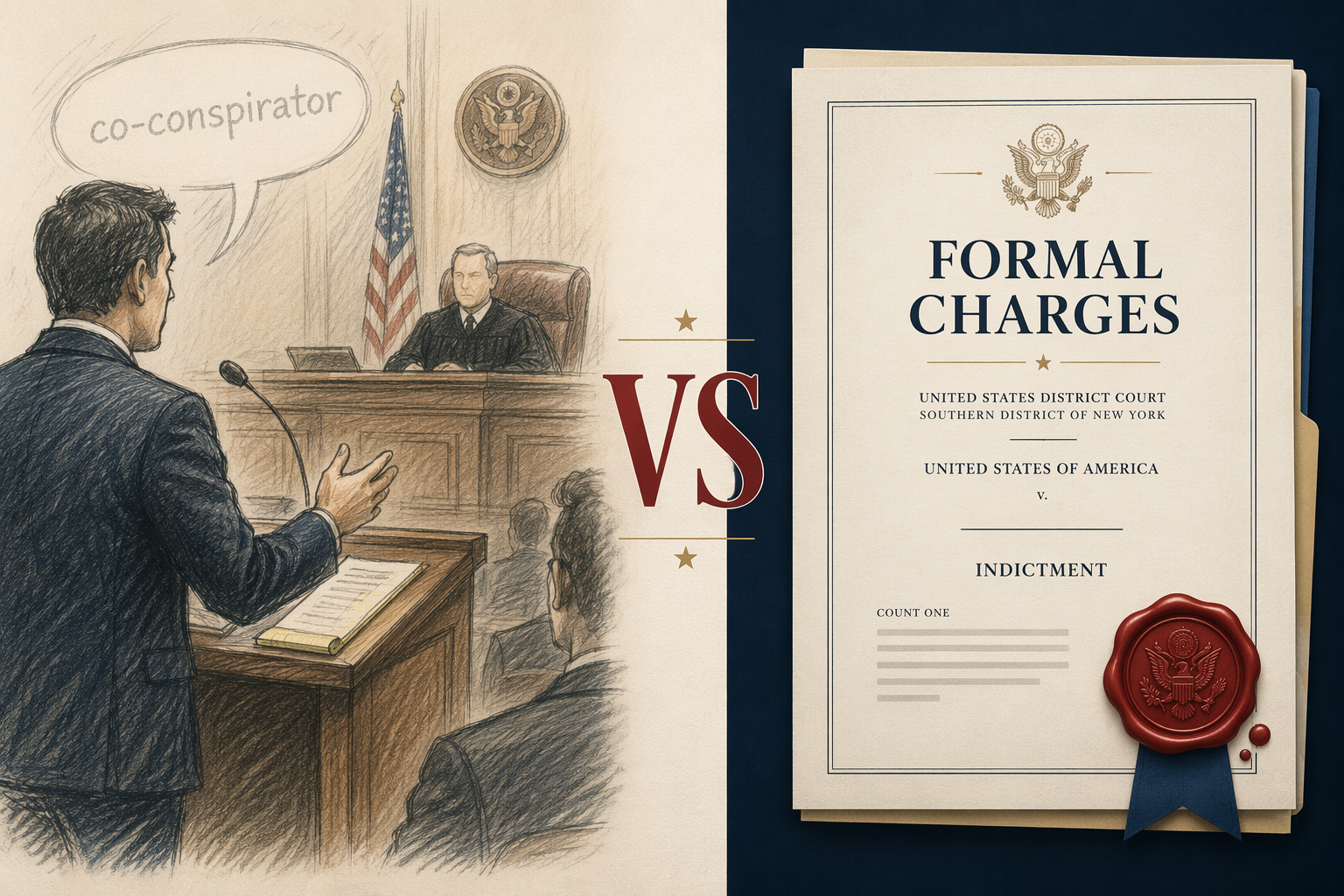
The public record on Salinas is therefore uncomfortable but procedurally specific. Prosecutors described him as a co-conspirator; reporting tied him to NXIVM’s Mexican network and elite recruitment circles; but he was not indicted, arrested, or charged in the federal criminal case reflected in the available materials.[3][4]
That is not a technicality in the dismissive sense. It is the line between accusation and prosecution. An indictment must identify charges approved through the charging process. It triggers arraignment, discovery, motion practice, trial exposure, plea leverage, and sentencing risk. A courtroom characterization of an uncharged person can be consequential for reputation, but it does not create the same legal posture.
| Public record category | What it means legally | How it applies here |
|---|---|---|
| Named or described by prosecutors | May reflect the government’s theory or evidentiary view, but is not itself a charge | Salinas was described as a co-conspirator during a hearing |
| Indicted or formally charged | Creates a criminal case against the person and requires the government to prove charges | Neither Salinas nor Paleta was charged in the available criminal record |
| Married to a person under scrutiny | Does not establish knowledge, agreement, or participation | Paleta’s connection is derivative through marriage |
| Civilly sued or named in victim litigation | May create exposure to damages or discovery, depending on claims and parties | The cited continuing civil vehicle concerns victims’ claims against alleged NXIVM actors, not criminal charges against Paleta |
This is also where public language often does the most damage. “Co-conspirator” sounds like a conviction to readers who encounter it in headlines or recap articles. In court, the word can occupy several positions: a charged conspiracy defendant, an unindicted alleged participant, or a person whose statements or conduct matter to the government’s theory. Those positions are not interchangeable.
NXIVM’s Mexico pipeline was real context, not proof against Paleta
None of this minimizes the NXIVM record. Keith Raniere was sentenced to 120 years after convictions that included racketeering, sex trafficking, forced labor conspiracy, and related charges.[5] Allison Mack, one of the group’s most visible public figures, was sentenced to three years and was released in 2023.[6]
Mexico was not incidental to the story, either. Reporting described Salinas as a key figure in NXIVM’s Mexican operations and in recruitment among elite Mexican circles.[4] At trial, a Mexican woman testified that she dropped out of school and left Mexico to join NXIVM, a concrete example of how the group’s reach crossed borders and altered victims’ lives.[7]
But context is not transferable guilt. Evidence that NXIVM recruited in Mexico, or that Salinas was scrutinized for a Mexican role, does not answer whether Paleta knowingly joined, assisted, financed, recruited for, or concealed criminal conduct. The available materials do not show that bridge.
That is the practical legal distinction between a scandal’s social map and a prosecutor’s proof map. The social map can include spouses, business partners, celebrities, political families, dinner photographs, and old press clips. The proof map is narrower. It has to show conduct that matches the elements of an offense.
Paleta’s public reemergence did not change her legal posture
Spanish-language coverage has treated Paleta’s public appearances and comments as notable because she was largely silent while the NXIVM story was at its most toxic. Infobae reported on her reappearance with Salinas after Mack’s 2023 release, a timeline detail that predictably revived public attention around the marriage.[8]
The legal significance of that reappearance is limited. Being seen with a spouse after a scandal does not retroactively create participation in the spouse’s alleged conduct. Nor does standing by a spouse amount to adopting every allegation ever made about that spouse. It may be a public-relations choice, a private family decision, or both. It is not a charging fact.
Telemundo and Latin Times reporting on Paleta’s comments is more useful for what it separates than for what it dramatizes: she said she was not a member and did not know the extent of NXIVM’s activities, while continuing to support Salinas.[1][2] Those are public statements, not sworn findings. Still, they align with the absence of any reported criminal action against her.
Why no charges were filed is not the same as why prosecutors used the label
Readers often want one satisfying reason that a publicly named person was not charged. Criminal dockets rarely give that kind of answer. A person may go uncharged because prosecutors do not believe the evidence proves each element beyond a reasonable doubt, because admissible evidence is thinner than investigative suspicion, because witnesses are unavailable or unreliable, because venue or limitations issues complicate the case, because charging strategy focuses elsewhere, or because the government’s proof against tried defendants does not require adding another accused person.
The available materials do not disclose the government’s internal charging analysis for Salinas. They do show the outcome that matters legally: no formal criminal case was brought against him in the record described here. That outcome also matters for Paleta because her connection is one step further removed. If Salinas remained uncharged despite being the person prosecutors discussed, Paleta’s derivative connection through marriage supplies even less basis for criminal jeopardy.
There is a temptation to treat the absence of charges as either exoneration or proof of impunity. Neither conclusion is required by the available record. Not charged means not placed under formal criminal accusation. It does not prove a person behaved admirably, and it does not prove prosecutors were wrong to scrutinize them. It means the criminal process did not move against that person.
Civil litigation keeps NXIVM legally alive, but in a different lane
The NXIVM legal aftermath did not end with the criminal convictions. Edmondson v. Raniere, a civil case filed in the Eastern District of New York, remains an important vehicle through which victims have pursued claims against alleged NXIVM actors. CourtListener reflected a record update on July 10, 2026, and docket activity including a Schedule A filing in February 2025, though the full current procedural posture should be confirmed through PACER, Westlaw, or the complete docket before publication.[9]
Civil exposure and criminal exposure should not be collapsed. A civil case can seek damages, name broader sets of defendants, proceed under different pleading standards, and continue long after a criminal sentencing. A criminal case can threaten imprisonment and requires proof beyond a reasonable doubt. The continuing civil docket is evidence that victims’ claims remain legally consequential. It is not, on the materials provided, evidence that Paleta faced criminal charges.
The legal implications for Paleta stop at reputational spillover
The legal implication of the NXIVM scandal for Ludwika Paleta is therefore mostly negative space: no charge, no reported membership, no reported ESP coursework, no reported Raniere relationship, and no public record tying her to the operational conduct that drove the criminal case. The scandal touched her public image because of her marriage. It did not become her criminal case.
Salinas’s posture was materially different but still short of prosecution. Prosecutors’ courtroom language placed him under public scrutiny, and reporting on NXIVM’s Mexico network gave that scrutiny substance. But without an indictment, arrest, plea, trial, or sentence, “co-conspirator” remains a prosecutor’s characterization in a hearing setting, not a formal adjudication of criminal liability.
That is the boundary the record supports. NXIVM’s crimes were grave. Victims continue to pursue legal accountability. Salinas’s public association with the group was not casual. But Paleta’s known connection was marital and reputational, not operational or charged. Treating those categories as separate is not softness toward NXIVM; it is the minimum discipline criminal law requires.
References
- Telemundo reporting on Ludwika Paleta’s NXIVM comments, Telemundo
- Latin Times reporting on Ludwika Paleta’s NXIVM statements, Latin Times
- Univision reporting on Emiliano Salinas being identified as a NXIVM co-conspirator, Univision
- Slate reporting on NXIVM’s Mexico connections and Emiliano Salinas, Slate
- Keith Raniere, Wikipedia
- Allison Mack: Smallville actress jailed for role in Nxivm sex cult, BBC
- CNN trial coverage of Mexican victim testimony in the NXIVM case, CNN, 2019
- Infobae reporting on Ludwika Paleta’s reappearance with Emiliano Salinas after Allison Mack’s release, Infobae, July 2023
- Edmondson v. Raniere, 1:20-cv-00485, CourtListener, updated July 10, 2026
Comments
Join the discussion with an anonymous comment.