
The legal significance of the Madewell sweater recall is not that a retailer offered refunds. It is that the Consumer Product Safety Commission notice puts a federal violation, a defined supply chain, and a burn-hazard incident in the same frame: about 5,900 women’s sweaters manufactured in China, imported by J. Crew Group LLC, distributed by Madewell Inc., and sold through Madewell stores, Madewell.com, and TJ Maxx were recalled because they “violate the mandatory standard for clothing textiles,” with one reported fire and no reported injuries as of the notice date.[1]
That sentence changes the posture of the file. A plaintiff no longer has to begin with a vague allegation that a sweater seemed unusually flammable. Defense counsel cannot treat the issue as only a customer-service event. Risk managers have to ask who controlled compliance before the product reached the sales floor, who received what guaranty, and whether the testing record behind that guaranty can survive inspection.
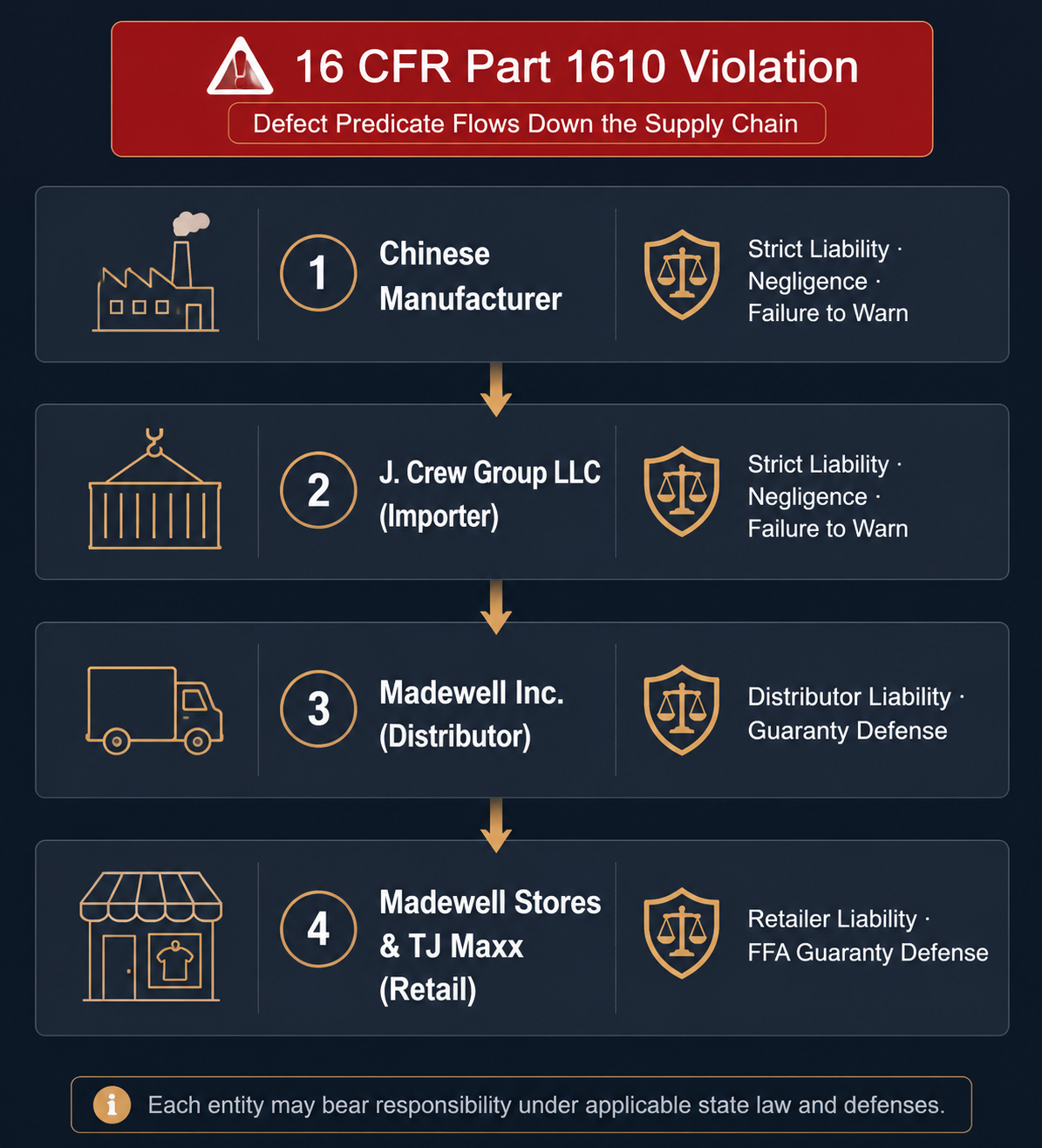
For anyone assessing legal liability from the Madewell sweater recall burn hazard, the core question is therefore narrower than “who sold the sweater?” It is: what does a published federal flammability violation do to the exposure of each entity that made, imported, distributed, or sold the product?
Why the Part 1610 finding matters
The CPSC notice points to 16 CFR Part 1610, the federal flammability standard for clothing textiles. The regulation classifies fabrics by burn behavior. Class 1 textiles are considered acceptable for clothing, Class 2 applies to certain raised-fiber surface textiles with intermediate flammability, and Class 3 textiles are considered dangerously flammable and are prohibited from use in clothing.[2]
The regulatory detail that matters most for liability is not the laboratory choreography of the test. It is the legal consequence. Under Part 1610, a plain-surface textile with a flame spread time of less than 3.5 seconds is Class 3, and a raised-surface textile can be Class 3 when the flame spread time is less than 4 seconds under the specified criteria. Class 3 textiles “are considered dangerously flammable and shall not be used for clothing.”[2]
That gives plaintiffs a clean defect predicate. In many product cases, defect is the first expensive fight: Was the product designed badly? Was this unit different from the intended design? Was the warning adequate? Here, the recall notice supplies a public agency statement that the garments violated a mandatory flammability standard.[1] That does not prove causation, injury, class certification, or damages. It does make it harder for any supply-chain defendant to frame the issue as merely a subjective consumer complaint.
The TravisMathew apparel recall from 2025 is a useful comparison, but only for scale and regulatory pattern. In that matter, the CPSC announced a recall of about 59,450 women’s sweatshirts and men’s and women’s hoodies for violation of the federal flammability regulation for clothing, with no injuries reported.[3] It shows that Part 1610 apparel recalls are not unique to Madewell. It does not tell us that the Madewell entities face identical exposure, because the entities, documents, testing history, sales channels, and remedy uptake are all case-specific.
The supply chain is not just background
The notice identifies multiple tiers: a Chinese manufacturer, J. Crew Group LLC as importer, Madewell Inc. as distributor, and Madewell and TJ Maxx as sales channels.[1] That allocation is legally useful because burn-hazard claims rarely stay fixed at the point of purchase. Plaintiffs tend to plead outward. Defendants then plead and tender inward.
| Supply-chain tier | Likely liability pressure | Immediate defense question |
|---|---|---|
| Manufacturer | Manufacturing defect, regulatory noncompliance, negligence in production or textile selection | What fabric was used, what testing was done, and whether the product as made matched the tested sample |
| Importer | Strict liability as a commercial seller, negligence in compliance oversight, possible regulatory responsibility | Whether it relied on a valid guaranty and whether that reliance was reasonable |
| Distributor | Strict liability and distribution-chain responsibility for placing the product into commerce | Whether it had compliance documents, notice of risk, or control over recall communications |
| Retailer | Retailer liability, warranty theories, refund and warning disputes | Whether a supplier guaranty exists and whether the recall remedy cures the alleged injury |
The table is not a prediction that every tier will pay. It is a map of where the questions land once the notice becomes part of a claim file. The same public violation can support different theories against different actors, and each theory asks a slightly different question.
Strict liability follows the product
Strict product liability is usually the most direct route for a consumer who alleges that the recalled sweater was defective when sold. The manufacturer is the obvious target because it made the garment. The importer and distributor can also face pressure because they helped place the product into the U.S. stream of commerce. The retailer may be named because it sold the product to the consumer.
The CPSC finding matters here because a mandatory-standard violation looks like more than ordinary disappointment with a product. If a textile is prohibited for clothing under Part 1610, a plaintiff can argue that the product was defective as a matter of regulatory compliance. That argument still has to be fitted to the governing state law, and state law can treat nonmanufacturing sellers differently. But the recall notice gives the plaintiff a simpler starting exhibit than a privately retained expert report alone.
Negligence looks for the broken compliance step
Negligence shifts the inquiry from the condition of the sweater to the conduct of the defendants. Who selected the textile? Who specified the fabric? Who ordered testing? Who reviewed the test report? Who accepted the shipment? Who had the authority to stop distribution?
Those questions are especially important for the importer and distributor. A retailer can sometimes say it relied on upstream compliance representations. An importer or branded distributor may have had more leverage over sourcing, labeling, quality control, and document collection. The recall notice identifies J. Crew Group LLC as importer and Madewell Inc. as distributor, which makes those roles hard to treat as incidental.[1]
The negligence file will likely turn on ordinary documents: purchase orders, specifications, lab reports, vendor manuals, compliance certificates, internal emails, and recall communications. The painful question is not whether someone had a certificate in a folder. It is whether the certificate corresponded to the product, the fabric, the production lot, and a testing program that the law recognizes.
Failure to warn depends on timing
Failure-to-warn theories need more care. A product that violates a mandatory flammability standard cannot usually be rescued by a better hangtag. If the textile is prohibited from clothing, the central allegation is not that consumers needed better instructions before using it. The stronger warning questions arise after the hazard is known: when did each entity learn of the issue, how quickly did it participate in the recall, and did recall communications reach purchasers in a meaningful way?
The CPSC notice reports one fire and no injuries.[1] That limits the immediate personal-injury posture, but it does not eliminate warning questions. If additional incidents were later alleged, timing would matter: a pre-recall sale raises different issues than a post-notice failure to communicate with known customers. The present public record, however, does not support writing as if injury claims have already materialized.
The guaranty defense is where the paper trail gets tested
The Flammable Fabrics Act guaranty system is the part of the liability analysis that deserves more attention than it usually gets. The CPSC explains that a guaranty is a written statement that a product, fabric, or related material complies with an applicable flammability standard. Guaranties can be used in the supply chain, including by downstream sellers, but the agency’s guidance ties that protection to testing and reasonable support for the compliance representation.[4]
In practical terms, a retailer or distributor wants the guaranty to do two jobs. First, it helps explain why the downstream seller did not independently retest every sweater before sale. Second, it helps move responsibility upstream if the product later fails. That is why guaranties often look reassuring during ordinary operations. They have supplier names, product references, signatures, and compliance language.
The recall is when those documents stop being decorative. A guaranty is not magic paperwork if the testing foundation is missing. The CPSC’s business guidance describes guaranties in connection with testing of products, fabrics, or related materials and warns that guaranties must be based on reasonable and representative tests.[4] The downstream seller’s best defense can therefore become a discovery problem: produce the guaranty, then produce the testing record that made the guaranty worth relying on.
A strong guaranty file would normally answer several questions without improvisation. Which exact textile was tested? Was the test performed under the correct Part 1610 method? Did the tested sample represent the production run? Did the guaranty cover the finished garment or only a component fabric? Was there any fabric substitution after testing? Did the importer, distributor, or retailer have reason to doubt the supplier’s representation?
A weak file answers a different question: why did no one notice the gap before the recall? That is where a downstream defendant can lose the clean story it expected to tell. The guaranty may still matter for indemnity, tender, allocation, and comparative fault. But if the factual record shows no reasonable-and-representative testing, the paper may not defeat a plaintiff’s liability theory as cleanly as the retailer hoped.
Civil penalties are possible, but the numbers need restraint
Civil penalty exposure should not be treated as identical to consumer damages. The Fashion Law’s summary of the Flammable Fabrics Act framework states that violations may be subject to civil penalties of $6,000 per product and $1.5 million for a related series of violations.[5] Those figures are useful as a historical FFA reference, but current penalty ceilings can vary depending on the statutory authority, adjustment regime, and how the agency characterizes the violation. They should not be dropped into a demand letter as if they automatically set the value of this recall.
For the entities in the Madewell chain, the more immediate civil-penalty questions would be factual: when did the company know or have reason to know of the flammability issue, what reporting decisions were made, what corrective action was taken, and whether any noncompliant units remained in commerce after the issue was identified. The available recall notice establishes the product, entities, remedy, and incident count. It does not, by itself, answer those internal-timing questions.[1]
Damages look different without injuries
The one reported fire matters. So does the absence of reported injuries. As of the CPSC notice, there was one fire incident and no injuries.[1] That record slows down the personal-injury analysis. It does not support assuming a docket of burn cases, medical specials, pain-and-suffering claims, or punitive-damages narratives tied to known physical harm.
The likely near-term claim shape, if litigation emerges, is therefore economic loss: consumers paid for sweaters that allegedly should not have been sold as clothing; they may claim overpayment, loss of use, diminished value, or insufficient remedy. Those theories still have hurdles. Plaintiffs would need standing, a cognizable injury, a viable class theory, and a reason the recall remedy does not fully redress the loss.
That is where the Madewell remedy becomes legally relevant. Madewell’s recall page offers affected consumers a full refund to the original form of payment or store credit and instructs them to cut the sweater in half and provide a photograph to verify destruction.[6] For defense counsel, a full refund program can support arguments that putative class members have an available remedy and may lack continuing injury. For plaintiffs, the destruction-and-photo requirement may become the friction point: a consumer may argue that a remedy conditioned on cutting up the product, documenting destruction, and completing the process is not equivalent to automatic restitution.
Foley & Lardner’s discussion of voluntary CPSC recalls as potential class action defenses is useful as a framework, not as a result. The analysis discusses cases in battery and automobile contexts where defendants argued that recall or replacement programs affected Article III standing or mooted claims.[7] Those cases are not apparel-specific, and they do not answer whether a court would treat this particular sweater recall remedy as sufficient. They do identify the questions a court may care about: whether the remedy is complete, whether consumers can actually obtain it, whether the alleged injury survives the offer, and whether plaintiffs seek relief beyond what the recall provides.
How exposure likely separates by defendant
The Chinese manufacturer faces the most direct product-focused allegations because it made the recalled sweaters.[1] If the textile failed Part 1610, claims against the manufacturer would likely focus on fabric selection, production controls, finished-garment testing, and whether any supplier or subcontractor introduced a material change after compliance testing. The hard part for U.S. plaintiffs may be jurisdiction, service, collection, and contractual traceability, not the conceptual link between manufacture and defect.
J. Crew Group LLC, identified as importer, sits in a different position.[1] Importers often become the practical litigation target because they are domestic, commercially involved, and closer to compliance documentation. The importer will want to show a disciplined compliance program: supplier qualification, Part 1610 testing requirements, review of guaranties, document retention, and escalation procedures when failures appear. If the importer merely passed along upstream assurances without a reliable testing basis, negligence and regulatory arguments become harder to contain.
Madewell Inc., identified as distributor, is tied to the branded channel and recall communications.[1] Its exposure may overlap with the importer’s if corporate roles, sourcing oversight, or compliance functions are integrated. As distributor, it may also be central to remedy administration, customer notice, and coordination with sales channels. In class litigation, that operational role can matter almost as much as the original compliance failure because the adequacy of the remedy becomes part of the standing and damages fight.
Madewell retail channels and TJ Maxx face the familiar downstream-seller problem. They are closest to the consumer transaction, so they are easy to name. But their ultimate exposure may depend heavily on state seller-liability rules, indemnity agreements, supplier guaranties, and whether they had notice of the defect before sale. A retailer with a real guaranty backed by valid testing is in a different position from a retailer with only an invoice-level assurance that nobody can substantiate.
The recall gives plaintiffs a strong defect predicate across the chain. It does not collapse all defendants into the same legal position. The manufacturer answers for production and testing. The importer answers for compliance gatekeeping. The distributor answers for placing and managing the product in commerce. The retailer answers for the sale, the remedy experience, and whatever it knew or should have known.
What the recall does, and does not, decide
A voluntary recall notice can sound soft until the operative language is read closely. This one says the sweaters violate a mandatory federal flammability standard.[1] That is why the notice has litigation value. It can support strict liability and negligence theories, sharpen failure-to-warn timing questions, and force every commercial seller to account for the compliance documents it relied on.
The same notice also limits overstatement. It reports one fire and no injuries.[1] The current record does not justify treating the recall as an established personal-injury docket. The refund or store-credit remedy may reduce or defeat some consumer claims if courts view it as complete and accessible. The guaranty system may protect some downstream sellers if their paperwork is backed by reasonable-and-representative testing. Those are not footnotes; they are the places where liability becomes allocation.
The Madewell recall supplies a serious defect predicate because the CPSC identified a violation of 16 CFR Part 1610. Actual liability and damages will turn on the testing records, the guaranties, who controlled compliance, how many consumers use the remedy, whether any injuries later appear, and whether a court accepts the recall process as enough to defeat economic-loss or class claims.
References
- Madewell Recalls Women’s Sweaters Due to Risk of Serious Injury or Death from Burn Hazard; Violate Mandatory Standard for Clothing Textiles, U.S. Consumer Product Safety Commission, July 16, 2026
- 16 CFR Part 1610 — Standard for the Flammability of Clothing Textiles, eCFR
- TravisMathew Recalls Women’s Sweatshirts and Men’s and Women’s Hoodies Due to Burn Hazard; Violation of Federal Flammability Regulation for Clothing, U.S. Consumer Product Safety Commission, February 2025
- Flammable Fabrics Act, U.S. Consumer Product Safety Commission
- What is the Flammable Fabrics Act?, The Fashion Law
- Product Recall, Madewell
- Can a Voluntary Consumer Product Safety Commission Recall Short-Circuit Costly Class Action Litigation?, Foley & Lardner, August 2024
Comments
Join the discussion with an anonymous comment.