
As of July 20, 2026, the Maine Senate race is no longer just a campaign problem. Graham Platner’s withdrawal has pushed the Democratic nomination into the part of election law where political decisions have to become filings, signatures, delegate credentials, certifications, and bank-account restrictions. The triggering allegation was published July 6; Platner suspended his campaign July 8; he filed his official withdrawal with Secretary of State Shenna Bellows on July 10; county caucuses were scheduled for July 18 and 19; the party convention is set for July 25 in Bangor; and the replacement certification deadline is July 27.[1]
That sequence matters because withdrawal does not refill a ballot line. It only creates a vacancy that must be addressed under overlapping state-law, party-rule, and federal campaign-finance constraints. The allegation against Platner remains an allegation; the available materials identify no criminal charge or civil judgment. But the legal consequence of his withdrawal is already concrete: Maine Democrats have days, not months, to convert an emergency nomination process into a candidate who can qualify for the general-election ballot.
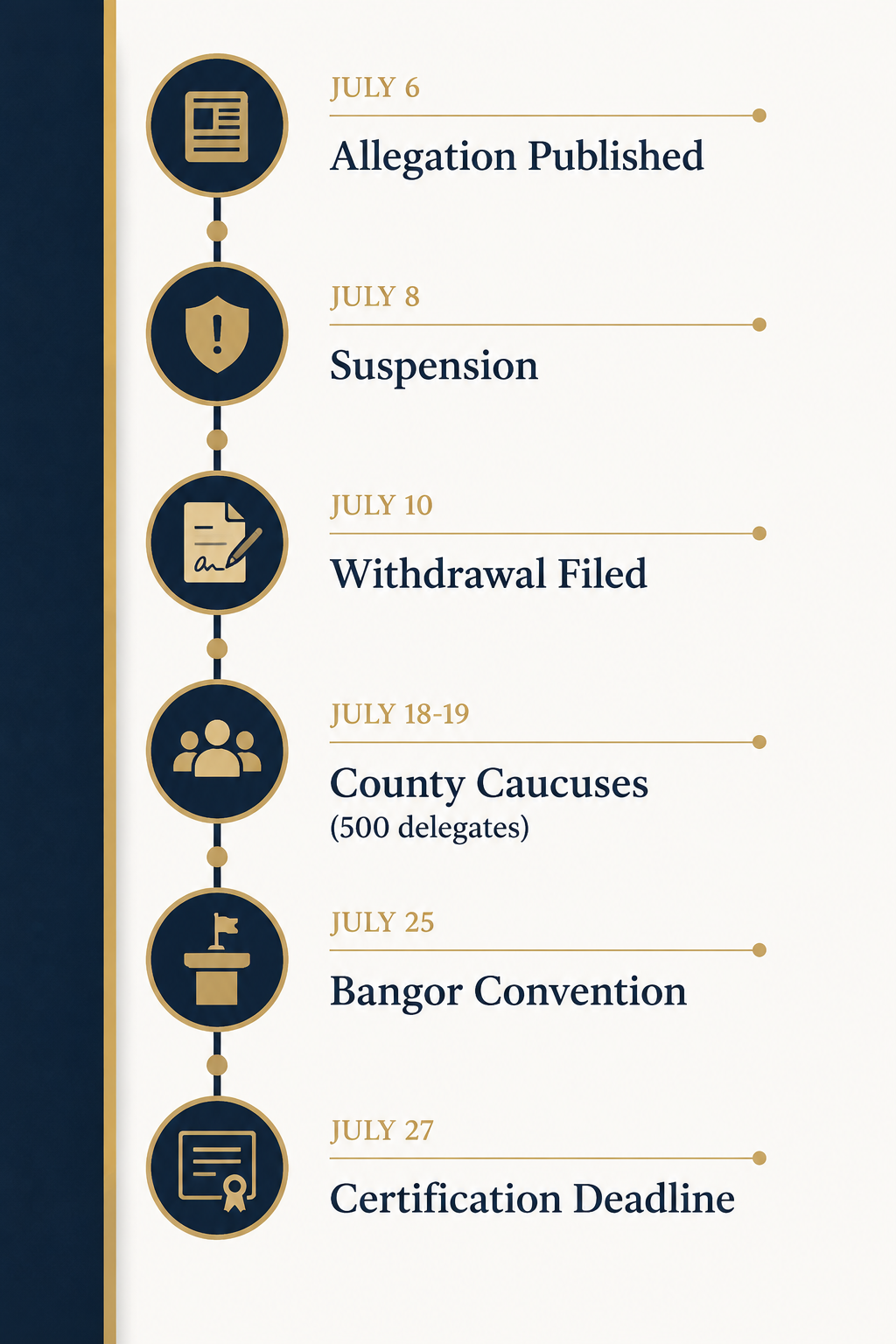
The Withdrawal Filing Opens a Vacancy; It Does Not Name a Successor
The July 10 withdrawal filing is the legal hinge. Before that filing, Democrats had a collapsing candidacy. After it, they had a ballot-access vacancy requiring action by the state party and recognition by the Secretary of State’s office. For a general framework on why withdrawal and replacement are separate legal acts, see How Candidate Withdrawal Works Under State Election Law.
The practical distinction is easy to miss. A campaign may announce a suspension, donors may stop giving, staff may leave, and endorsers may move on. None of that by itself gives the party a replacement nominee. The operative event is the filing that removes the candidate from the ballot process and allows the party to attempt a substitution under Maine’s election calendar.[1]
The absence of a modern Maine precedent is not a decorative point. It means lawyers and administrators are not simply following a familiar playbook from the last comparable Senate race. They are working from statutes, party rules, state filing requirements, and a compressed factual calendar while the convention rules themselves remain partly fluid as of July 20.
| Date | Procedural Event | Legal Significance |
|---|---|---|
| July 6, 2026 | Rape allegation against Platner published | Political trigger; not an adjudication |
| July 8, 2026 | Platner suspends campaign | Campaign event; not enough by itself to replace nominee |
| July 10, 2026 | Withdrawal filed with Secretary Bellows | Creates the vacancy the party must fill |
| July 18-19, 2026 | County caucuses | Select most convention delegates |
| July 25, 2026 | Bangor convention | Party process for choosing replacement |
| July 27, 2026 | Certification deadline | State deadline for nominee recognition |
The Party Process Is Only Useful If It Produces a Qualifying Candidate
The Maine Democratic Party’s replacement process is built around a 600-delegate convention, with 500 delegates elected through county caucuses held July 18 and 19.[1] Reuters described the party as seeking a path forward after the sudden vacancy, with multiple Democrats moving toward the opening under an unusually short timeline.[2]
Coverage naturally gravitates toward the July 25 Bangor convention because that is where the political selection happens. But the convention is not the finish line. A convention vote that does not produce a nominee capable of meeting the qualification and certification requirements is only an internal party result. The state ballot question is narrower: did the party certify a lawful replacement, and did that replacement satisfy the Maine requirements in time?
The signature requirement is the part that turns the replacement from a convention winner into a ballot-access candidate. The nominee must submit 500 candidate signatures, including at least 50 from each of 8 counties.[1] That distribution rule is more than an arithmetic chore. A campaign that collects 500 signatures statewide but fails the county spread has not solved the qualification problem.
This is where the compressed mechanics become unforgiving. County caucuses feed the delegate pool; delegates feed the convention; the convention feeds the certification package; and the candidate must still have signatures that satisfy a geographic threshold. Each piece depends on the one before it, but the Secretary of State’s deadline does not expand to accommodate internal party friction.
What the Convention Must Actually Accomplish
The Bangor convention has to do more than register Democratic preference. It has to generate a result the party can reduce to a valid certification. That requires attention to delegate credentials, voting rules, candidate eligibility, recordkeeping, and the authority of whoever signs and transmits the party’s certification documents.
- The party needs a delegate-selection process it can defend if challenged.
- The convention must identify a replacement nominee under rules that are settled enough to administer.
- The replacement must satisfy Maine’s signature threshold, including the county-distribution requirement.
- The certification must reach the Secretary of State by July 27.
The uncertain point, as of July 20, is not whether Democrats want a replacement. It is the final shape of the convention rules and how binding or advisory each piece of the process will be. That uncertainty should not be inflated into illegality. Parties often finalize procedures under pressure. But it is a compliance risk because every unresolved procedural question has to be answered before the paperwork can safely leave the party’s hands.
The July 27 Certification Deadline Is the State-Law Bottleneck
By July 27, the Secretary of State must receive the replacement certification.[1] That deadline is the point at which the political process meets the state’s ballot machinery. The office is not being asked to decide whether the party made a wise choice. It is being asked to determine whether the party has submitted a nominee who can be recognized under the applicable rules.

The role of Secretary Bellows becomes legally notable here, not as a campaign subplot but as an administrative fact. She is the official receiving the replacement certification, and she has also been reported as a candidate or leading contender for the nomination.[2][3] That dual position is unusual. The materials do not support an implication of misconduct. The narrower point is that the same person may be situated on both sides of the process: as a potential beneficiary of the nomination and as the state officer whose office receives the certification.
If Bellows becomes the nominee, the recordkeeping burden becomes more important, not less. The party’s convention minutes, credentialing records, signature submissions, and certification chain would need to be especially clean because the appearance of dual roles can invite scrutiny even where the legal authority is routine. The available sources also identify United States v. Bellows as part of the surrounding legal context, but the status of any appeal was not established; that uncertainty should remain exactly that.
Historical Rarity Raises the Stakes, But It Does Not Supply the Rule
Recent Senate history offers scale, not a Maine-specific answer. The American Prospect reported that only 9 U.S. Senate nominees had been replaced in the prior 30 years, and only 2 of those replacements won the general election.[3] That history is relevant because it shows how rarely campaigns, state parties, and election offices have to run this sequence in a live Senate race.
It does not tell Maine officials what to file by July 27. Historical rarity can explain why there is little institutional muscle memory. It cannot cure a missing county threshold, an unclear delegate credential, or a late certification.
The Money Problem Does Not Follow the Ballot Line
Once a replacement nominee exists, the next misunderstanding is usually financial: that the new nominee can simply inherit Platner’s campaign account. That is not how federal contribution limits work.
Platner’s campaign had raised $16.3 million and reported about $2.2 million cash on hand in a May 2026 FEC filing.[1][4] Those figures describe the withdrawn candidate’s committee, not an asset account automatically portable to the replacement. Under 52 U.S.C. § 30116(a)(1)(A), a direct contribution from one candidate committee to another is subject to the $2,000 federal contribution cap for that election.[4]

That cap changes the practical meaning of replacement. Ballot access may move from Platner to another Democrat if the party completes the Maine process. The candidate committee balance does not move with it. Most of the $2.2 million remains stranded in the withdrawn candidate’s committee unless spent or disposed of through legally permissible channels.
This is where campaign-finance compliance diverges from campaign politics. A party can unify around a new nominee and still leave the new nominee’s own committee undercapitalized. The replacement can raise money, the party can spend through its own committees, and outside groups can act within their own legal lanes. But a candidate-to-candidate transfer cannot be treated as a workaround for the contribution limit.
Party committees are different legal actors. The DNC, DSCC, and state party may have spending and transfer capacities that do not match the withdrawn candidate’s restrictions. That distinction is why the stranded-funds problem should not be described as Democrats having no money. It is more precise, and more useful, to say the replacement nominee cannot simply receive Platner’s candidate-account balance.
The FEC’s current lack of quorum adds a second layer of difficulty. It does not suspend the statute. The $2,000 cap still binds the actors, but formal advisory-opinion and enforcement capacity is constrained. For readers tracking that institutional problem across the cycle, see How Shutdowns and CRs Gutted FEC Enforcement for the 2026 Midterms.
That combination is uncomfortable for compliance counsel. The legal rule remains in force, but the agency process that would normally clarify close questions is unavailable. The safer course is to treat the candidate committee funds as legally boxed off from the replacement except for permitted transfers and expenditures, and to document every decision as if later review is possible. For a broader compliance map, see The Three Enforcement Tracks for Campaign Finance Mismanagement.
The Campaign Reset Is Real, But Legally Secondary
The replacement will also reset the political frame of the race. The 19th reported that Platner’s exit shifted attention back toward Senator Susan Collins’s abortion record and the broader issue environment for the contest.[5] That may matter enormously to campaign strategy.
It does not alter the replacement mechanics. A stronger message does not validate a convention credential. A favorable national environment does not satisfy the 500-signature requirement. A fluid rating from an election forecaster does not extend the July 27 certification deadline. The legal sequence still has to close in order.
That is also the limit of the national midterm reading. Maine may become a symbol of Democratic risk, Republican opportunity, or voter reaction to legal turmoil in the 2026 cycle. Those frames belong elsewhere. For the ballot-access question, the relevant actors are much more specific: county caucus organizers, convention officials, candidate petition teams, party counsel, the Secretary of State’s office, and federal campaign-finance compliance staff.
What Has to Be True by July 27
By the certification deadline, the replacement effort has to satisfy several conditions at once. They are not interchangeable.
- Platner’s withdrawal must be properly recognized as creating the vacancy.
- The party must conduct a replacement process under rules it can identify and defend.
- The convention must produce a nominee with documented authority to stand in the general election.
- The nominee must satisfy the 500-signature requirement, including at least 50 signatures from each of 8 counties.
- The certification package must reach the Secretary of State by July 27.
- The replacement campaign must treat Platner’s candidate funds as restricted, not inherited.
Those conditions answer the central legal issue in the Maine Senate race 2026 nominee swap. Democrats may be able to replace the withdrawn nominee, but only by completing a tightly sequenced process in which party authority, state ballot qualification, certification timing, and federal campaign-finance limits each do separate work. The ballot line and the bank account do not solve each other.
References
- 2026 United States Senate election in Maine, Wikipedia.
- Six Maine Democrats clamor to fill sudden void, Reuters, July 9, 2026.
- Maine's Three Likely Replacements, The American Prospect, July 9, 2026.
- FEC campaign finance data page for the 2026 Maine Senate election, Federal Election Commission.
- Maine Senate race resets Susan Collins abortion, The 19th, July 2026.
Comments
Join the discussion with an anonymous comment.