
The legal significance of the Mark Lamb sheriff sex scandal allegations is not that Pinal County prosecutors declared the allegations admirable, harmless, or politically irrelevant. They did not. The narrower point is more important: on June 22, 2026, the Pinal County Attorney’s Office closed its criminal investigation after concluding that the available evidence did not establish violations of Arizona criminal statutes, while expressly saying that the decision did not resolve questions of personal misconduct or civil liability.[1]
That limiting language does most of the legal work. It separates three questions that public scandals often collapse into one: whether alleged conduct happened, whether it can be charged as a state crime, and whether it can still support civil-rights, employment, political, or institutional consequences. In Lamb’s case, the first question remains publicly contested, the second has been answered by the local prosecutor for now, and the third is still open.

What the county attorney actually cleared
The clearance concerned potential criminal wrongdoing under Arizona law. It did not purport to decide whether Lamb behaved appropriately as an elected sheriff, whether alleged victims have civil claims, whether county officials handled earlier complaints properly, or whether voters should treat the allegations as disqualifying. That distinction is not a technicality. It is the difference between the state’s power to punish and the broader accountability that can follow official misconduct.
The allegations reported around Lamb included sexting, nude-image disputes, alleged threats to involve law enforcement against an accuser, racist messaging, and questions about whether earlier county officials gave Lamb a less searching review than an ordinary suspect would have received. The sexual allegations drew the public attention. The alleged invocation of official authority is the legally sharper fact.
A public official can engage in private misconduct that is politically damaging and still fall outside a criminal statute. Conversely, conduct that begins as private misconduct can move into civil-rights territory if the official uses government power to threaten, coerce, retaliate, or chill someone’s rights. Lamb’s clearance sits directly on that fault line.
Why the Arizona criminal theories narrowed quickly
Two Arizona criminal theories have mattered most in the public discussion: harassment and unlawful disclosure of intimate images, often described as revenge porn. Neither is a general-purpose punishment for sexual hypocrisy, embarrassing messages, consensual adult sexting, or reputational harm. Each requires statutory elements that prosecutors must be able to prove.
Arizona’s unlawful-disclosure statute focuses on the disclosure of another person’s identifiable intimate image under specified conditions, including circumstances involving intent, lack of consent, and reasonable expectations of privacy. The statute also contains exceptions and definitional limits; it is not triggered simply because intimate images existed or because adults exchanged sexual messages.[2]
The limitations issue matters too. Available sources identify a seven-year felony limitations period for Arizona unlawful-disclosure offenses, which means some allegations may be legally stale even if they remain publicly relevant.[3] Statutes of limitation are often unsatisfying in misconduct cases because they do not say the conduct was acceptable. They say the state waited too long, or the alleged conduct occurred too long ago, for that criminal remedy to remain available.
Harassment has a different problem. The theory requires more than proof that communications were sexual, offensive, unwanted in hindsight, or damaging once exposed. Prosecutors generally need evidence that fits the statute’s required pattern and mental state: a course of conduct, and an intent to harass, threaten, or otherwise meet the statutory standard. If the communications were consensual at the time, or if the evidence does not clearly show a chargeable course of threatening conduct within the relevant period, the criminal case becomes harder even before questions of witness credibility or proof beyond a reasonable doubt are reached.
That is why the phrase “fell short of charges” should be read with care. It is not a finding that every allegation is false. It is not a judicial ruling after trial. It is a prosecutorial conclusion that the evidence, as reviewed, did not satisfy the elements and time limits of the Arizona offenses under consideration.[1]
| Question | What the criminal clearance answered | What it did not answer |
|---|---|---|
| Consensual sexting among adults | Not itself an Arizona crime on the facts described | Whether it showed poor judgment by an elected sheriff |
| Intimate-image allegations | No chargeable offense found under the reviewed Arizona statutes | Whether civil claims or noncriminal remedies remain |
| Alleged threats invoking law enforcement power | No state criminal charge filed | Whether the conduct could support federal civil-rights theories |
| Earlier handling of complaints | Not resolved as a criminal charge against Lamb | Whether county processes applied unequal scrutiny |
The part that changes the legal temperature
The alleged threats are more legally consequential than the sexting itself. Public reporting has described allegations that Lamb threatened to contact state police or pursue revenge-porn accusations against an accuser. If proved, that kind of statement would not merely be private sexual fallout. It would raise the question whether a sheriff used, or appeared to use, the machinery of law enforcement as personal leverage.
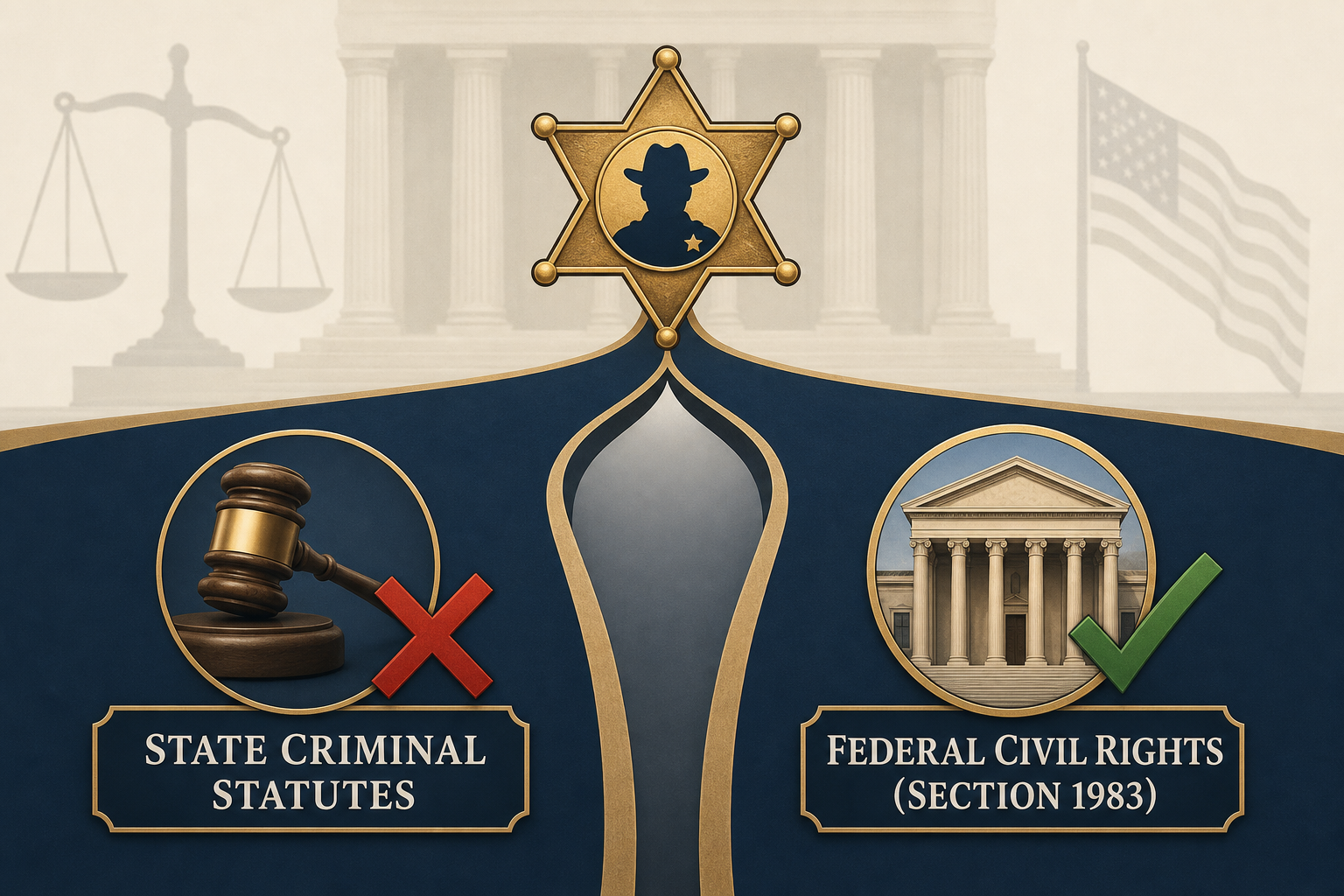
This is where the legal analysis moves away from Arizona’s sex-related criminal statutes and toward federal civil-rights law. The Department of Justice describes deprivation of rights under color of law as conduct in which a person acting under governmental authority willfully deprives someone of rights protected by the Constitution or federal law.[4] Cornell’s Legal Information Institute publishes the text of 18 U.S.C. § 242, the federal criminal color-of-law statute, which addresses willful deprivation of rights under color of law.[5]
A federal criminal civil-rights case under § 242 is still a demanding route. It requires proof of willfulness and a deprivation of a protected right, and the charging decision belongs to federal prosecutors. The fact that an allegation sounds abusive or coercive does not by itself establish a federal crime. But the theory explains why the alleged use of sheriff authority matters in a way that private sexual misconduct alone may not.
Why Section 1983 may be the more durable route
For civil exposure, 42 U.S.C. § 1983 is the more practical surviving frame. Section 1983 creates a civil action against a person who, under color of state law, deprives another person of rights secured by the Constitution and federal statutes.[6] It does not require the local county attorney to have filed state criminal charges. It also does not require the challenged conduct to fit Arizona’s harassment or intimate-image statutes.
The difficulty for a plaintiff would be connecting the alleged misconduct to state authority. A sheriff’s private sexual relationship, standing alone, is usually not state action. The potential change comes when the sheriff allegedly invokes official power: threatening to involve state police, threatening criminal accusations, or using the credibility of elected law-enforcement office to intimidate someone. The legal question becomes less about the sexual content and more about whether official authority was used as a weapon.
That distinction is central for lawyers evaluating the case. A civil-rights claim cannot be built only on disgust. It needs a protected right, state action, causation, injury, and a defendant who can be sued despite any available immunity arguments. But the county attorney’s state-law clearance does not erase those questions. It leaves them to a different forum, under different standards, with different remedies.
The investigation history compounds the accountability problem
The institutional record is not clean simply because the criminal file closed. Reporting on the county review described a troubling earlier gap: former Pinal County Attorney Kent Volkmer had publicly suggested that an investigation occurred, while current County Attorney Brad Miller later found that “not a single investigator” could recall such an investigation. KTAR, citing the Arizona Republic’s reporting and the county attorney’s findings, also described the conclusion that Lamb received a “different standard of review.”[7]
That finding does not prove the underlying sexual allegations. It does something narrower and still serious: it suggests unequal institutional treatment of a powerful law-enforcement official. For compliance officers, municipal lawyers, and oversight bodies, that is a separate risk from criminal exposure. A public office can fail at intake, documentation, conflict management, or investigative independence without producing a chargeable offense against the official at the center of the complaint.
It also explains why a prosecutorial clearance can land badly with the public. If people believe an official received special handling before the final review even began, a later “no charges” decision will not restore confidence by itself. The law may have answered the charging question; it has not repaired the process question.
Public admissions, denials, and the limits of what they prove
The public record is also mixed in the ordinary way scandal records are mixed. Matt Hilsabeck, identified in reporting as Lamb’s friend, publicly confirmed that sexting and encounters occurred, while Lamb’s campaign characterized reporting on the matter as lies.[8] Those two facts can coexist with the county attorney’s conclusion because criminal law is not a truth commission. It asks whether admissible evidence proves each element of an offense beyond a reasonable doubt.
Racist messaging allegations and campaign denials belong in the public-accountability record, but they do not carry the same legal weight as the alleged use of law-enforcement authority against an accuser. They may affect voters, donors, endorsers, and party actors. They may shape credibility assessments. They do not, without more, supply the missing elements of an Arizona criminal sex-related offense or a federal color-of-law claim.
Politics did not close the gap
Lamb’s July 21, 2026 Republican primary victory in Arizona’s 5th Congressional District shows the political side of the accountability gap rather than resolving it.[9] The primary result means the allegations did not end his campaign before the general election. It does not convert the county attorney’s clearance into vindication, and it does not make civil-rights exposure disappear.
The political context also includes Lamb’s association with the constitutional sheriff movement; Cronkite News reported that he spoke at the Constitutional Sheriffs and Peace Officers Association convention in 2020.[10] That background matters because the movement’s posture often emphasizes local sheriffs as unusually independent constitutional actors. In a misconduct dispute, that posture can make conventional oversight appear not merely inconvenient but ideologically contested.
Still, ideology should not be used as a substitute for statutory analysis. The legal question is not whether Lamb’s brand of sheriff politics is appealing. It is whether the alleged conduct fits a criminal statute, whether a civil plaintiff could show action under color of state law, and whether public institutions applied the same investigative standards they would have applied to anyone else.
The door that remains open
The Mark Lamb case is a useful warning for legal professionals because it resists the two easiest readings. “No criminal charges” is not exoneration of conduct. Public outrage is not a substitute for statutory elements. The case sits in the space between those propositions.
Arizona prosecutors closed the state criminal inquiry under the statutes they reviewed. That closed one door. It did not decide whether accusers could pursue civil claims, whether federal civil-rights theories could be tested, whether county officials mishandled earlier complaints, or whether voters and institutions should impose their own consequences.
The structural lesson is narrow but consequential: elected law-enforcement executives can face allegations severe enough to damage public trust and still fall outside state criminal statutes. The remaining legal exposure may depend on a smaller, harder, and more important question — whether official authority was used to threaten, coerce, or retaliate.
References
- Pinal Co. Attorney clears Mark Lamb of criminal wrongdoing, closes investigation, ABC15 Phoenix
- 13-1425. Unlawful disclosure of images depicting states of nudity or specific sexual activities; classification; definitions, Arizona Legislature
- Arizona Statutory Criminal Law, Without My Consent
- Deprivation Of Rights Under Color Of Law, U.S. Department of Justice Civil Rights Division
- 18 U.S. Code § 242 - Deprivation of rights under color of law, Cornell Legal Information Institute
- 42 U.S. Code § 1983 - Civil action for deprivation of rights, Cornell Legal Information Institute
- Pinal County closes investigation into Mark Lamb sex claims, KTAR
- Why Mark Lamb's friend broke silence on sex claims, Tucson.com
- Arizona 5th District Republican primary results, CBS News
- Lamb scandal tests Trump's reluctance to rescind endorsements, Cronkite News
Comments
Join the discussion with an anonymous comment.