
The useful starting point for the legal impact of the Mark Walter federal probe on the Dodgers and Lakers is not Walter’s wealth, the Dodgers’ profile, or the Lakers’ sale price. It is a timing problem. The NBA Board of Governors approved Walter’s purchase of a majority stake in the Lakers on Oct. 30, 2025, before the grand jury subpoenas tied to the federal scrutiny became public, and as of the July 20, 2026 reporting on the matter, no charges had been filed against Walter or his companies. The league therefore is not looking at a disapproved buyer. It is looking at an already-approved controlling owner under investigation, without an indictment, adjudicated violation, or league finding yet attached to the conduct under review. [1][2][3][4]
That distinction does most of the legal work. An investigation is a signal that prosecutors or regulators are asking questions. Formal charges are a public procedural step with consequences that leagues can evaluate against their own constitutions and conduct standards. League-actionable conduct is narrower still: it requires a league to identify the contractual or constitutional hook that lets it fine, suspend, remove authority, block a transaction, or seek divestiture. Sports coverage often compresses those categories into one phrase — “federal probe” — but league governance documents do not usually operate by headline.

The reported probe is serious enough to test that architecture. USA Today, Bloomberg Law, and Sports Business Journal reported on July 20, 2026 that federal prosecutors are examining entities connected to Walter, including insurance companies and Guggenheim-related structures; Bloomberg Law also described a parallel SEC-criminal dimension to the inquiry. [1][2][3] Seriousness, however, is not the same as an ownership termination trigger. A league can dislike the optics of an investigation and still lack a defensible path to force a sale before the investigation produces a formal finding.
The Lakers’ approval came before the public probe
The Lakers facts are unusually clean on chronology. On Oct. 30, 2025, the NBA unanimously approved Walter’s purchase of a majority stake in the Lakers at a $10 billion valuation. The transaction reporting also said Jeanie Buss would remain the Lakers’ governor for at least five years under the sale agreement. [4] Those two facts point in different directions. The valuation explains why the approval mattered: the NBA was blessing control of one of its most important franchises. The governorship provision explains why the investigation does not immediately place Walter in the ordinary day-to-day posture of a hands-on league representative.
In NBA governance, the “governor” role is not ceremonial in the way public ownership stories sometimes make it sound. The governor is the person who represents the franchise inside the league’s formal decision-making structure. If Buss remains governor for at least five years, the Lakers have an institutional buffer between Walter’s economic control and the person sitting in the league room on behalf of the club. That does not make the federal investigation irrelevant. It does mean the NBA’s immediate governance problem is different from a situation in which the investigated individual is also the franchise’s current governor.
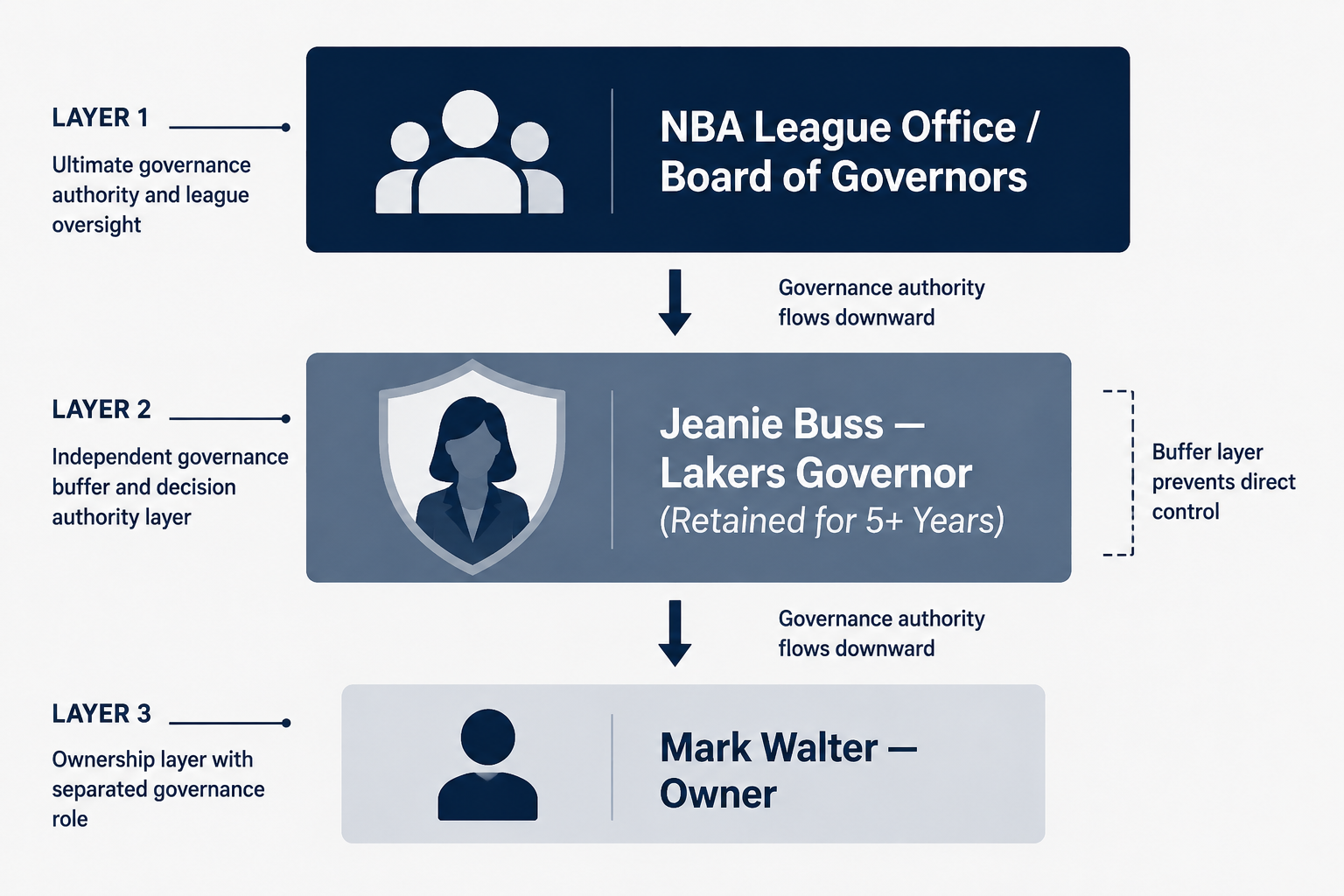
This is why the five-year Buss provision deserves more legal attention than the sale price. A $10 billion valuation increases the public stakes; it does not itself create league authority. A retained governorship, by contrast, stabilizes the franchise’s formal interface with the NBA while the investigation remains uncharged. It gives the league an answer to the practical question every constitution eventually has to confront: who is authorized to speak and vote for the team while outside facts are still developing?
What the NBA could do, and what it probably cannot justify yet
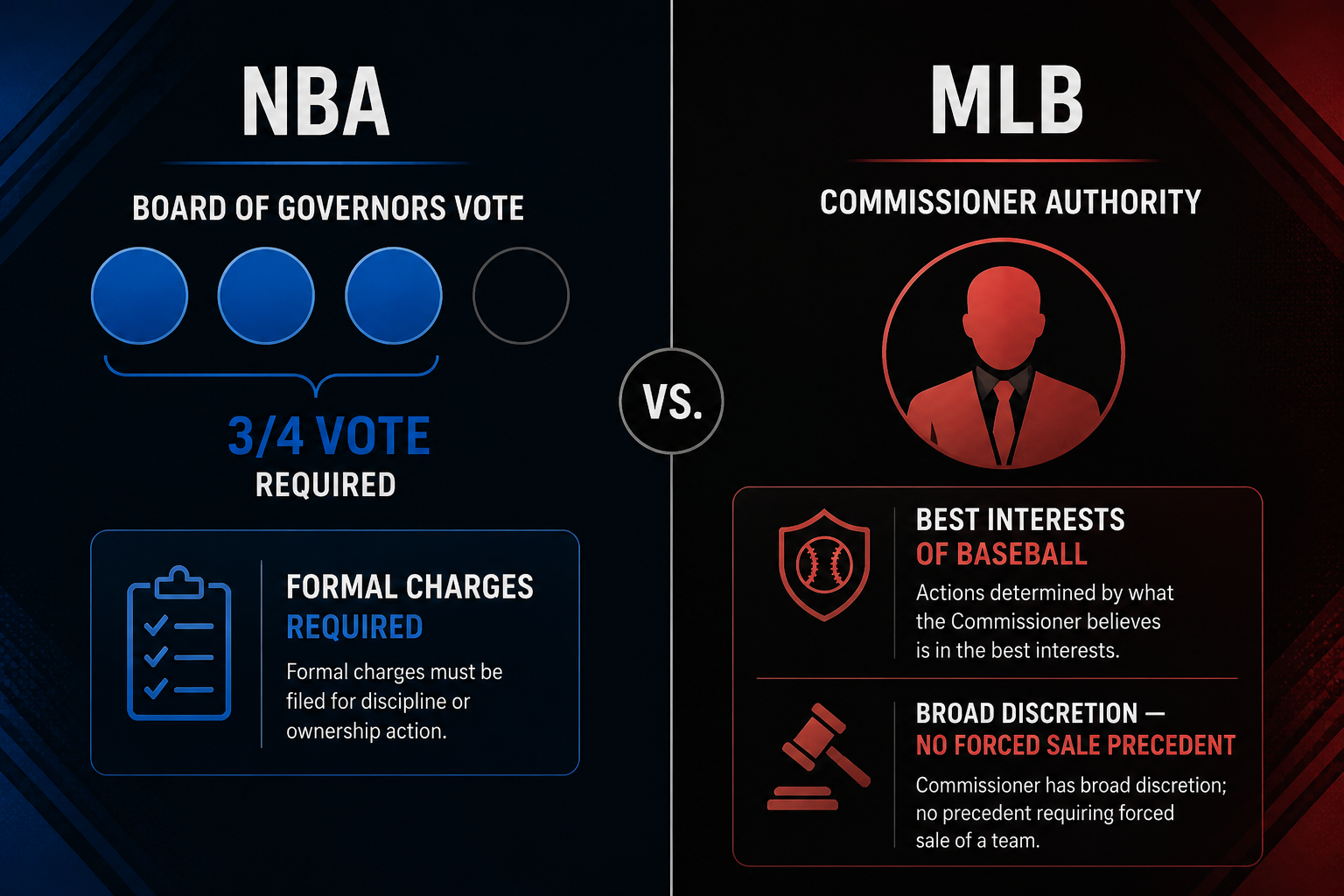
Secondary summaries of the NBA Constitution describe an ownership termination mechanism requiring a three-fourths vote of the Board of Governors. Those summaries should be handled carefully because the complete primary constitutional text is not always publicly available in a form that permits clean citation and clause-by-clause analysis. Still, the reported threshold is important: termination is not a commissioner press release, and it is not an automatic consequence of adverse news. It is a supermajority governance act. [5]
| Stage | What exists as of Q3 2026 | Governance consequence |
|---|---|---|
| Investigation | Federal scrutiny has been reported; no charges have been filed | Creates monitoring, disclosure, and reputational concerns, but not an automatic removal trigger |
| Formal charges or regulator action | Not present in the reporting cited here | Would give the league a more concrete record to evaluate under conduct and ownership standards |
| League finding or Board action | Not reported | Would require the NBA to identify a constitutional basis and obtain the necessary governance support |
A three-fourths termination threshold, if accurately summarized, does not mean the NBA is powerless. It means the league’s strongest remedy is designed to be difficult. That difficulty is not a drafting accident. Forced divestiture is the corporate death penalty for a franchise owner. A league that uses it before prosecutors have charged anyone would need to show more than discomfort, sponsor anxiety, or the ordinary reputational drag of an investigation.
The more plausible NBA response at this stage is procedural: request updates, review transaction representations, monitor whether the investigation touches financing, control, or integrity issues, and preserve the Board’s options if the facts change. Those steps are less dramatic than forced sale speculation, but they are more consistent with how private league governance usually works when the public record is incomplete. They also avoid creating a precedent in which an uncharged investigation alone becomes enough to unwind a previously approved ownership transaction.
The Lakers’ structure gives the NBA another reason not to overreach. If the league’s concern is immediate franchise governance, Buss’s continued role as governor provides continuity. If the concern is owner fitness, the absence of charges or a league finding leaves the Board with an evidentiary gap. Those are separate concerns, and the Lakers sale agreement appears to separate them in a way that matters.
MLB has broader language, but the Dodgers question is still evidentiary
The Dodgers sit in a different league architecture. MLB’s commissioner traditionally has broad authority under the “best interests of baseball” concept, and that authority is intentionally flexible. It lets the commissioner respond to integrity threats, discipline problems, and conduct that may not fit neatly into a narrow rule. But broad discretion is not the same thing as a clean precedent for compelling divestiture based only on an uncharged federal investigation.
For the Dodgers, the governance question is therefore not whether MLB has strong language in the abstract. It is what record would make the use of that language defensible. A commissioner acting against an owner before charges would need to connect the investigation to baseball interests in a way that can survive internal politics and, potentially, owner resistance. The record would matter: admissions, regulator findings, obstruction allegations, financing misrepresentations, integrity-related facts, or conduct that directly affects club operations would be much more significant than the mere existence of subpoenas.
That matters because Walter’s Dodgers position predates the Lakers transaction and does not appear to include the same public governorship buffer that the Lakers sale reporting identified. The Dodgers analysis therefore turns less on structural insulation and more on MLB’s tolerance for uncertainty. The commissioner may have room to investigate, demand information, or pressure an owner informally. Turning that pressure into a forced sale without charges would be a different act.
Why past owner controversies do not supply the missing precedent
Owner misconduct examples are tempting here, but most do not travel well. League action after a formal charge, a public recording, an internal finding, or admitted conduct does not establish that a league can force divestiture when prosecutors are still investigating and the owner has not been charged. The legal relevance is not that leagues have punished owners before. Of course they have. The relevance is whether the predicate was comparable.
The same caution applies to older Walter-adjacent litigation. The 2018 Ogles class-action lawsuit alleged that Guggenheim used policyholder funds connected to the $2.15 billion Dodgers purchase, but the suit was dismissed. [2] A dismissed civil case can provide background for why insurance-related allegations attract attention. It is much weaker as evidence that either the NBA or MLB has a present basis to remove an owner. Treating the dismissal as a footnote while using the allegation as a major pillar would get the weight backwards.
Credit-market signals should be treated with similar restraint. S&P Global Ratings published an outlook revision concerning Delaware Life Insurance Co., but without using the ratings item as a substitute for the full investigative record, it should be read only as a financial-market data point, not as a league-law conclusion. [6] A ratings outlook can matter to financing and risk perception. It does not tell the NBA Board of Governors or the MLB commissioner that a forced divestiture threshold has been met.
The practical consequences before charges
Before charges, the main consequences are likely to be quieter than the public narrative expects. League counsel will want updates. Team counsel will revisit disclosure obligations. Transaction lawyers will review what was represented during the Lakers approval process and whether any ongoing duty is implicated. Minority investors and legacy operators will care about who has authority to bind the franchise in league matters. Sponsors and lenders may ask their own questions, but those questions do not automatically become league remedies.
The Lakers have the cleaner containment structure because Buss remains governor. The Dodgers have a more conventional ownership-exposure problem because MLB’s assessment will depend on commissioner discretion and the development of facts. In neither case does the current public record support the easy jump from “federal investigation” to “forced sale.” A forced sale requires a legal mechanism, a factual predicate, and enough institutional support to make the action stick.
The sharpest change would come if the investigation produces charges, a regulatory finding, or facts that a league can classify as conduct detrimental to the league, club, or sport. That would not guarantee divestiture, but it would move the analysis from reputational management to formal discipline. The present posture is different. As of Q3 2026, the reported investigation is real, the charges are not, and the leagues’ strongest ownership remedies remain procedurally guarded.
The property with the least insulation may not be the Dodgers or Lakers
The PWHL is the uncomfortable outlier. Walter is not merely another wealthy owner in a league full of similarly capitalized franchise operators. Reporting on the probe has noted his central role as the league’s primary financier, and the league’s championship trophy bears his name. [1][3] That creates a different kind of vulnerability from the Dodgers or Lakers problem.
The NBA and MLB have mature ownership-control systems, powerful internal actors, and established procedures for managing owner controversy. They may be cautious, self-protective, and politically complicated, but they have buffers. The PWHL’s exposure is more concentrated. If Walter’s reputation or financial posture deteriorates, the issue would not necessarily be forced removal doctrine. It would be dependence: who funds the league, whose name sits on its most visible symbol, and how quickly a young league can separate its institutional identity from a single benefactor if it ever needs to.
That is where the current facts leave the governance analysis. Neither the NBA nor MLB has a clear path or precedent to force Walter to divest solely because of an uncharged federal investigation, and the Lakers are additionally insulated by Buss’s retained governorship. The ownership protections are holding for now. Not every sports property around Walter has the same buffer.
References
- What Mark Walter's federal probe means for the Dodgers and Lakers — USA Today, July 20, 2026
- Mark Walter's Insurers, Guggenheim Probed by Prosecutors (2) — Bloomberg Law, July 20, 2026
- Report: Mark Walter's insurance companies, Guggenheim face federal probe — Sports Business Journal, July 20, 2026
- NBA approves Los Angeles Lakers majority stake sale to Mark Walter — The Athletic / New York Times, Oct. 30, 2025
- What the Mark Walter investigation means for the Lakers — Lakers Daily
- Delaware Life Insurance Co. Outlook Revised To Negative — S&P Global Ratings
Comments
Join the discussion with an anonymous comment.