
The Mark Walter insurance probe turns on one stubborn control fact: Delaware Life Insurance Co. first reported that 3% of its invested assets, about $1.4 billion, were linked to Walter affiliates. After grand jury subpoenas forced a reexamination, the company restated that exposure to at least 39%, or about $17 billion, in regulatory filings dated June 26, 2026.[1]
That is not a rounding issue. It is a disclosure number moving by roughly 13 times. Just as important, the number did not change because ordinary statutory reporting, a routine examination, or an internal year-end control caught the problem in the normal course. Bloomberg Law reported that grand jury subpoenas from the US Attorney’s Office for the Southern District of New York were issued in February 2025 to Delaware Life and Clear Spring Life and Annuity Co., with a second subpoena to Delaware Life in June 2026 seeking information about the same set of transactions.[1]
No charges have been filed, and an investigation is not a finding of wrongdoing. That distinction matters. It matters just as much as the distinction between a bad investment and a bad disclosure process. The available record supports the narrower conclusion: Delaware Life had a material related-party identification failure, and the failure sat inside regular reporting until outside legal compulsion forced the company to rebuild the answer.

The 3% number and the 39% number were answering the same question
The practical question was not exotic: which investments were linked to affiliates? For an insurer, that question is not a footnote nicety. Related-party exposure can affect statutory reporting, concentration analysis, examination priorities, rating-agency review, and the way regulators evaluate whether assets are being managed at arm’s length.
Delaware Life’s original answer was 3%. Its revised answer was at least 39%.[1] The gap is what makes this case useful beyond the names involved. A small restatement might suggest a boundary judgment, a late data feed, or a classification call that came out differently on review. A move from $1.4 billion to $17 billion suggests that the control designed to identify affiliate-linked assets was not seeing a large portion of the relevant universe.
Group 1001, Delaware Life’s parent, has said capital and liquidity remain strong, that the issue came from an “inadvertent error” in characterizing certain investments, and that the $17 billion figure is an upper bound rather than a conclusion that every dollar in that pool was improper.[1] Those points should not be brushed aside. An upper-bound remediation number is not the same thing as a proven improper transaction total. But it also does not make the control failure disappear. If the process can only identify the outer boundary after subpoenas, the process was not fit for the reporting burden it carried.
Where the affiliate check appears to have broken down
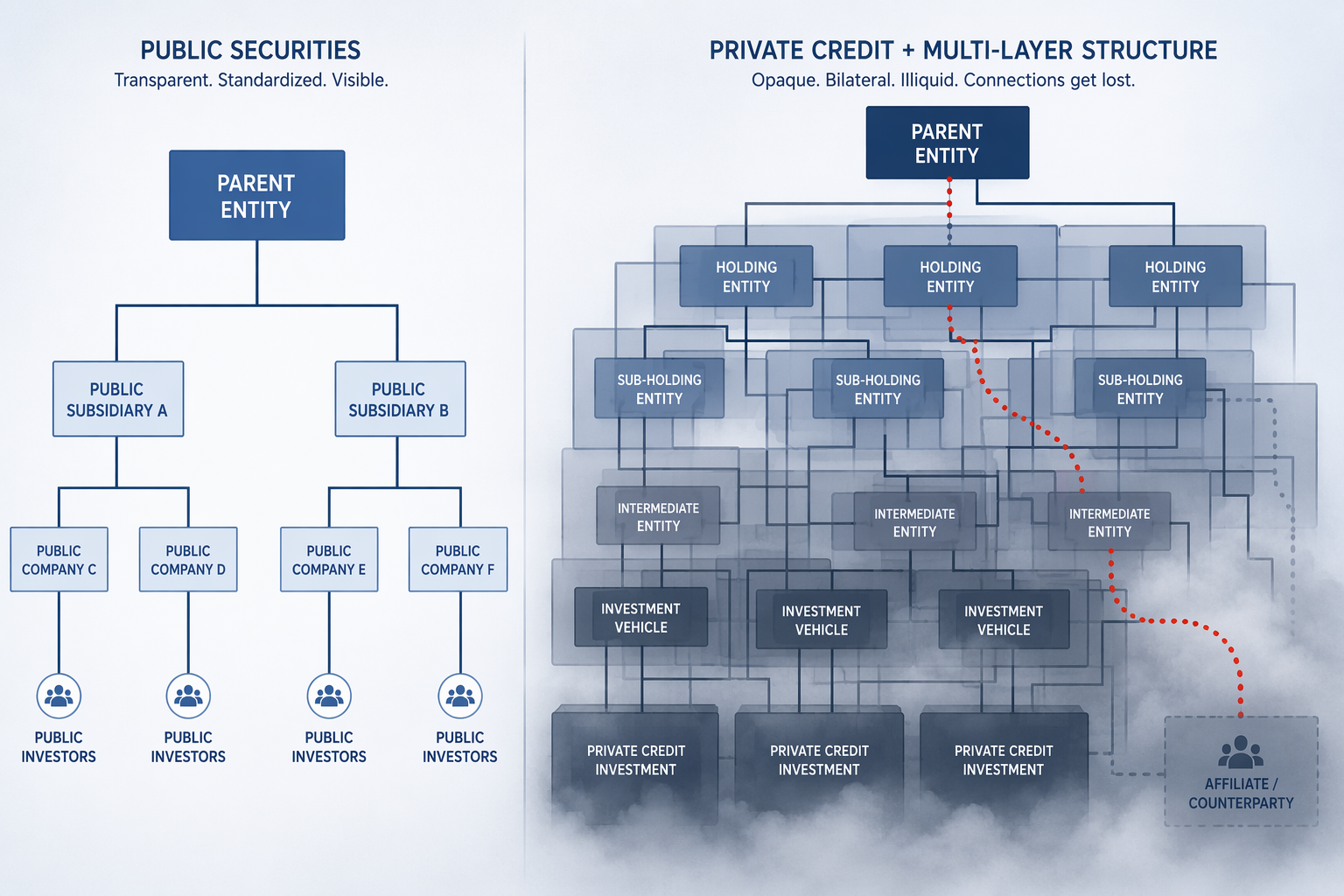
The reported holding structure matters only because it explains how the identification problem could become so large. Bloomberg Law reported that Walter controls Guggenheim Partners, which controls Group 1001, which owns Delaware Life Insurance Co. and Clear Spring Life and Annuity Co.[1] In that kind of structure, the affiliate question is not answered by looking for one familiar name on a trade blotter. It requires a maintained map of control relationships, investment vehicles, managers, issuers, borrowers, co-investment entities, and other links that may sit several layers away from the insurer’s own legal entity.
Public securities often make part of that work easier. They tend to come with standardized identifiers, more visible issuers, repeatable data sources, and market infrastructure that forces a certain amount of naming discipline. Private credit does not give the statutory reporting team those benefits for free. A bilaterally negotiated loan or private placement may move through special-purpose entities, bespoke documentation, nonpublic borrower information, side arrangements, and asset-management relationships that do not surface cleanly in a public-security master file.
That does not make private credit inherently improper. It does make weak affiliate controls more dangerous. If the investment team classifies the economics, the legal team tracks the holding-company chart, finance owns the statutory statement, and nobody owns the reconciliation between those records, the affiliate field becomes a place where assumptions accumulate.
| Control point | What it must do in a private credit portfolio | What the Delaware Life gap suggests can go wrong |
|---|---|---|
| Affiliate master | Track control, ownership, management, and other related-party links across the holding company structure | The map may not capture remote or indirect relationships that matter for statutory disclosure |
| Investment onboarding | Ask whether the issuer, borrower, manager, sponsor, counterparty, or vehicle has an affiliate connection before the asset enters the book | The affiliate question may be treated as a legal-entity name match instead of a transaction-level inquiry |
| Private credit documentation review | Extract relationship information from bespoke agreements, side letters, and vehicle documents | Material relationship facts may stay in deal files and never reach statutory reporting data fields |
| Year-end reporting reconciliation | Compare the investment inventory against the current affiliate map and investigate exceptions | Routine reporting may reproduce earlier classifications rather than challenge them |
| Regulatory response process | Rebuild exposure defensibly when regulators or prosecutors ask for a complete answer | The company may discover that the ordinary process never created a reliable audit trail |
SSAP No. 25 and Model #440 are visibility rules, not paperwork rules
The relevant insurance-accounting framework is not built around the word “governance” in the abstract. NAIC Statement of Statutory Accounting Principles No. 25 governs related-party transactions for insurers and requires specialized disclosure of such relationships. NAIC Model #440, the Framework for Insurance Holding Company Regulation, sets standards for related-party transactions in insurance holding company systems.[1]
The point of those rules is visibility. Regulators need to see when an insurer’s assets, liabilities, fees, services, guarantees, loans, reinsurance arrangements, or investment transactions may be connected to the same controlling system. The concern is not limited to whether a transaction has already harmed policyholders. The first question is whether regulators can identify the relationship at all.
That is why the 13x movement matters even if the restated $17 billion remains an upper bound. A disclosure system that cannot reliably distinguish third-party exposure from potentially affiliate-linked exposure deprives regulators of the chance to ask the next questions in time: Who approved the transaction? Was pricing arm’s length? Were concentration limits affected? Did the insurer receive fair value? Did the holding company structure change the risk profile?
A company can have strong capital and still have weak relationship data. It can have an investment that performs and still have a reporting control that fails. In insurance regulation, those are separate files. They may meet later, but one does not cure the other.
The subpoena chronology is part of the control finding
The subpoenas do not prove financial impropriety. They do show that the ordinary process did not surface the reported gap. Bloomberg Law’s chronology places the first grand jury subpoenas in February 2025 and the regulatory restatement in June 2026 filings, with another Delaware Life subpoena in June 2026 seeking information about the same transactions.[1]
That timing is uncomfortable for any compliance program that relies too heavily on completed audits, filed statements, or prior examinations as comfort. A filed number is not the same as a tested number. A prior period without objection is not proof that the population was complete. Examiners and auditors can test what is presented to them, but they may not independently reconstruct every ownership chain behind every private credit position unless the exam scope, data access, and time allow it.
Once subpoenas arrive, the company is no longer answering the question as a routine filing task. It is preserving documents, coordinating counsel, collecting deal files, reviewing entity relationships, and rebuilding a record under legal pressure. People doing that work may be careful and competent. The harder question is why the company needed that level of compulsion to produce a materially different affiliate-exposure answer.
S&P treated the remediation risk as real
The market response was measured, but not dismissive. S&P Global Ratings affirmed Delaware Life’s A- financial strength rating, categorized as Strong, but revised its outlook from stable to negative on July 1, 2026. Bloomberg Law reported that S&P cited “execution risk” around the remediation plan, which includes reducing concentration in private credit and investments tied to Walter affiliates.[2]
That is a familiar ratings posture when the balance sheet has not collapsed but the control environment now has to prove itself. The negative outlook does not say the company is insolvent. It says the cleanup has operational risk: identifying the affected population, reducing concentrations, changing processes, and doing so without creating new asset-liability, liquidity, or earnings problems.
There is also a parallel SEC investigation into Guggenheim Partners’ asset-management unit, Guggenheim Partners Investment Management. Bloomberg Law reported that this follows a prior SEC probe into Guggenheim that ended without enforcement action in 2019.[1] For readers tracking that history, our earlier discussion of Guggenheim Partners’ SEC disclosure matters is useful context. Still, the SEC thread should not swallow the insurance issue. The Delaware Life disclosure gap stands on its own as a statutory reporting and related-party control problem.
Private credit made the failure harder to catch, not impossible to define
It is tempting to turn the case into a general warning about private credit. That is too easy. The better point is narrower: private credit increases the cost of knowing who is really on the other side of an exposure and how that exposure connects back to the holding company system.
Regulators were already paying attention to that asset class. NAIC’s Credit Rating Provider Discretion Authority became effective January 1, 2026, allowing the Securities Valuation Office to challenge credit rating provider ratings that differ from NAIC designations by three or more notches.[3] Treasury Secretary Scott Bessent convened insurance regulators in April 2026 to discuss private credit risks.[4] A December 2024 Fitch analysis found that 97% of private credit securities received higher ratings from credit rating providers than from NAIC’s Securities Valuation Office.[5]
Those facts concern ratings, valuation oversight, and regulatory confidence in private credit classifications. They do not prove Delaware Life’s affiliate disclosure failure. They do explain why a large private-credit-heavy restatement attracts attention. When the same asset class is harder to value, harder to compare, less liquid, and less transparent on counterparty identity, the related-party control has to be stronger than the one used for a plain public bond portfolio.
What insurers should change before the subpoena version of the review
The useful lesson is not “avoid complexity.” Insurance groups are complex. Asset managers use vehicles. Holding companies acquire, reorganize, and delegate. The lesson is that the affiliate-identification process has to be designed for that reality instead of assuming that names and public identifiers will do most of the work.
- Maintain an affiliate map that is owned, dated, and reconciled. It should include controlling persons, parent entities, subsidiaries, asset managers, sponsored vehicles, material counterparties, and other relationship categories that matter under insurance holding company rules.
- Make related-party identification part of investment onboarding. The question should be answered before the asset is booked, not reconstructed at annual statement time.
- Require private credit deal files to feed structured compliance data. If the affiliate fact lives only in a PDF, a side letter, or a lawyer’s memory, it is not a reporting control.
- Reconcile the investment ledger against the affiliate map on a recurring schedule. The review should look for indirect links, management relationships, and sponsor connections, not just identical legal names.
- Document negative determinations. If a position is treated as non-affiliate exposure after review, the file should show who decided that, what information was checked, and when the conclusion should be revisited.
- Test the process with subpoena-grade questions. Compliance teams should occasionally ask whether they could reproduce the complete affiliate exposure population quickly, with supporting documents, if an outside authority demanded it.
This is also where legal operations and compliance governance matter. A control cannot depend on one lawyer who understands the group chart or one investment professional who remembers how a vehicle was sourced. The process needs assigned ownership, data lineage, escalation rules, and periodic challenge. That principle applies well beyond this case; it is the same reason broader compliance frameworks, including those discussed in our piece on professional responsibility and AI contract review, keep returning to evidence, ownership, and reviewability rather than policy language alone.
The legal conclusion should stay narrow, and the control conclusion should not
The public materials do not support a conclusion that the $17 billion upper-bound figure equals improper transactions. They do not show charges. They do not turn an investigation into a judgment. They do support a serious control conclusion: Delaware Life’s routine reporting process failed to identify a much larger population of potentially affiliate-linked investments than the company had disclosed.
The mechanism is visible enough. A multi-layer holding structure made the affiliate map harder. Private credit made transaction-level identity and relationship data less transparent. The statutory reporting process did not force those two bodies of information to meet with enough discipline. The number changed only after subpoenas broke the routine.
For insurers with private credit exposure, that is the durable warning. The absence of a problem in ordinary oversight is not proof that the problem is absent. Sometimes it only means the ordinary process was never looking at the full map.
References
- Bloomberg Law report on Delaware Life regulatory filings and Mark Walter probe — Bloomberg Law
- S&P Global Ratings note on Delaware Life rating outlook — S&P Global Ratings — July 1, 2026
- NAIC Credit Rating Provider Discretion Authority issue brief — National Association of Insurance Commissioners
- Capstone DC analysis on private credit insurance regulatory scrutiny — Capstone DC
- Fitch analysis on private credit securities ratings and NAIC SVO designations — Fitch Ratings — December 2024
Comments
Join the discussion with an anonymous comment.