
The first Markey-Moulton Senate debate became legally interesting only after it stopped sounding like a debate. On July 8, Sen. Ed Markey pressed Rep. Seth Moulton over investments tied to defense-sector companies, framing them as a transparency problem for a House member who sits on the Armed Services Committee. Moulton answered in familiar ethics-law terrain: he had followed the rules, consulted counsel, and moved toward a blind trust. That exchange is the useful entry point for the broader question: not whether every uncomfortable financial interest is already unlawful, but whether the existing law is built to see this kind of interest at all.[1]
The record now available supports a narrower conclusion than either campaign rhetoric or instant scandal language tends to allow. Moulton’s reported holdings raise a serious conflict-of-interest concern because they sit near the jurisdiction of his committee. They do not, on the present record, produce a clean STOCK Act violation or an obvious House-rule violation. That distinction is not a courtesy to Moulton. It is the whole problem.

What the debate put on the table
Markey’s cleanest contrast is easy to understand. He has said he holds only mutual funds, and he released his 2025 federal tax return on June 15, 2026. Moulton, by contrast, filed an IRS extension for his 2025 tax return and obtained the maximum 90-day extension for his 2025 House financial disclosure, moving the deadline to Aug. 13, 2026 — roughly three weeks before the Sept. 1 Massachusetts Democratic primary.[2] In a primary where voters are being asked to judge trust, not merely ideology, that timing matters.
It matters, however, for a different reason than the word “violation” suggests. The public-facing integrity issue is not that a late disclosure extension proves misconduct. House members may seek extensions. Nor does a tax-return release automatically make one candidate pure and another suspect. The sharper point is that one candidate’s posture is simple enough for voters to inspect early: mutual funds, early tax release, fewer bespoke explanations. The other requires voters to parse private-company valuations, defense contracting, committee jurisdiction, disclosure timing, and a promised remedy that arrives after press scrutiny.
That is why the debate moment should not be treated as ordinary campaign heat. It forced into public view a mismatch between the ethics architecture Congress advertises and the financial arrangements that modern members can actually hold.
The holdings are private, defense-linked, and politically hard to explain
WBUR’s June 18 reporting, based on congressional filings it reviewed, identified Moulton stakes in Oura, webAI, and Divergent Technologies. The reported values are not trivial. His Oura stake rose from a disclosed range of $100,000 to $250,000 in 2021 to a range of $1 million to $5 million in 2024, a rise WBUR connected to an $11 billion company valuation and Department of Defense enterprise contracts. His webAI stake rose from a disclosed range of $30,000 to $100,000 to a range of $500,000 to $1 million. WBUR also reported a holding in Divergent Technologies, a company associated with Tomahawk missile production and Air Force contracts.[2]
Those ranges are doing a lot of work. Congressional financial disclosures often report assets by broad bands rather than exact dollar amounts, so the public can see magnitude without seeing precise valuation. That may be adequate for many ordinary holdings. It becomes less satisfying when the asset is a private stake in a defense-linked company and the member sits on the House Armed Services Committee, where defense policy, authorizations, and oversight are not abstract subjects.
| Reported holding | Reported change or context | Why it matters for the ethics question |
|---|---|---|
| Oura | Reported range rose from $100,000-$250,000 in 2021 to $1 million-$5 million in 2024 | Private-company appreciation tied in reporting to valuation growth and DoD enterprise contracts |
| webAI | Reported range rose from $30,000-$100,000 to $500,000-$1 million | A private technology stake whose value is not captured by public-securities trading rules |
| Divergent Technologies | Reported as a holding connected to Tomahawk missile production and Air Force contracts | A defense-linked private interest near the policy area of the Armed Services Committee |
| 2025 disclosures | Tax extension and financial-disclosure extension to Aug. 13, 2026 | Public review arrives close to the Sept. 1 primary |
The point is not that committee membership turns every adjacent asset into a prohibited holding. Congressional service would become impossible if every policy-adjacent mutual fund or retirement asset were treated as a personal disqualification. The harder case is a private investment whose value may be affected by government demand, procurement priorities, or defense-sector credibility, while the public is asked to rely on after-the-fact disclosures and the member’s assurance that no improper action occurred.
Moulton’s blind-trust response also belongs in the sequence, not outside it. The Boston Globe reported that Moulton would move defense-sector-linked investments into a blind trust after WBUR’s reporting, and that he had consulted the House Ethics Committee and outside counsel about the mechanics.[3] Consultation is relevant; so is the fact that the remedy followed public scrutiny. A voluntary blind trust can reduce future control, but it does not erase the political question created by assets the official already knows he transferred.
That limitation is not a technical quibble. A blind trust is strongest when it prevents an official from knowing what he owns. When a trust receives known assets, especially assets that have already become campaign issues, the public cannot pretend the knowledge has been laundered away. The remedy may improve governance going forward. It does not rewrite the architecture that allowed the issue to arise.
Why the STOCK Act does not neatly reach the conduct
The STOCK Act is often invoked as if it were a general congressional-conflicts statute. It is not. Its core function is to make clear that members of Congress and covered officials are not exempt from insider-trading rules and to require prompt reporting of certain transactions in securities. It was designed around trading in public securities, where market transactions, timing, and nonpublic information can be matched to a legal theory.
Private equity and venture-style holdings do not fit that machinery well. A member can hold a private stake whose value increases because a company grows, raises capital, wins credibility, or obtains government contracts. That value increase may be politically explosive and still not look like a STOCK Act trade. If there is no covered purchase or sale of a public security within the reporting framework, the usual transaction-reporting hook is missing.
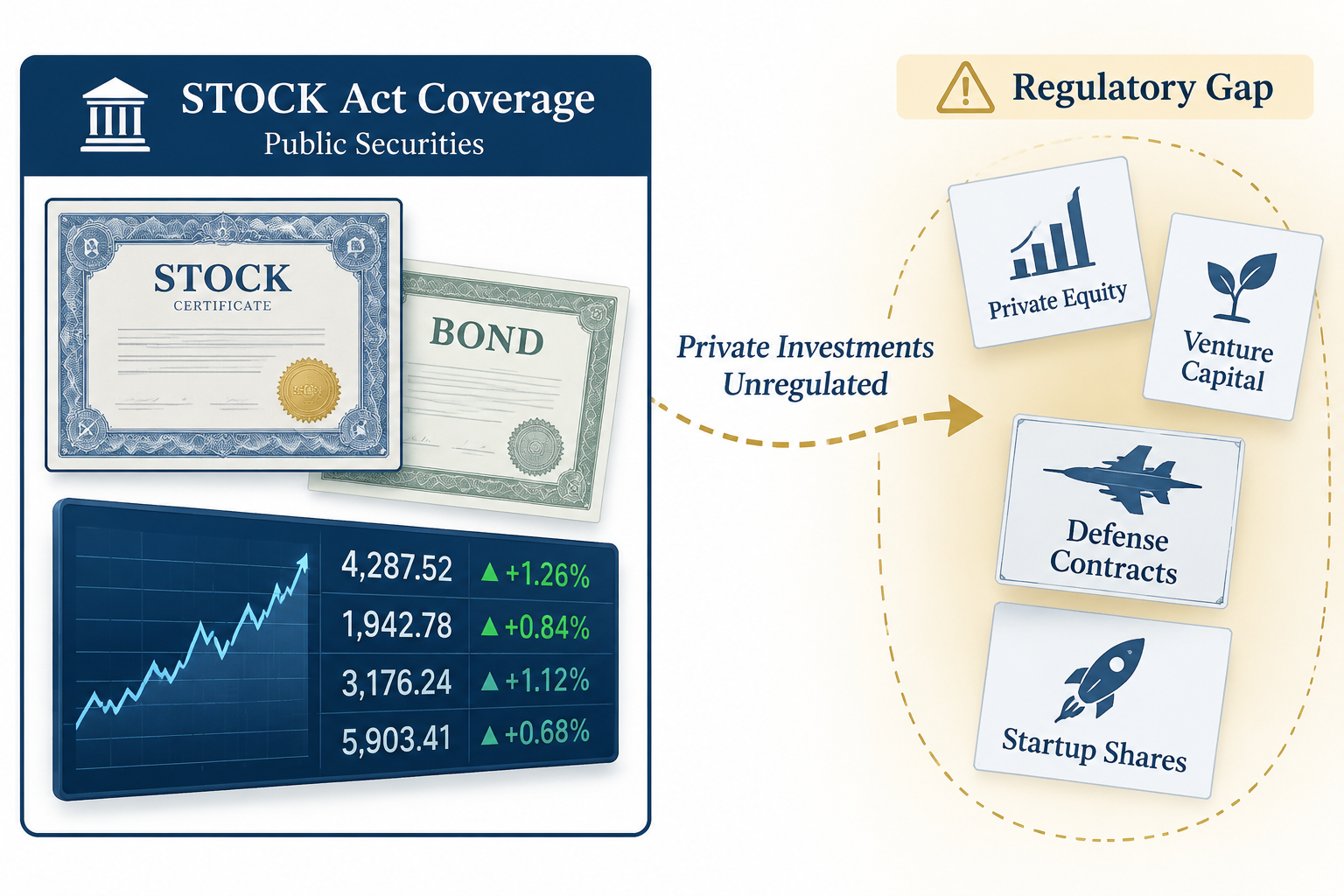
That matters for Moulton because the most important facts in the public record are not allegations of suspicious public-market trades. They are holdings, appreciation, defense-sector proximity, committee jurisdiction, and delayed public disclosure of later-year financial information. Those facts create an ethics problem in the ordinary sense of the word: the public can reasonably worry that official duties and personal financial interests are too close. They do not automatically create the kind of securities transaction the STOCK Act is best equipped to police.
House ethics rules are also not a perfect substitute. They require disclosure, impose gift and outside-income limits, and contain conflict principles that can require caution, consultation, recusal, or other remedial steps in particular circumstances. But on the facts currently available, the public record does not establish that Moulton took a specific official act to benefit a particular holding, used confidential information for a transaction, or failed to disclose an asset that the rules required him to disclose. The discomfort is real; the violation theory is not yet clean.
This is the gap voters are being asked to evaluate. Federal ethics law can require disclosure without forbidding ownership. It can condemn insider trading without reaching every private investment that benefits from a member’s policy environment. It can permit a voluntary trust while leaving unresolved whether the public should accept that trust as sufficient.
Disclosure timing is part of the legal politics
The Massachusetts primary calendar gives the disclosure issue its force. Moulton’s maximum 90-day extension moves his 2025 House financial disclosure to Aug. 13, 2026, leaving roughly three weeks before the Sept. 1 primary for voters, reporters, and opponents to review it.[2] That is lawful if properly obtained. It is also a poor answer to voters who are deciding whether the blind-trust promise is enough.
Markey’s June 15 release of his 2025 federal tax return gives him a practical advantage here because it shifts the burden of explanation. He does not have to argue that complex private investments are technically permissible. He can say he does not have them. That is politically cleaner and ethically less fragile. It also does not make every Markey campaign claim self-proving.
The Markey campaign has issued its own debate-related fact-check attacking Moulton’s voting record, including claims about defense spending and other policy positions. That material may be useful as a statement of the campaign’s theory of contrast, but it is campaign material, not independent adjudication.[4] For the legal question, the sturdier evidence is the disclosures reported by local outlets, the timing of releases and extensions, and the statutory fit of the rules being invoked.
The proposed fixes still have a scope problem
Congress has not ignored congressional trading. The current menu includes the Ban Congressional Stock Trading Act, introduced as S.1879 in the 119th Congress; the ETHICS Act; the Stop Insider Trading Act; and related proposals aimed at limiting or banning covered officials from trading or holding certain assets while in office.[5] Moulton has also cosponsored H.R. 4890.
The important question is not whether those bills sound tough on congressional stock trading. It is whether they reach the structure exposed here. A bill that bans individual stock trading, requires divestment of publicly traded securities, or expands transaction reporting may still leave difficult questions about private funds, venture stakes, private-company equity, carried interests, or preexisting interests whose value is hard to observe in real time.
That does not make the bills meaningless. A serious public-stock ban would address a large and visible category of conflicts. It would also reduce the recurring problem of members trading around market-moving legislative information. But the Moulton controversy shows why “stock trading ban” is too narrow a phrase if the policy goal is broader congressional conflict control. The most awkward asset in a member’s portfolio may not trade on an exchange.
A rule that actually reaches this fact pattern would need to decide harder issues: whether covered officials may hold private interests in companies substantially affected by committees on which they serve; whether qualified blind trusts must be established before service on a relevant committee or before candidacy for higher office; whether private-company holdings require more granular valuation or contract-related disclosure; and when recusal is meaningful in a Congress where members vote on broad authorizations rather than single procurement awards.
What voters are actually being asked to choose
The debate’s legal significance is therefore not that it revealed a proven statutory violation. It revealed the distance between statutory compliance and ethical adequacy. Moulton’s position is legally stronger than the politics around it may make it sound: the available record points to private defense-sector holdings and a later voluntary blind-trust commitment, not to a clearly prohibited STOCK Act transaction. But that legal strength has limits. Compliance with a law aimed principally at public securities trading does not answer whether a House Armed Services Committee member should hold private stakes in companies whose fortunes may be affected by the defense ecosystem.
Markey’s position is easier to defend because it avoids much of the private-investment problem before the legal analysis begins. Mutual funds are not conflict-free in some metaphysical sense, but diversified funds are treated differently for good reason: they reduce the connection between a member’s official work and the financial outcome of a particular company. Early tax-return disclosure also gives voters more time to inspect the candidate’s posture before the primary. Those are transparency advantages, not proof of superior virtue.
For lawyers and compliance officers, the useful lesson is a familiar one: do not confuse a disclosure regime with a conflicts regime. Disclosure tells the public what a member reports owning. It does not necessarily prohibit the ownership, require divestment, or cure the appearance problem. A blind trust can be a serious governance tool, but when it is voluntary, post-scrutiny, and populated with assets the beneficiary already knows, it is not the same as a rule that prevented the conflict architecture from forming.
The Massachusetts Democratic primary now presents two different ethics offerings. One is statutory compliance plus a promised voluntary remedy for private investments that existing congressional trading law does not neatly regulate. The other is a stricter transparency posture that avoids the private-equity problem and makes the candidate’s financial story simpler to review. Voters need not declare Moulton guilty by implication, or Markey vindicated by contrast, to recognize which choice asks them to tolerate more uncertainty.
References
- Markey, Moulton trade barbs, try to claim the mantle of change during first debate — WBUR
- Rep. Moulton holds stakes in defense-linked startups overseen by his committee — WBUR
- Moulton to move defense sector-linked investments into blind trust — The Boston Globe
- Seth Moulton Misleads on Voting Record During First Senate Primary Debate — Ed Markey campaign
- S.1879 - Ban Congressional Stock Trading Act — Congress.gov
Comments
Join the discussion with an anonymous comment.