
Massachusetts is now occupying two rooms in the same ticketing dispute. In federal court, Attorney General Andrea Joy Campbell is among the state enforcers still pressing Live Nation/Ticketmaster after an April 15, 2026 jury verdict found the company liable for monopolizing primary ticketing at major concert venues; in Boston, the state is considering a resale price cap that would fall on StubHub, Vivid Seats, SeatGeek, and other secondary channels, while leaving primary-market Ticketmaster pricing outside the cap. That is the competition problem embedded in the proposed Great Divide Act, and it is why a Massachusetts concert ticket resale price cap legal analysis cannot stop at whether voters dislike scalpers.[1]
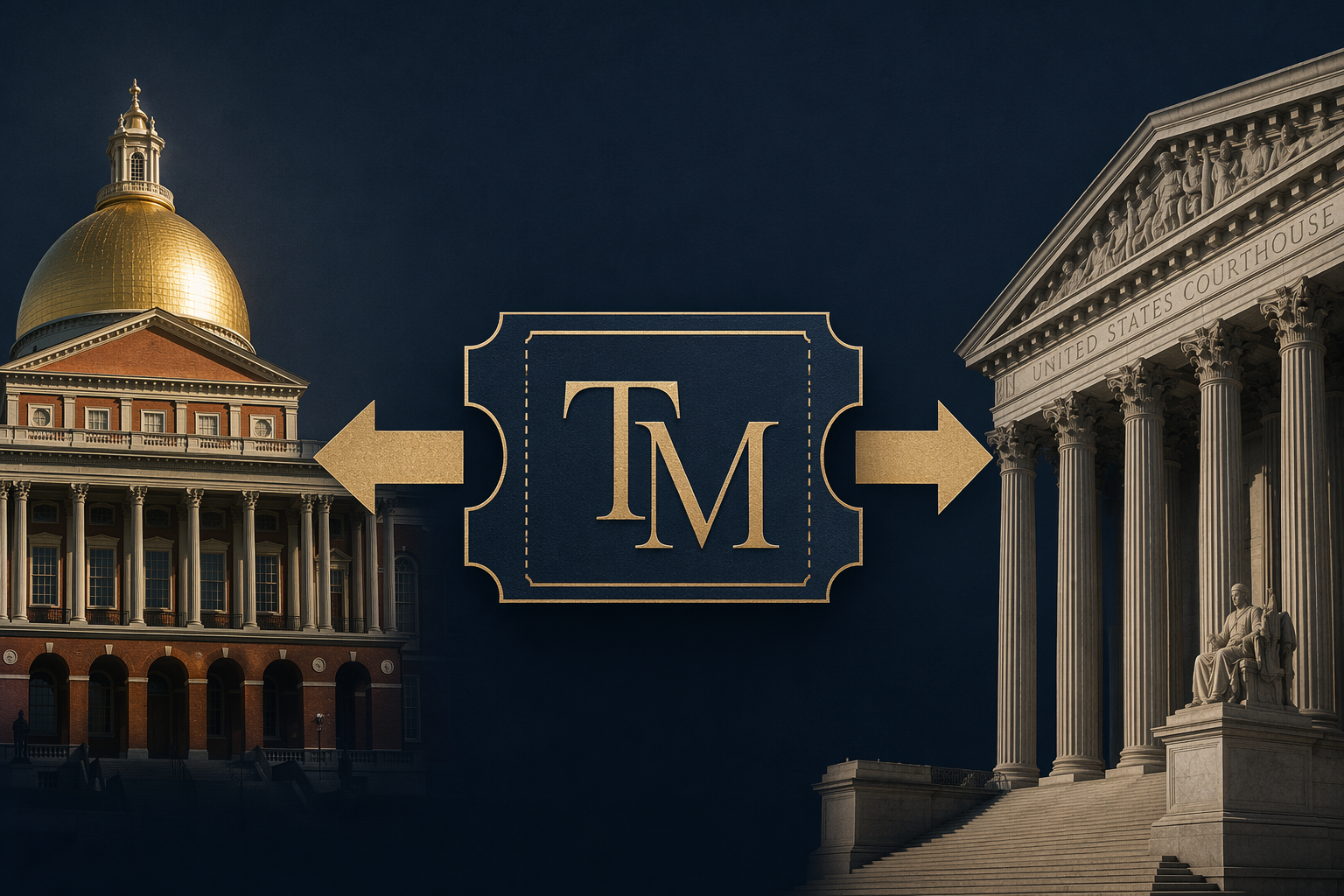
The federal posture matters because Massachusetts is not merely making a consumer-protection comment from the sidelines. After the Department of Justice reached a consolidated settlement with Live Nation involving a $280 million victim fund and a 15% primary-market fee cap, 33 states plus the District of Columbia rejected that settlement and continued litigating toward broader remedies, including possible structural relief involving Ticketmaster. Post-trial Rule 50 and Rule 59 motion briefing was extended through July 9, 2026, with a hearing pending at the court's convenience.[1]
That sequence gives the Massachusetts proposal its legal oddity. A state that says Ticketmaster's market structure requires structural correction is also entertaining a rule that would regulate only the resale layer, not the primary channel where the federal case found monopolization. The point is not that secondary platforms deserve immunity from regulation. The point is that remedy design should have a limiting principle, especially when the burden lands on the firms that create the nearest available transaction alternatives to a dominant primary-ticketing system.
The Verdict Makes This More Than A Local Pricing Bill
The April verdict is the fact that should slow the analysis down. The jury found Live Nation/Ticketmaster liable for monopolizing primary ticketing at major concert venues, with damages calculated at $1.72 per ticket in 21 states and, after trebling, roughly $450 million in exposure.[1] Whatever happens on post-trial motions or remedy, Massachusetts is already aligned with the theory that Ticketmaster's primary-market power is not just a political nuisance but an antitrust problem.
That posture does not automatically answer every state ticketing question. A state can pursue antitrust relief against a platform and still regulate adjacent markets. But the closer the state regulation comes to redirecting transactions back toward the alleged monopolist's ecosystem, the more the state owes a competition explanation rather than a consumer-protection label.
Here, the remedy-phase contrast is unusually stark. The rejected DOJ settlement would have capped certain primary-market fees; the continuing state case seeks structural relief. The Great Divide Act, by contrast, would cap resale prices and secondary-market fees while leaving the primary ticket price and primary fees untouched. That is not a small drafting choice. It identifies one channel as the regulatory target and exempts the channel at the center of the monopoly case.
What The Great Divide Act Would Actually Regulate
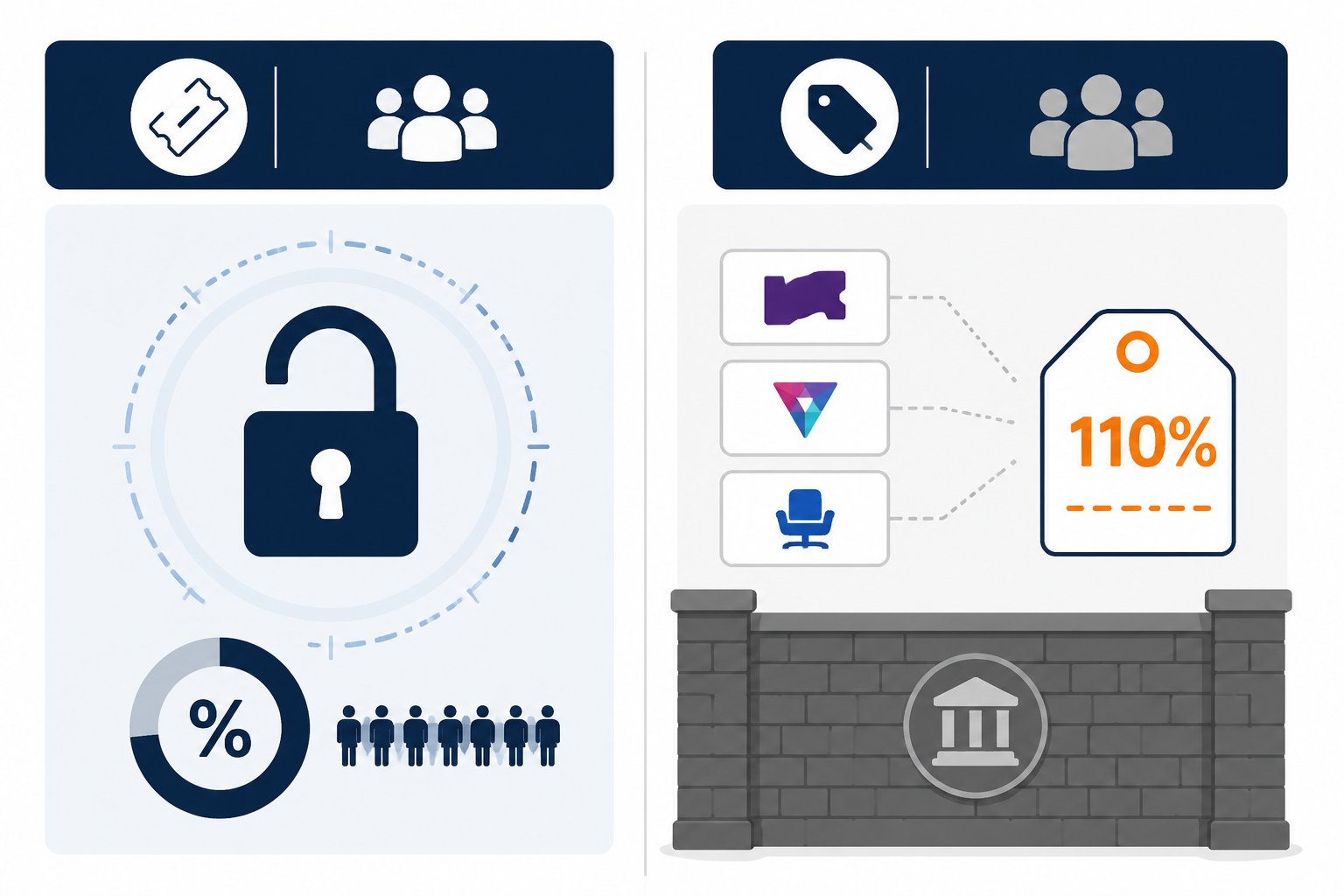
As reported in July 2026, the proposal would cap resale prices at 110% of face value and limit secondary-market fees to 10%. The same reporting describes the measure as applying to secondary-market transactions, not to primary-market prices or fees.[2][3] Ticketmaster's primary-market pricing therefore remains outside the central discipline of the proposal even though Ticketmaster is described in the coverage as controlling roughly 80% to 86% of the relevant primary-ticketing market.[2][3]
| Market Layer | How The Proposal Treats It | Competition Significance |
|---|---|---|
| Primary ticketing | No 110% resale cap; no comparable primary-price cap in the proposal | This is the layer tied to the Live Nation/Ticketmaster monopoly verdict |
| Secondary resale platforms | 110% resale cap and 10% secondary-fee limit | This is the layer where StubHub, Vivid Seats, SeatGeek, and other channels compete for fan transactions |
| Off-platform resale | Not the apparent target of the platform-fee discipline | If regulated platforms become less useful, transactions may move to channels with weaker protections |
The most defensible version of the bill is easy to understand. A fan sees a ticket listed at several multiples of face value and concludes that resale is the abuse. A legislator sees a clean number, 110%, and a fee limit, 10%, and can say the bill attacks the visible markup. That is politically legible.
The competition question is less legible but more important. A face-value-based cap can bind only after the original ticket has been priced and allocated. If the primary seller can set the initial price, add primary fees, manage distribution, and restrict transferability, then a resale cap may discipline only the downstream symptom while leaving upstream market power intact.
The Ticket Policy Forum Objection Is Interested, But Not Irrelevant
The Ticket Policy Forum has put the objection in deliberately sharp terms. Executive Director Brian Berry said the Massachusetts proposal "ignores and exempts the illegal Ticketmaster-Live Nation monopoly" and argued that the cap would weaken independent resale competition.[2] That is advocacy, not adjudication. It comes from a policy organization aligned against resale caps, and it should not be treated as proof that the bill would entrench Ticketmaster.
But the criticism does identify the bill's most important design feature: asymmetry. The proposal does not appear to cap Ticketmaster's primary ticket prices. It does not appear to impose the same 10% fee discipline on the primary channel. It does not appear to use the Live Nation remedy record as the organizing principle for state ticketing reform. It starts downstream.
That does not make the proposal unlawful on its face. State price regulation and antitrust remedies are different instruments. But when the state is simultaneously asking a federal court to restructure the dominant primary-ticketing firm, lawmakers should be able to explain why the immediate state-level burden falls on the firm's resale competitors rather than on the conduct that anchors the monopolization case.
Consumer Welfare Cuts Both Ways
A resale cap is usually sold as a consumer-savings measure, and sometimes it would save a particular buyer money on a particular high-demand ticket. That is not the same as proving that the rule improves consumer welfare across the market. The welfare question includes availability, fraud risk, transferability, refundability, search costs, and whether fans can buy below face value when demand turns out to be weaker than the original seller expected.
R Street Institute, citing Sports Fans Coalition data submitted in Massachusetts legislative testimony, says Massachusetts fans saved approximately $25.5 million on secondary markets between 2017 and 2024.[4] That figure should not be overread. It does not prove every secondary-market transaction benefits consumers, and it does not erase cases where scarcity pricing harms fans. It does show why the premise "resale equals extraction" is too crude for policy design.
The below-face-value function matters because live events are perishable inventory. A ticket that is expensive at on-sale can become discounted later if schedules change, teams underperform, weather intervenes, or supply exceeds expected demand. A rule built around maximum resale price may be politically aimed at the worst visible markups, but the market it regulates also includes fans trying to recover some value from tickets they can no longer use.
R Street also argues that price caps on regulated marketplaces can push transactions toward unregulated channels such as social media or cash sales, where fraud protections and platform accountability are weaker.[4] That is an economic claim about likely substitution, not a measured Massachusetts outcome. Still, it is a foreseeable channel-shifting risk. If a cap makes compliant platforms less attractive for sellers, the transaction does not necessarily disappear; it may move somewhere less visible to regulators and less safe for buyers.
Transfer Rules Make The Asymmetry More Consequential
Massachusetts ticketing law already has a complicated baseline, including older resale limits and newer transfer-related reforms. Readers who need the statutory background can start with the earlier overview of the state's resale framework, but the competition point here is narrower: price caps do not operate in isolation when event operators can also shape how, when, and whether tickets move between platforms.
In 2024, Massachusetts enacted a ticket-transfer law that allows event operators to limit transfers in certain circumstances. Consumer groups including MassPIRG and the National Consumer Law Center warned that transfer restrictions could lock fans into Ticketmaster-controlled ecosystems and reduce resale-market liquidity.[5] Later reporting described continuing disputes over the rules after they took effect.[6]
That history matters because a secondary-market price cap has different effects in an open-transfer environment than in a restricted-transfer environment. If sellers can freely move tickets among platforms, a cap may chiefly limit price. If transferability is constrained, the same cap can interact with platform control, official resale channels, and inventory rules in ways that strengthen the primary platform's practical leverage.
The evidence does not establish that this is the bill's purpose. It does not establish that Ticketmaster would gain market share because of the cap. It does establish that lawmakers are regulating a resale channel already affected by transfer policy while leaving the primary channel's core pricing decisions outside the proposed cap.
The Maine Problem: A Cap Is Only As Clear As Its Enforcement Theory
Administrability is not a side issue in ticketing. A facially simple cap can become difficult once regulators must decide what counts as face value, which fees are included, how bundled benefits are treated, whether season-ticket allocations create a reliable baseline, and whether the cap applies to marketplaces, brokers, individual sellers, or all of them.
Maine's recent resale controversy is a useful warning, though not a direct Massachusetts precedent. The Maine Attorney General described a 10% limit in consumer-alert terms, while industry advocates contested whether the law should be understood as a marketplace-fee limit or a total resale-price cap.[7] The lesson is modest: if lawmakers want a price ceiling, a fee ceiling, or both, they should say so with enough precision that enforcement does not become the real policymaking forum.
That is especially important where the regulated party is not the alleged monopolist in the parallel antitrust case. Ambiguity may be tolerable when a rule distributes compliance costs evenly. It is harder to defend when the practical effect is to create legal uncertainty for secondary platforms while the dominant primary channel keeps pricing discretion.
The Federal Lobbying Backdrop Does Not Decide The Case, But It Explains The Suspicion
The national politics of ticketing make the Massachusetts timing harder to dismiss. TicketNews has reported that Live Nation and the Fix the Tix coalition have advocated federal resale price caps in FTC comments and congressional testimony while opposing constraints on primary-market pricing.[2] That fact does not prove coordination behind the Massachusetts proposal, and it should not be used as a substitute for statutory analysis.
It does, however, show why the asymmetry is not an academic quibble. A dominant primary-ticketing firm would predictably prefer rules that constrain independent resale channels over rules that constrain primary pricing, venue contracting, or platform fees. When state policy tracks that preference at the same moment the state is litigating against the firm, the burden of explanation rises.
What The Current Record Supports
The record supports a serious policy tension, not a final antitrust conclusion. The Great Divide Act has not been enacted. Its legislative path remains uncertain as of July 19, 2026, and the proposal has been discussed in connection with a closeout supplemental budget vehicle rather than as a fully settled standalone law.[2] The Live Nation remedy phase is also unresolved, with post-trial motions still pending after the July briefing extension.[1]
Nor does the present material prove causation. It does not prove that a 110% resale cap would empirically entrench Ticketmaster. It does not prove that secondary platforms would exit Massachusetts, that fans would abandon regulated marketplaces, or that primary prices would rise. Those are testable predictions, not established facts.
As of July 19, 2026, Massachusetts is advancing two ticketing policies that point in different competitive directions. It is pursuing structural relief against Live Nation/Ticketmaster in federal court while considering a state rule that would constrain Ticketmaster's resale competitors and leave Ticketmaster's primary-market pricing untouched. If the state wants to protect fans through a resale cap, it should explain why the bill burdens secondary channels while sparing the pricing conduct of the firm the state is simultaneously trying to restructure.
References
- After the Verdict: Navigating the Live Nation/Ticketmaster Antitrust Fallout — Crowell & Moring LLP
- Massachusetts Governor Considers Pushing Ticket Resale Price Cap in Budget After Standalone Bill Stalls — TicketNews
- Massachusetts Eyes Ticket Resale Price Cap Under New Law — Digital Music News
- Price Caps on Secondary Ticket Sales Are Just Bad Policy — R Street Institute
- Consumer groups worry Massachusetts' new ticket transfer law will harm event-goers — WBUR, November 21, 2024
- Ticket reselling rules contested months after taking effect — WWLP
- Consumer Alert – Ticket Resales — Maine Attorney General
Comments
Join the discussion with an anonymous comment.