
For patients, the legal impact of Medicaid work requirements turns on a deceptively small change in the exemption screen. HR 1 made expansion adults ages 19 to 64 subject to an 80-hour-per-month work requirement by January 1, 2027, unless they fall into excluded groups, including people who are medically frail. The statute’s medical-frailty categories include disability, serious mental illness, substance use disorder, chronic conditions, serious illness including cancer, and pregnancy; KFF’s implementation tracker describes those categories without a separate showing that the condition impairs work capacity.[1]
CMS’s June 1, 2026 interim final rule does something narrower. It requires the enrollee to have a qualifying condition and to show that the condition impairs the ability to work. States must build auditable diagnosis-code lists, may not rely on claims data older than 12 months, and must use provider documentation to verify medical frailty. Self-attestation remains available in 2027 but becomes sharply more limited beginning in 2028.[2]
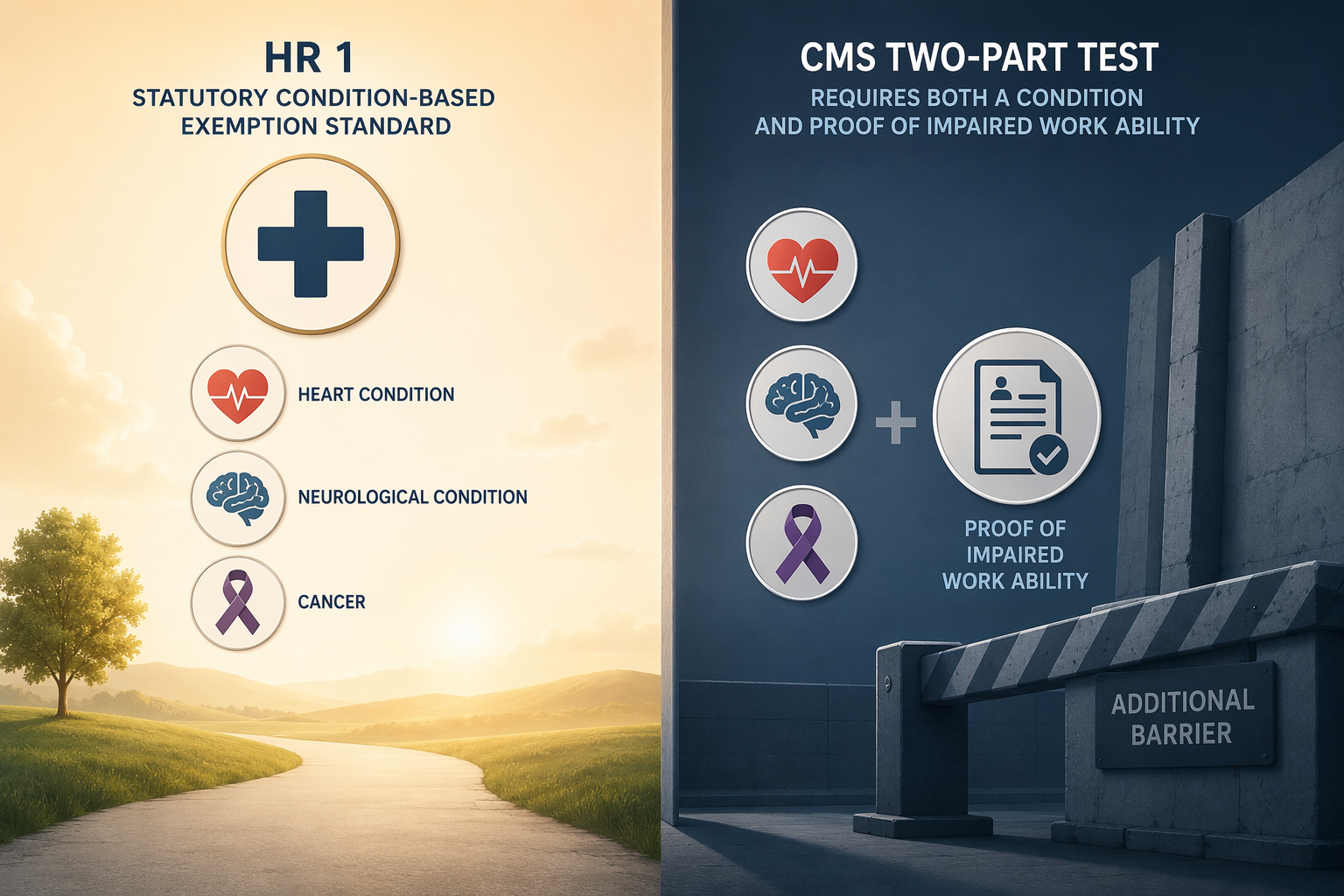
That is the hinge in the 26-state lawsuit filed against CMS on June 29, 2026. The case is not just about whether work requirements are good policy. It asks whether an agency can take a statutory exemption framed around medical categories and add a functional-capacity filter that Congress did not write into the listed categories. For patients, the difference is not academic. A diagnosis can appear in claims. Work impairment has to be translated into forms, provider signatures, state system logic, and denial codes.
What CMS Added To The Exemption
The federal work requirement does not apply to every Medicaid beneficiary. It is aimed at the Medicaid expansion population within the age band, with exclusions for groups such as pregnant people, full-time caregivers, and medically frail enrollees. The relevant statutory move is that HR 1 identifies medical frailty through categories: disability, serious mental illness, substance use disorder, chronic conditions, serious illness, cancer, and pregnancy.[1]
CMS then converted those categories into an operational test. Under the interim final rule, a state cannot simply treat a person receiving chemotherapy, a person with schizophrenia, or a person with an unmanaged chronic condition as medically frail because that person falls within a listed category. The state must also determine whether the condition impairs the person’s ability to work.[2]
| Question | HR 1 baseline | CMS interim final rule |
|---|---|---|
| Who must comply? | Expansion enrollees ages 19-64 unless excluded, including for medical frailty | Same general population, with medical frailty screened under a two-part test |
| What does medical frailty require? | Listed categories such as disability, serious mental illness, substance use disorder, chronic conditions, serious illness including cancer, and pregnancy | A qualifying condition plus impaired ability to work |
| How do states verify? | The statute supplies categories but does not prescribe a functional-impairment showing | Auditable diagnosis-code lists, recent claims data, provider documentation, and limited self-attestation after 2027 |
For an eligibility system, that added step matters. Diagnosis data and recent claims can be matched against a code list. A functional limitation is harder. It asks whether the condition impairs work, who may say so, how recent the proof must be, what happens if the provider refuses to sign, and whether a caseworker can accept a patient’s explanation. Each answer becomes a field, a notice reason, an appeal issue, or a system exception.
The APA Claim Is Strongest Where The Text Is Plainest
Secondary coverage of the complaint reports that the plaintiff states are challenging the rule under the Administrative Procedure Act as exceeding statutory authority and as arbitrary and capricious.[3][4] Those are distinct theories, but the statutory-authority argument is the cleaner one: Congress listed medical-frailty categories, and CMS added a work-impairment condition that changes who qualifies.
Agencies often need verification rules. Medicaid programs cannot run on open-ended labels, and CMS has a legitimate interest in standards states can audit. But verification is supposed to confirm eligibility under the statute, not redefine the class. A rule that asks for evidence of cancer treatment is different from a rule that asks whether the person with cancer is impaired enough to work. The first polices the category. The second narrows it.
The states also say CMS departed from earlier informal guidance. KFF’s June 30 quick take reports that states had relied on December 2025 CMS guidance suggesting condition-based exemptions, then had to adjust after the interim final rule imposed the two-part test with less than seven months before the January 1, 2027 deadline.[4] That allegation does not matter because informal guidance binds CMS forever; it matters because implementation reliance is part of the arbitrary-and-capricious story. States were not writing law review hypotheticals. They were building eligibility pathways.
As of July 21, 2026, the lawsuit is still very young. It was filed three weeks ago, and the available public discussion summarized the complaint rather than supplying a fully parsed record. No injunction or merits ruling is identified in the provided materials. That makes confident predictions about timing premature, especially because early state implementation may not be uniform. Nebraska began implementation early in May 2026, and Iowa and Montana also moved early, according to KFF’s tracker.[1]
Who Feels The Narrower Test First
The patients most exposed are not necessarily people with no medical evidence. They are people whose medical evidence proves a serious condition but does not neatly prove work impairment under the state’s verification design.
- Cancer patients may have a diagnosis and active treatment records, but the state still has to decide whether the records show impaired ability to work.
- People with diabetes or HIV may have chronic conditions that are managed some months and destabilizing in others, making a recent-claims-only lookback a blunt screen.
- People with serious mental illness, including bipolar disorder or schizophrenia, may have episodic functional limitations that are difficult to document on a schedule set by eligibility renewal.
- People with substance use disorder may qualify by condition but face provider-access, stigma, and documentation barriers when asked to establish work impairment.
- People with disabilities outside SSI pathways may be treated as work-capable unless their Medicaid record separately proves functional limitation.
CBPP identifies disabled Medicaid enrollees who receive coverage through non-disability pathways as a particularly important group, reporting that about 66% of disabled enrollees fall outside disability-based Medicaid pathways.[5] That statistic is easy to miss in legal coverage, but it is central to implementation. A person can be disabled in ordinary clinical or functional terms without already having an SSI or disability determination that fits cleanly into an eligibility system.
Older adults from 50 to 64 sit in a similar gap. KFF’s work-requirements overview notes that older Medicaid adults are more likely to report health-related barriers to work, while not all will qualify for disability benefits.[6] In a condition-based exemption, chronic disease can do more of the legal work. Under the CMS test, the person has to carry the additional burden of showing how the disease affects work capacity.

Why Documentation Burden Becomes Coverage Risk
Coverage-loss estimates should be used carefully because several major projections predate the June 2026 interim final rule. CBPP reports that CBO estimated 4.8 million people would lose Medicaid specifically because of work requirements, with 5.3 million becoming newly uninsured overall.[7] Those estimates measure the work-requirement policy as modeled before the narrower medical-frailty rule was in place. They do not prove exactly how many additional people will lose coverage under the two-part test.
They do, however, show the scale of the cliff. If the exemption is narrower than expected, more people must either document qualifying work activities or prove an exemption. CBPP also cites JAMA research finding that two-fifths of Medicaid enrollees at risk of disenrollment have three or more chronic conditions.[5] That is not a finding that all of them are unable to work. It is evidence that a large share of the exposed population has medical complexity that will not be well served by a thin paperwork screen.
The provider-documentation requirement is the most patient-facing part of the rule. Clinicians are not only asked to verify a diagnosis. They may be asked, directly or indirectly, to certify whether a patient’s condition impairs the ability to work. CBPP points to New Hampshire’s 2019 experience, where primary care providers resisted signing forms tied to inability to work, leaving some patients without exemptions.[5] That example does not establish that every state will have the same failure pattern. It does show why a verification rule can become a denial mechanism even when the underlying medical condition is real.
The claims-data limit creates another filter. CMS’s rule prevents states from using claims data older than 12 months to establish medical frailty.[2] A person with a serious mental illness who had a hospitalization outside the lookback window, a person with cancer treatment interrupted by coverage instability, or a person with a chronic condition managed through sporadic care may have a record that understates current risk. In an eligibility office, absence of recent data can look like absence of impairment.
The State-Cost Argument Is Real, But Secondary
The states also raise a Spending Clause and implementation-cost theory, according to secondary reports of the lawsuit.[3][4] That argument deserves attention, but it should not distract from the patient-facing statutory question. If CMS lacked authority to add the functional-impairment requirement, the fact that states must spend money implementing it is a consequence, not the central defect.
The cost numbers still help explain why the dispute is urgent. CHCS reports that HR 1 provided $200 million in implementation funding and cites GAO estimates showing state implementation costs ranging from under $10 million to more than $270 million per state. CHCS also notes that Georgia’s Pathways program spent about 80% of roughly $86 million on administration and consulting rather than health care.[8] Those figures do not decide the APA claim. They show what happens when Congress sets a fast national deadline and the agency requires states to build a more granular exemption engine.
National implementation history supports the same practical concern. KFF’s review of state waiver experience found that work-requirement implementation requires extensive eligibility-system changes, reporting processes, notices, exemptions, and data matching.[9] The 2026 dispute adds a new layer: states must decide not only who is working or exempt, but which medically frail people are impaired enough to avoid the work screen.
What A Plaintiff-State Win Would Actually Change
If the plaintiff states prevail on the statutory-authority claim, the practical effect would likely be a medical-frailty exemption closer to the condition-based categories in HR 1. That would not eliminate verification. States would still need to confirm that a person has cancer, a chronic condition, serious mental illness, substance use disorder, disability, or another listed basis. But the proof fight would move away from whether the patient is impaired enough to work.
That distinction would matter most for patients whose clinical records are strong but whose functional evidence is ambiguous. A patient receiving cancer treatment may not have to persuade a provider to complete a work-capacity form. A person with bipolar disorder may not have to compress fluctuating symptoms into a current impairment certification. A disabled enrollee not receiving SSI may have a better chance of being recognized through medical-frailty categories rather than being routed into ordinary work reporting.
If CMS wins, the two-part test remains a major coverage-risk filter. Serious diagnosis alone will not be enough. States will continue building code lists, provider-documentation workflows, self-attestation limits, and denial notices around impaired ability to work. The people at greatest risk will be the ones whose lives are medically complicated but administratively thin: intermittent care, limited provider access, unstable housing, cognitive symptoms, behavioral-health stigma, or a disability record that does not line up with Medicaid’s pathway.
What To Watch Next
The next meaningful developments are procedural rather than predictive: any preliminary-injunction motion, a scheduling order, briefing on the APA and Spending Clause claims, and any CMS or state implementation updates issued before January 1, 2027. Because no ruling has issued in the materials available as of July 21, 2026, the safest reading is that the legal challenge and the eligibility-system buildout are moving at the same time.
For legal and compliance readers, the docket alone will not be enough. State guidance will show how the contested CMS rule is being translated into diagnosis-code lists, provider forms, claims lookbacks, self-attestation rules, notices, and appeal language. The court will decide whether CMS can require the two-part test. The systems being built now will decide how quickly that legal answer reaches patients.
References
- Tracking Implementation of the 2025 Reconciliation Law, KFF, updated June 29, 2026.
- The Medical Frailty Exemption from Medicaid Work Requirements: Key Takeaways from the CMS Interim Final Rule, KFF, June 23, 2026.
- States Sue Trump Administration Over Medicaid Work Requirements Rule, Healthcare Dive, June 30, 2026.
- States Sue CMS Over Medicaid Work Requirements Rule Citing Departure from Earlier Guidance on Medical Frailty, KFF, June 30, 2026.
- Administration's Last-Minute Restrictions Likely to Worsen Impact of Medicaid Work, CBPP, June 3, 2026.
- 5 Key Facts About Medicaid Work Requirements, KFF, February 2025.
- Medicaid Work Requirements Could Put 36 Million People at Risk of Losing Health Coverage, CBPP, February 5, 2025.
- A Summary of Federal Medicaid Work Requirements, CHCS, July 2026.
- Implementing Work Requirements on a National Scale, KFF, May 2025.
Comments
Join the discussion with an anonymous comment.