
As of July 21, 2026, the Michigan athletic director scandal legal timeline is not a single proceeding. It is a set of overlapping legal tracks that happened during Warde Manuel’s tenure as athletic director: a civil mass-abuse settlement, NCAA infractions proceedings, a federal criminal indictment, a state criminal prosecution, an outside-law-firm investigation, public-records litigation, and employment litigation.
That distinction matters. This article treats “under Manuel” as a chronology and administrative frame, not as a finding of personal legal liability against Manuel. Some matters are resolved. Some remain pending. Some involve university institutional exposure; others involve allegations against former employees or disputes over records. Collapsing them into one scandal obscures the legal posture of each track.
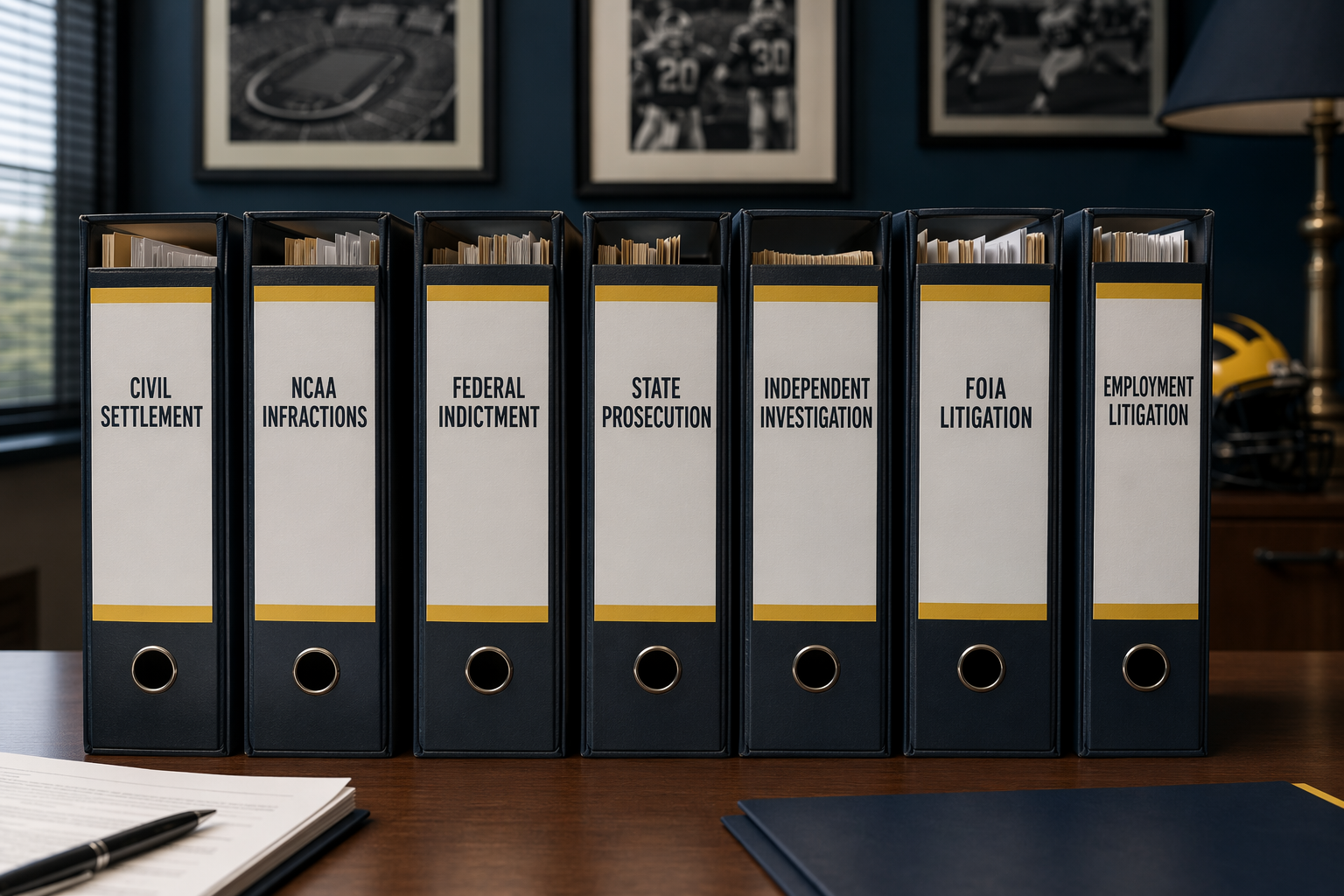
Chronological Legal Timeline
| Date or period | Track | Forum or process | Status as of July 21, 2026 | Source |
|---|---|---|---|---|
| 2018–2022 | Robert Anderson sexual-abuse claims | Civil settlement process involving University of Michigan claimants | Resolved by a $490 million settlement with more than 1,050 claimants; reported as the largest sexual-abuse settlement in NCAA history. | [1] |
| 2023–2025 | Connor Stalions / Michigan football sign-stealing matter | NCAA infractions process | NCAA found an impermissible scouting scheme and cited “overwhelming evidence”; Michigan self-imposed penalties later reported to cost more than $30 million. | [2][3] |
| March 20, 2025–ongoing | Matt Weiss computer-access case | Federal criminal indictment in the Eastern District of Michigan | Pending. Weiss was charged with 24 federal counts involving unauthorized computer access and aggravated identity theft; the indictment alleges more than 3,300 victims across more than 100 universities. Charges remain allegations. | [4] |
| December 2025–April 2026 | Sherrone Moore criminal case | State criminal prosecution | Resolved. Moore was fired for cause on Dec. 10, 2025, arrested the same day on felony charges, pleaded no contest to two misdemeanors on March 6, 2026, and was sentenced on April 14, 2026, to 18 months’ probation, a $1,000 fine, a suspended jail sentence, and a no-contact order. | [5][7] |
| December 2025–ongoing | Jenner & Block athletic department investigation | Independent outside-counsel investigation | Ongoing or not fully disclosed. Michigan retained Jenner & Block for dual probes involving the Moore matter and broader athletic department culture; reported legal fees exceeded $11.8 million by June 2026, with no written public report released. | [5][6][7] |
| March 2026–ongoing | Chris Partridge wrongful termination lawsuit | Employment / wrongful termination litigation | Ongoing. The suit is part of the employment-litigation track arising from Michigan’s football investigations and includes unadjudicated allegations about how investigation-related meetings were handled. | [7] |
| July 7, 2026–ongoing | Paige Shiver public-records lawsuit | Washtenaw County Circuit Court / Michigan FOIA litigation | Early-stage. Shiver sued Michigan, alleging improper denial of six FOIA requests submitted between February and June 2026; no ruling had issued as of July 21, 2026. | [8] |
| July 2026 | Manuel employment uncertainty | University governance / board oversight | Unresolved. Reports before and after the July 16, 2026, Board of Regents meeting described uncertainty over Manuel’s status, but the board did not publicly resolve it at that meeting. | [9][10][11] |
The table is the spine of the record. It shows why a single label such as “Michigan scandal” is legally inadequate. A settlement does not operate like an indictment. An NCAA infractions ruling does not answer a state criminal case. A FOIA lawsuit can proceed even when an internal investigation is shielded from public release. The burden on the institution comes from the simultaneity of those tracks, not from their sameness.
The Anderson Settlement Set the Civil-Liability Baseline
The Robert Anderson matter is the baseline legal event in Manuel’s tenure because it is not primarily an athletics controversy. It is a mass civil-liability resolution involving institutional responsibility for abuse by a former university doctor. In September 2022, the University of Michigan finalized a $490 million settlement with more than 1,050 people who said they were abused by Anderson, a former university physician; the settlement was reported as the largest sexual-abuse settlement in NCAA history.[1]
That number does not become legally important merely because it is large. It matters because it describes a scale of claimant management, settlement administration, insurance and reserve questions, privilege review, board oversight, and reputational consequence that an athletic department cannot file away as a sports-cycle embarrassment. It also demonstrates why chronology matters. The settlement was finalized during Manuel’s tenure, but the underlying abuse allegations concerned conduct that predated him. The legal relevance is institutional exposure during his administration, not a finding that he caused the underlying abuse.
For lawyers and compliance officers, that distinction is not a defense of the institution. It is the beginning of accurate analysis. The Anderson resolution required Michigan to confront liability on a scale that dwarfs ordinary athletic-department discipline. It established the first major marker in this timeline: by 2022, the department was already operating inside a university environment shaped by one of the most consequential abuse settlements in college sports.
The NCAA Track: Connor Stalions and the Sign-Stealing Penalties
The Connor Stalions matter belongs in a different legal category. It was an NCAA infractions proceeding, not a criminal case and not a civil damages action. In August 2025, the NCAA announced that “overwhelming evidence” showed an impermissible scouting scheme in the Michigan football program.[2]
The legal significance is regulatory. The NCAA’s finding addressed rule compliance, institutional cooperation, penalties, and competitive-integrity concerns within the association’s enforcement system. It did not resolve the Anderson settlement, the Weiss indictment, the Moore prosecution, the FOIA dispute, or the employment claims. Those matters continued on their own tracks.
The financial consequence still matters. In November 2025, the Associated Press reported through FOX Sports that Michigan’s self-imposed penalties tied to the sign-stealing case would cost the school more than $30 million, according to the athletic director.[3] For a university counsel’s office or a board committee, that is not just a football budget line. It is another institutional cost layered onto existing legal and investigative exposure.
The Weiss Indictment Is a Pending Federal Criminal Case
The Matt Weiss case requires a slower sentence than scandal coverage usually gives it. On March 20, 2025, the U.S. Department of Justice announced that Weiss, a former University of Michigan football quarterbacks coach and co-offensive coordinator, had been indicted on 24 federal counts: 14 counts of unauthorized access to computers and 10 counts of aggravated identity theft.[4]
The indictment alleged unauthorized access affecting more than 3,300 victims across more than 100 universities.[4] Those figures are enormous, but they are allegations in a pending criminal case. They should not be written as findings. As of July 2026, the case remained pending after a motion to dismiss was denied, and no trial date had been set.
The federal track is administratively distinct from the NCAA track. It raises questions about evidence preservation, device access, victim notification, cooperation with federal investigators, and possible employment-record implications. It also creates obvious pressure on public communications. A university can describe personnel history and institutional cooperation, but it cannot responsibly narrate a pending indictment as though a jury has already resolved it.
Moore Moved From Employment Action to State Criminal Disposition
The Sherrone Moore matter is the place where employment action, criminal prosecution, and outside investigation most visibly converge. In December 2025, Michigan fired Moore for cause, and Yahoo Sports reported that the university hired a law firm to investigate athletic department scandals in the wake of Moore’s firing and felony charge.[5]
The criminal case then moved quickly compared with the rest of the timeline. MLive reported that Moore was fired for cause on Dec. 10, 2025, arrested the same day on felony charges including third-degree home invasion, stalking, and breaking and entering, pleaded no contest to two misdemeanors on March 6, 2026, and was sentenced on April 14, 2026.[7] The sentence was 18 months’ probation, a $1,000 fine, a suspended jail sentence, and a no-contact order.[7]
That track is resolved as a state criminal case. It does not resolve the separate investigation into athletic department culture, the FOIA dispute over records, or any employment litigation. In institutional terms, Moore’s criminal disposition closed one legal file while leaving several related administrative files open.
Jenner & Block, Oral Briefings, and the Cost of Keeping the Record Narrow
The Jenner & Block investigation is not a court case, but it is one of the most consequential legal processes in the current timeline. After Moore’s firing and criminal charge, Michigan retained the firm for work that included the Moore matter and broader athletic department culture issues.[5] By April 2026, MLive reported an $11 million price tag for the probe.[6] By June 2026, MLive reported that more than $280,000 had been added for May 2026 work and that the total exceeded $11.8 million.[7]
The invoice trail is doing work that a public report has not done. Michigan had not released a written report as of July 21, 2026. The reported strategy of oral briefings rather than a written report is legally significant because it bears directly on public-records access and privilege positioning. It may reduce the universe of documents available to requesters, but it also increases the accountability pressure on invoices, board minutes, correspondence, and testimony in related litigation.
Skepticism about that structure is warranted, but the record supports a narrower conclusion than concealment as a proven fact. The public record shows expensive outside-counsel work, dual investigative subjects, continued billing into 2026, and no released written report. It does not, on the sources available, establish the full factual findings of the investigation or whether any privilege claim will survive a court challenge.
The FOIA Suit Turns Investigation Strategy Into Litigation
The public-records dispute is not a side issue. It is the legal mechanism through which the investigation’s structure may be tested. On July 7, 2026, Paige Shiver sued Michigan in Washtenaw County Circuit Court, alleging that the university improperly denied six FOIA requests submitted between February and June 2026 concerning the Moore investigation and related records.[8]
As of July 21, 2026, that case was early-stage and no ruling had issued. The allegations therefore should be treated as allegations. Still, the lawsuit is important because it moves the records dispute from university processing queues into a court file. The question is no longer only what Michigan chooses to release. It is also what a judge may require Michigan to justify.
For a public-records officer, the practical burden is immediate. Requests touching the Moore matter, the Jenner & Block work, board communications, personnel records, and possible privilege claims cannot be handled as routine athletic department correspondence. Each response may affect the next filing, the next exemption argument, and the next credibility fight over whether the university created or withheld records in a legally defensible way.
Employment Litigation Adds a Separate Risk Channel
The Chris Partridge wrongful termination suit belongs in the timeline because employment litigation creates a different kind of institutional exposure. It is not an NCAA penalty proceeding. It is not a public-records case. It is a dispute over employment consequences arising from the football investigations, and it places internal decision-making at issue.
The most legally sensitive allegation attributed to that track is that President Santa Ono directed Manuel and others to take no notes during investigation-related meetings.[7] That allegation remains unadjudicated. Its significance lies in what it would mean if tested in discovery: who attended the meetings, whether records were created, whether privilege was invoked, and whether the absence of notes was ordinary legal caution or something a court might view differently.
This is where employment litigation and FOIA litigation can begin to speak to each other without becoming the same case. A former employee may seek discovery for one purpose; a public-records plaintiff may seek disclosure for another. The university’s position in one matter can constrain or complicate its posture in the other.
Why Manuel’s Status Became a Governance Question
By July 2026, reports about Manuel’s future were no longer just personnel speculation. Front Office Sports reported on July 13, 2026, that Manuel’s position was in question as investigation findings loomed.[9] USA Today reported the same day on the uncertainty surrounding his contract and status.[10] Yahoo Sports reported after the July 16 Board of Regents meeting that Manuel remained in place, with no public resolution of his status at that meeting.[11]
The board’s silence did not erase the legal record. It left the administrative question where it already was: how much cumulative legal and investigative burden can sit inside one athletic director’s tenure before governance bodies must treat continuity itself as a risk-management decision?
That question does not require a finding that Manuel is personally liable for each underlying event. The record supports a more precise conclusion. His tenure contains an unusually large and legally varied set of scandal tracks, with some resolved, some pending, and some shielded from full public view. That makes the tenure one of the most legally consequential athletic director records in NCAA history, while leaving central questions unresolved because the Weiss indictment, the Shiver FOIA case, the Partridge employment litigation, and the Jenner & Block investigation remain pending, undisclosed, or unadjudicated.
References
- UM finalizes $490M settlement with those abused by Anderson, The Detroit News, Sep. 16, 2022.
- Overwhelming evidence shows impermissible scouting scheme in Michigan football program, NCAA.org, Aug. 15, 2025.
- Michigan football's sign-stealing fines will cost school over $30 million, athletic director says, FOX Sports, Nov. 24, 2025.
- Former University of Michigan Football Quarterbacks Coach and Co-Offensive Coordinator Indicted for Computer Access Crimes, U.S. Department of Justice, Mar. 20, 2025.
- In wake of Sherrone Moore's firing and felony charge, Michigan hires law firm to investigate athletic department's scandals, Yahoo Sports, Dec. 2025.
- $11M new price tag for Sherrone Moore, University of Michigan athletics probe, MLive, Apr. 30, 2026.
- $280K added to Sherrone Moore, University of Michigan athletics investigations, MLive, Jun. 17, 2026.
- Paige Shiver sues Michigan for records in Sherrone Moore investigation, The Detroit News, Jul. 8, 2026.
- Michigan AD’s Position in Question as Investigation Findings Loom, Front Office Sports, Jul. 13, 2026.
- Warde Manuel Michigan athletic director investigation contract, USA Today, Jul. 13, 2026.
- Michigan athletic director Warde Manuel, Yahoo Sports, Jul. 16, 2026.
Comments
Join the discussion with an anonymous comment.