
The NCAA's age-based eligibility fight has moved past the stage of abstract governance. On June 23, 2026, the NCAA adopted a new five-year eligibility model that limits Division I athletes to five seasons within a five-year window tied to age-based enrollment timing, and the immediate litigation response has turned that rule into a multi-jurisdictional test of how much discretion the association still has after years of eligibility, NIL, transfer, and compensation defeats in court. [1]
Michigan State enters the picture because Jaxon Kohler is listed among the athletes seeking relief in a California filing, making the rule less a national policy debate than a live roster-management problem for an athletic department with basketball, football, and hockey consequences. [2] The harder legal question is not whether the NCAA may ever draw eligibility lines. It is whether this particular line, applied to athletes who entered college under one eligibility landscape and then reached the transition point under another, can survive contract, antitrust, and administrative-record scrutiny.

The 5-in-5 Rule Has a Transition Problem
The challenged rule is commonly described as a 5-in-5 model: five seasons of competition within a five-year eligibility window. The litigation pressure point is the class of 2022, especially athletes who relied on the prior structure, used four seasons, and now face exclusion from a fifth season that might have been available under the older COVID-era and waiver-influenced eligibility environment. [1]
That transition matters because eligibility rules are not merely internal scheduling preferences. They allocate economic opportunity, scholarship planning, roster slots, transfer leverage, and, in the post-House settlement environment, access to direct institutional compensation. The NCAA can defend administrable eligibility limits in the abstract. Its burden becomes more delicate when the record shows selective grandfathering, different treatment for adjacent athlete groups, or an abrupt change imposed on athletes who had already structured college careers around the prior regime.
The plaintiffs' best facts are therefore not sentimental. They are transitional. The NCAA previously gave broad COVID-19 eligibility relief and has maintained professional re-entry rules that allow some athletes to return to college competition after professional involvement. Those precedents do not prove that every fifth-year request must be granted. They do, however, make it harder for the association to say that age-clock exceptions are inherently unadministrable or that transitional leniency would destabilize college sports as a matter of first principle. [3]
Borovicanin Is the Early Bellwether
The most important ruling so far is Borovicanin v. NCAA in the Southern District of Ohio. On July 9, 2026, Judge Wagner granted a preliminary injunction for 24 men's and women's basketball players challenging the NCAA's exclusion of the high school class of 2022 from transitional relief. [3][4]
Preliminary injunctions are not final judgments, and Borovicanin does not automatically free every similarly situated athlete. Its legal significance is narrower and still substantial: a federal court looked at the NCAA's transition design and found enough likelihood of success, irreparable harm, and balance-of-equities support to stop enforcement against the named plaintiffs while the case proceeds. [3][4]
The sharpest part of the order is the court's treatment of arbitrariness. Judge Wagner found the NCAA's exclusion of the class of 2022 from the transition rule to be arbitrary and capricious, rejecting the idea that the association's status as a voluntary membership organization insulated the decision from judicial review. [3] That matters because NCAA defenses often begin with institutional autonomy: member schools agree to the rules, athletes participate through those schools, and courts should avoid becoming eligibility administrators. Borovicanin does not erase that defense, but it shows its limits when the challenged action looks less like a neutral eligibility framework and more like selective transition management.
The third-party beneficiary theory is also important. The plaintiffs did not need to establish a full employment-style relationship with the NCAA to get traction. They argued that student-athletes are intended beneficiaries of the NCAA's contractual arrangements with member institutions, including eligibility rules that directly govern their ability to compete. The Ohio order accepted enough of that framing at the preliminary stage to treat the plaintiffs as having enforceable interests rather than merely disappointed expectations. [3]
Then there is Exhibit 7. Foley Hoag's account of the order notes that the NCAA's own threat letter was used against it as evidence of arbitrary enforcement. [3] That is the kind of record problem that can change a case. A governing body can usually survive a hard line if the line is prospective, consistently justified, and supported by a coherent transition rationale. It has a much more exposed position when its correspondence suggests pressure tactics or inconsistent enforcement at the exact point where athletes and schools are trying to determine who is eligible.
The NCAA has indicated that it intends to appeal the Borovicanin ruling. [4] That caveat should stay visible. An appellate court could narrow the third-party beneficiary analysis, defer more heavily to NCAA rulemaking, or accept the association's concern that broader relief would invite longer and older college careers beyond the intended model. But at the present litigation stage, Borovicanin gives plaintiffs in other jurisdictions a working template: focus on the transition record, the NCAA's own exceptions, and the concrete loss imposed on athletes who were already inside the system when the rule changed.
Contract Theory and Antitrust Theory Are Doing Different Work
The lawsuits should not be treated as one undifferentiated challenge. Borovicanin is most valuable to plaintiffs as a contract-like and arbitrariness case. Campbell v. NCAA, filed in the Northern District of Illinois on June 26, 2026, takes a different route by asserting Sherman Act claims against the age-based rule. [5]
Campbell's theory is that the NCAA is using eligibility limits to suppress athlete compensation in the relevant college sports labor market. Reuters reported that the class action challenges the new age-based sports eligibility rule, and Varnum's analysis ties the theory to the Supreme Court's 2021 Alston decision and the House revenue-sharing settlement environment. [5][6]
That framing changes the litigation stakes. Under a contract or third-party beneficiary approach, the central question is whether the NCAA administered its own rules fairly enough, especially during transition. Under an antitrust approach, the question becomes whether the rule restrains competition in a market for athlete services and whether the NCAA can justify the restraint as procompetitive. A rule can be orderly and still anticompetitive; a rule can be economically restrictive and still survive if justified and appropriately tailored. The plaintiffs are trying to keep both doors open.
| Case or filing | Main reported theory | Why it matters |
|---|---|---|
| Borovicanin v. NCAA | Third-party beneficiary and arbitrary enforcement challenge | Produced the July 9 preliminary injunction for 24 named plaintiffs |
| Campbell v. NCAA | Sherman Act antitrust class action | Tests whether the age cap suppresses athlete compensation after Alston and House |
| California injunction filing | Reported multi-player injunction request | Pulls Michigan State into the live dispute through Jaxon Kohler |
| Colorado class action | Reported challenge by Division I athletes | Shows the dispute is spreading beyond one venue |
Campbell also keeps the post-Alston legal environment in view without requiring every eligibility dispute to become a compensation case. Alston did not hold that all NCAA eligibility rules are unlawful. It did confirm that NCAA rules are not immune from antitrust scrutiny simply because they concern college sports. That distinction is why Campbell matters even if Borovicanin remains the cleaner early win for athletes.
Where Michigan State Fits
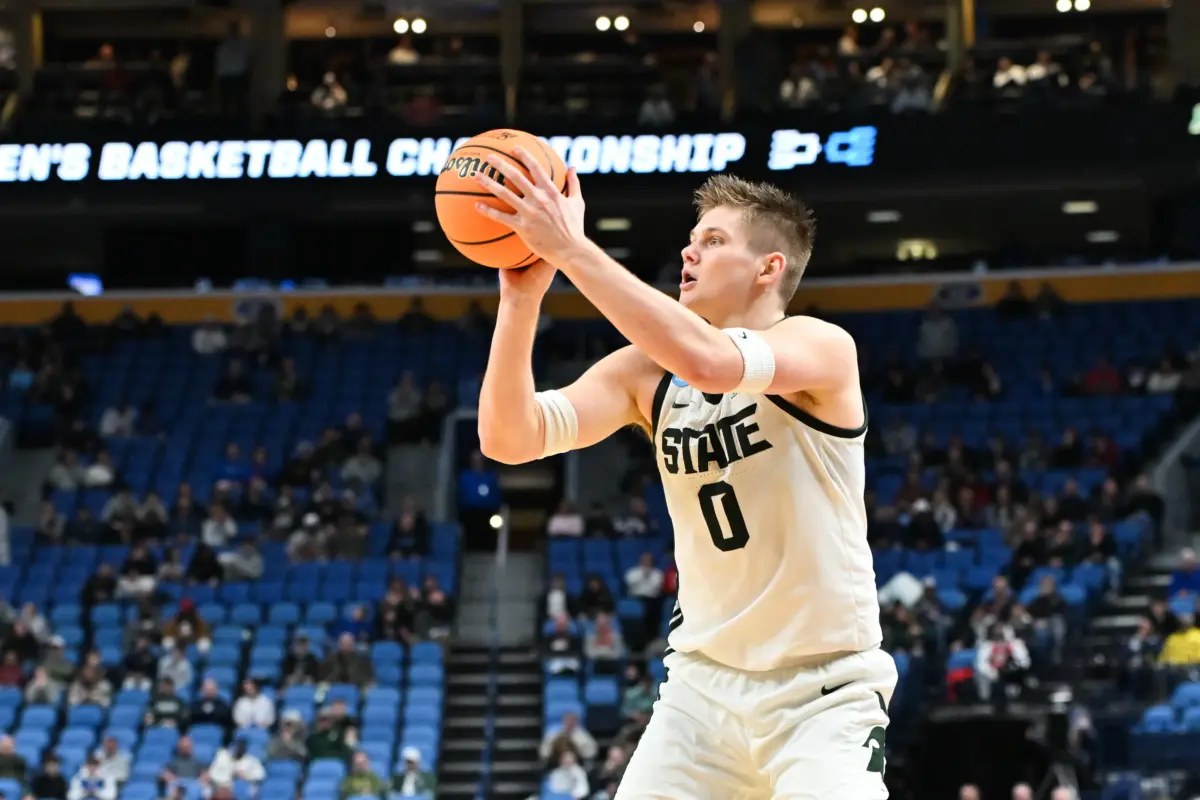
Kohler's name in the California filing gives Michigan State a direct stake in the age-rule litigation. Sports Illustrated reported that Kohler is among more than 25 players seeking an injunction for a fifth year of eligibility, while 247Sports described him as a Michigan State graduate named in the California eligibility injunction. [2][7]
The basketball facts are straightforward enough to show why the legal timing matters. Kohler averaged 12.5 points and 8.9 rebounds, and the reporting on the California filing also references an Exhibit 10 deal with the Utah Jazz. [7][8] If he is eligible, Michigan State is not just adding an abstract plaintiff back into a lineup. It is potentially adding a productive veteran to a roster already being managed under numerical limits and designated student-athlete mechanics.
That is where the compliance problem becomes more concrete than the headline. SI's Michigan State report notes the basketball roster constraint of a 15-player limit and discusses designated student-athlete exceptions, while also reporting that Michigan State denied a FOIA request for the full designated-student-athlete list. [2] Because that information comes through a single report and not a complete public roster filing, it should be treated cautiously. Still, the operational issue is real: an injunction for one athlete can force a school to decide how to count him, who must wait, and whether other roster commitments become contingent on a court order.
Kohler's case is also useful because it avoids a common distortion in eligibility debates. The strongest argument is not that Michigan State deserves another experienced frontcourt player. The stronger argument is that an athlete who moved through college under one rule environment may suffer an immediate loss of competition and compensation opportunity if a new age clock is applied without adequate transition relief. That remains a legal argument, not a roster preference.
The Spillover Is Not Limited to Basketball
The State News reported that the new NCAA age-based eligibility clock could shift multiple sports at Michigan State, including football and hockey. Its reporting described potential effects from football redshirt changes under coach Pat Fitzgerald and hockey pipeline disruption tied to an age clock beginning around an athlete's 19th birthday. [9]
Those sport-specific consequences are not identical. Basketball's issue is immediate roster space and veteran eligibility. Football's issue is how redshirt and development planning interact with a compressed eligibility clock. Hockey's issue is more structural because players often arrive through junior or developmental pathways that do not always align neatly with an age-triggered college clock. Lumping all three together as the same harm would overstate the record. Treating them as separate compliance problems better reflects how athletic departments actually absorb eligibility uncertainty.
There is also a boundary on the Michigan State story. Yahoo's Michigan State coverage reported Kohler's inclusion in the California injunction, but the available materials do not establish that every former or current MSU athlete affected by the rule has joined litigation. [8] Carson Cooper, for example, is not reported in the research materials as being named in any injunction. That absence should not be converted into a conclusion about his legal position; it only means the public filings described here do not place him in the same procedural posture.
The California Filing Is Important, But Not Yet Decisive
The California filing broadens the map, but it should not be mistaken for a ruling. It was filed on July 17, 2026, and the materials available here do not report a decision on the requested injunction. [2][8] That makes it procedurally different from Borovicanin, where the court has already granted preliminary relief.
For Michigan State, that distinction matters immediately. Borovicanin changes the legal temperature because a federal judge has already found the NCAA's transition treatment vulnerable. The California case changes Michigan State's planning environment because it puts Kohler into a pending injunction posture. The first is a precedent signal; the second is an institutional exposure.
It is also possible that the California theory will not track Borovicanin exactly. Multi-player injunction filings often borrow successful arguments from related cases, but venue, state-law framing, plaintiff facts, and requested relief can alter the analysis. Until a court rules, the California filing is best understood as an attempt to extend the pressure created by Borovicanin, not as proof that Kohler or the other named players will receive the same relief.
The Lawsuit Count Shows Pressure, Not Merits
The volume of eligibility litigation is now part of the story. Morgan Lewis tracked more than 70 eligibility lawsuits since the Diego Pavia case in 2024 and more than 50 in early 2026 alone. [10] That is an institutional stress indicator. It is not, by itself, proof that the NCAA is wrong in every case.
Courts can and do reject athlete eligibility claims when the facts are weaker, the requested relief is too broad, or the governing rule is applied consistently. The number of lawsuits tells us that athletes, agents, schools, and lawyers increasingly view judicial relief as a routine part of eligibility strategy. The merits still turn on rule text, transition design, reliance, irreparable harm, competitive balance, and the quality of the NCAA's administrative record.
A reported Colorado class action by 11 Division I athletes adds another jurisdictional pressure point. [8] Its main significance, based on the available materials, is not that Colorado has already resolved anything. It is that the NCAA now faces coordinated pressure from different plaintiff groups trying different procedural and substantive routes.
The NCAA's Defense Is Strongest in the Abstract and Weaker in the Transition
The NCAA's best defense is administrability. A national eligibility system needs clear lines. Without them, roster limits, competitive balance, scholarship allocation, and conference scheduling become harder to manage. Courts are not well positioned to act as season-by-season eligibility boards, and voluntary associations usually receive some room to define membership rules.
But the current rule is not being challenged only as a line-drawing exercise. It is being challenged as a line drawn after athletes had already entered the system, with carveouts and precedents that make the association's claimed need for rigidity less convincing. The NCAA's prior COVID-19 blanket waiver and professional re-entry transition rules give plaintiffs a ready response to the claim that transitional relief is inherently unworkable. [3][4]
The NCAA's reported slippery-slope concern, including arguments about extreme extensions of college playing careers, may have more force on appeal than it had at the preliminary stage. [3] Courts sometimes react differently when asked to preserve a specific athlete's final season than when asked to bless a doctrine that could be invoked repeatedly. That appellate risk is real. It is also not the same as a persuasive justification for excluding the class of 2022 if comparable transition relief was available to adjacent groups.
That is the NCAA's main vulnerability: the defense sounds categorical, while the rule's application appears selective. A categorical defense can survive hard facts when the record is clean. Selective transition rules require a better explanation, and Borovicanin suggests the NCAA has not yet supplied one that satisfies at least one federal court.
Congress Could Change the Field, But Has Not Yet
Pending federal legislation remains a possible external interruption. Front Office Sports reported that the Protect College Sports Act advanced through a Senate committee, while also noting opposition from the Big Ten and SEC. [11] If enacted in a form that grants the NCAA protection or creates a federal eligibility framework, it could moot or reshape parts of the current litigation.
For now, though, the courts are the active forum. Compliance offices cannot plan around a bill as though it were law, and athletes cannot preserve a final season by waiting for Congress. Michigan State's practical problem is therefore immediate: monitor the California filing, account for the persuasive but limited effect of Borovicanin, and avoid treating any preliminary injunction as a stable final entitlement.
What This Means for Michigan State
For Michigan State, the age lawsuits create three layers of exposure. The first is athlete-specific: Kohler may obtain relief, lose relief, or remain in limbo while the California court evaluates the injunction request. The second is roster-specific: basketball staff must account for the possibility that a veteran player is eligible only because of a court order, while roster limits and designated-student-athlete mechanics remain unsettled in public reporting. The third is department-wide: football and hockey may face different but related planning problems if the age clock alters development timelines.
The legal posture also affects how MSU should read the NCAA's position. A school does not need to take an anti-NCAA view to recognize that the association's administrative record is now a litigation asset or liability. If Exhibit 7 can be used against the NCAA in Ohio, then future communications, waiver decisions, and enforcement threats may matter as much as the published rule text. That is a compliance lesson, not a fan reaction.
The most defensible forecast is modest. The NCAA has not lost the 5-in-5 rule on final merits, and Borovicanin binds only the named plaintiffs before that court. The California filing has not produced a reported ruling. Campbell's antitrust theory still must survive the ordinary burdens of market definition, restraint analysis, justification, and remedy. But the NCAA's defense is weakened by the selective treatment of the class of 2022, its own COVID and professional re-entry precedents, and an early federal order finding arbitrary and capricious enforcement.
That is enough to matter at Michigan State. Not because every plaintiff is certain to play, but because eligibility has become a litigation-dependent asset. Kohler's case shows how quickly a national rule can become a local roster question, and Borovicanin shows why the NCAA's transition choices will be tested not just for policy logic, but for record discipline.
References
- NCAA New 5-Year Eligibility Rule Has Major Legal Implications, Sportico
- MSU's Kohler Seeks Injunction for 5th Year of Eligibility, SI/MSU
- Game Changer: Ohio Court Grants Preliminary Injunction Against the NCAA's Arbitrary Exclusion, Foley Hoag
- Ohio judge grants preliminary injunction for 24 men's, women's players, AP News
- NCAA hit with class action over new age-based sports eligibility rule, Reuters, 2026-06-26
- NCAA Age-Based Eligibility Rule Faces Antitrust Challenge, Varnum Law
- Michigan State graduate Jaxon Kohler named in NCAA eligibility injunction in California, 247Sports
- Michigan State's Jaxon Kohler Included in California Injunction, Yahoo Sports
- New NCAA age-based eligibility clock to shift sports at MSU, The State News
- Recent NCAA Eligibility Rulings Highlight Expanding Judicial Role, Morgan Lewis, 2026-03
- Players Sue NCAA Over New Five-Year Eligibility Model, Front Office Sports
Comments
Join the discussion with an anonymous comment.