
Micron’s rise into the trillion-dollar market-cap club is not just a semiconductor headline. For law firms planning AI rollouts, it is a supply-chain warning. The same AI data center buildout that has made memory vendors suddenly more valuable is also competing for the DRAM capacity that used to flow more predictably into ordinary laptops, desktops, and servers. Micron crossed the $1 trillion valuation threshold in May 2026 as AI demand powered a memory-chip boom, after a stock surge of more than 700% tied to that demand cycle.[1]
That does not mean Micron’s stock price is directly raising the cost of a litigation associate’s laptop. The chain is less theatrical and more important: AI data centers need high-value memory, including high-bandwidth memory used alongside Nvidia-class accelerators; memory producers allocate scarce production toward those customers; standard DRAM supply tightens; PC makers face higher input costs; and firms buying machines in 2026–2027 see the increase in refresh quotes.

This matters because AI adoption in law firms is often budgeted as software first: subscriptions, pilots, governance, training, maybe outside consulting. The workstation line item arrives later, usually when IT explains that the existing 16 GB fleet is not the right baseline for serious AI-enabled workflows. By then, procurement is no longer negotiating last year’s hardware market.
The market signal is real, but it is only the first link
Micron’s Q3 2026 results gave investors more than a narrative. The company reported results that beat expectations, with coverage pointing to AI-driven memory demand as the force behind the upside.[2] That is useful evidence for legal operations leaders, but not because they need to become memory-stock analysts. It confirms that AI infrastructure buyers are absorbing memory supply at a scale large enough to change producer economics.
In an ordinary refresh cycle, a firm could treat RAM as a configurable add-on: 16 GB for most users, higher specifications for e-discovery specialists, trial teams, finance, or developers. The AI cycle changes the baseline. When more legal workstations are expected to support AI-assisted drafting, document analysis, local indexing, heavy browser sessions, video calls, secure endpoint tools, and matter-management applications at the same time, memory stops being a small upgrade and becomes a planning assumption.
The uncomfortable timing is that this higher workstation requirement is arriving while DRAM itself has become more expensive. Counterpoint Research, cited by IEEE Spectrum, reported that DRAM prices rose 80–90% in a single quarter.[3] That is not a minor fluctuation for firms standardizing new machines across practice groups. Even when OEM discounts and enterprise purchasing blunt the full effect, the direction of travel is clear enough to affect budgets.
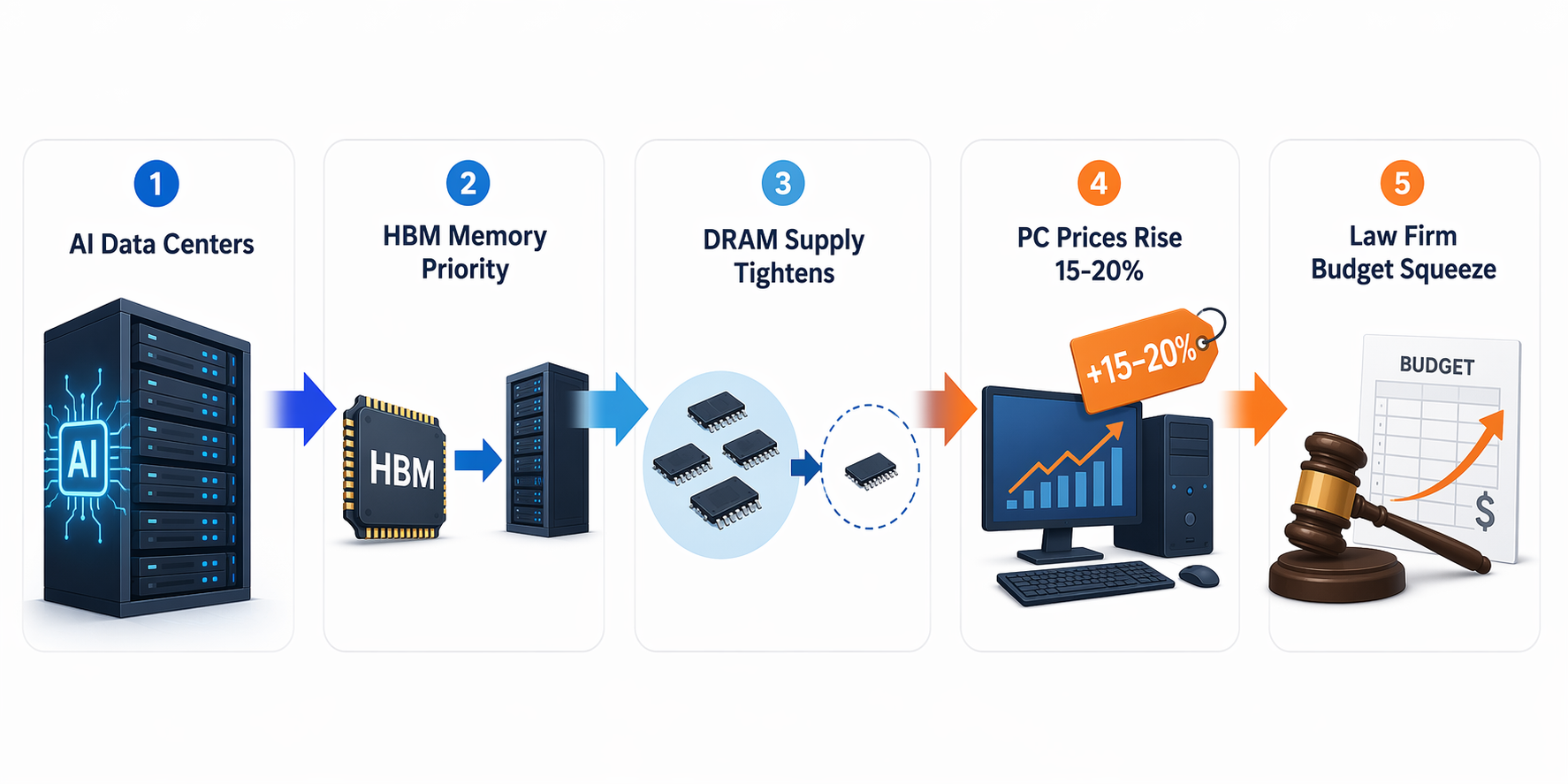
Why AI data centers crowd out ordinary PC memory
The memory shortage is not simply a story of everyone buying more laptops. AI infrastructure changes what memory manufacturers are incentivized to produce. High-bandwidth memory commands strategic attention because it sits close to the GPU bottleneck in AI data centers. When hyperscalers and AI infrastructure buyers compete for that supply, producers have a rational reason to favor the highest-value channels.
That leaves ordinary DRAM customers exposed. PC manufacturers and conventional server buyers are not necessarily being abandoned, but they are bidding into a tighter allocation environment. IEEE Spectrum’s July 2026 analysis described a shortage timeline in which Intel’s CEO warned there would be “no relief until 2028,” while Micron’s New York fabrication facility was not expected to reach full production until around 2030.[3]
For law firm budgeting, the date matters more than the drama. If relief is not expected until 2028 and new capacity takes years to become meaningful, a 2026 price spike cannot be treated as a one-quarter procurement annoyance. It becomes a refresh-cycle assumption. Firms replacing a third of their fleet each year, expanding AI use, or moving more staff to higher-spec devices need to model memory costs as structurally elevated rather than temporarily inconvenient.
| Supply-chain step | What changes for law firms |
|---|---|
| AI data centers absorb more high-value memory | Memory producers prioritize capacity tied to AI infrastructure demand |
| HBM and DRAM markets tighten | Component costs rise before the firm ever sees a vendor quote |
| PC makers pass through higher costs | Refresh pricing increases even for firms not running AI locally at scale |
| AI workflows require more RAM | The standard workstation specification moves from a basic productivity machine toward 32 GB or 64 GB configurations |
| Refresh cycles collide with AI pilots | Software ROI discussions become hardware ROI discussions too |
The 15–20% PC price increase should be used carefully, not ignored
The most directly relevant downstream figure for legal buyers is the reported 15–20% increase in PC and laptop prices attributed to Dell, Lenovo, and HP pass-through. The sourcing deserves a caveat: the figure comes through The Tech Savvy Lawyer’s December 2025 coverage citing manufacturer reports, and the underlying manufacturer investor communications were not independently verified in the provided research crawl.[4]
Even with that caveat, the figure is operationally plausible in light of the stronger upstream evidence: DRAM prices rising 80–90% in a single quarter, a shortage timeline stretching toward 2028, and memory suppliers reporting AI-driven demand.[2][3] The right use of the 15–20% number is not to forecast every invoice with false precision. It is to stress-test hardware refresh budgets that were built on 2024 or early-2025 assumptions.
A firm that budgeted for 300 replacements at last cycle’s configuration may now face two simultaneous increases: a higher price for the same class of machine and a higher required specification for the users included in the AI rollout. Procurement can negotiate discounts, standardize models, extend some warranties, and stagger purchases. It cannot negotiate away the fact that the component stack has changed.
The real workstation question is no longer 16 GB versus “nice to have”
The Tech Savvy Lawyer’s guidance is blunt enough to be useful: 32 GB is described as the minimum for AI work, with 64 GB for power users, compared with the 16 GB standard that many firms were still using in 2024.[4] That does not mean every receptionist, summer associate, or partner who occasionally opens an AI drafting tool needs a 64 GB workstation. It does mean the old default is no longer a safe default for everyone.
The users most likely to justify higher specifications are not hard to identify. Litigation support professionals handling document-heavy workflows, associates working with large research sets, knowledge-management teams, innovation staff, trial teams, and attorneys expected to run multiple secure applications alongside AI tools are different from occasional users. Legal operations should segment those groups before approving a blanket hardware refresh.
- Keep 16 GB machines only where the user’s workflow remains ordinary productivity, browser access, document editing, and light cloud-based AI usage.
- Set 32 GB as the planning baseline for users included in meaningful AI-enabled legal work, especially where multitasking and endpoint controls already tax memory.
- Reserve 64 GB configurations for power users whose work involves large files, discovery platforms, local processing, heavy research sessions, trial preparation, or advanced AI experimentation.
- Tie every higher-spec purchase to a named workflow, not to a general desire to be “AI ready.”
That last point is where finance discipline belongs. AI-capable hardware is not a morale perk, and it is not an innovation trophy. It is an enabling cost for specific work. If the firm cannot name the workflow, identify the users, and estimate the productivity or risk-management value, then the hardware upgrade should wait.
AI budgets that omit endpoint costs are incomplete
Law firm technology budgets were already rising before the memory squeeze fully reached refresh planning. The Thomson Reuters 2026 State of the US Legal Market report found that firms had increased technology spending by 39.3% since 2021, while also warning about the risk of overinvestment without clear return on investment.[5] That is the budgeting tension: firms cannot underfund the hardware layer and expect AI adoption to work, but they also cannot approve every AI-adjacent expense just because the market is moving quickly.
The cleanest procurement conversation starts by separating three categories that are too often blended together. First, there is required replacement: aging machines that need to be refreshed regardless of AI. Second, there is AI-driven uplift: higher RAM, better processors, stronger warranties, and endpoint management for users whose workflows justify it. Third, there is speculative acceleration: buying earlier than the refresh schedule to avoid possible future price increases.
The first category belongs in the normal capital plan. The second belongs in the AI business case. The third needs scrutiny. If a firm has a defined rollout, known user groups, and quotes showing that delay materially worsens economics, acceleration may be defensible. If the firm only has a pilot committee, a vendor demo, and no adoption threshold, buying hundreds of higher-spec machines early is just another way to overinvest.
A practical 2026–2027 procurement stance
Legal operations leaders do not need to predict Micron’s next earnings call. They need a refresh plan that assumes memory volatility will be present through at least the 2028 window flagged in the shortage discussion, while leaving room for the firm to avoid unnecessary upgrades.[3]
- Reprice the 2026 and 2027 workstation plan using current quotes rather than last-cycle averages.
- Create a separate AI hardware uplift line item so software pilots do not hide endpoint costs.
- Map user groups to 16 GB, 32 GB, and 64 GB configurations before procurement begins.
- Ask vendors to show the cost difference between memory configurations, warranty terms, and delivery timing.
- Avoid firmwide acceleration unless the AI use case, rollout schedule, and ROI threshold are already approved.
- Review lease, warranty, and endpoint-management costs together; a higher-spec machine still has to be secured, supported, and replaced.
The broader economy is seeing the same pressure. The Wall Street Journal has framed the global memory-chip shortage as a cost issue that will reach beyond chip buyers themselves.[6] For firms, that means the hardware increase is not an isolated vendor negotiation problem. It is part of the cost of participating in an AI infrastructure cycle that law firms did not create but still have to buy into.
There may be relief on the software side over a longer horizon. Gartner has forecast a major decline in inference costs by 2030, which could lower part of the total cost of AI use if the forecast proves right.[7] But that does not solve the nearer procurement issue. A lower model-serving cost in 2030 does not equip a 2026 associate with enough memory to run today’s secure, AI-enabled workflow smoothly.
For law firms, Micron’s AI-driven stock surge is best understood as a budgeting signal, not an investment story. The question is no longer only which AI tools the firm wants. It is which users actually need AI-capable machines, when those machines should be refreshed, and how the firm will budget for memory prices that may remain tight through at least 2028.
References
- Micron joins $1 trillion club as AI race powers memory chip boom, Reuters, 2026-05-26.
- Micron Q3 2026 results, CNBC, 2026-06-24.
- How and When the Memory Chip Shortage Will End, IEEE Spectrum, 2026-07-09.
- The Tech Savvy Lawyer coverage of AI workstation RAM requirements and PC price increases, The Tech Savvy Lawyer, 2025-12.
- 2026 State of the US Legal Market report, Thomson Reuters, 2026.
- The Global Memory-Chip Shortage Will Cost Us All, The Wall Street Journal, 2026.
- Gartner forecast on inference cost reduction by 2030, Gartner.
Comments
Join the discussion with an anonymous comment.