
Minnesota’s assisted living alcohol license exemption rules do not say that care facilities may freely operate happy hours. They create a narrow exemption from liquor-license requirements for qualifying facilities, effective August 1, 2026, if the facility satisfies the conditions now codified at Minnesota Statutes Section 340A.4015. The provision was enacted through SF 2511, signed April 21, 2026, and it sits inside the state’s liquor-control framework rather than replacing it.[1]
That placement matters. A facility looking at the new law should read it less as “happy hour is allowed” and more as “a liquor license is not required when these statutory facts are true.” If one of those facts is missing, the exemption becomes much harder to defend when the Department of Public Safety Alcohol and Gambling Enforcement Division, the Minnesota Department of Health, a resident’s family member, or an inspector asks what authority the facility relied on.
Why The Law Exists
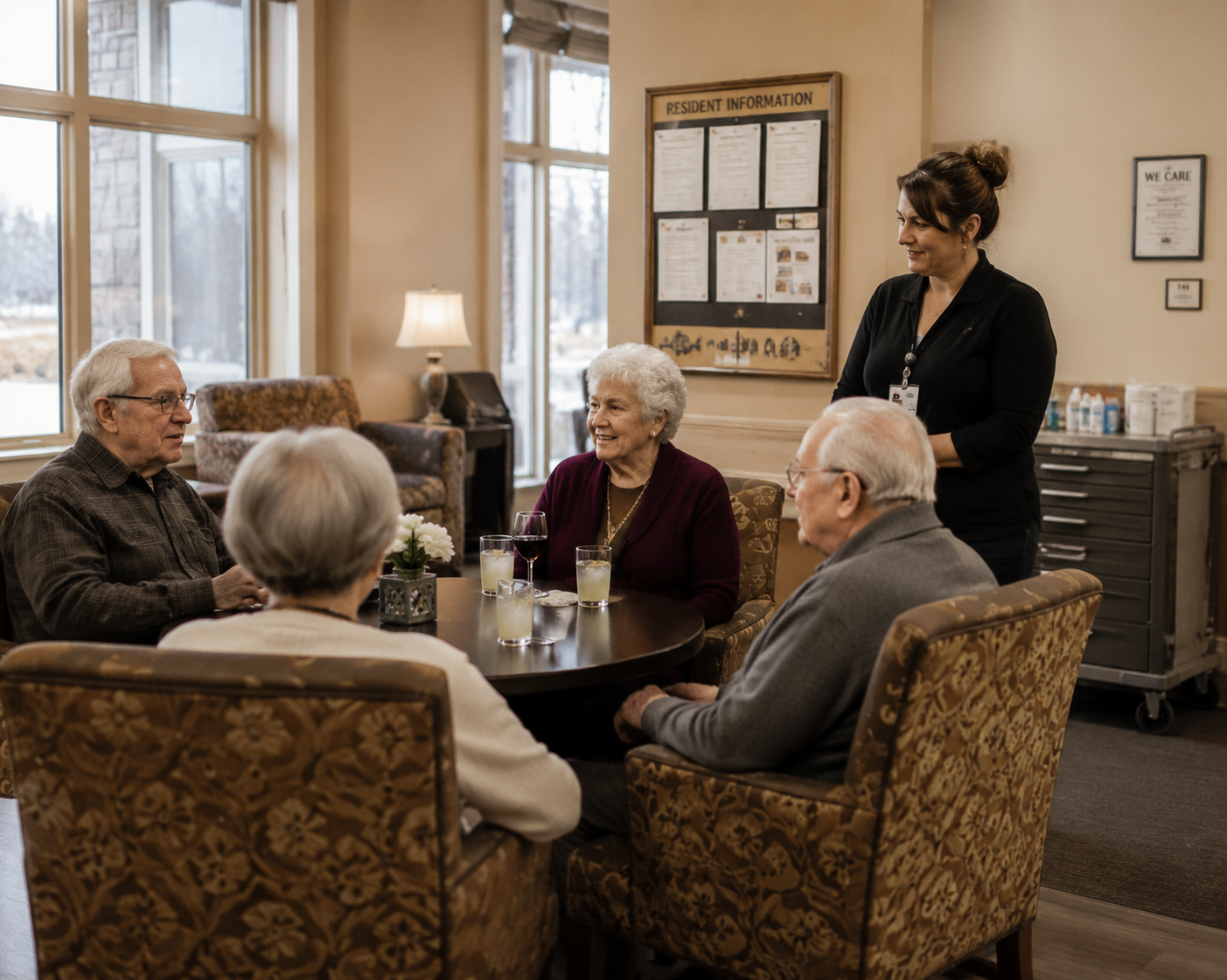
The public story behind the law is unusually easy to understand. Residents at Amira Choice Champlin in Champlin, Minnesota, reportedly pushed for the change after being told that the community would need a liquor license to host a resident happy hour. The resulting coverage attached the phrase “Grandparents’ Happy Hour” to the bill, a label that captured the everyday nature of the request: older adults wanted a social drink with neighbors, not a new commercial bar inside a care setting.[2][3]
That story explains the political appeal, but it does not answer the compliance question. The harder question is what a licensed care provider must be able to show after the toast is over: who qualified for the exemption, what event was being held, who was served, whether anything of value changed hands, whether DPS was notified, and how the facility handled clinical risks that never disappeared merely because the liquor-license barrier changed.
Who Qualifies For The Exemption
Section 340A.4015 applies to three categories of licensed care settings: nursing homes as defined in Section 144A.01, subdivision 5; boarding care homes licensed under Minnesota Rules, chapter 4655; and assisted living facilities as defined in Section 144G.08, subdivision 7.[1] The facility also must hold the valid health-related license required for its category.[1]
That is the first eligibility screen. The exemption is not written for senior apartment communities generally, unlicensed social clubs, outside caterers, family-hosted gatherings on unrelated property, or any operator that merely serves older adults. It is tied to specified Minnesota-licensed care settings, and the facility’s health license is not just background context; it is one of the statutory conditions.
For assisted living operators, the licensing connection should also prevent a common misread. The alcohol exemption does not move the event outside the regulated care environment. It allows qualifying alcohol service without a liquor license only inside a framework where the facility remains accountable as a licensed provider.
The Six Conditions Are The Core Control
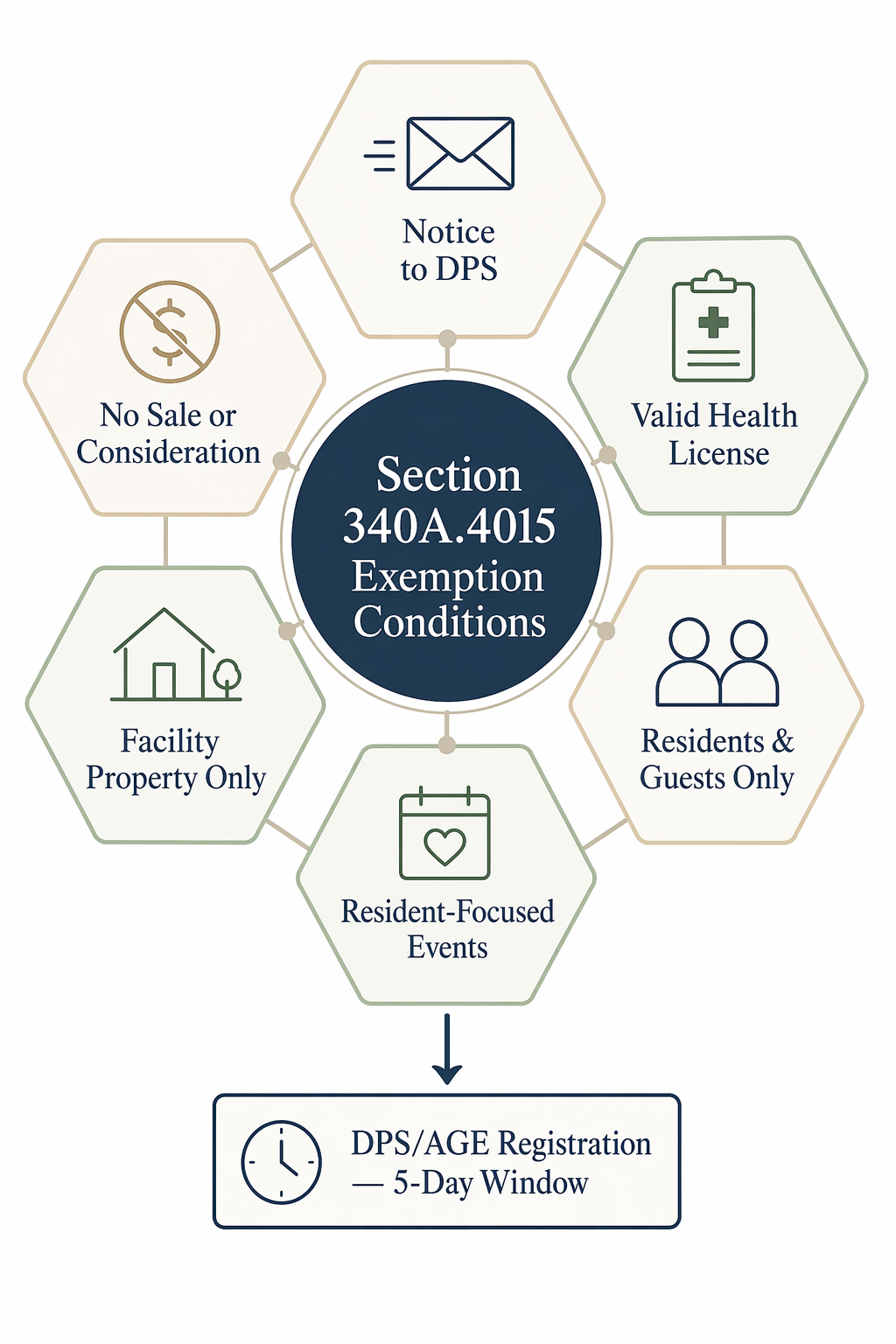
The exemption depends on six statutory conditions. A qualifying facility must provide written notice to the Department of Public Safety; hold the required valid health-related license; serve alcohol only to residents and their physically accompanied guests; limit service to resident-focused events; provide service only on the facility’s property; and ensure that no sale or consideration of any kind is charged or received for the alcohol.[1]
| Condition | Operational Meaning |
|---|---|
| Written notice to DPS | The facility should not treat the exemption as self-executing without a notification record. |
| Valid health-related license | The facility must fit one of the covered licensed provider categories and maintain the relevant license. |
| Residents and physically accompanied guests only | The event population is limited; the exemption is not for public service. |
| Resident-focused events only | The purpose and audience of the event should be resident-centered. |
| Facility property only | The exemption is tied to the covered facility’s property. |
| No sale or consideration | The facility may not charge or receive anything of value for the alcohol. |
The “residents and physically accompanied guests” language does real work. A resident’s guest is not simply anyone with a relationship to the facility. The guest must be physically accompanied, and the service must remain tethered to the resident-centered event. That phrasing gives a compliance officer something concrete to build into sign-in, staff instruction, and event monitoring.
The “resident-focused event” condition also keeps the exemption from becoming a general hospitality permission. A resident social hour, holiday gathering, or similar activity may fit the statutory idea if the other conditions are met. A public-facing promotional event, a paid fundraiser, or an event whose real audience is not residents would be harder to square with the language. The statute’s focus is not alcohol as an amenity for marketing; it is alcohol service within a resident-centered activity.
The facility-property limit is similarly plain but easy to overlook. The exemption follows the covered facility setting. If an activity moves off the facility’s property, the operator should not assume Section 340A.4015 travels with it. The law was drafted around service by licensed care settings on their own property, not around all social activities involving residents.
The No-Consideration Rule Deserves Its Own Review
The condition most likely to be mishandled in ordinary operations is the prohibition on sale or consideration. Section 340A.4015 says no sale or consideration of any kind may be charged or received for the alcohol.[1] That is broader than “do not sell drink tickets.” It should make operators examine activity fees, bundled event charges, admission-style packages, donations connected to the event, or any accounting treatment that could look like the facility received value in exchange for alcohol.
This is where cheerful programming language can create poor records. If a calendar notice says “wine tasting included with premium event package,” the facility has created a different evidentiary problem from a no-charge resident social event where alcohol is simply served under the exemption. The statute does not require a resident to pay separately for a drink before consideration becomes a concern. The phrase “of any kind” should push review beyond the bar table.
DPS Notice And The Five-Day Processing Window
Written notice to DPS is the first listed condition, and implementation guidance has treated that notice as a one-time registration through the Alcohol and Gambling Enforcement Division. LeadingAge Minnesota advised providers that the registration process includes a five-day processing window.[4] That is a small procedural fact with outsized risk: it is exactly the kind of deadline that can be missed when leadership approves an event before anyone has checked the state process.
Facilities should preserve the notice record, the date submitted, confirmation of processing if available, and the internal decision that no alcohol service will begin until the notice requirement has been satisfied. A calendar entry alone is not a compliance file. If the exemption is questioned later, the operator should be able to produce a record that maps back to Section 340A.4015 rather than relying on staff memory.
There is also a pre-effective-date wrinkle. As of July 20, 2026, the DPS/AGE page identified at dps.mn.gov/divisions/age/alcohol/nursing-homes-boarding-care-homes-and-assisted-living-facilities returned a 404. LeadingAge Minnesota, however, reported on June 4, 2026, that the page was live and accepting registrations.[4] Before implementation, providers should verify the current DPS URL, check for revised forms or instructions, and contact AGE directly if the online path is unavailable.
Because the effective date is August 1, 2026, any DPS procedural update issued between July 20 and the effective date could matter. A facility that prints a June newsletter and stops there may miss the actual form, submission method, confirmation language, or processing expectation in force when service begins.
The Enforcement Provision Is Not Decorative
Section 340A.4015 gives DPS inspection authority and links violations to enforcement under Section 340A.415. The statute authorizes consequences that may include a corrective action plan, mandatory staff training, or prohibition of alcohol service under the exemption.[1] That is a meaningful enforcement pathway, not a courtesy reminder.
The statute also creates a cross-agency path. DPS may refer to the Minnesota Department of Health any pattern of unsafe service, health risk associated with alcohol service or storage, or other issue within MDH’s authority.[1] In practice, that means a facility’s alcohol-control problem can become a healthcare-licensing problem if the facts implicate resident safety, storage, supervision, or care obligations.
This split is where operators should be careful with internal ownership. DPS notice may sit with compliance or administration. Event planning may sit with activities. Resident screening may sit with nursing. Documentation may sit across all three. If no one owns the handoff, the facility can satisfy one part of the process while leaving another part exposed.
Alcohol Law Still Applies Around The Exemption
The exemption removes a liquor-license requirement only for qualifying service. It does not erase the rest of Chapter 340A or related alcohol-control rules. Care Providers of Minnesota has reminded providers that obligations involving over-service to intoxicated persons, underage access, unlawful furnishing, and Minnesota Rules chapter 7515 remain relevant.[5]
That distinction should shape staff training. The training message is not simply “we are now allowed to serve alcohol.” Staff need to know who may be served, where service may occur, when the event qualifies, what to do if a guest is not physically accompanied, how to respond to intoxication concerns, and who has authority to stop service. A license exemption without event-level controls is a fragile defense.
Clinical Duties Remain In The Room
The most serious operational mistake would be to treat the liquor-license question as the whole risk analysis. Nurse.org reported concerns from nurses about medication interactions involving blood thinners, sedatives, and antidepressants, as well as fall risk, cognitive impairment, and the absence of clear staff protocols.[6] Those concerns do not decide whether a liquor license is required. They do affect whether a licensed care facility is managing residents safely.
The resident autonomy interest is real. Older adults do not lose ordinary social preferences because they live in a licensed setting. But a provider that administers medications, maintains service plans, monitors falls, or supports residents with cognitive impairment cannot pretend that a glass of wine is only a hospitality choice. The clinical review belongs before the event, not after an incident.
LeadingAge Minnesota and Care Providers of Minnesota have both pointed providers toward practical implementation steps such as reviewing resident care plans, assessing medication interactions, training staff, and maintaining documentation policies.[4][5] Those steps are not listed in Section 340A.4015 as separate liquor-license conditions, but they are the controls that help a facility reconcile the exemption with its continuing healthcare duties.
What The Legislative Record Adds
The legislative record helps explain why the bill was framed as resident-centered. During House coverage of the omnibus liquor bill, supporters described the measure as allowing residents to enjoy a happy hour with neighbors without requiring a facility to obtain a liquor license. The Consumer Advocates Coalition, including AARP Minnesota, the Minnesota Elder Justice Center, Legal Aid, and the Ombudsman, supported the idea that residents should not need a facility liquor license for that ordinary social activity.[7]
That advocacy context matters, but it should not be stretched into a broader permission than the statute gives. The coalition argument was about removing a licensing barrier for resident social life. The enacted provision still uses conditions, notice, inspection authority, and enforcement tools. It is resident-friendly legislation drafted as a regulated exemption.
A Practical Pre-Service File
Before serving alcohol under Section 340A.4015, a facility should be able to assemble a simple file that answers the predictable questions. The point is not to create paperwork for its own sake. The point is to make the exemption visible to the people who must apply it on a Friday afternoon and defensible to the people who may review it later.
- Eligibility: documentation that the provider is a covered nursing home, boarding care home, or assisted living facility with the required valid health-related license.
- DPS notice: proof of written notice or registration, submission date, processing confirmation if available, and the current AGE instructions used.
- Event scope: the calendar listing, purpose, location, and explanation showing that the event is resident-focused and held on facility property.
- Service limits: staff instructions covering residents, physically accompanied guests, underage access, intoxication concerns, and when to refuse or stop service.
- No-consideration review: confirmation that no sale, fee, donation, package charge, or other value is tied to the alcohol.
- Clinical review: resident care-plan and medication considerations, fall-risk or cognitive-impairment concerns, staff roles, and incident-response expectations.
The file does not need to be theatrical. It does need to be specific enough that a new activities director, charge nurse, administrator, or compliance officer can follow it without reconstructing the law from memory.
The Narrow Bottom Line
Minnesota’s new exemption is a meaningful change for residents and providers, and the catalyst story explains why it passed. It also leaves plenty of operational risk on the table. The facility must qualify, notify DPS, keep the event resident-focused, limit service to residents and physically accompanied guests, stay on facility property, avoid any sale or consideration, and remain ready for DPS inspection and possible MDH referral.
The safest reading is therefore modest: Section 340A.4015 removes a liquor-license requirement for qualifying service. It does not remove alcohol-law exposure, healthcare-licensing duties, clinical judgment, staff training, or documentation. Before the first event under the exemption, the operator should have verified eligibility, completed the DPS/AGE notice process, reviewed resident medication and care issues, trained staff on service limits, and preserved records tied to each statutory condition.
References
- SF 2511 2nd Engrossment — 94th Legislature (2025–2026), Minnesota Revisor of Statutes,
- New Minnesota Law Lets Assisted Living Communities Have Happy Hours, Sans Liquor License, Senior Housing News, July 15, 2026,
- Minnesota's 'Grandparents' Happy Hour' bill signed into law, CBS Minnesota, July 15, 2026,
- What Providers Need to Know About Minnesota's New Happy Hour Process, LeadingAge Minnesota, June 4, 2026,
- New law clarifies alcohol service in licensed assisted living facilities, Care Providers of Minnesota,
- MN Just Legalized 'Happy Hour' in Nursing Homes, Without A License — Nurses Have Concerns, Nurse.org, April 23, 2026,
- Omnibus liquor bill that includes 'Grandparents' Happy Hour' passes House, MN House Session Daily, April 13, 2026,
Comments
Join the discussion with an anonymous comment.