
Minnesota's grandparents happy hour bill, now a 2026 law, does one deceptively simple thing: it lets certain senior living facilities serve alcohol without first obtaining a liquor license. For licensed nursing homes, boarding care homes, and assisted living facilities, the licensing barrier is gone if the facility notifies the Department of Public Safety. The harder questions did not disappear with it.
Effective April 22, 2026, the exemption allows those facilities to serve alcoholic beverages to residents and physically accompanied guests who are at least 21 years old, but only during organized activities on facility property. The law does not allow alcohol sales, cash bars, or service to the general public. Staff who are at least 18 may serve, and facilities remain exposed to enforcement for over-service, underage access, and unlawful possession.[1][2]
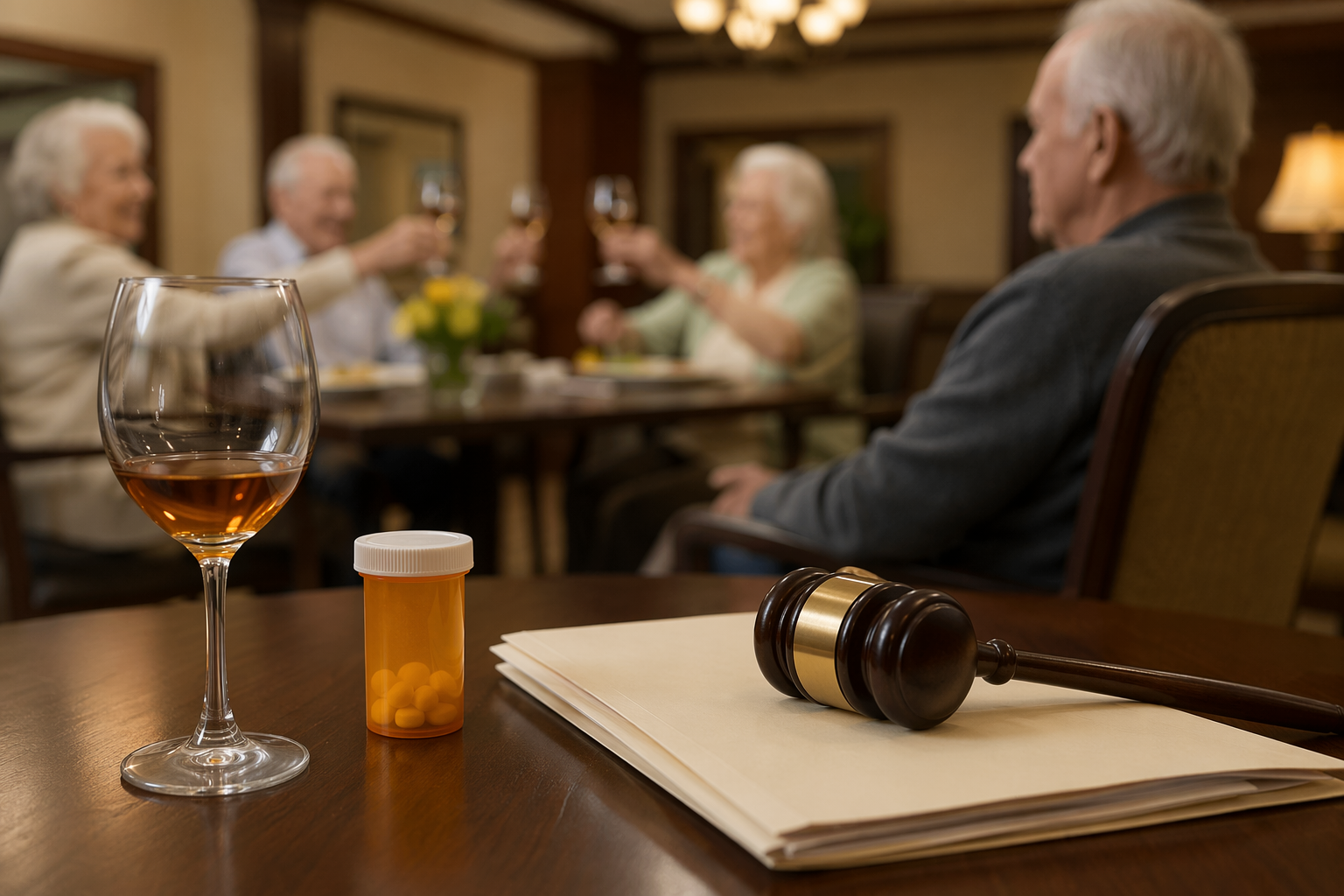
That is the before-and-after that matters for counsel. Before the law, a facility generally needed a liquor-license route before hosting the champagne toast, wine-and-cheese social, or beer-with-the-game activity. After the law, the state permits a narrow category of alcohol service without that license. But the statute does not say which resident is clinically fit to drink, who makes that call, what medication review is enough, or how a refusal should be documented when a resident objects.
What the exemption actually changes
The new law is not a general permission slip for alcohol in senior housing. It is a liquor-license exemption with conditions. The covered operators are licensed nursing homes, boarding care homes, and assisted living facilities. They must notify the Department of Public Safety before relying on the exemption. Service must occur as part of an organized activity on facility property. The recipients must be residents or physically accompanied guests who are 21 or older. Alcohol cannot be sold.[1][2]
| Statutory condition | Risk-management consequence |
|---|---|
| Facility must notify the Department of Public Safety | The facility creates a record that it affirmatively elected to serve alcohol. |
| Service is limited to organized activities on facility property | Policies should identify qualifying events, responsible staff, and supervision expectations. |
| Only residents and physically accompanied guests 21 or older may be served | Age and guest-control procedures still matter, even without a liquor license. |
| No sales or cash bars are allowed | Revenue-generating service remains outside the exemption. |
| Staff 18 or older may serve | The statute permits service by younger adult staff, but does not define clinical decision-making authority. |
| Over-service, underage access, and unlawful possession remain enforceable | The exemption does not remove alcohol-control exposure. |
The notification requirement deserves more attention than it will probably receive in day-to-day operations. It is easy to treat notice as a small administrative step. In a later incident file, however, that notice may become evidence that the facility made a deliberate operational choice to serve alcohol. That does not make the choice negligent. It does mean the facility should be able to show what system came with the choice.
The law also leaves existing health-facility oversight in place. The House materials describe the exemption while noting that covered facilities remain subject to Department of Health licensing and Department of Public Safety enforcement boundaries.[1][2] For a facility administrator, that means the liquor-license obstacle is removed, not the duty to operate a safe care environment under the facility's existing regulatory and tort-risk framework.
The gap is not alcohol service. It is resident-specific judgment.
The statute does not create a screening duty. It does not require a nurse review before service. It does not mention blood thinners, sedatives, antidepressants, diabetes drugs, cognitive impairment, swallowing concerns, fall history, or individualized care plans. Those omissions are not drafting trivia. They are where the most likely post-incident disputes will live.
Care Providers of Minnesota, in a July 2026 practical guide, recommends that facilities build policies addressing resident choice and informed decision-making, individual risk assessment including medication interactions, safe storage, staff responsibilities for recognizing intoxication, and documentation of service refusals.[3] That guidance is useful precisely because it speaks to the operational questions the statute does not answer. It should not be mistaken for a binding regulation.
A written policy should begin with a threshold distinction: the law permits a facility to serve alcohol, but the resident-specific decision still belongs inside the facility's clinical and care-management process. A resident may have the legal capacity and personal preference to drink at an activity. The facility may still need a process for identifying whether alcohol conflicts with known medication risks, care-plan restrictions, behavioral symptoms, physician orders, or recent changes in condition.
That process does not need to turn every social event into a formal medical encounter. It does need to be real enough that, after a fall, confusion episode, hypoglycemic event, altercation, or elopement concern, the facility is not left saying only that the Legislature allowed happy hour.
Medication interactions are the obvious first file
The clinical concern is not limited to heavy drinking. A nurse.org analysis warns that common medications in older adult populations, including blood thinners, sedatives, antidepressants, and diabetes medications, can interact negatively with even small amounts of alcohol, increasing risks such as dizziness, confusion, and falls.[4] That article is a clinical-opinion piece by a registered nurse, not a substitute for a facility's medical director, pharmacist, or treating-provider process. But it identifies the right operational problem: the server at the activity may not be the person equipped to decide whether a particular resident should receive a glass of wine.
For risk purposes, the medication issue should not be handled as a generic warning printed on an activity calendar. The relevant question is whether the facility has a way to flag residents for whom alcohol service should be restricted, reviewed, or discussed with the resident or representative before the event. If the facility uses an electronic health record, activity sign-up process, medication-administration review, or care-conference note, the policy should identify where the risk flag lives and who is expected to check it.
The law allows staff 18 or older to serve alcohol.[1][2] That service permission should not be confused with authority to make clinical judgments. A policy that lets an aide, server, receptionist, or activities assistant pour the drink but gives no instruction on when to pause service creates a predictable problem: the staff member closest to the resident has the least clarity about the decision the law leaves unassigned.
Cognition and refusal should be documented before they become testimony
Resident autonomy is a serious value here. An older adult does not lose the dignity of ordinary social choice merely because a facility is licensed or because a staff member is cautious. But autonomy cases become much harder to defend when the record is silent about the resident's understanding, the reason for a restriction, or the conversation that occurred when the resident disagreed.
Facilities should expect the most uncomfortable disputes to arise around residents who are neither plainly incapable nor plainly low-risk. A resident with intermittent confusion, a history of falls, a medication change, or a family member who insists on restriction may still want to participate. The Care Providers of Minnesota guide's emphasis on resident choice, informed decision-making, individualized risk assessment, staff responsibility, and documentation is useful because those are the categories that will later organize the chart review.[3]
A defensible record does not need theatrical detail. It should show the reason for any restriction, the person responsible for the decision, the resident or representative communication when appropriate, and what staff should do at the event. If service is refused at the point of activity, the record should capture more than the fact that the resident became upset. It should identify who refused service and why.
Storage and access can defeat a careful service policy
The statutory exemption is framed around service during organized activities. It does not solve storage, leftover alcohol, family-supplied bottles, unattended beverages, or residents carrying drinks away from the event. Because enforcement exposure remains for unlawful possession and underage access, the facility's alcohol-control procedure should follow the bottle before, during, and after the activity.[1][2]
Storage rules are not merely housekeeping. They determine whether the facility can say alcohol was controlled, who had access, and how staff prevented service from drifting beyond the statutory setting. A procedure that carefully limits pours during a scheduled event but leaves open bottles in an unlocked activity-room cabinet is not aligned with the risk the exemption preserves.
Why the law passed does not answer how to defend it
The legislative story is understandable. The proposal grew out of Amira Choice Champlin's inability to host a champagne toast after a renovation under existing city permit options. HF 4145, carried by Rep. Danny Nadeau, was folded into the omnibus liquor bill HF 2027/SF 2511. The House passed the broader bill 129-1, and the Senate passed it 56-10. The effort had bipartisan sponsorship from Nadeau, a Rogers Republican, and Sen. Matt Klein, a Mendota Heights DFLer.[2][5]
Supporters framed the change as a humane and practical fix. Abby Dahl, executive director of Amira Choice Senior Living, testified that assisted living facilities already operate under more than 500 health and safety regulations. The Consumer Advocates Coalition, including AARP Minnesota, the Minnesota Elder Justice Center, Legal Aid, and Ombudsman offices, supported the bill.[5]
That support matters because it shows the law was not simply an industry deregulation bill dressed up as a toast. It also explains why opposition was limited. Still, Rep. Leigh Finke cautioned during the process by pointing to Minnesota's 2,000 annual alcohol-related deaths.[5] Her concern does not convert a controlled glass of champagne in assisted living into a public-health crisis. It does underscore that alcohol is not legally or clinically neutral just because the setting is warm and the quantity may be small.
For operators and their counsel, the political appeal of the bill is not a litigation defense. A jury, regulator, insurer, or claimant's expert will not stop at the fact that the facility complied with the exemption. The follow-up questions are likely to be narrower and less forgiving: Was this resident assessed? Were medications reviewed? Who knew about the fall history? Did the resident understand the risk? Why did staff serve a second drink? Where was the refusal documented?
The policy file counsel should want to see
The Care Providers of Minnesota guide offers a practical map for facilities that want to move from permission to procedure. Because it is an industry association resource, it should be treated as recommended risk control rather than binding law. But if an incident occurs, the absence of policies on the very issues the guide identifies may be difficult to explain.[3]
- Eligibility and assessment: identify who reviews resident-specific risks, including medication interactions, cognitive status, fall history, and relevant care-plan limits.
- Event controls: define what counts as an organized activity, where service may occur, how quantities are limited, and who supervises service.
- Staff roles: separate the person who may pour or distribute alcohol from the person authorized to resolve clinical or behavioral concerns.
- Refusal and escalation: state when staff must decline service, who must be contacted, and how resident disagreement is handled.
- Storage and access: control unopened, opened, leftover, and resident- or family-supplied alcohol.
- Documentation: record notice to the Department of Public Safety, event details, resident restrictions, service refusals, and any post-event incident review.
The documentation point is not paperwork for its own sake. Once a facility has notified the Department of Public Safety, it has a clean record that it chose to enter the exemption. If alcohol is later alleged to have contributed to a fall, confusion, medication event, altercation, or injury to a guest, the facility's defense will depend less on the charm of the activity and more on whether the chart and policy file show a controlled decision-making process.
Counsel also should be careful about over-reading the national comparison point. Some industry coverage characterized Minnesota's previous approach as unusually strict, but the research available here does not include a verified 50-state survey. The safer conclusion is narrower: Minnesota has now removed a state liquor-license barrier for covered facilities under specified conditions. It has not created a comprehensive clinical protocol for alcohol service in elder-care settings.
The defensibility problem is foreseeable
The new law is narrow, and that is part of its appeal. It lets a facility host the kind of ordinary social moment that many residents and families reasonably value. It removes a licensing problem that could make a champagne toast legally cumbersome. It does not require facilities to sell alcohol, expand access, or turn activities programming into bar service.
But narrow permission is still permission. A facility that uses the exemption without written assessment criteria, defined staff responsibilities, intoxication-recognition procedures, storage controls, refusal protocols, and documentation practices is accepting exposure the statute does not resolve. The Grandparents' Happy Hour law authorizes a category of service. It does not supply the clinical risk system needed to make that service defensible.
References
- New Laws: Grandparents' happy hour, Minnesota House of Representatives
- Session Daily Story 19075: HF 2027/SF 2511 omnibus liquor bill coverage, Minnesota House of Representatives
- Care Providers of Minnesota: Practical guide on Grandparents' Happy Hour law, Care Providers of Minnesota, July 2026
- Nurse.org: Nursing Home Happy Hour Bill Raises Nurse Safety Concerns, nurse.org
- Session Daily Story 18994: HF 4145 grandparents' happy hour bill coverage, Minnesota House of Representatives
Comments
Join the discussion with an anonymous comment.