
Missouri Amendment 4 would change the approval rule for citizen-initiated constitutional amendments in a way that is easy to understate if it is described only as a “higher threshold.” A citizen proposal would still need to win statewide. But it would also need a majority in each of Missouri’s eight congressional districts. One district voting no would defeat the amendment, even if the statewide electorate voted yes by a large margin.
That is the legal center of the measure. The statewide majority would remain necessary, but it would no longer be sufficient. A geographically concentrated minority would acquire a veto over a statewide constitutional vote, and the veto would apply only to citizen-originated amendments, not to amendments referred by the General Assembly.

The practical effect is not speculative. A Missouri Independent analysis republished by the Springfield News-Leader calculated that, using 2024 turnout, as few as roughly 156,000 voters in a single low-turnout congressional district could block a citizen amendment supported by a statewide supermajority. That figure represented about 5.3% of 2024 turnout.[1]
Ballotpedia’s district-by-district analysis, reported by Bolts, gives the mechanism a record to test against. Every Missouri citizen-initiated constitutional amendment since 2020 would have failed under Amendment 4’s all-district approval rule. District 7 would have been the recurring blocking district.[2]
That retrospective result matters more than campaign language on either side. It shows that the rule is not merely a device for requiring broader consensus. It changes which votes are decisive. Once one congressional district rejects a citizen amendment, additional statewide support no longer has legal effect.
The Veto Is Geographic, Not Just Numerical
A supermajority rule asks the same statewide electorate to supply a larger share of yes votes. Amendment 4 asks something different. It divides the electorate into eight congressional-district electorates and gives each one a blocking right over citizen amendments.
That distinction is not formalism. A measure could win 58% statewide and still fail if one district records a no majority. Ballotpedia’s retrospective analysis found that Missouri’s 2024 minimum-wage and paid-sick-leave initiative, which passed 58% to 42%, would not have cleared the proposed district rule. The same analysis found that a 2016 tax-cap measure that received 57% support would have failed as well.[2]
| Approval Model | What It Requires | Legal Consequence |
|---|---|---|
| Current Missouri citizen-amendment rule | Statewide majority | Every yes and no vote contributes to one statewide result |
| Amendment 4 citizen-amendment rule | Statewide majority plus majority in all eight congressional districts | One district can defeat a statewide-winning citizen amendment |
| Missouri legislator-referred amendment rule under Amendment 4 | Statewide majority | The all-district veto does not apply |
The table’s third line is where the constitutional problem sharpens. Amendment 4 does not impose the same ratification structure on every proposed constitutional amendment. It burdens citizen-initiated amendments with district-level consent while leaving legislator-referred amendments on the ordinary statewide-majority track.
A state may have legitimate reasons to treat constitutional amendments differently from statutes. It may also decide that constitutional change should require more than a bare majority. But Amendment 4 is not simply a general entrenchment rule. It selects one path into the constitution—the citizen initiative—and makes votes against that path count differently depending on where they are cast.
Why the One-Person-One-Vote Issue Is Hard to Avoid
The most direct equal-protection objection is vote dilution. Under Amendment 4, a no vote in the decisive district can carry statewide blocking force that no yes vote elsewhere can overcome. The voter has not merely participated in a district-level tally; the district tally has been converted into a condition precedent for the statewide result.
Congressional districts are designed for representation in Congress, not for allocating veto power in statewide constitutional elections. Even when districts are equipopulous at the time of redistricting, turnout is not equal across districts. The Missouri Independent calculation illustrates the consequence: in a lower-turnout district, a comparatively small number of voters can supply the decisive no majority that defeats a statewide-supported citizen amendment.[1]
The constitutional question is not whether every voting rule that takes geography into account is invalid. States use districts for many lawful purposes. The problem is the conversion of one district’s result into a statewide veto in an election where the relevant office or measure is statewide. The voter in a non-blocking district may help produce a statewide majority and still be unable to affect the legally controlling condition.
That is why the strongest challenge would likely be framed not as a generalized objection to supermajority requirements, but as an objection to unequal voting consequences. Amendment 4 does not merely ask whether the state may make citizen amendments harder to pass. It asks whether the state may give one congressional district an independent veto over a statewide vote while denying comparable force to votes cast elsewhere.
The Asymmetry Between Citizen and Legislative Amendments
The unequal treatment of amendment sponsors is the second pressure point. Citizen-originated amendments would need to satisfy the all-district concurrent-majority rule. Legislator-referred amendments would not. They would continue to pass with a simple statewide majority.
That structure invites an equal-protection challenge because the state is not only setting a high bar for constitutional change. It is setting a higher bar for constitutional change when the proposal bypasses the legislature. The distinction maps onto political power: voters and petition organizers face the district veto; lawmakers do not.
There are arguments the state could offer. It could say citizen initiatives lack the deliberative screening of the legislative process, that the constitution should not be amended by narrow statewide coalitions, or that district approval ensures support across regions. Those are not frivolous interests. Initiatives can be blunt instruments, and expensive statewide campaigns can distort the text voters actually consider.
But the tailoring problem remains. If broad geographic consensus is essential for constitutional legitimacy, the reason for exempting legislator-referred amendments is not obvious. If a constitutional amendment can alter statewide rights, offices, taxes, or procedures, its legal effect does not become less constitutional because lawmakers placed it on the ballot.
This is where Amendment 4 differs from a clean supermajority rule. A uniform 60% statewide threshold may be debatable policy, but at least it applies the same arithmetic statewide. Amendment 4 creates two ratification systems inside one constitution and reserves the more onerous system for the path voters can use without legislative permission.
The Other Two Pieces Are Not the Legal Core
Amendment 4 also contains provisions addressing foreign contributions and petition fraud. Those provisions explain part of the political presentation of the measure, but they do not carry the same constitutional weight as the district-veto mechanism.
- The concurrent-majority provision would require citizen amendments to win statewide and in all eight congressional districts.
- The foreign-contributions provision addresses conduct already restricted under federal and Missouri law.
- The petition-fraud provision addresses conduct already covered by Missouri statute.
MultiState’s summary of the measure identifies those three components and notes that the foreign-contributions and petition-fraud subjects already exist elsewhere in law. It also reports a fiscal impact statement identifying annual Department of Corrections costs of $21,817 and unknown Public Defender costs.[3]
Calling those two provisions “ballot candy” is a political critique, not a complete legal analysis. Voters may care about fraud and foreign money even when a measure’s operative legal change lies elsewhere. Still, for constitutional purposes, the district approval rule is the provision that changes the weight and consequence of votes. The other provisions do not explain why a citizen amendment with statewide majority support should fail because one congressional district votes no.
Why Missouri Is Not Just Following Florida, Colorado, or Ohio
Supporters of higher thresholds often point to other states that require more than a simple majority for constitutional amendments. Florida requires 60% approval for constitutional amendments. Colorado requires 55% for many constitutional amendments. Ohio voters rejected Issue 1 in 2023, which would have raised the constitutional-amendment threshold to 60%.[4]
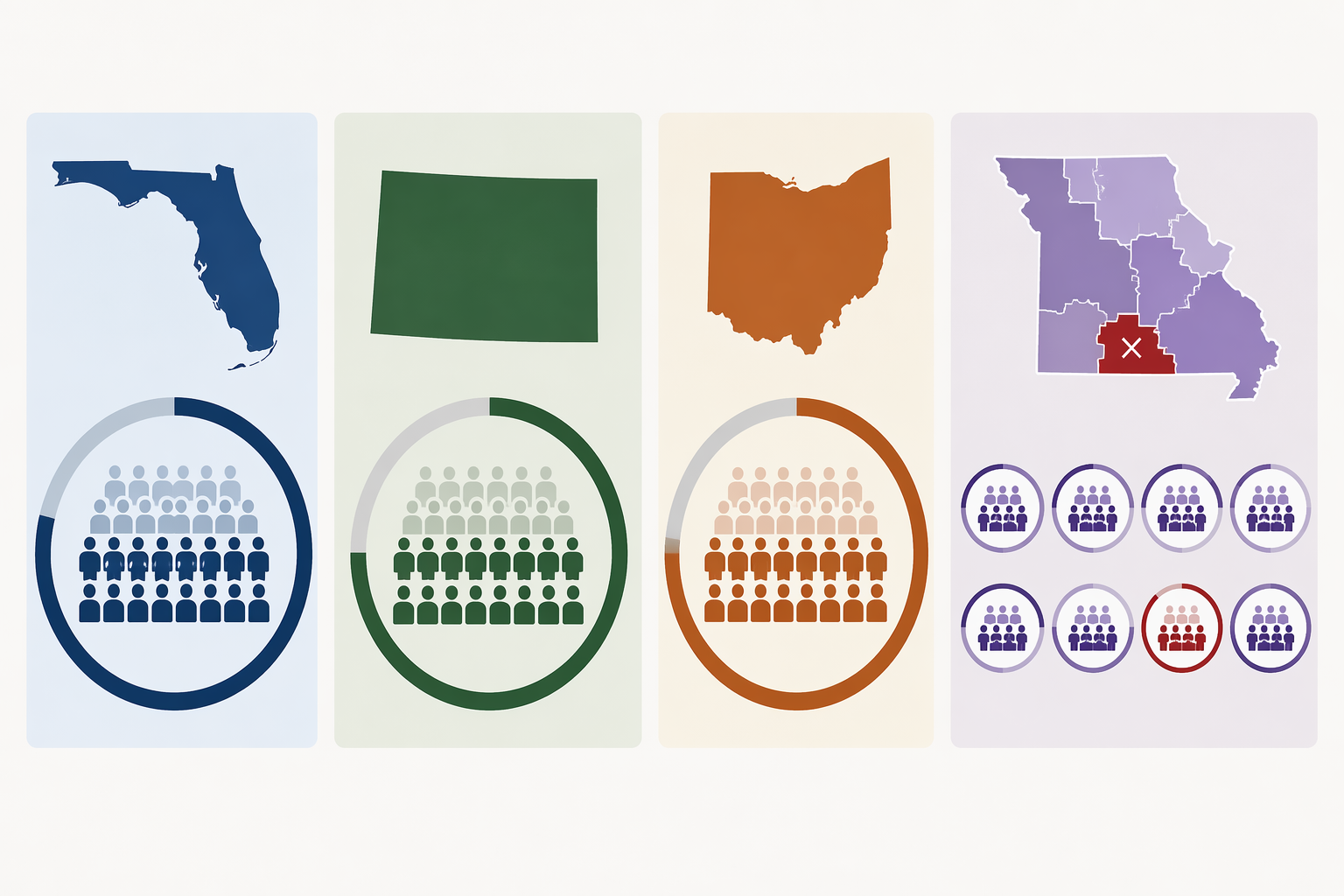
Those models are relevant, but they are not the same design. Florida and Colorado use statewide percentage thresholds. Ohio’s failed proposal also used a statewide percentage threshold. In those systems, votes remain pooled in one statewide electorate; the rule changes how much support is required, not whether a particular district can nullify support elsewhere.
Amendment 4 would do both less and more than a traditional supermajority rule. It would not necessarily require 60% statewide. A citizen amendment could receive just over 50% statewide and pass if it also won every district. But it could also receive well above 50% statewide and fail because of one district. That makes the burden turn on geographic distribution rather than only on total statewide support.
The comparison also exposes the asymmetry problem. A statewide 60% rule can be defended as a judgment about constitutional entrenchment generally. Amendment 4 is harder to defend on that ground because legislator-referred amendments are not subject to the same geographic-consensus requirement.
The Procedural Calendar Matters, But It Is Not the Main Event
The measure reached the ballot through an accelerated political path. Missouri lawmakers took up the proposal in a September 2025 special session, passed it, and moved the vote from the November 2026 general election to the August 4, 2026 primary ballot, according to the Kansas City Star.[5]
That calendar may matter for turnout, campaign strategy, and political legitimacy. It does not, by itself, establish the constitutional defect. The harder legal question is structural: whether the state may condition citizen-initiated amendments on unanimous district approval while allowing legislator-referred amendments to pass by statewide majority.
As of July 21, 2026, there are no election results or reliable polling that would support confident claims about the outcome. The legal case should not be dressed up as prediction. The vote may turn on campaign conditions outside the current public record. The constitutional issue will exist if the measure passes.
What a Challenge Would Likely Target
A post-adoption challenge would likely focus on two linked features: the vote-dilution effect of the single-district veto and the differential treatment of citizen-initiated amendments. The plaintiff’s theory would not need to deny that states can regulate initiatives. It would instead press the narrower claim that once a state offers a statewide constitutional initiative process, it cannot allocate voting power in a way that lets one congressional district defeat the statewide electorate only for citizen-originated proposals.
The unresolved issue is the standard of review. If a court treats the rule as a severe burden on voting equality in a statewide election, the state would face a more demanding justification. If a court treats the initiative process as a state-created lawmaking mechanism subject to broad procedural regulation, the state may receive more deference. The available materials do not settle which path a court would take.
That uncertainty should not be mistaken for weakness in the claim. The most vulnerable feature is not simply that Amendment 4 makes initiatives harder. It is that the measure makes some no votes structurally more powerful than other votes and does so only when the amendment comes from citizens rather than legislators.
There is also a practical recursion problem. The Respect MO Voters measure, described in reporting on the competing ballot fight, is designed to protect the initiative process. If Amendment 4 takes effect first, efforts to restore or protect that process may themselves have to clear the all-district veto.[5]
That is the design’s most revealing consequence. The initiative process would remain formally available, but the path around legislative inaction would be made dependent on concurrence from every congressional district. If Amendment 4 passes, the strongest constitutional challenge will likely target that structural asymmetry and its vote-dilution effects. Whether a court applies strict scrutiny, a more deferential standard, or something in between remains open.
References
- Missouri Amendment 4 would let one district block statewide votes, Springfield News-Leader, June 19, 2026
- Missouri amendment on ballot initiatives, Bolts
- What Are Citizen Initiatives? Missouri as 2026 Direct Democracy Battleground, MultiState, December 10, 2025
- Direct democracy state constitutional amendment thresholds, NPR, July 14, 2026
- Missouri Amendment 4 ballot coverage, Kansas City Star
Comments
Join the discussion with an anonymous comment.