
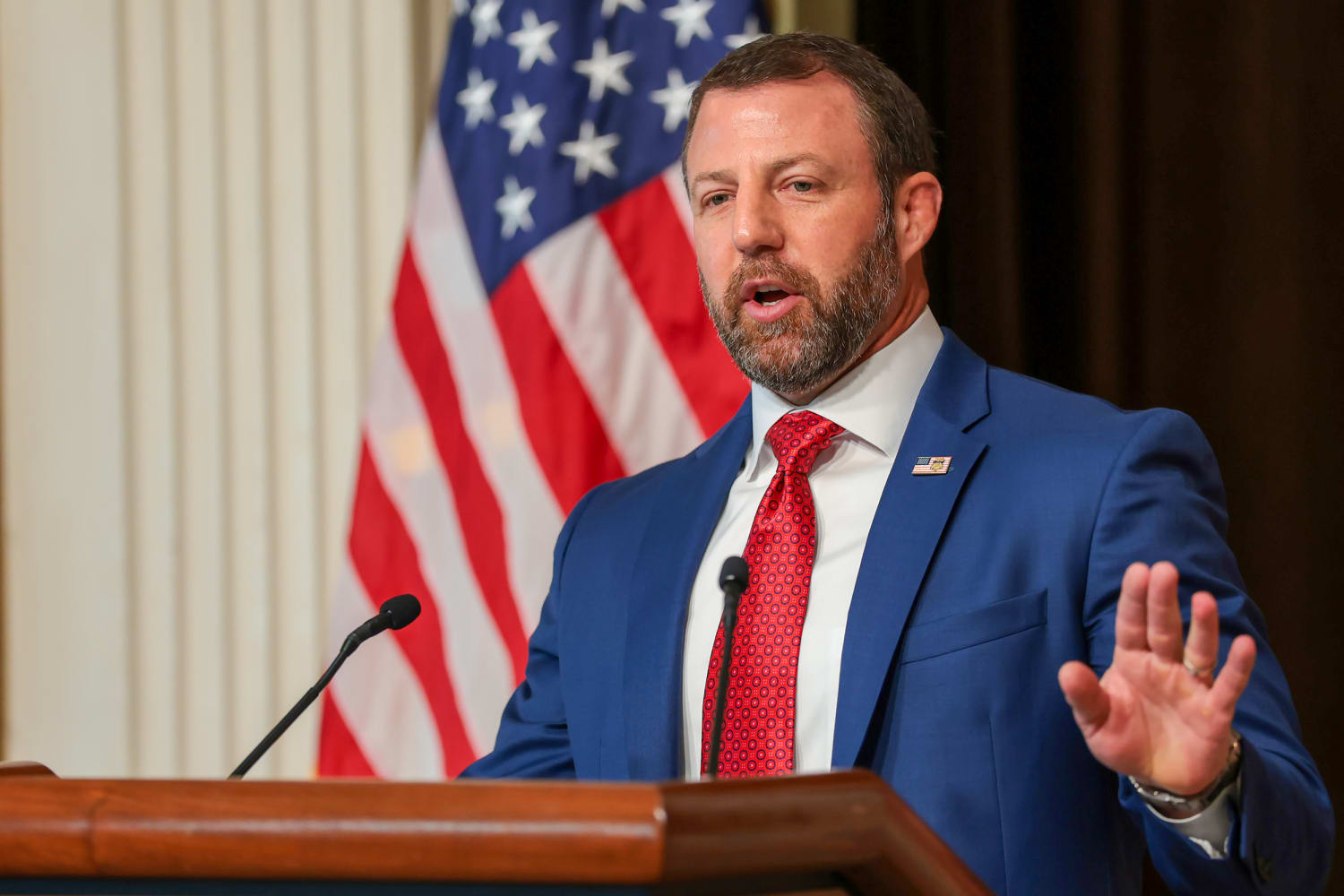
On July 17, Homeland Security Secretary Markwayne Mullin told reporters that election officials could go to jail if they refused to cooperate with federal voter-roll demands, tying the threat to a DHS claim that more than 250,000 noncitizens are on the rolls. That is not a harmless flourish. It is a prosecution claim, and it has to survive the usual questions: who has power over elections, which statute creates the duty, and what conduct would actually be criminal. [1]
The office matters
The first legal cut is the easiest one. Mullin is speaking as DHS secretary, not as a senator, and DHS does not control federal charging decisions. More important, Article I, Section 4 gives the states the primary job of running elections unless Congress validly displaces them. That means a federal executive demand does not become an election-law command just because it arrives with agency letterhead. [2]
A state election director can still choose to cooperate with a federal inquiry, but the constitutional baseline is the opposite of the threat posture: the federal executive cannot simply announce a new obligation and then treat refusal as criminal contempt of a federal election regime that does not exist.
Where the prosecution theory breaks
The Justice Department has already been sending warning letters of its own. Reuters reported on July 8 that DOJ told state officials they could be prosecuted over noncitizen voter rolls.[3] That still leaves a hard gap between a warning letter and a viable jail case. The statutes DOJ invokes do not cleanly supply a criminal theory for an election administrator who declines to hand over data on demand. The National Voter Registration Act is about list maintenance and notice procedures, not a free-standing federal power to commandeer state rolls. The Help America Vote Act does not contain an express disclosure command that turns every delay or refusal into a crime. The Privacy Act can also limit disclosure of federal records absent the procedures Congress required. And the election-crime statutes the administration gestures toward are aimed at specific misconduct — falsification, coercion, obstruction, or knowing interference — not a generic refusal to adopt DHS's preferred data-sharing method.
The same problem runs through the SAVE database. A federal judge has blocked its use for voter-roll checks, and a federal agency cannot convert a disputed data source into a jail theory before the underlying access question is resolved.
The litigation record
The enforcement pattern looks broader than one press conference. Brennan Center tracking shows DOJ has sued 30 states seeking voter information, but 15 of those cases have been dismissed and none has produced a final win for the government.[4] That does not prove every appeal will fail, but it does show how little settled law the administration has to lean on.
That matters because a prosecution theory needs more than a publicity cycle. If the underlying disclosure theory keeps losing in civil court, it is harder to turn the same premise into a clean criminal charge against county counsel, registrars, or state election directors.
The evidence problem
The factual claim anchoring the threat is also thin. A Georgia audit found 20 noncitizens among 8.2 million registrants, a rate of 0.00024%.[5] That is not nothing, but it is a far cry from the scale implied by a claim of 250,000-plus noncitizens on the rolls.
Rick Hasen put the evidentiary mismatch bluntly: "If his government had actual evidence of noncitizen voting, there would be indictments."[6] That is the right way to read the present record. The administration has made a threat, but the public record still shows a large gap between accusation and proof.
What counsel should treat as real risk
None of this means election administrators can ignore the pressure. Officials can still face exposure if they destroy records, obstruct lawful process, discriminate, or violate a court order. State-law election-interference provisions may also matter; Wisconsin Law School's survey notes that states including California, Pennsylvania, Delaware, Mississippi, and Arizona have laws that could reach federal actors in some circumstances.[7]
So the practical response is narrower than panic but firmer than dismissal. Preserve records. Document the legal reason for any refusal or limited disclosure. Track DOJ letters and any appeal activity. Confirm whether a state-law backstop applies before treating a federal demand as self-executing. The right reading of Mullin's threat is not that nothing can happen, but that the current federal theory does not yet look like a prosecution path a competent government lawyer would expect to win.
References
- Homeland Security Secretary Markwayne Mullin threatens states' election officials with jail over voter rolls — NBC News, July 17, 2026
- Can the federal government force states to hand over citizens' voter information? — Wisconsin Law School
- US Justice Department tells state officials they could be prosecuted over noncitizen voter rolls — Reuters, July 8, 2026
- Tracker: Justice Department Requests for Voter Information — Brennan Center
- Trump tries to undermine trust in elections but documents don't support his claims — PBS NewsHour
- If his government had actual evidence of noncitizen voting, there would be indictments — Election Law Blog
- Can state prohibitions on election interference constrain federal actors? — Wisconsin Law School
Comments
Join the discussion with an anonymous comment.