
As of July 21-22, 2026, the MV Barima sinking has left 41 bodies recovered, 77 people rescued, and roughly 179 believed aboard, while officials still treat the death toll as provisional and one report says the final count could reach 110.[3][4]
The count is still moving
The public record hardened fast. Early reporting described two dead and several still missing, then the figure rose to 27 dead and 83 missing, before the search effort reached 41 bodies recovered by July 21.[1][2][3] That pace matters because the legal exposure expands with every confirmed body: the case is no longer just about a capsizing, but about how many people were on board, who approved the loading, and whether the record was complete when the voyage began.
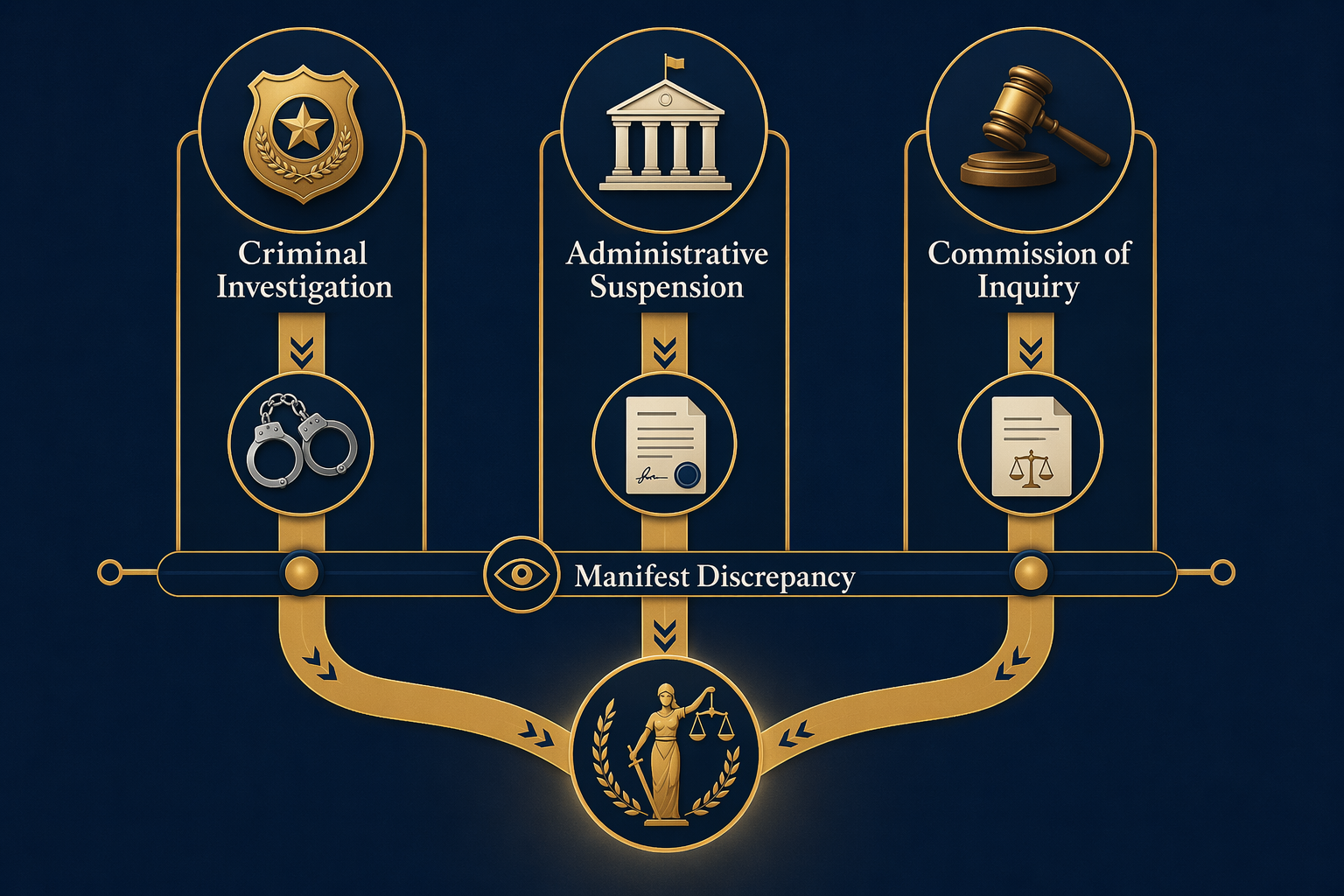
What the accountability tracks are doing now
| Track | Current step | Why it matters |
|---|---|---|
| Criminal investigation | The captain and first engineer have been arrested; reporting says the captain tested positive for cannabis, a mate tested negative on a separate panel, and public reporting has not yet confirmed formal charges.[1][5] | This is the clearest route to personal liability and the only track already moving through custody and evidence testing. |
| Administrative suspension | The entire loading and dispatch management team has been suspended pending internal review, and video footage from Kingston Wharf has been seized.[7][8] | The state is already trying to freeze the record before it decides who failed and where the chain of supervision broke. |
| Political inquiry | Opposition voices are pushing for a Commission of Inquiry under the Commission of Inquiry Act, Chapter 19:03, together with document disclosure.[9][10] | A COI can compel witnesses and records in a way an internal probe usually cannot. |
Criminal track
The criminal file is the most concrete because it already has named suspects and a drug-test result. Police have arrested the captain and first engineer, and reporting says the captain tested positive for cannabis while a different panel on the mate came back negative.[1][5] Prime Minister Mark Phillips has said that where negligence, misconduct or criminal wrongdoing is established, those responsible will face the full force of the law.[6] That is still a conditional statement, not a charge sheet. The record so far shows detention and testing, but not yet a public charging theory.
Administrative suspension
The administrative response has moved faster than any courtroom process. The entire loading and dispatch management team was suspended to protect the integrity of the inquiry, and investigators seized wharf video as they tried to lock down the evidence before it could be rewritten or lost.[7][8] That does not prove fault, but it does show the government treating the event as a record-preservation problem as much as a rescue operation.
Political pressure for a Commission of Inquiry
The political demand is broader and more forceful: an independent Commission of Inquiry under the Commission of Inquiry Act, Chapter 19:03, with compulsory powers over witnesses and documents.[9][10] That matters because the immediate question is not whether officials can produce a press statement, but whether they can be made to produce manifests, loading instructions, dispatch records, and any correspondence that explains why the voyage left with so many names missing or disputed.
The manifest problem is the separate legal risk
The issue most likely to outlast the search phase is the manifest discrepancy. Reporting says only 35 of 67 rescued passengers were on the official manifest, and Minister Edghill called that "criminal action" and "mischief," while describing off-manifest boarding as a decades-old practice.[8] If that record was incomplete, altered, or knowingly tolerated as incomplete, the legal problem is no longer limited to negligence at sea. It becomes a paper trail problem, with possible exposure for falsification of an official document or for allowing an inaccurate passenger list to stand as the vessel's formal record.
What remains unresolved
The Barima itself is part of the legal context, but not the whole explanation. The vessel was built in 1939, last dry-docked in 2024, and described by officials as certified for 397 passengers and 284 tonnes of cargo, with 250 life jackets, six inflatable rafts, and two rigid rafts on board.[11] Those specifications matter because they frame the arguments that may follow over seaworthiness, loading, and compliance, but they do not yet settle causation. The government has not released a final finding on whether overloading, a rogue wave, structural failure, impairment, or some combination drove the sinking. For now, the serious point is simpler: criminal, administrative, and political accountability are all already underway, and the manifest discrepancy is the clearest issue that can survive the rescue phase and become its own evidentiary problem.
References
- MV Barima Tragedy: Captain arrested after positive drug test — WIC News
- Guyana ferry capsize leaves 27 dead and 83 missing — BBC News
- 41 bodies from MV Barima tragedy recovered — Demerara Waves Online News — July 21, 2026
- MV Barima Disaster… Death toll could reach 110 — Kaieteur News — July 21, 2026
- MV Barima capsize: Captain arrested after drug test — AFRO American Newspapers / AP
- Government launches full investigation as MV Barima search & rescue continues — DPI Guyana
- Entire MV Barima management team suspended pending investigation — Ignite News — July 20, 2026
- Major discrepancies found on MV Barima manifest — Kaieteur News — July 20, 2026
- TMV Barima tragedy: AFC calls for removal of Minister, MARAD boss — Guyana Standard — July 20, 2026
- An urgent call for an independent, transparent and internationally supported commission of inquiry into the MV Barima tragedy and for comprehensive maritime safety reform in the Cooperative Republic — Village Voice News — July 21, 2026
- MV Barima was seaworthy – Min Edghill — DPI Guyana
Comments
Join the discussion with an anonymous comment.