
The AIVD's July 10, 2026 warning matters because it turns a familiar camera-security story into a live espionage file: compromised internet-connected cameras near Dutch military logistics routes, with access in Ukraine used to target Ukrainian personnel. [1] For legal operations, the hard part is not the label on the campaign; it is that many organizations will not yet know whether they are confirmed victims, whether their cameras sit on the AIVD notification list, or whether the first reportable fact is still only suspicion.
Q3 2026 leaves little room for a single-track response. Dutch Digital Government says the Cyberbeveiligingswet was approved by the Senate on July 7 and takes effect on Aug. 15, covering more than 8,000 organizations. [2] A separate CRA overview places manufacturer-side reporting duties from Sep. 11, 2026, including 24-hour notification for actively exploited vulnerabilities and fines up to EUR 15 million or 2.5% of global turnover. [3] That means the same camera, vendor record, and incident memo may have to support GDPR, NIS2/Cbw, and CRA analysis at once.
Scale matters, but only as a lower bound. Censys counted 87,000-plus internet-connected camera hosts in the EU and NATO region with known exploited vulnerabilities, while a 2025 Bitsight/SC Media report had already described more than 40,000 exposed security cameras. [4][5] Neither figure proves compromise by itself; together they show why a camera incident can move from abstract IoT risk to an evidence-preservation problem very quickly.
When the clock starts
The first question is not whether the camera was part of a foreign intelligence operation. It is when the organization had enough information to treat the event as real enough to hold evidence and triage legal duties. The July 10 advisory can be that moment, even before a confirmed AIVD notification arrives. [1] Once that happens, the file should already include footage retention settings, admin-access logs, vendor communications, firmware versions, and a note on who inside the organization can stop routine deletion or reimaging.
- Freeze deletion and overwrite cycles for relevant cameras, exports, and access logs.
- Mark the earliest timestamp at which breach awareness could reasonably exist, not the later date when certainty arrives.
- Separate the operator entity from the manufacturer or supplier entity.
- Record whether the event may involve personal data, operational security data, or both.
One incident, three regulatory files
| Date | Regime | What changes |
|---|---|---|
| July 10, 2026 [1] | AIVD advisory | Starts the legal hold conversation and may start the GDPR awareness clock. |
| Aug. 15, 2026 [2] | Cyberbeveiligingswet / NIS2 | Brings Dutch incident-reporting duties into force for in-scope organizations. |
| Sep. 11, 2026 [3] | EU Cyber Resilience Act | Pulls manufacturer-side active-vulnerability reporting into the same quarter. |
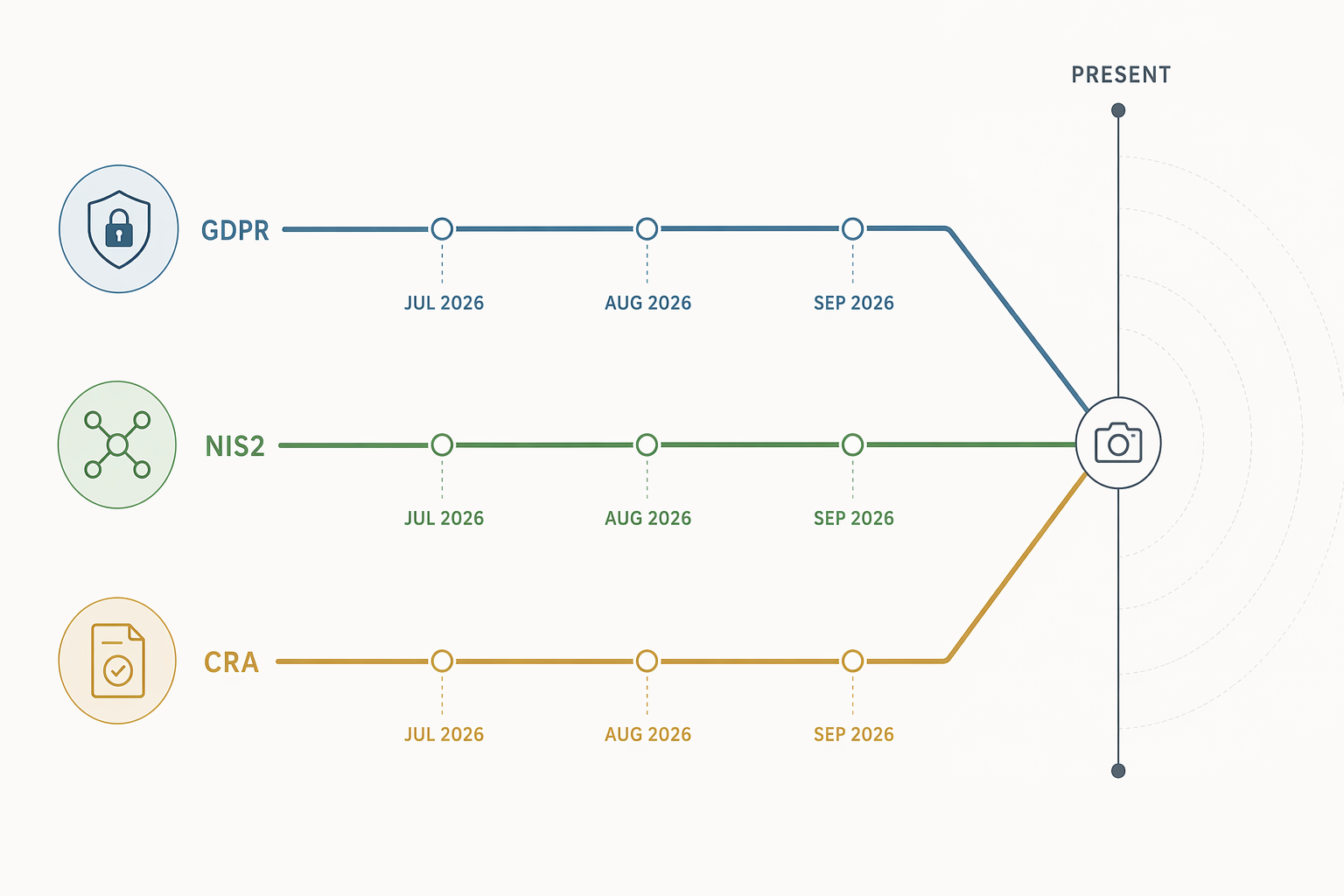
If the organization only operates the cameras, CRA may still matter indirectly through supplier questions and contractual notice chains; if it manufactures or white-labels the hardware or software, the Sep. 11 reporting obligations become direct. [3] The important point is that the legal map follows the entity and the role, not the device alone.
Civil liability does not wait for certainty
International law is not the main lever for the victim organization, but it is a useful boundary. DIIS notes that cyber espionage is not explicitly prohibited by international law, which is why the geopolitical story does not solve the company's disclosure problem. [6] Bloomberg Law's analysis of the Verkada breach is more useful for civil exposure: it collected wiretapping claims, invasion-of-privacy suits, CCPA private-rights exposure, and FTC or state AG action theories tied to surveillance-camera failures. [7] The Dutch response is not just theoretical, either; CADE reports that the Netherlands has expanded espionage offenses to cover cyber espionage, with penalties reported at 8 to 12 years. [8]
Insurance carriers will care less about the campaign narrative than about prompt notice, cooperation, forensic preservation, and whether internal statements stayed consistent with the facts that were known at the time. The same issue can trigger a privacy notice analysis, a cybersecurity incident report, a product-vulnerability inquiry, and a coverage conversation with different clocks and different audiences.
What a defensible record looks like
Before a confirmed AIVD notification arrives, the defensible move is to align privacy, cybersecurity, product, litigation, and insurance workflows around one evolving fact pattern rather than wait for one framework to finish before another begins. Preserve the evidence, identify which entity and vendor relationships are actually in scope, prepare conditional notification logic for GDPR, NIS2/Cbw, and CRA, and document why each reporting decision was made. That is less dramatic than treating the campaign as a grand cyberwar story, but it is the position that will still make sense when the file is read six months later. This is legal analysis, not legal advice.
References
- AIVD cybersecurity advisory brochure - AIVD - July 10, 2026
- Dutch Digital Government confirmation of Cyberbeveiligingswet timing - Dutch Digital Government - July 2026
- Cyber Resilience Act overview - Taylor Wessing - Nov. 2025
- Russia camera hacking espionage campaign - Censys - July 2026
- TRACE report on exposed security cameras - SC Media - June 2025
- Cyber espionage and international law - DIIS - Oct. 2023
- Verkada hack analysis - Bloomberg Law - March 2021
- Netherlands expands espionage laws to cyber espionage - CADE - May 2025
Comments
Join the discussion with an anonymous comment.