
The oddest thing about Peter Navarro’s contempt appeal was not that a criminal defendant pressed an aggressive executive-privilege theory. It was that, when the D.C. Circuit heard the case, the United States had stopped defending the conviction the United States had obtained.
In an Aug. 29, 2025 letter, the Justice Department told the court that it “is no longer taking the same position as the prior administration in this case” and asked to withdraw its brief defending Navarro’s contempt-of-Congress conviction.[1] The panel allowed the withdrawal. It also declined to appoint amicus counsel to stand in for the absent government. When Navarro’s lawyer finished arguing, Judge Patricia Millett observed that there was “nothing to rebut.”[2]
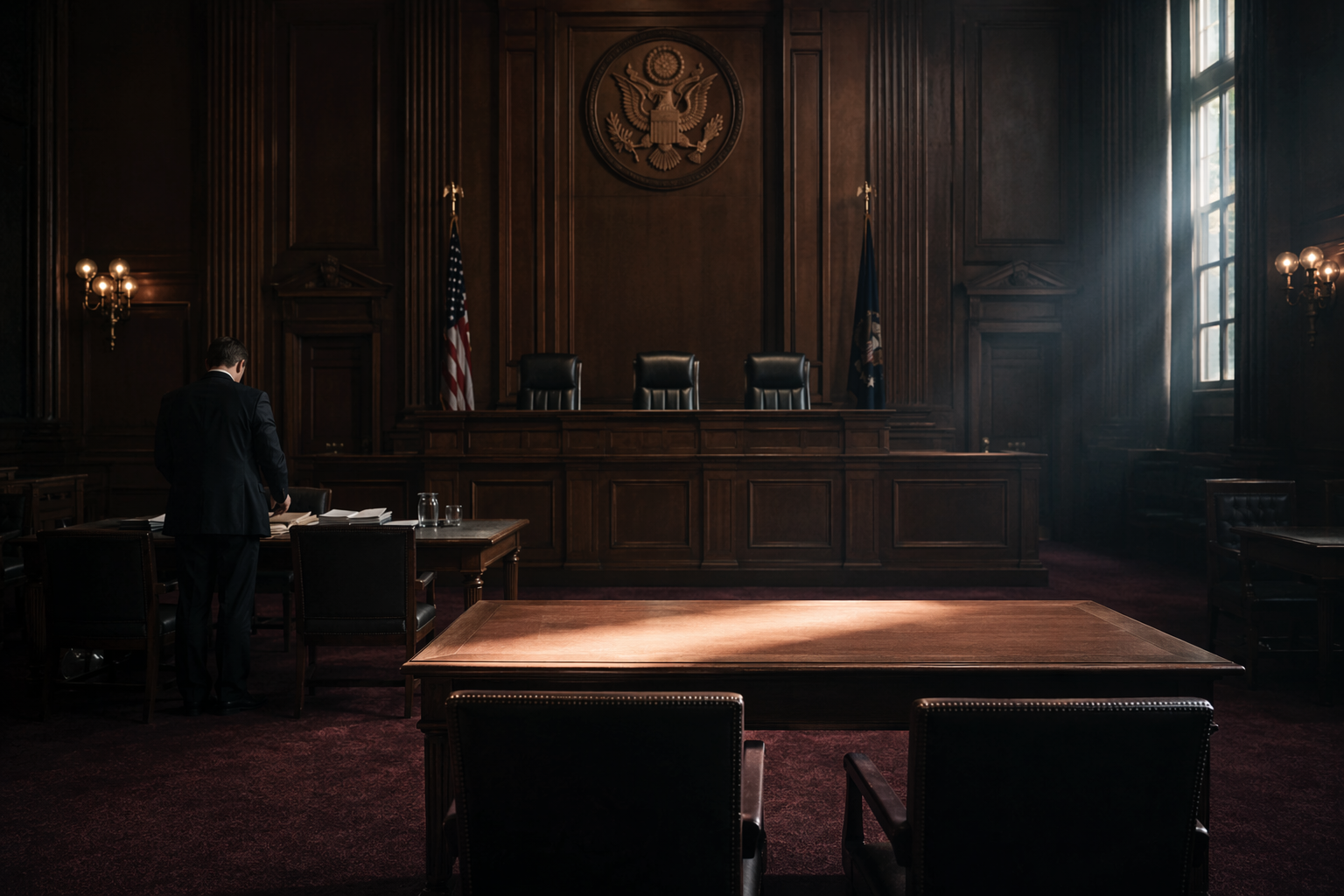
That sentence did more than describe the day’s argument calendar. It named the procedural problem. A criminal appeal usually assumes that someone will press against reversal: the government, defending its judgment; an amicus, if the government confesses error and the court wants adversarial testing; or at least a litigating posture that tells the court what the executive branch thinks remains worth defending. In Navarro’s appeal, the court had the defendant, the record, the briefs that had been withdrawn, and its own questions. What it did not have was an adversary defending the conviction on the merits.
On July 21, 2026, the D.C. Circuit unanimously affirmed Navarro’s conviction.[3][4] That result matters. It means the empty chair did not produce a reversal. But it does not make the episode ordinary. The court could decide the appeal. It could not recreate the missing institutional role.
The appeal that lost its appellee
Navarro had been convicted under 2 U.S.C. § 192, the federal contempt-of-Congress statute, after refusing to comply with a subpoena from the House committee investigating Jan. 6. The statutory background is not complicated for present purposes: Congress issued a subpoena; Navarro did not comply; the House referred the contempt; the Justice Department prosecuted; a jury convicted him; he appealed.
The harder question arrived later, after the administration changed. The Justice Department did not merely adjust an argument, abandon a weak subsidiary point, or confess error in a way that invited the court to decide whether the confession was correct. It withdrew its appellate defense and did not appear at oral argument. The court then declined to appoint another lawyer to defend the judgment.
That combination is what makes the Navarro appeal a useful test case. Any one piece might be manageable. New administrations change legal positions. The government sometimes confesses error. Courts are not required to appoint amici every time an adversarial gap appears. Defendants are entitled to use every procedural advantage that lawful government choices create. But when those pieces are stacked together after a conviction, the system reaches a point its ordinary habits do not fully cover.
The D.C. Circuit’s affirmance shows that appellate courts retain independent judgment. They are not obliged to reverse because the government has walked away. Yet criminal appeals are not designed as chambers memos with a defendant attached. They are designed around adversarial presentation, especially where the question is whether a validly entered criminal judgment should stand.
Why a withdrawn brief is different from confessed error
The easiest mistake is to treat this as a simple version of a familiar event: DOJ changes its mind. That happens. It happens across administrations, inside administrations, and after appellate review exposes weaknesses that trial prosecutors did not see or did not credit. There is nothing inherently scandalous about the Solicitor General, a U.S. Attorney’s Office, or Main Justice deciding that a prior position should no longer be defended.
Confessed error, however, at least gives the court a position to test. The government tells the court what it believes went wrong, what relief follows, and often how far the concession reaches. The court can accept, reject, narrow, or probe the confession. If the judges are concerned that the government’s new position lacks adversarial testing, they can appoint amicus counsel to defend the judgment or the reasoning below.
Withdrawal without replacement is thinner. It leaves the court with less to test. The government is not defending the conviction, but it is also not necessarily giving the court a full merits account of why the conviction should fall. The defendant argues for reversal. The court asks questions. No lawyer has the responsibility to answer as the appellee whose judgment is at stake.
That matters because the appellee’s role is not ceremonial. A government lawyer defending a criminal conviction identifies harmless-error arguments, record constraints, preservation problems, alternative grounds, statutory consequences, and administrability concerns that may not be apparent from the appellant’s framing. The lawyer also bears institutional duties: candor to the court, fidelity to the record, and responsibility for the consequences of the position being advanced.
Judges can and do find those issues themselves. But appellate judging is not supposed to depend on judges becoming substitute prosecutors. The point of adversarial briefing is not that judges lack intelligence; it is that role separation improves the reliability and legitimacy of the decision.
The conviction survived, but the gap remains
The July 21, 2026 affirmance makes the institutional problem easier to miss. Navarro lost. The panel was unanimous. News accounts of the opinion describe the court as rejecting his challenge and upholding the contempt conviction.[3][4] For many readers, that will sound like the system worked.
In one sense, it did. The court did not treat DOJ’s silence as dispositive. It did not vacate the conviction simply because a new administration disliked the prosecution or declined to stand behind it. That is an important judicial backstop.
But a backstop is not the same as an adversary. The court’s ability to reach the right answer in a particular case does not resolve whether appellate procedure has a workable answer for the next one. If the next abandoned conviction turns on a more complex record, a closer statutory question, or a procedural default argument the court does not develop on its own, the absence of an appellee could matter more.
Nor is the cost limited to judges. Career prosecutors who tried the case watch the institution that authorized their work later disown it. Defense counsel, quite properly, treat the withdrawal as part of the litigation terrain. Congress sees that contempt referrals may depend not only on the statute and the facts, but on which administration controls DOJ when the case reaches appeal. None of those effects is answered by saying the conviction was affirmed.
The old contempt framework did not anticipate this posture
Contempt-of-Congress prosecutions have always involved executive-branch judgment. A House or Senate referral does not mechanically produce an indictment. The Justice Department decides whether to prosecute, and longstanding executive-branch views have recognized discretion in that decision, including in disputes involving executive privilege and senior presidential aides.
The historical baseline often discussed in this area is the 1984 Office of Legal Counsel opinion on prosecutorial discretion in contempt cases. As Lawfare has explained in its discussion of DOJ’s Navarro, Mark Meadows, and Dan Scavino decisions, that framework has not been tested at this scale.[5] It addresses whether and when the executive branch may decline to prosecute congressional contempt referrals. It does not squarely answer what should happen when DOJ prosecutes, wins a conviction, and then a later administration refuses to defend that conviction on appeal.
That distinction is not technical. Before prosecution, the executive branch is deciding whether to bring the coercive power of the state to bear. After conviction, a jury verdict and a district court judgment have entered the system. The question is no longer only whether DOJ wants to spend resources on a case. It is also whether an already-entered criminal judgment will receive an adversarial defense before it is set aside or affirmed.
Existing doctrine gives DOJ room. It likely must. The executive branch cannot be forced in every circumstance to make arguments it believes are wrong. But the Navarro appeal exposes how little procedure says about the space between two familiar poles: full defense of the judgment and a reasoned confession of error. The government can step back; the court can permit it; the court may decline an amicus; and the appeal can proceed with no one assigned to defend the conviction.
Bannon makes the Navarro episode harder to treat as isolated
The Navarro withdrawal would be easier to cabin if it stood alone. It does not. In February 2026, DOJ moved to dismiss Steve Bannon’s contempt-of-Congress indictment entirely, going beyond a refusal to defend an appellate judgment. Deputy Attorney General Todd Blanche referred to the Jan. 6 committee as “Unselect,” language that made plain the political framing around the department’s action.[6]
The Bannon case should not swallow the Navarro analysis. The procedural postures were different. Navarro had been convicted and was on appeal; Bannon’s matter involved a DOJ motion to wipe out the indictment. But the cases point in the same direction: under the second Trump administration’s anti-weaponization posture, the department has used prosecutorial discretion not only to make forward-looking charging choices, but to undo or abandon Jan. 6-related contempt cases inherited from its predecessor.[6]
There are defensible reasons a new administration might revisit old prosecutions. If DOJ concludes that a case was unjust, legally unsound, or infected by improper considerations, it should not be locked into defending it for the sake of continuity alone. Criminal law is not a relay race in which each administration must carry every baton to the finish line.
The difficulty is that discretion does not distinguish, by itself, between correction and retaliation, between principled reassessment and partisan nullification. A department may say it is unwinding weaponization. Critics may say it is weaponizing the unwind. Courts are then left to evaluate concrete motions under procedural rules that were not built to resolve the larger institutional question.
Executive privilege is not the central issue here
Navarro has not treated the D.C. Circuit’s ruling as the end of the matter. After the July 21, 2026 decision, his attorney, Stanley Kambli, said Navarro “intends to move swiftly with his appeal” and described the case as one that “affects every senior presidential advisor.”[7]
That claim explains why the case will continue to attract attention from lawyers who care about executive privilege, congressional subpoenas, and the status of senior presidential advisers. Those are real questions. They are also not the center of this analysis. The unusual feature of the appeal was not merely that Navarro argued for a broad privilege-based defense. It was that no government lawyer appeared to explain why the conviction should be affirmed despite that defense.
A defendant should not be faulted for taking advantage of that absence. Navarro’s counsel had one job: seek reversal for his client. If the government chose not to defend the judgment, defense counsel had every reason to press the consequences of that choice. The institutional concern belongs elsewhere, with the rules and norms that allowed the appellee’s side of a criminal appeal to go effectively unoccupied.
What guardrail actually failed?
It is tempting to search for one rule that should have stopped the Navarro withdrawal. That may be the wrong way to look at it. The more revealing point is that several institutions each had a lawful-looking move available, and the combined result was an appeal without an appellee defending the judgment.
| Institution | Available move | Unanswered problem |
|---|---|---|
| DOJ | Withdraw its prior appellate position after an administration change | No clear standard separates principled reassessment from partisan abandonment after conviction |
| D.C. Circuit | Permit withdrawal and decide the case on the record before it | No automatic mechanism ensures adversarial defense of a criminal judgment |
| Congress | Refer contempt matters for prosecution under 2 U.S.C. § 192 | A referral may later depend on DOJ’s political control at the appellate stage |
| Defense counsel | Argue the appeal without a government opponent | A valid defense advantage may still expose a systemic gap |
The court had one available tool: appoint amicus counsel. It declined to do so.[2] That choice may have reflected confidence that the panel could decide the issues without additional help, concern about appointing a quasi-prosecutor, or a judgment that the withdrawn briefing and record were enough. The public reporting does not establish the panel’s full reasoning on that procedural choice, and it would be too much to infer a general rule from it.
Still, the choice matters because amicus appointment is the cleanest available way to restore adversarial testing when the government will not defend a judgment. It does not force DOJ to speak. It does not deny the defendant the benefit of the government’s changed position. It simply gives the court a lawyer whose assigned task is to test the appellant’s arguments against the judgment below.
The harder guardrail would have to come from DOJ itself. Internal norms could require a more formal explanation before the department abandons defense of a criminal conviction obtained by a prior administration. They could distinguish between confessing legal error, declining to defend a discretionary judgment, and withdrawing without merits engagement. They could require review by officials insulated, at least procedurally, from the political stakes of the defendant’s identity.
But internal norms are only as strong as the officials who accept them. The Navarro and Bannon matters are important precisely because they show how quickly continuity norms can become optional when a new administration defines inherited prosecutions as part of a broader anti-weaponization project.
The institutional question after Navarro
A narrow account of Navarro’s appeal ends with affirmance. A broader account should not. The most important consequence is not that Navarro won some procedural windfall; he did not. It is that a court of appeals had to adjudicate a criminal conviction after the prosecuting sovereign declined to defend it and no substitute adversary was appointed.
That posture puts pressure on assumptions that usually remain unstated. It assumes DOJ will defend convictions unless it can explain why it should not. It assumes cross-administration legal change will be translated into litigating positions courts can evaluate. It assumes contempt-of-Congress cases, however politically charged, will not become null or durable depending on the election calendar. Those assumptions are not statutes. They are habits.
After Navarro and Bannon, the unresolved question is not whether the Justice Department has prosecutorial discretion. It does. The question is whether courts, Congress, or DOJ’s own internal rules have any workable answer when a new administration uses that discretion to abandon the defense of politically disfavored convictions or prosecutions it inherited.
The D.C. Circuit could affirm Navarro’s conviction. It could not make the missing adversary reappear.
References
- Navarro argues contempt of Congress conviction at appeals court, Roll Call, Dec. 18, 2025.
- DC Circuit likely to reject Peter Navarro’s contempt appeal on broad executive privilege theory, Courthouse News Service.
- Appeals court upholds contempt of Congress conviction for Navarro, Roll Call, July 21, 2026.
- DC Circuit upholds Trump adviser Peter Navarro’s contempt conviction, Courthouse News Service.
- Dissecting Justice Department’s Prosecutorial Decisions on Navarro, Meadows, and Scavino, Lawfare.
- US moves to wipe out Stephen Bannon contempt of Congress case, Roll Call, Feb. 9, 2026.
- Peter Navarro seeks precedent for years to come with renewed contempt fight, Washington Examiner, July 21, 2026.
Comments
Join the discussion with an anonymous comment.