
The Navy has removed officer photographs three different ways since 2020, and the legal basis has not stayed put. One action changed what promotion boards could see. One reportedly changed what belonged in an officer’s personnel file. The newest action, issued in July 2026, removes many command portraits and biographies from public-facing websites under an operations-security rationale. Those are not interchangeable moves, even when the practical result is the same: fewer officer images available to decision-makers or the public.
| Year | Photo Location | Document Trail Located | Stated Legal Or Policy Route | What It Did Not Resolve |
|---|---|---|---|---|
| 2020 | Officer promotion and selection-board materials | NAVADMIN 247/20, citing the Secretary of Defense’s July 14, 2020 diversity, inclusion, and equal opportunity memorandum | Board-process intervention aimed at reducing intentional or unconscious bias in career decisions | It did not remove officer photos from every Navy system or explain broader public-access consequences |
| 2024 | Official Military Personnel File, as reported through a BOL notification screenshot | Third-party career blog documentation; no official NAVADMIN or MILPERSMAN revision located | Personnel-records management, if the reported change is accurately reflected | The precise issuing authority and text remain thinly documented |
| 2026 | Public-facing command websites for officers VADM and below | NAVADMIN 170/26 as described by Navy Times and Task & Purpose; full .mil PDF text was not directly accessed | Operations Security, tied to concerns that adversaries aggregate publicly available biographical information | It does not publicly explain the flag-officer carveout, FOIA consequences, or any specific threat assessment |
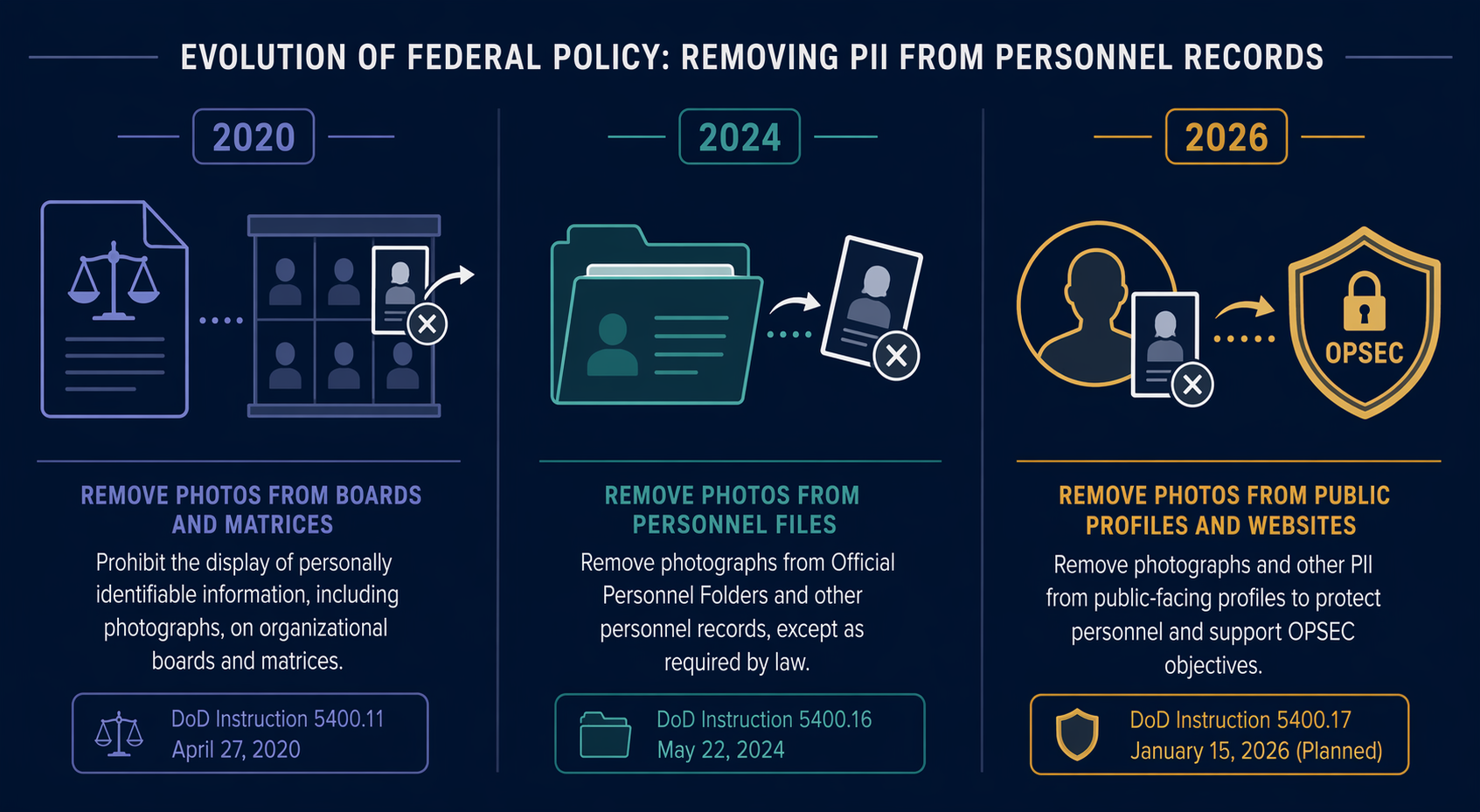
That comparison matters because the legal basis for the Navy’s officer-photo removals cannot be answered by naming one statute. The available record points instead to a series of administrative choices inside the military chain of command. The documents use different authorities, affect different record locations, and leave different legal questions outside the frame.
The 2020 Removal Was About Board Visibility, Not Public Disappearance
NAVADMIN 247/20, issued September 1, 2020, removed photographs from officer selection-board materials and cited as its first reference the Secretary of Defense’s July 14, 2020 memorandum, “Immediate Actions to Address Diversity, Inclusion, and Equal Opportunity in the Military Services.” The Navy’s own release described the measure as applying to selection boards convened after September 1, 2020, and placed it in the same administrative channel used for personnel record and board procedures.[1]
Vice Adm. John B. Nowell Jr., then Chief of Naval Personnel, explained the purpose in bias-reduction terms: the change was intended to “ensure no intentional or unconscious bias, based on race, ethnicity, gender or national origin,” affected career decisions.[1] That sentence is doing legal and administrative work. It ties the photo removal to equal opportunity and board integrity, not to privacy, press access, or public-web operations.
The distinction is easy to lose. A selection-board record is not the same thing as a biography page. The 2020 directive changed what a board would receive or consider in a promotion process. It did not purport to erase portraits from command websites, official biographies, public affairs archives, or every personnel system in which an image might appear. It was a narrower intervention in a decision-making process where visual information could influence evaluation.
The timing also matters. The 2020 action followed a longer cycle in which officer photographs had already moved in and out of board materials. Navy reporting at the time described photographs as removed from boards in 2016, reinstated in 2018 through NAVADMIN 265/18, and removed again in 2020.[2] That history does not prove that any one version was legally superior. It does show that the mechanism was administrative and reversible, with the Navy able to alter board inputs as policy judgments changed.
The broader Navy diversity review supplies the policy setting, but it should not be treated as an automatic legal basis for every later photo decision. In February 2021, the Navy released 57 recommendations from Task Force One Navy, developed after roughly 300 listening sessions and about 1,000 online surveys.[3] That context supports why anti-bias measures were institutionally salient in 2020 and 2021. It does not, by itself, explain a 2026 OPSEC directive aimed at public websites.
The 2024 OMPF Claim Goes Further, But The Source Chain Is Thin
The 2024 item is conceptually important because it appears to move beyond board display. A January 2024 career blog post reported that officer photos were “no longer required anywhere” and included a screenshot of a BOL system notification stating that officer photographs had been eliminated from the Official Military Personnel File.[4] If accurate, that is a different legal event from the 2020 board rule. It would mean the photograph was no longer a required part of the personnel file itself, not merely hidden from a promotion board.
But the located documentation does not support more than that. The official NAVADMIN, MILPERSMAN revision, or comparable Navy instruction text implementing the 2024 OMPF change was not located. That absence should not be papered over. A BOL screenshot can be useful evidence that the personnel system changed; it is not the same as the issuing document that would show who ordered the change, what authority was cited, whether the rule amended an existing personnel-file article, and whether any transition rule applied.
For that reason, the safest legal characterization is limited. The 2024 reported change belongs in the personnel-records-management lane, not the equal-opportunity-board lane and not the OPSEC-public-website lane. It may have reduced the chance that photographs could later flow into board materials, but the record located here does not establish the exact administrative route.
The 2026 Directive Uses OPSEC, Not The 2020 Diversity Rationale
The July 2026 directive is the sharpest contrast. Navy Times reported that NAVADMIN 170/26 directed commands to remove command triad portraits and biographies from public-facing websites for officers vice admiral and below, while excluding flag officers and preserving internal, non-public hosting.[5] Task & Purpose likewise reported that the Navy was removing commander biographies from public websites and attributed the rationale to operational security concerns about adversaries aggregating publicly available biographical information.[6]
Because the full .mil PDF text of NAVADMIN 170/26 was not directly accessed, the directive’s precise wording should be attributed to those reports. The title located for the message — “DISPLAY OF NAVY OFFICIAL BIOGRAPHIES ON PUBLIC FACING WEBSITES” — matches the reported subject, but the operative text quoted in public discussion comes through Navy Times and Task & Purpose rather than direct inspection of the PDF.
The legal route described in those reports is OPSEC. That matters because OPSEC is not a generalized discomfort with public information. ALNAV 072/16 warned that adversaries compile publicly available information from social media, public websites, and other sources, and it directed commanders to review publicly accessible information for vulnerabilities.[7] In that framework, the risk is aggregation: a biography that looks harmless in isolation may become more useful when combined with duty history, family information, location clues, social-media posts, or other data points.
The public-affairs regulation also leaves room for command judgment. 32 CFR § 705.16 addresses release of information and states that Navy public affairs activity must be consistent with security requirements and other limitations; it does not create a freestanding right for every official biography to remain online.[8] Read together with the reported reliance on SECNAV OPSEC policy, that gives the 2026 directive a different administrative character from the 2020 board rule. The officer image is no longer being withheld from a promotion board to reduce bias. It is being removed from public-facing platforms to reduce information exposure.
That shift changes the group of people affected. In 2020, the immediate users were board members, record managers, and officers whose promotion packets were being evaluated. In 2026, the immediate users include command public-affairs staff told to remove content, journalists trying to identify responsible officials, members of the public looking for command leadership information, and lawyers trying to distinguish a website-management order from a withholding rule under FOIA.
The Flag-Officer Carveout Is A Legal Tension, Not A Footnote
The reported exclusion of flag officers is the hardest part of the OPSEC explanation to square publicly. If adversaries can aggregate biographical information about officers, the reason for excluding admirals from the removal requirement is not self-evident. There may be operational, statutory, diplomatic, congressional, or public-accountability reasons for retaining flag-officer biographies. The located materials do not provide that explanation.
That does not make the carveout unlawful on its face. It does mean the public rationale is incomplete. A tiered rule can be perfectly ordinary in military administration, but when the stated risk is information aggregation, the line between officers covered and officers excluded needs more than assumption to explain it.
ALNAV 072/16 Raises A Procedural Question
ALNAV 072/16 also matters because it did not merely say, in broad terms, that public information can be risky. It referred to OPSEC review and, in paragraph 6, discussed circumstances involving credible threats as assessed by appropriate authorities.[7] The public reporting on NAVADMIN 170/26 does not identify a specific threat assessment or NCIS credibility determination for the 2026 website removals. That may be because the directive rests on a broader preventive OPSEC judgment rather than an individualized threat finding. It may also be because the supporting assessment is not public. Either way, the gap is visible in the public record.
The Same Result Can Travel Through Different Authority Chains
A useful way to read the decade-long pattern is to separate location from rationale. Once those are separated, the changes look less like one continuous photo policy and more like several administrative systems reaching similar outcomes.
| Question | 2020 Board Removal | 2024 OMPF Elimination | 2026 Website Removal |
|---|---|---|---|
| Where was the photo? | In or associated with selection-board materials | Reportedly in the Official Military Personnel File | On public-facing command websites with biographies |
| Who was the direct audience? | Promotion and selection boards | Personnel-file users and record managers | The public, press, adversaries, and public-affairs staff |
| What rationale was identified? | Equal opportunity and reduction of intentional or unconscious bias | Personnel-records management, based on limited located documentation | Operations Security and aggregation of public biographical data |
| What authority type appears most important? | SecDef memorandum implemented through Navy personnel administration | Unclear; likely Navy personnel-record administration if the BOL notice reflects the official change | NAVADMIN directive invoking OPSEC policy and public-affairs/security limits |
| What legal issue is left outside? | Public access and website transparency | The exact issuing authority and official text | FOIA access, First Amendment press concerns, threat-assessment basis, and flag-officer distinction |
That is why a single-label answer is misleading. Saying “the Navy removed officer photos under diversity policy” accurately describes the 2020 board action but not the reported 2026 website action. Saying “the Navy removed officer photos for OPSEC” describes the 2026 public-facing directive but not the 2020 promotion-board intervention. Saying “personnel records authority controls” may fit the 2024 OMPF report, but the official mechanism has not been located here.
The hierarchy of documents also matters. A Secretary of Defense memorandum, a NAVADMIN, a MILPERSMAN article, a SECNAV instruction, an ALNAV, and a CFR provision do not sit at the same level. Some direct subordinate agencies or commands. Some manage internal personnel processes. Some announce service-wide policy. Some reflect codified public-affairs rules. Treating them as interchangeable “legal bases” blurs the question the documents are supposed to answer.
What These Directives Do Not Cite
None of the three located policy tracks is best described, on the available record, as resting primarily on a single federal statute. The 2020 board rule cites the SecDef diversity memorandum and uses Navy personnel-administration machinery. The 2024 OMPF item lacks the official document trail needed to identify a statutory hook. The 2026 website rule, as publicly reported, relies on OPSEC and public-information controls, not on the Privacy Act or FOIA exemptions as its stated basis.
That negative space is not a technicality. FOIA, the Privacy Act, and the First Amendment may become relevant when a journalist asks for removed biographies, when an officer challenges how a record was handled, or when a court has to evaluate access to government-held information. But relevance is not the same as being the directive’s invoked authority. The available materials do not show the Navy saying, in 2026, that it is removing public biographies because FOIA requires or authorizes removal. They show an OPSEC rationale.
The same caution applies to the Privacy Act. Personnel records may implicate Privacy Act analysis, especially when personally identifying information is maintained in a system of records. But the 2020 action was about what board members saw, the 2024 action is not fully documented, and the 2026 action concerns information already placed on public command websites. The located record does not support treating the Privacy Act as the controlling explanation for all three.
The 2025 Pentagon Image Purge Is A Separate Comparison Point
The 2025 Pentagon DEI image removals show why the authority chain matters. Associated Press reported that more than 26,000 images were flagged for removal under an executive-order-driven review of diversity-related material.[9] That is a different legal and administrative track from NAVADMIN 247/20, the reported 2024 OMPF change, or NAVADMIN 170/26.
It is tempting to group every removed military image into one transparency or culture-war category. The documents do not support that shortcut. The 2025 image purge comparison is useful precisely because it is not the same thing: it involved a broader Pentagon review tied to executive-order implementation, while the Navy officer-photo policies discussed here move through service-specific personnel and OPSEC channels.
The Legal Map Left After The Photos Come Down
The cleanest conclusion is narrower than most commentary wants. Since 2020, the Navy has used at least three distinct administrative routes to reduce or remove officer photographs from different settings. The 2020 route was a promotion-board and equal-opportunity measure. The 2024 route, as currently documented, appears to be a personnel-file change but lacks the official source text needed for firmer analysis. The 2026 route is an OPSEC and public-website directive, as described in public reporting, with internal sites preserved and flag officers reportedly excluded.
Those choices carry different consequences. A board-process rule affects how officers are evaluated. A personnel-file rule affects what record custodians maintain and what future decision-makers may retrieve. A public-website rule affects public affairs, press access, civic visibility, and the practical ability to identify command leadership. The legal basis matters because it tells downstream users what kind of rule they are dealing with.
The unresolved questions are therefore not peripheral. If a removed biography is requested under FOIA, the Navy would still have to process that request under FOIA’s own framework. If the 2026 directive is challenged, the record would need to show the authority relied on and the rational connection between the OPSEC concern and the categories of officers covered. If the flag-officer carveout remains unexplained, it will remain a pressure point in the public rationale. If the OPSEC theory depends on threat-assessment logic reflected in ALNAV 072/16, the absence of a publicly cited assessment will continue to matter.
What the record does not show is a single master legal theory governing every Navy officer photo removal decision. The Navy has achieved similar practical outcomes through different administrative lanes. That is a defensible way for a military department to manage records, boards, and public information, but it also means each removal decision has to be read on its own document trail: who issued it, what it cited, where the photograph was located, and which legal questions it left unanswered.
References
- Navy Removes Photographs from All Officer Boards, U.S. Navy, September 1, 2020.
- Navy Removes Photographs from All Officer Boards, MilitaryNews.com.
- Navy unveils 57 recommendations from Task Force One Navy to promote diversity, inclusion in the fleet, Navy Times, February 3, 2021.
- Officer Photos No Longer Required Anywhere, McCareer.org, January 4, 2024.
- Navy instructs commands to remove portraits, biographies from websites, Navy Times, July 17, 2026.
- Navy removes commander bios from public websites, Task & Purpose.
- ALNAV 072/16, U.S. Navy.
- 32 CFR § 705.16, Legal Information Institute.
- Pentagon flagged more than 26,000 images for removal in DEI purge, Associated Press.
Comments
Join the discussion with an anonymous comment.