
Navy Photo Removal Controversy Raises Transparency Law Questions
Analyzes the legality of the Navy's July 17, 2026 order to remove commander portraits from public websites under FOIA, the Federal Records Act, and public accountability principles for a legal professional audience.
- Hallucination rate
- Not measured / undisclosed
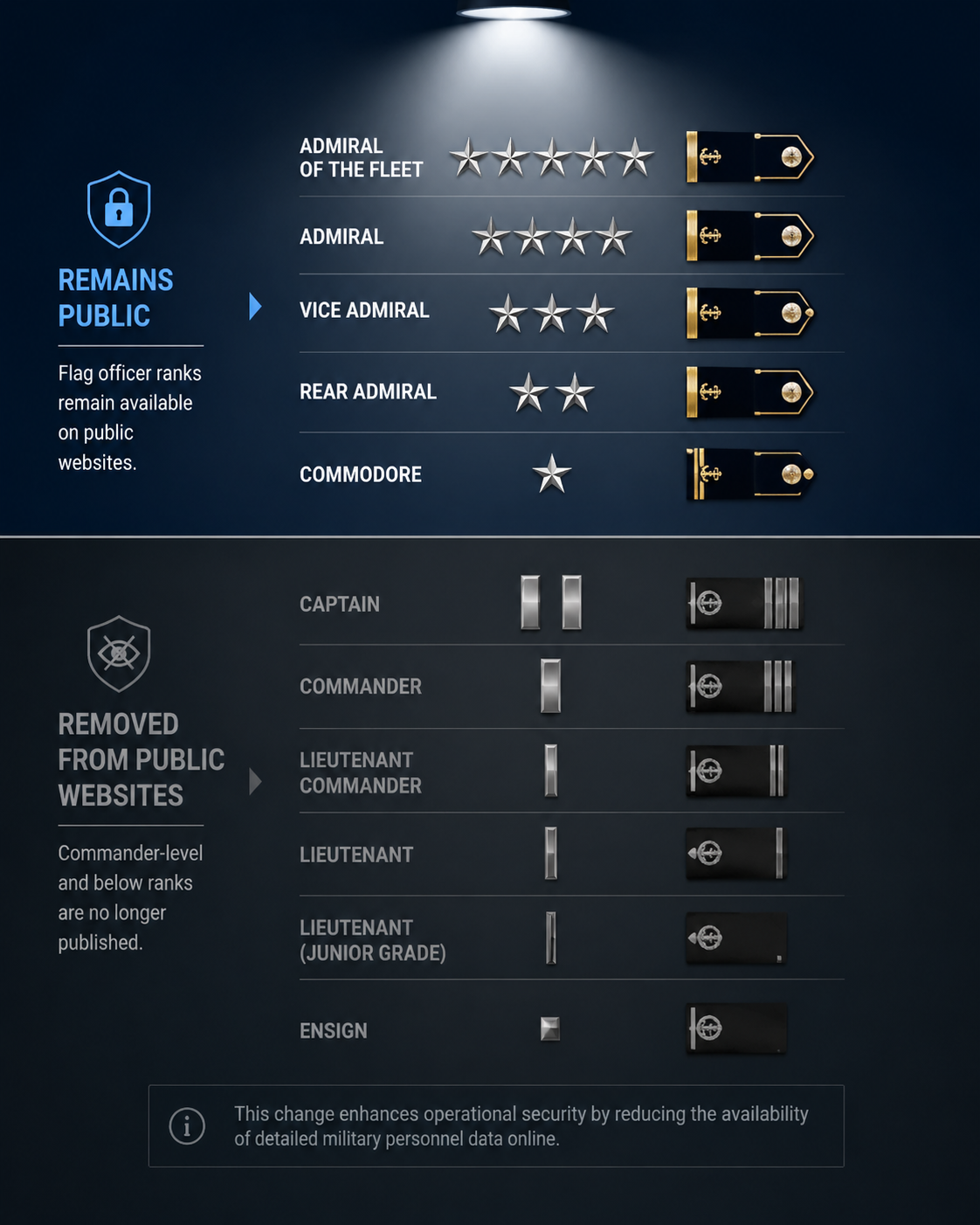
The Navy’s new rule is easy to describe and harder to justify at its edges. On July 17, 2026, NAVADMIN 170/26 directed commands to remove official portraits and biographies from public-facing Navy websites for officers at the rank of vice admiral and below, while leaving public display in place for the Navy’s most senior flag officers and allowing internal access to remain available. Navy Times reported the message under the title “170/26 DISPLAY OF NAVY OFFICIAL BIOGRAPHIES ON PUBLIC FACING WEBSITES,” quoting the Navy’s explanation that adversaries can aggregate publicly available biographical information for intelligence purposes.[1] Task & Purpose reported the same basic structure and security rationale the same day.[2]
That source posture matters. The full NAVADMIN PDF was not directly available for this analysis, so the operative account here rests on the two contemporaneous reports quoting and describing the directive. That is enough to analyze the legal and accountability problem the order creates, but not enough to pretend every implementation detail is settled.
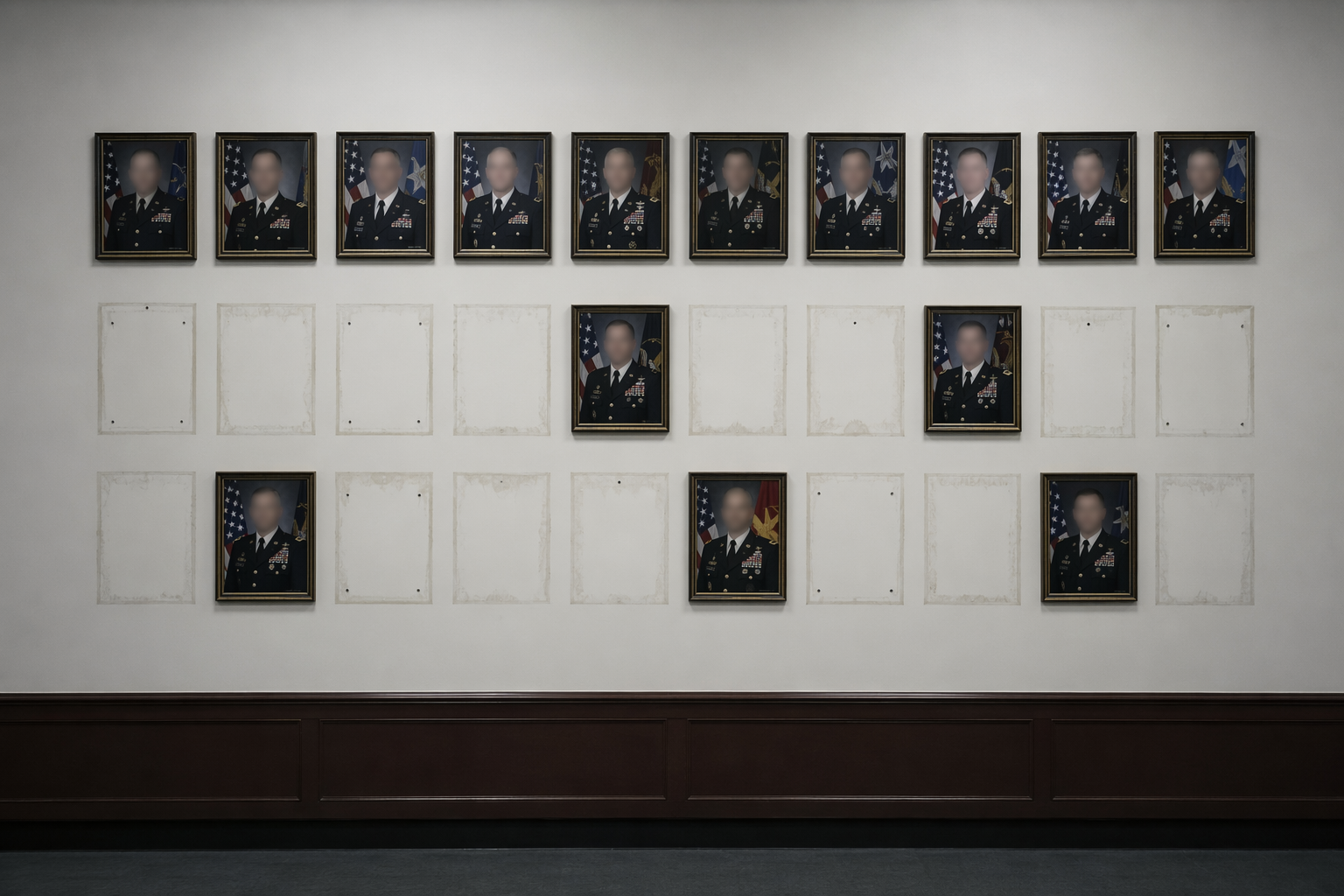
The controversy is not simply that portraits are coming down. A photograph on a command page is not usually the record that decides a legal dispute. The sharper issue is that the Navy appears to be moving a familiar public-identification system into a request-based system for a large class of officers who exercise command authority. The names, biographies, and visible chain-of-command markers may still exist somewhere inside the Navy. They may still be obtainable in some circumstances. But existence and visibility are different things.
The Rank Line Is the Policy
The most important feature of NAVADMIN 170/26 is its tiered design. Public-facing identification remains for the highest-ranking officers, while officers at vice admiral and below are removed from public websites, subject to reported exceptions for internal sites and senior flag-officer visibility.[1][2] That is not a universal blackout. It is a rank-based visibility line.
That line creates an accountability problem precisely because many public questions about Navy command do not start at the very top. When a commander is relieved, a mishap occurs, a disciplinary matter becomes public, or a change-of-command ceremony marks a transfer of authority, the public interest often concerns the officer who held immediate command responsibility. Reporters, watchdogs, sailors’ families, and junior personnel may need to know who occupied that office, when, and with what prior assignments.
A public biography is not a court file, an investigative report, or a personnel folder. It is thinner than that. But its thinness is part of its utility. It allows a non-specialist to identify the responsible official without already knowing which office to contact, which name to request, or which record system to navigate. Removing that layer does not end transparency; it raises the price of using it.
Security Rationale, Uneven Fit
The Navy’s stated concern is not frivolous. Aggregation is a real intelligence problem. A single biography may reveal little; a large set of biographies, assignments, photographs, timelines, family references, education histories, and command movements can reveal patterns. Foreign intelligence services do not need every source to be classified to build a useful picture. Open-source collection works because dispersed fragments become more valuable when sorted and combined.
The difficulty is the carveout. If the public aggregation theory is doing the work, the continued visibility of the most senior officers needs an explanation. Senior officers are more prominent, more likely to appear in press releases and congressional materials, and more difficult to remove from public life. That may be the answer: their exposure may be unavoidable, while command-level biographies are more discretionary. But the reported explanation does not fully resolve why the line falls where it does.
There is a plausible operational distinction. Lower-ranking commanders may be closer to units, facilities, deployments, or operational tempo in ways that make biographical aggregation more sensitive than a polished senior-leadership page. If that is the Navy’s theory, it can be tested. The agency can explain why public exposure at this level creates a risk materially different from exposure at the top. What it cannot do, at least not persuasively, is rely on the word “security” as if it answers the rank question by itself.
FOIA Can Retrieve Records, Not Rebuild a Public Directory
The Freedom of Information Act is the first legal tool many requesters will reach for, and it is both important and inadequate. FOIA generally gives a person the right to request agency records. It does not automatically require the Navy to keep every command biography on a public website. A removed web page and a withheld FOIA response are different legal events.
That distinction is where the practical loss sits. Before NAVADMIN 170/26, a member of the public might identify a commanding officer by visiting a command page. After removal, the same person may need to draft a request, choose the right component, describe the records with enough precision, wait through processing, and litigate if the Navy withholds or delays. For a lawyer, that is a procedural path. For a sailor’s spouse, a local reporter, or a small watchdog group, it may be the difference between timely knowledge and no usable knowledge at all.
FOIA would still matter if the Navy tried to withhold the underlying biographies. The government would need to invoke an exemption, not merely point to the fact that a biography is no longer posted online. Milner v. Department of Navy, decided in 2011, is relevant because the Supreme Court rejected an expansive reading of FOIA Exemption 2 and confined it to records concerning employee relations and human resources matters. That does not decide every possible Navy argument. The government might look to privacy, security, law-enforcement, or classification-related theories depending on the content of a particular record. But a biography once prepared for public display is not transformed into exempt material simply because the agency later decides the website should not carry it.
The likely FOIA fights would be granular. A requester might ask for the official biography of a named officer, a roster of command leadership for a defined period, or archived versions of command pages. The Navy might release the record, redact portions, claim a foreseeable harm from disclosure, or argue that certain compilations create a security risk. Those disputes are familiar enough. What is less familiar is the front-end removal of an entire category of public-facing identity information before any request has been made.
That is why “you can still file a FOIA request” is not a complete answer. FOIA is a disclosure statute, but it is also slow, adversarial, and request-dependent. Public web posting performs a different democratic function: it lets people know what to ask about before they know enough to ask.
The Federal Records Act Asks a Different Question
The Federal Records Act does not solve the same problem as FOIA. FOIA concerns public access to existing agency records. The FRA concerns whether federal records are properly created, preserved, scheduled, and disposed of. If the Navy removes biographies from public websites but preserves the underlying records according to an approved records schedule, the FRA issue may be limited. If records are deleted, overwritten, or allowed to disappear without proper authority, the FRA becomes more serious.
That preservation/access divide is visible in American Oversight’s recent Navy-related records demands. In December 2025, the organization demanded that the Navy account for the reported deletion of USS Iwo Jima footage following a deadly October boat strike.[3] In May 2026, American Oversight said the Navy had acknowledged an “ongoing investigation” and pressed the National Archives and Records Administration over Federal Records Act obligations connected to the same boat-strike records issue.[4]
Those letters do not establish that NAVADMIN 170/26 violates the FRA. They do something narrower and more useful: they show the enforcement frame. A records problem begins when a federal record that should be preserved may have been destroyed, altered, or mishandled. A visibility problem begins when a record still exists but is no longer easy for the public to find. The same episode can involve both, but the legal questions are not interchangeable.
For NAVADMIN 170/26, the FRA questions would be concrete. Are commands preserving removed biography pages? Are photographs and biographies covered by existing records schedules? Are web archives maintained? Are commands receiving uniform instructions on retention, or only on public removal? If a command deletes a biography because the public page is no longer allowed, has it destroyed a federal record without authorization? Those questions matter more than a general claim that removal from the internet must be unlawful.
Courts Can Reach Navy Information Systems
Recent litigation over Navy-controlled information systems offers an adjacent lesson, though not a direct answer. In 2025, ProPublica described a First Amendment victory concerning access to Navy court records, reporting that a federal court rejected the Navy’s position in a dispute over public access to military justice materials.[5] That case does not hold that commander biographies must remain online. It does show that when the Navy controls an information system with public-accountability consequences, courts may be willing to examine whether access restrictions are legally supportable.
A challenge to NAVADMIN 170/26 would have to be built on its own theory. A plaintiff might use FOIA after a denial, the FRA after evidence of improper deletion, the Administrative Procedure Act if a reviewable final agency action and cause of action can be established, or constitutional access arguments in a narrower setting. None is automatic. Standing, finality, justiciability, military deference, and exemption doctrine would all matter.
That legal uncertainty should not be mistaken for legal emptiness. Agencies often win security cases because courts defer to military judgments, especially where operational risk is explained with specificity. They do not win simply because a public-information practice has become inconvenient to defend.
The DEI Image Purge Is Context, Not Proof
The Pentagon’s earlier image-removal episode is relevant background, but it should not carry more weight than it can bear. In March 2025, the Associated Press reported that the Pentagon’s diversity-related purge affected more than 26,000 images and that officials later acknowledged some removals were “incorrect.”[6] That matters because it shows large-scale content removals inside the Defense Department can sweep too broadly, require correction, and affect materials the public had already been using.
It does not prove that NAVADMIN 170/26 is motivated by the same concerns, or that this directive is unlawful. The Navy has offered a security rationale specific to adversary aggregation of biographical information.[1][2] The stronger comparison is institutional rather than evidentiary: once a military department centralizes removal decisions across thousands of public-facing pages, errors and overbreadth become foreseeable governance risks. That is a reason to demand auditing, retention rules, and a fuller explanation, not a substitute for them.
What Oversight Could Actually Test
Congressional oversight may be the most direct path to answers that FOIA cannot quickly provide. A committee can ask for the legal memorandum behind NAVADMIN 170/26, the threat assessment supporting the rank cutoff, the retention instructions sent to commands, and any alternatives the Navy considered before ordering removal. It can also ask whether the policy applies uniformly across ships, installations, expeditionary units, schools, reserve commands, and archived pages.
The questions should be practical rather than theatrical:
- Which categories of officers are removed from public-facing websites, and which remain public?
- What specific aggregation risks justify removing vice admirals and below while retaining senior flag-officer biographies?
- Are removed pages, photographs, and biographies preserved under an approved records schedule?
- Will the Navy provide a standard FOIA processing path for command biographies and historical rosters?
- Is there an exception process for public accountability events, including reliefs, mishaps, courts-martial, or official investigations?
Those questions do not require Congress to second-guess every operational judgment. They require the Navy to connect the security concern to the actual line it drew, and to show that public removal has not become informal destruction or avoidable obscurity.
Where the Law Stands Now
As of July 18, 2026, there is no known lawsuit specifically challenging NAVADMIN 170/26. That matters. The present legal analysis is prospective: it identifies pressure points, not a filed complaint, a docket, or a ruling.
FOIA may recover individual records if requesters can identify what they need and if the Navy cannot justify withholding. The Federal Records Act may matter if removed biographies, photographs, or web pages are deleted or improperly managed. Prior transparency litigation involving Navy information systems suggests that courts are not categorically closed to access claims, but it does not dictate the result for command biographies. Congressional oversight could force the Navy to explain the rank-based distinction faster and more comprehensively than requester-by-requester litigation.
NAVADMIN 170/26 may be defensible as security policy. The Navy is entitled to take adversary aggregation seriously. But the directive creates a transparency gap that existing access laws do not automatically close: senior leaders remain publicly identifiable, many lower-ranking commanders move behind a procedural wall, and the public loses the ordinary visibility that often makes later accountability possible.
References
- Navy instructs commands to remove portraits, biographies from websites, Navy Times, July 17, 2026
- Navy removes commander bios, Task & Purpose, July 17, 2026
- American Oversight Demands Navy Account for Reported Deletion of Footage Following Deadly October Boat Strike, American Oversight, December 2025
- NARA Boat Strikes Federal Records Act, American Oversight, May 2026
- Navy court records ruling first amendment, ProPublica, 2025
- DEI purge images Pentagon diversity women Black, AP News, March 2025
Chronological incident history
No sanction cases have named this tool in the tracked record set to date. This does not imply the tool is safe — see Risk Digest for ongoing monitoring.
← Compare peer toolsReport a correction or tip
Spotted an outdated figure, a misstated fact, or a ruling this tool profile should reflect? Public comments are disabled for this content given the professional cost of a misreported case outcome, penalty amount, or rule text — use the structured correction channel instead.
Report a correction or tip for this record →