
The New Hampshire legislative privilege argument begins, and nearly ends, with one sentence from Part II, Article 21 of the state constitution: “No member of the General Court shall be arrested, or held to bail, on mesne process, during his going to, returning from, or attendance upon, the Court.”[1]
That is the text Rep. Ellen Read invoked after two alleged speeding stops, one reported at 107 mph and another at 92 mph. It is also the text that makes the claim difficult. Article 21 does not say legislators are free from all law enforcement while traveling to Concord. It does not mention traffic citations. Its operative protection is narrower: no arrest, no being held to bail, and only “on mesne process” while going to, returning from, or attending the General Court.[1]
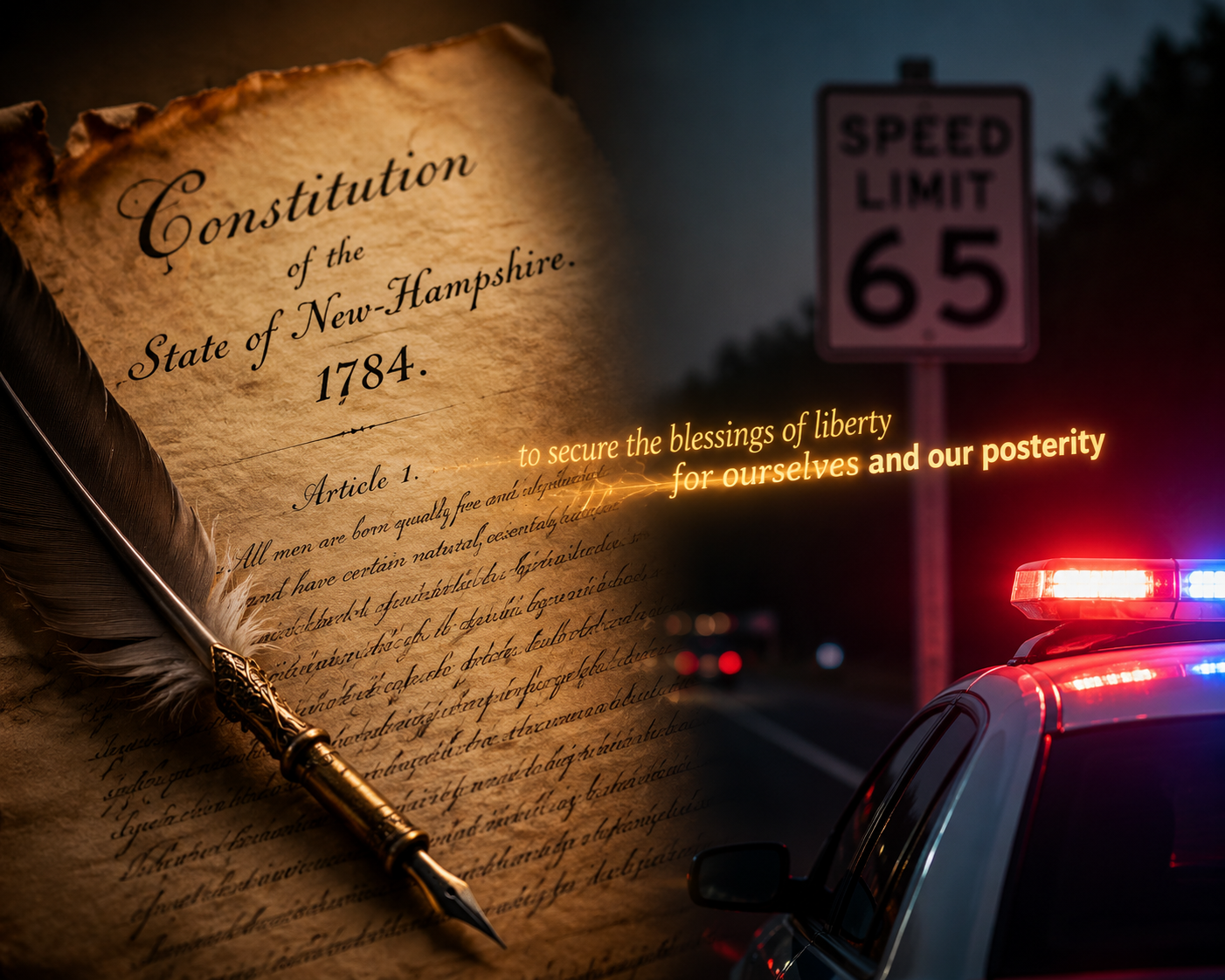
For a modern reader, the awkward word is “mesne.” For a court, it is the limiting word. Cornell’s Wex describes legislative immunity of this kind as a protection against civil arrest or civil process that could interfere with legislative attendance, not as a general immunity from criminal law or ordinary enforcement.[2] In older procedural language, “mesne process” referred to intermediate civil process in a lawsuit, the sort of coercive legal step that could physically keep a person from appearing elsewhere before judgment. That is a long way from a police officer issuing a speeding citation after a roadside stop.
The Clause Protects Attendance, Not a Driving Corridor
Article 21 belongs to a family of legislative privilege rules meant to keep outside legal pressure from disabling a legislature. The institutional worry is real. If lawmakers could be arrested on private civil process on their way to a session, litigation could become a tool for changing who is present to vote. The privilege answers that problem by protecting attendance at the General Court from a particular kind of coercive interruption.
But the text does not create a protected travel zone in which legislators may disregard generally applicable rules. It does not say “shall not be stopped.” It does not say “shall not be cited.” It does not say “shall not be prosecuted.” The words chosen in 1784 are procedural words: arrested, held to bail, mesne process.[1]

That distinction matters because a traffic citation is not naturally understood as civil intermediate process in a private lawsuit. Even if a roadside stop briefly delays travel, the delay is a feature of ordinary public-law enforcement, not an attempt to hold a legislator to bail or arrest the legislator on mesne process. Treating any police stop on a session day as constitutionally suspect would expand the clause by replacing its procedural vocabulary with a much broader concept: inconvenience.
How Read’s Speeding Cases Put Article 21 in Play
The litigation arose from two alleged speeding incidents involving Read, a New Hampshire state representative. The first involved an allegation that she was traveling 107 mph; the second, from June 5, 2025, involved an alleged 92 mph speed.[3] Read argued that Article 21 barred the enforcement action because she was traveling in connection with legislative duties.[3]
The procedural posture is unusual in ways that help explain why the story traveled farther than an ordinary traffic case. Read was represented by Dana Albrecht, who is not an attorney, and the reported defense rested on the constitutional privilege rather than simply contesting speed, identification, or radar evidence.[3] The Rockingham County Sheriff’s Office does not use body-worn cameras, so there was no body-camera audio from either stop; factual disputes depended on other evidence, including officer testimony.[3]
Read has also pushed back on the public framing. She called the matter a “non-scandal” and said her 2009 Toyota Yaris, with more than 440,000 miles, “cannot go that fast.”[4] Those assertions may matter to public perception and to any factual dispute about the stop. They do not, by themselves, make Article 21 a defense to a speeding citation.
What the Trial Court Did
The trial court rejected Read’s Article 21 defense in August 2025. It found her guilty of negligent driving and imposed a $1,240 fine.[3] That ruling is the most concrete judicial treatment so far because it addressed the defense in an actual case and refused to treat the constitutional clause as a bar to traffic enforcement.
The rejection is unsurprising if the analysis starts with the text. A negligent driving finding after an alleged high-speed traffic stop is not an arrest on mesne process. It is not bail on civil intermediate process. It is the application of a traffic-law framework to conduct on a public road. The fact that a legislator was traveling to or from legislative activity supplies only one part of Article 21’s condition; it does not erase the clause’s separate requirement that the restraint be the kind of process the clause names.
Former New Hampshire Supreme Court Chief Justice Bob Lynn, now a state representative, captured the weakness of the argument by calling it “a stretch.”[5] That is more useful than the predictable political outrage because it points to the legal problem: the privilege claim has to pass through the words “mesne process,” and speeding enforcement does not fit comfortably there.
What the New Hampshire Supreme Court Did Not Decide
The New Hampshire Supreme Court did not issue a full merits opinion construing Article 21. That caveat is important. On June 11, 2026, the court declined to hear Read’s constitutional appeal without prejudice, and on July 2, 2026, it denied reconsideration.[3] A refusal to accept review, especially one without prejudice, is not the same thing as an authoritative constitutional holding on the scope of legislative privilege.
So the careful formulation is this: the trial court rejected the defense, and the state Supreme Court allowed that result to stand procedurally for now. The Supreme Court’s action does not foreclose every future Article 21 argument in every setting. It does mean Read did not obtain appellate relief on the theory that the clause blocked the traffic case.
That distinction also keeps the case from being overstated. New Hampshire’s high court has not, in a merits opinion, written the definitive modern test for “arrested, or held to bail, on mesne process.” But nothing in the reported handling of Read’s case suggests that Article 21 is being treated as a license to avoid speeding or negligent-driving consequences.
The Remaining Proceedings
The first case is not entirely closed. A deferred sentencing hearing is scheduled for August 12, 2026.[6] That hearing may affect the final posture of the case, but it does not convert the Supreme Court’s refusal of review into a merits ruling, and it does not change the trial court’s rejection of the privilege defense.
The second citation, based on the alleged 92 mph incident from June 5, 2025, also remains live, with a bench trial still pending.[3][6] Read could attempt to raise Article 21 again there. If she does, the same textual problem will be waiting: a legislator’s travel status is not enough unless the government action is the kind of arrest or bail on mesne process that Article 21 addresses.
Why the Speeding-Law Reading Fails
A plausible legal argument usually has to do more than find one friendly phrase. Here, the friendly phrase is “during his going to, returning from, or attendance upon, the Court.”[1] Standing alone, that language sounds broad. But it does not stand alone. It is attached to a specific protection against being “arrested, or held to bail, on mesne process.”[1]
| Article 21 term | What it points to | Why that matters for speeding enforcement |
|---|---|---|
| “No member of the General Court” | Legislators serving in the state legislature | Read falls within the class of people the clause protects. |
| “during his going to, returning from, or attendance upon, the Court” | Travel to or from legislative attendance, and attendance itself | Travel status may satisfy the timing condition, but timing is not the whole clause. |
| “shall not be arrested, or held to bail” | Physical restraint or bail-related coercion | A citation or traffic prosecution is not automatically the same thing as arrest or bail. |
| “on mesne process” | Intermediate civil process in litigation | Routine traffic enforcement is not civil intermediate process. |
The most defensible reading keeps all of those words in the sentence. Article 21 protects legislators from a particular procedural interference with legislative attendance. It does not announce a personal exemption from the rules of the road. That is why the difference between civil process and traffic enforcement is not a technicality; it is the hinge of the entire claim.
The public reaction was unsurprisingly bipartisan and blunt. Democratic Minority Leader Alexis Simpson said, “No one is above the law,” while House Deputy Majority Leader Joe Sweeney also criticized the privilege theory.[5] Those reactions help explain the political temperature, especially given the alleged speeds. The legal conclusion, however, does not depend on outrage. It depends on the clause’s old procedural vocabulary and on the trial court’s refusal to stretch that vocabulary into a traffic-law shield.
As of Q3 2026, Article 21 still has not received an authoritative merits construction from the New Hampshire Supreme Court in this setting. A properly framed future appeal could ask for one. But the present explanation is straightforward: Article 21 protects legislative attendance from arrest or bail on mesne civil process; it has not been interpreted to immunize lawmakers from routine traffic enforcement, and Read’s attempt to use it that way has not succeeded.
References
- New Hampshire Constitution, Part II, Article 21 — 50 Constitutions Project — https://50constitutions.org/nh/constitution/section-id-81392
- Legislative Immunity — Cornell Wex — https://www.law.cornell.edu/wex/legislative_immunity
- NH legislative privilege speed arrest — The Boston Globe — July 13, 2026 — https://www.bostonglobe.com/2026/07/13/metro/nh-legislative-privilege-speed-arrest/
- Rep. Ellen Read says 100 mph speeding ticket is a 'non-scandal' — NHPR — July 16, 2026 — https://www.nhpr.org/politics/2026-07-16/rep-ellen-read-says-100-mph-speeding-ticket-non-scandal
- NH speeding representative legislative privilege — The Boston Globe — July 15, 2026 — https://www.bostonglobe.com/2026/07/15/metro/nh-speeding-representative-legislative-privilege/
- Lawmaker who drove 100 mph says speeding ticket flap is misguided non-scandal — Concord Monitor — July 15, 2026 — https://www.concordmonitor.com/2026/07/15/lawmaker-who-drove-100-mph-says-speeding-ticket-flap-is-misguided-non-scandal/
Comments
Join the discussion with an anonymous comment.