
There is no New York self-checkout discount obligation right now
For anyone asking whether New York now has a self-checkout discount law, the first correction matters most: New York has not enacted a self-checkout discount requirement. Assembly Bill A11501 was introduced on May 28, 2026, by Assemblymember Nikki Lucas of Brooklyn, referred to the Assembly Consumer Affairs and Protection Committee, and did not advance before the 2026 legislative session ended.[1]
That status point should not make the bill disposable. A11501 is worth tracking because it does something more legally interesting than capping item counts or requiring an employee nearby. It would add a new §396-ll to the New York General Business Law and require food retail establishments to give customers a 10% discount on goods purchased through a self-service checkout kiosk.[1]
Late-session bills often function as markers. They test a theory, give advocates statutory language to reuse, and let committee staff, trade groups, and agencies see where the next fight might land. Here, the test is not merely whether customers like staffed lanes better. The bill asks whether retail automation savings can be treated as something consumers are legally entitled to share.
What A11501 would require
The operative requirement is short. Proposed General Business Law §396-ll would prohibit a food retail establishment from failing to provide “a ten percent discount on any goods purchased through a self-service checkout kiosk.” The bill defines the covered self-service checkout equipment as a kiosk where a customer scans, bags, and pays for goods without the assistance of an employee.[1]
| Issue | A11501 approach |
|---|---|
| Current legal status | Introduced and referred to committee; not enacted |
| Covered setting | Food retail establishments |
| Covered transaction | Goods purchased through a self-service checkout kiosk |
| Required consumer benefit | 10% discount |
| Enforcement | Attorney General injunction and restitution proceedings |
| Private lawsuits | No private right of action appears in the bill text |
The bill’s enforcement language is just as important as the discount. A11501 authorizes the New York Attorney General to bring an action to enjoin violations and obtain restitution. It does not create an express private right of action for individual shoppers.[1]
That drafting choice keeps the proposed obligation in the territory of public consumer-protection enforcement rather than turning every missed discount into an immediate shopper-by-shopper damages vehicle. For retailers, that distinction affects how the risk would be managed. The compliance question would not be limited to whether a cashier corrected one receipt. It would include whether pricing systems, kiosk interfaces, receipt logic, refund procedures, training materials, and customer-service escalation channels could withstand review by an Attorney General’s office.
The bill’s real novelty is its labor-shifting theory
Most self-checkout disputes begin in operations: how many kiosks are open, how many employees are watching them, how often interventions are needed, and whether shrink or customer frustration offsets payroll savings. A11501 moves that operational design question into consumer-protection language.
The legislative memo is unusually direct. It states that “customers are effectively completing portions of the checkout labor themselves without compensation” and that a mandatory discount would “ensure fairness.” It also says the discount “allows the public to share in the financial savings created by self-service technology.”[2]
That is not the ordinary safety, accessibility, or staffing argument. It is a claim about who should receive the economic benefit when a retailer redesigns checkout so that the customer performs work once performed by an employee. The theory may sound intuitive to shoppers standing at a kiosk with a flashing intervention light. It is still untested as law. No cited case in the available materials establishes that failing to discount self-checkout purchases is already a recognized unfair trade practice.
The percentage also cannot be treated as a harmless token. A 10% discount is meaningful in a business where the Food Industry Association average net profit margin figure cited in public commentary is about 2.1%.[3] That comparison does not decide the policy question, but it does show why retailers will not experience the proposal as a small courtesy adjustment. If applied broadly, the discount would reach pricing architecture, promotion stacking, loyalty programs, taxable amounts, refund calculations, and vendor-funded discount arrangements.
Consumer irritation is real enough to explain why the idea travels. Coverage of the bill leaned into the familiar shopper reaction: customers scan, bag, troubleshoot, and still pay the same shelf price.[4] But the legal question is narrower than the mood. A11501 does not ban self-checkout, require retailers to maintain staffed lanes, or compensate customers as workers. It attaches a fixed consumer discount to a defined checkout method and gives the Attorney General the enforcement role.
Why the Attorney General mechanism matters
New York consumer-protection lawyers will notice the resemblance to the enforcement posture of General Business Law §349: public enforcement through injunction and restitution, with the state able to frame a market practice as unlawful even when the consumer injury is dispersed across many small transactions. A11501 does not simply tell stores to post a sign. It gives the Attorney General a route to say the retail checkout system itself failed to deliver a required consumer benefit.
That matters because self-checkout errors are rarely elegant facts. A missed discount could arise from a kiosk configuration issue, a product category exclusion that the statute does not recognize, a temporary fallback process during an outage, an employee overriding the transaction, or a chainwide pricing update that failed to reach one store. If the obligation were enacted, the legal exposure would likely sit in the gap between store-level messiness and centralized compliance design.
The absence of an express private right of action does not make the bill low-risk. It changes the actor. Instead of building the first wave of risk around individual complaints in court, the proposal would make the Attorney General the institution that decides whether a retailer’s self-checkout program has become a consumer-protection problem.
Do not confuse A11501 with the New York City self-checkout bill
A11501 is a New York State Assembly bill. It is separate from New York City Council Int 0729-2026, which takes a different route. The city proposal would regulate self-checkout staffing and use conditions, including a staff-to-kiosk ratio of one employee for every three self-checkout stations, a 15-item limit for self-checkout purchases, and civil penalties for violations.[5]
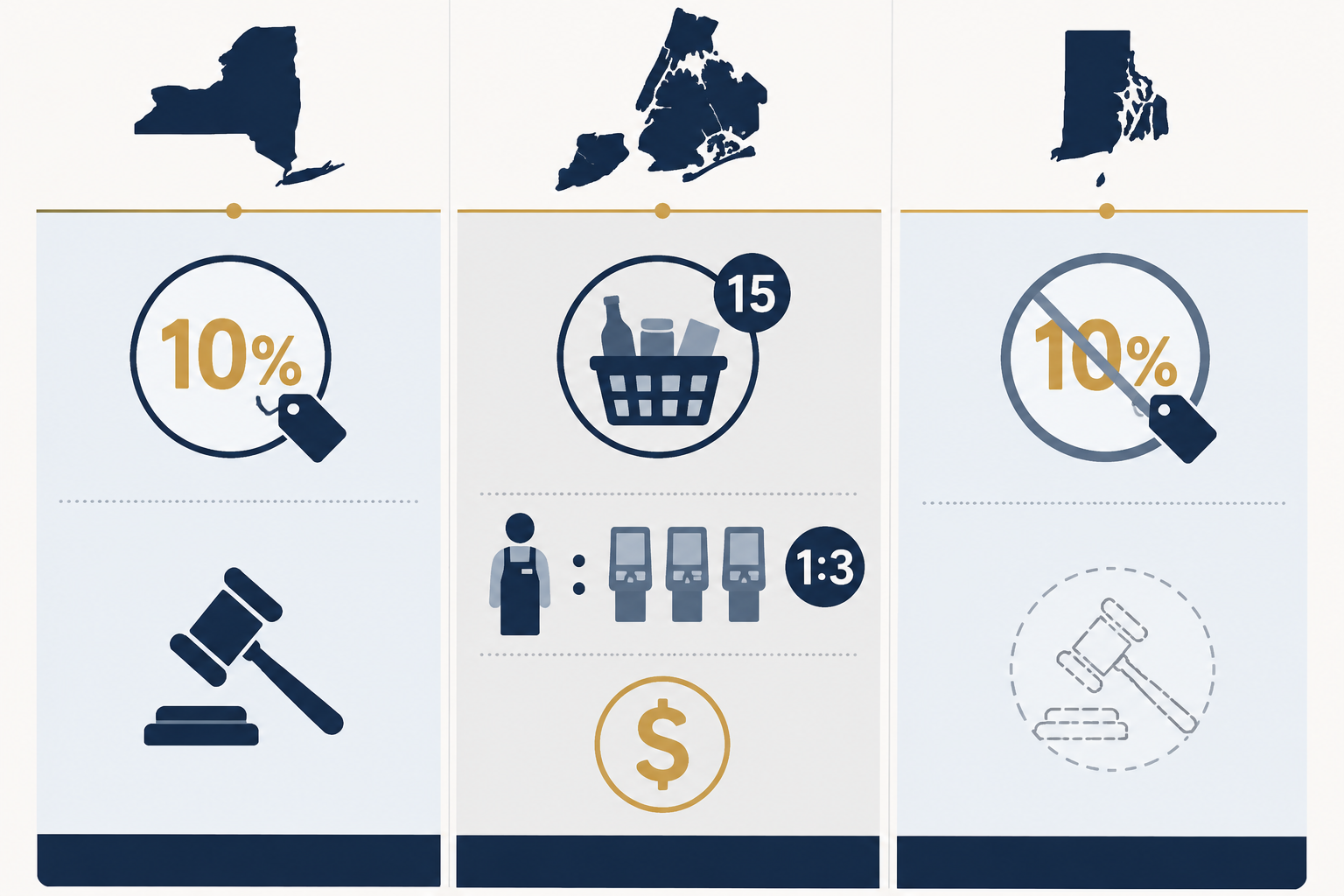
The distinction is not cosmetic. A staffing-ratio rule regulates store operations directly: how many kiosks can run, how many employees must be assigned, and which customers may use the lane. A discount rule regulates the economics of the transaction: if the customer uses the kiosk, the receipt must reflect a price reduction. Both proposals respond to self-checkout, but they create different evidence problems, different compliance systems, and different enforcement conversations.
For multi-store retailers, city/state separation is not a technicality. A city staffing rule might require labor scheduling changes in one jurisdiction. A state discount rule, if enacted, could require pricing-system changes across all covered stores in the state. Treating the two proposals as one “New York self-checkout law” obscures the operational work each would demand.
Rhode Island shows the discount model is not inevitable
Self-checkout legislation is gaining attention beyond New York. Hunton’s national review describes state-level bills that would regulate self-checkout through staffing, security, item limits, or other operational controls.[6] That trend matters, but it should not be flattened into a single national model.
Rhode Island is the useful comparator because its path shows that discount language can be considered and then removed. Rhode Island SB 2342B was signed on June 18, 2026, and is scheduled to take effect on January 1, 2027; public reporting notes that an earlier draft included a 10% self-checkout discount provision, but that provision did not survive into the enacted law.[3]
That makes New York’s A11501 more distinctive, not less. It is not simply another entry in a general backlash against kiosks. It preserves the consumer-compensation theory that Rhode Island dropped, and it places that theory in a state consumer-protection enforcement structure.
What retail counsel should monitor
A11501 did not become a 2026 compliance deadline. No retailer should be told that New York currently requires a 10% self-checkout discount. The more practical point is that the bill gives advocates and lawmakers reusable language for a new theory of automation regulation: when technology shifts labor to customers, the law may require part of the savings to be shared at the point of sale.
- Watch whether A11501 or similar language is reintroduced in a later New York session.
- Separate state discount proposals from city staffing, item-limit, or kiosk-ratio proposals.
- Track whether other states revive self-checkout discount language after Rhode Island removed it before enactment.
- Evaluate how an Attorney General-enforced discount obligation would interact with pricing systems, loyalty discounts, refunds, promotions, and receipt disclosures.
- Prepare internal explanations for why self-checkout is no longer only a store-technology question; it is becoming a consumer-protection theory question.
The bill’s failure to advance in 2026 limits its immediate effect. Its legal significance is the template. A11501 turns the ordinary store-operations decision to install or expand self-checkout into a claim about unpaid customer labor, mandatory consumer savings, and public enforcement.
References
- Assembly Bill A11501, New York State Assembly, link
- Nikki Lucas Introduces Bill: 10% Self Checkout Discount, NYC Newswire, link
- Rhode Island Is Regulating Grocery Checkout Lines Now, Reason, July 9, 2026, link
- NY state bill may give shoppers a 10% deal for self-checkout, New York Post, July 14, 2026, link
- Int 0729-2026, New York City Council, link
- State Self-Checkout Bills Gain Traction Across the Country, Hunton, link
Comments
Join the discussion with an anonymous comment.