
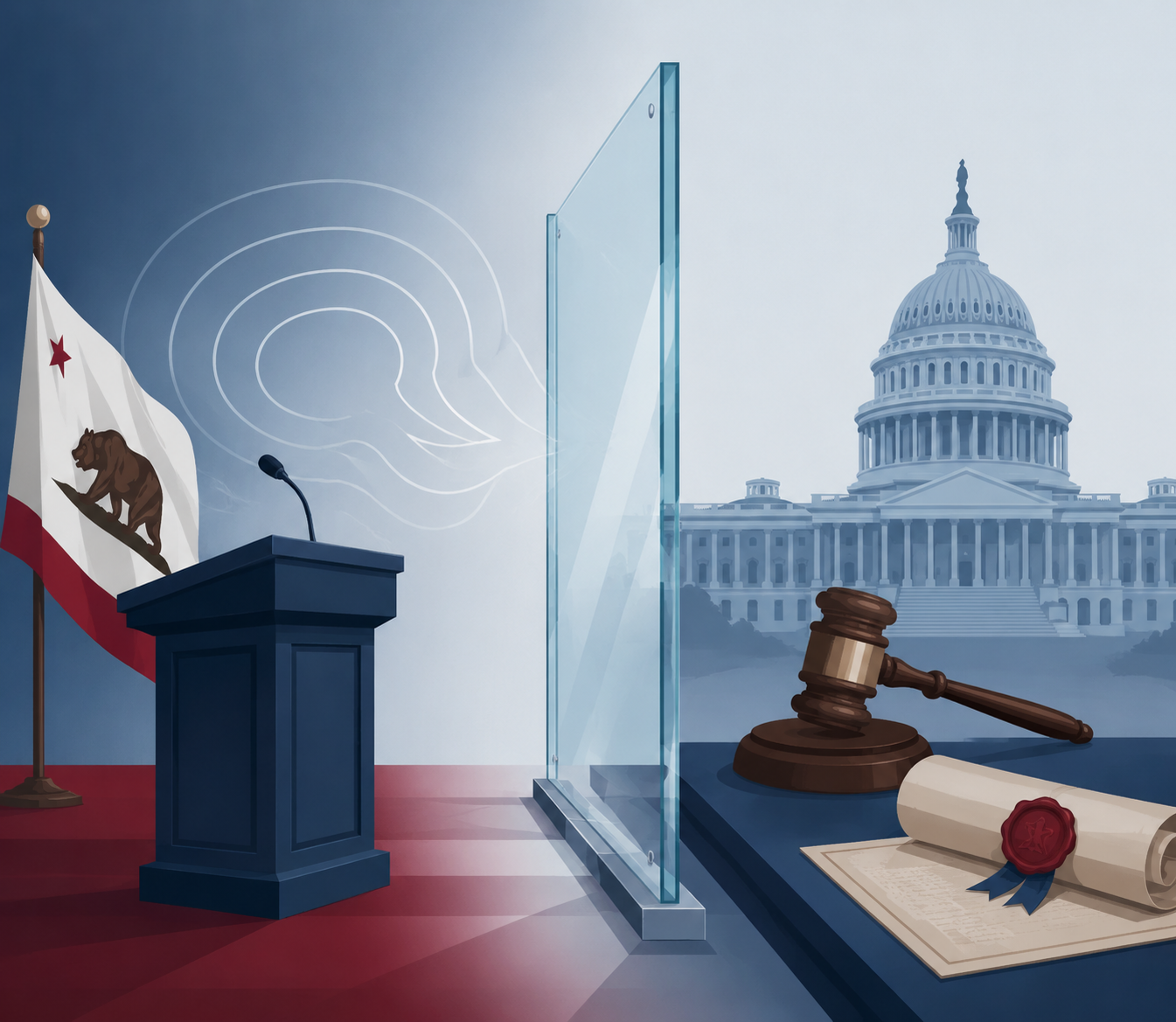
Gavin Newsom’s 25th Amendment call has one immediate legal implication: none. A governor can demand, criticize, dramatize, and try to pressure federal officials. What he cannot do is invoke Section 4, trigger a disability proceeding, force Vice President JD Vance or cabinet members to respond, or place any formal question before Congress.
The confusion is understandable because the verb “invoke” sounds procedural. But under the 25th Amendment, invocation is not a mood, a public appeal, or a social media formulation. It is a written declaration by named federal actors, sent to named congressional officers. Newsom is not one of those actors.
The factual spark was narrow. After President Trump’s July 16, 2026 speech, Newsom posted a social media video describing the address as the “ramblings of a mad king” and saying “it is time to invoke the 25th Amendment.” Reporting on the episode also said his office did not file a formal document or contact the vice president’s office.[1]
Section 4 Starts With A Written Declaration, Not A Public Demand
The operative language of Section 4 is not subtle about who must act:
“Whenever the Vice President and a majority of either the principal officers of the executive departments or of such other body as Congress may by law provide, transmit to the President pro tempore of the Senate and the Speaker of the House of Representatives their written declaration that the President is unable to discharge the powers and duties of his office, the Vice President shall immediately assume the powers and duties of the office as Acting President.”[2]
That sentence does almost all of the work. It identifies the decision-makers, the required instrument, the recipients, the finding that must be made, and the immediate consequence. The decision-makers are the vice president plus a majority of the principal officers of the executive departments, or the vice president plus a majority of another body Congress has created by law. The instrument is a written declaration. The recipients are the president pro tempore of the Senate and the speaker of the House. The consequence is that the vice president immediately assumes the powers and duties of the office as acting president.
Governors do not appear in that chain. State attorneys general do not appear. Members of the public do not appear. Members of Congress, acting alone, do not appear. Even a cabinet secretary, acting alone, cannot invoke Section 4. The mechanism is collective and federal, and it begins only when the constitutionally specified actors transmit the written declaration.
| Question | Section 4 Answer |
|---|---|
| Who can initiate? | The vice president and a cabinet majority, or the vice president and a majority of a congressionally created body |
| What must they do? | Transmit a written declaration that the president is unable to discharge the powers and duties of the office |
| Who receives it? | The president pro tempore of the Senate and the speaker of the House |
| What happens immediately? | The vice president assumes the powers and duties as acting president |
| Where is a governor in the process? | Nowhere |
That is why Newsom’s call is best understood as political persuasion. It may be directed at Vance, cabinet officials, members of Congress, donors, voters, or the press. It may be strategically useful or useless. But it does not alter the constitutional status of the presidency, impose a duty on the vice president, open a proceeding, or give Newsom standing to demand one.
Why The Amendment Excludes Outside Political Actors
The exclusion is not an oversight. Section 4 was designed around proximity to the president. Senator Birch Bayh, the principal congressional author of the 25th Amendment, explained that the vice president and cabinet were chosen because they are the officials closest to the president’s actual capacity to perform the office and best positioned to make a credible judgment about inability.[3]
That design does not assume cabinet officers are apolitical, heroic, or immune from pressure. It assumes something more modest: they are inside the executive branch, they work near the president, and they bear institutional responsibility for the functioning of the administration. A governor may have a sharp opinion about presidential fitness, but Section 4 does not treat distance plus political alarm as a substitute for executive-branch proximity.
The amendment also contains an escape hatch: Congress may create “such other body” to participate in the process. But that body would not replace the vice president. The text still requires the vice president to act with a majority of the cabinet or with a majority of the congressionally created alternative body.[2]
Congress has never created that alternative body in the 59 years since the amendment was ratified.[4] That matters because commentators sometimes talk about the clause as though it is a dormant switch someone else can flip in a crisis. It is not. Until Congress creates the body by law, there is no alternative body for anyone to join, petition, or pressure through formal channels.
Rep. Jamie Raskin’s April 2026 proposal for a 17-member Commission on Presidential Capacity is the real procedural reform path in the available record. But even that proposal would not convert a governor’s statement into a constitutional trigger. It remained stalled in a Republican-controlled Congress, and the proposed commission still would require Vice President Vance’s concurrence under Section 4’s structure.[5]
What Would Have To Happen For Section 4 To Actually Operate
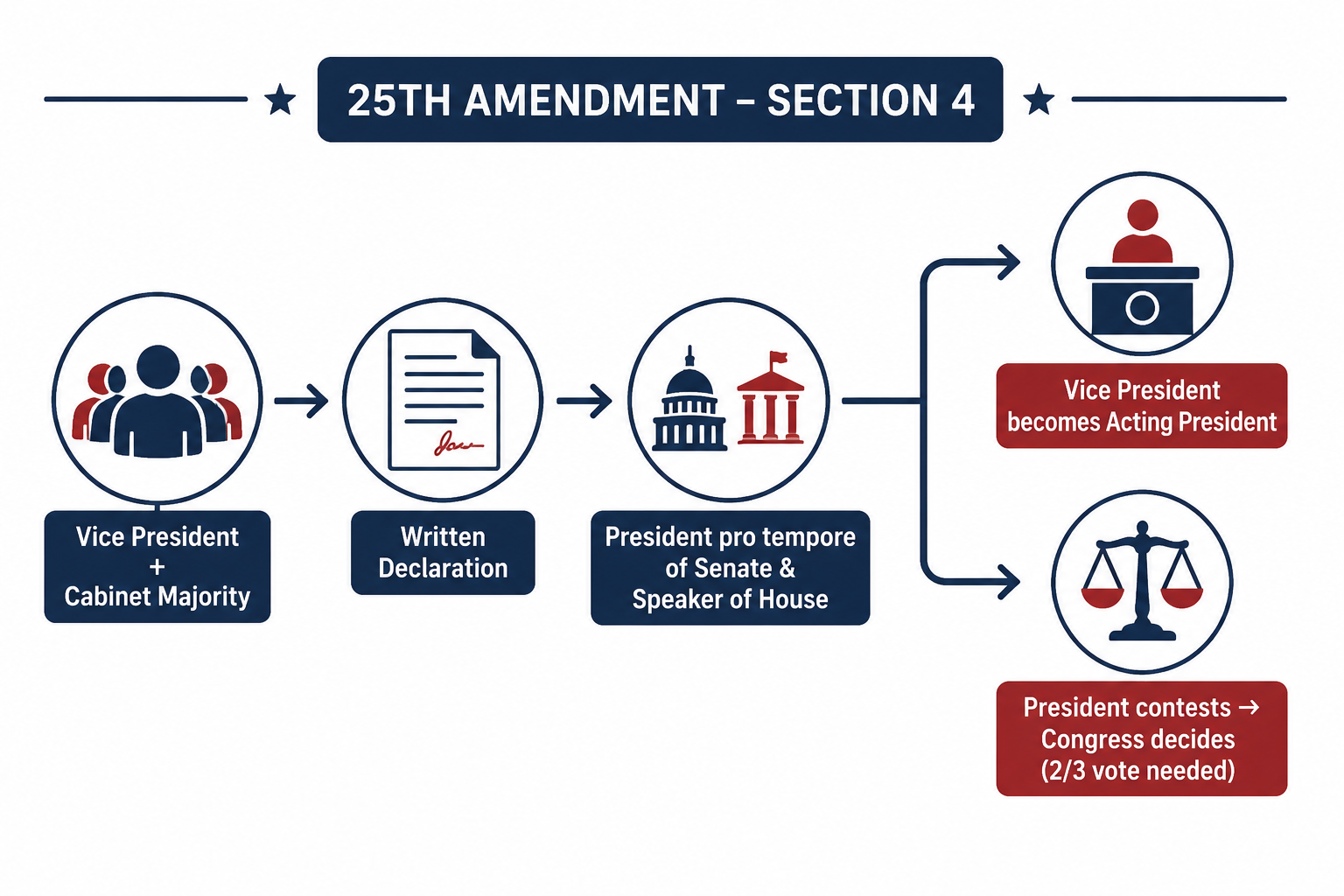
If Section 4 were actually invoked, the first legally meaningful event would be the written declaration. The vice president and the required majority would transmit it to the president pro tempore of the Senate and the speaker of the House. At that moment, the vice president would immediately assume the powers and duties of the office as acting president.[2]
The president is not silent in that process. Section 4 allows the president to transmit a written declaration stating that no inability exists. Unless the vice president and the required majority respond with another declaration within the constitutional time frame, the president resumes the powers and duties of the office.[2]
If the vice president and the required majority persist after the president contests, Congress decides. If Congress is not in session, it must assemble within 48 hours, and the amendment then gives it 21 days to determine the issue. The president remains displaced only if two-thirds of both the House and Senate vote that the president is unable to discharge the powers and duties of the office.[2]
That is a deliberately punishing threshold. Brian C. Kalt has described Section 4 as a structure that “stacks the deck decisively in the president’s favor,” especially once a president contests the declaration.[3] The point is not that invocation is impossible. The point is that the amendment was built to require agreement among a small set of executive insiders first, and then an extraordinary congressional supermajority if the president resists.
The White House Response Stayed On The Same Political Track
The White House response did not change the legal posture either. Spokesperson Davis Ingle dismissed Newsom as “Newscum” and “the worst governor in America,” which is a political reply to a political attack, not a constitutional answer to a filing.[6]
That distinction is the whole issue. Public pressure can matter in politics. Governors can shape coverage, supply language to allies, and try to make inaction costly for federal officials. But pressure is not standing. A demand is not a declaration. A video is not a transmission to the president pro tempore and the speaker. No constitutional machinery moves until the actors named in Section 4 use the instrument Section 4 requires.
So the answer to the legal question is clean. Newsom may call for the 25th Amendment as loudly as he wants. He may urge Vance and cabinet members to act. He may campaign on the claim that they should. But he cannot initiate the Section 4 process, and his July 2026 statement carries no legal weight under the 25th Amendment.
References
- Gavin Newsom ignites call for 25th Amendment after Trump's latest address, OregonLive, July 2026.
- 25th Amendment, National Constitution Center.
- The Limits of the 25th Amendment, National Affairs.
- 25th Amendment: How do we decide whether the president is competent?, Brookings.
- Raskin Introduces Legislation to Establish Commission on Presidential Capacity, Office of Congressman Jamie Raskin, April 2026.
- Newsom Demands 25th Amendment After Trump's 'Mad' Speech, Yahoo News, July 2026.
Comments
Join the discussion with an anonymous comment.