
Consider a narrow fact pattern: an NFL player bets on an NFL game, or gives an acquaintance nonpublic availability information that can be used in a player-prop market. The first legal mistake is to call that “an NFL gambling violation” and stop there. Counsel has at least three files open immediately: the player-contract file, the league-policy discipline file, and the criminal-exposure file.
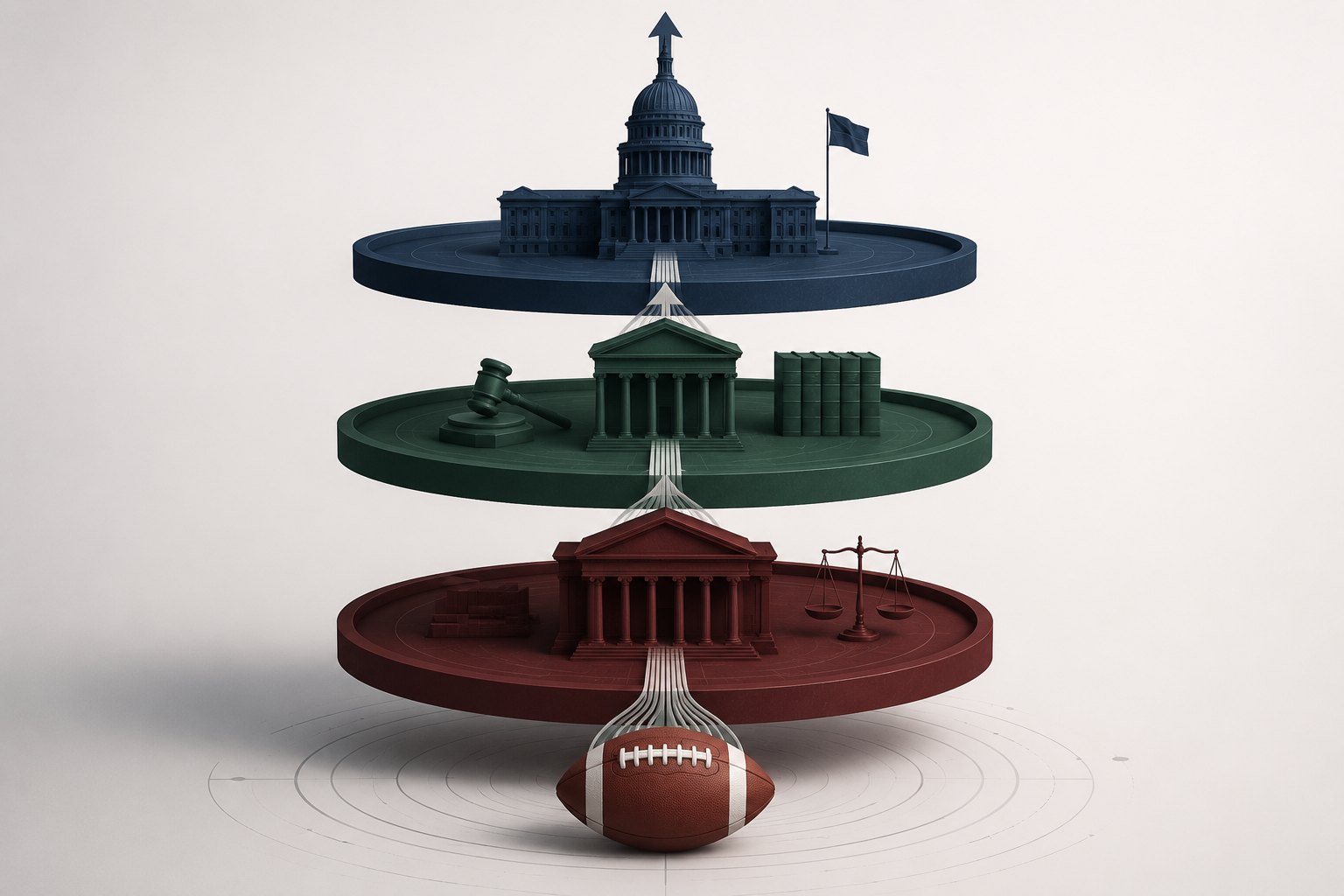
Those files overlap, but they are not the same matter. The contract question asks whether the player breached an integrity obligation in the collectively bargained player contract. The policy question asks what discipline the Commissioner may impose under the NFL’s gambling rules and the CBA’s disciplinary machinery. The criminal question asks whether the conduct, evidence, communications, money movement, or game-related act fits a federal or state offense. A suspension notice can be the first public consequence, but it is not the outer boundary of the legal problem.
| Layer | Primary Question | Decisionmaker or Forum | Possible Consequence |
|---|---|---|---|
| Player contract | Did the conduct breach the integrity obligation in the player contract? | League discipline and CBA arbitration framework | Contract-based discipline, grievance posture, limited court review |
| League gambling policy | Which policy category fits the conduct? | Commissioner discipline under Article 46 procedures | Tiered suspension or ban |
| Criminal law | Did the conduct involve fraud, bribery, manipulation, money laundering, or related conduct? | Federal or state investigators, prosecutors, and courts | Subpoenas, indictment risk, plea exposure, incarceration, forfeiture |
The Public Penalty Table Is Only One Layer
The easiest document to discuss is the NFL’s 2023 gambling discipline schedule because it translates violations into visible sanctions. Public reporting described a tiered structure: a two-game suspension for betting on non-NFL sports from the workplace or while working, a one-year minimum suspension for betting on NFL games, a two-year minimum for betting on the player’s own team, and a permanent ban for game-fixing, with reinstatement available only by petition after a defined period in some categories.[1][2]

That schedule is useful because it gives clubs, agents, and players a common vocabulary. It also creates a temptation to treat the case as solved once the conduct is classified. That is too quick. A table can identify the presumptive league penalty; it does not decide who has final interpretive authority, how evidence is obtained, what process is owed, whether the player has parallel criminal exposure, or what happens when the same facts are requested by a prosecutor.
The 2023 policy reporting also described six core rules for players: do not bet on the NFL; do not gamble at team facilities, while traveling for a road game, or while working; do not have someone else place bets for you; do not share inside information; do not enter a sportsbook during the NFL season; and do not play daily fantasy football.[2] For legal purposes, the inside-information rule may matter as much as the direct betting rule. A player who never opens a sportsbook account can still create a serious legal problem if he moves nonpublic information into a betting market.
The Contract Question Comes First, Even When the Policy Gets the Headline
The player’s contract and the CBA do work that the penalty table cannot do. The standard NFL player contract, included in the CBA appendix materials, contains an integrity obligation. Once gambling conduct is framed as conduct detrimental or integrity-related misconduct, the case moves into the disciplinary architecture of the collective bargaining agreement, including Article 46.
Article 46 matters because it defines who can discipline, who can hear the appeal, and how hard it is to disturb the result later. In the traditional CBA setting, the Commissioner has broad authority over conduct detrimental discipline and can serve, or appoint a designee to serve, as the hearing officer. That structure is not a neutral civil trial model. It is a collectively bargained labor model, and courts generally review labor arbitration awards under a narrow standard rather than rehearing the facts.
That distinction is often where public commentary goes wrong. A player may argue about notice, consistency, interpretation of the policy, evidentiary reliability, proportionality, or whether the charged conduct fits the category selected by the league. But a court asked to review a CBA arbitration outcome is usually not deciding whether it would have imposed the same suspension. It is asking a narrower labor-law question about the arbitrator’s authority and the award’s relationship to the agreement.
The Commissioner-arbitrator model is under pressure in other contexts. In August 2025, the Second Circuit’s Flores litigation and the Nevada Supreme Court’s Gruden litigation both rejected efforts to force non-CBA employment-related disputes into arbitration before Commissioner Roger Goodell, according to Constangy’s analysis of those decisions.[3] Those rulings are important signals of judicial discomfort with unilateral Commissioner-controlled arbitration outside the collective bargaining structure. They are not holdings that invalidate CBA-based gambling discipline for players.
That boundary matters. Flores and Gruden help counsel think about where Commissioner authority may be vulnerable when the league is relying on a non-CBA arbitration clause. They do not erase the different legal footing created by a collectively bargained disciplinary process. A player gambling case must still be analyzed through the player contract, the CBA, the policy text, and the specific appeal route available to that player.
The Same Act Looks Different in Each Forum
Suppose the conduct is a bet on an NFL game. In the policy file, the classification question is direct: betting on NFL games falls into the one-year minimum category under the 2023 schedule as publicly described.[1][2] In the contract file, the question broadens: did the conduct violate the integrity clause or constitute conduct detrimental under the CBA framework? In the criminal file, the mere fact of a prohibited bet does not automatically establish a federal crime. Investigators would need more: deception, corruption, manipulation, bribery, interstate communications used in a scheme, money laundering, or some other statutory hook.
Now change the fact pattern to inside information. The player does not bet. Instead, he tells someone that an injury limitation or usage change is not public. The policy file still has a rule to apply. The contract file still asks whether the player compromised league integrity. The criminal file becomes more fact-sensitive: who received the information, whether it was used to place wagers, whether the player was paid, whether communications crossed state lines, whether sportsbook accounts were deceived, and whether the information was tied to a broader scheme.
| Issue | CBA / Contract Discipline | League Policy Schedule | Criminal Law Overlay |
|---|---|---|---|
| Authority | Player contract, CBA integrity obligations, Article 46 | NFL gambling policy as enforced by the league | Federal or state statutes |
| Main decisionmaker | Commissioner or appointed hearing officer within the CBA process | League disciplinary authority | Prosecutors, grand jury, court |
| Core proof question | Did the player violate a bargained-for obligation or commit conduct detrimental? | Which policy category fits the conduct? | Can the government prove each statutory element? |
| Typical remedy | Discipline sustained, reduced, vacated, or remanded within labor framework | Suspension, ban, reinstatement process | Charges, plea, trial, sentence, forfeiture |
| Evidence consequence | Internal records and hearing record may matter | Monitoring data may support classification | League data and communications may be subpoenaed or independently investigated |
The burden of proof is not interchangeable. A league disciplinary record may support an internal finding without proving a criminal offense beyond a reasonable doubt. Conversely, a criminal investigation may pursue communications and financial records that were not necessary to impose league discipline. The same text message can be a policy exhibit, an arbitration exhibit, and a grand-jury exhibit, but it is being used for different legal purposes in each place.
Why Jontay Porter Belongs in the NFL Analysis, With Limits
Jontay Porter is not an NFL precedent. He was an NBA player. That limitation should be stated before the analogy does any work. The reason his case matters is narrower and more useful: it shows how conduct first recognizable as a league integrity violation can become a federal wire-fraud theory when performance manipulation, betting markets, and deceptive use of wagering infrastructure are alleged.
Porter was banned for life by the NBA and later pleaded guilty to conspiracy to commit wire fraud after prosecutors alleged that he manipulated his own performance in connection with prop bets. Wire fraud carries a statutory maximum of 20 years in prison.[4] That does not mean every sports-betting policy violation is wire fraud. It means counsel cannot safely end the analysis at the league penalty schedule when the alleged facts include performance manipulation, inside information, false appearances to sportsbooks, coordinated betting, or payment flows.
The statutory map is broader than wire fraud. Federal sports bribery law, 18 U.S.C. § 224, reaches certain bribery schemes intended to influence a sporting contest and carries a maximum penalty of five years.[5] Money laundering statutes may enter if proceeds are moved or concealed. State criminal statutes can also matter, particularly where bets were placed, where accounts were located, where communications occurred, and where the sporting event was played.
The important point is not that NFL players are next. As of Q3 2026, public materials identified in this research do not show federal gambling-related charges against NFL players. That boundary matters. Porter is an analogical warning about legal theory and evidence migration, not proof that NFL player discipline has already become federal prosecution.
Neighboring Prosecutions Show the Conduct Prosecutors Are Watching
The criminal-law overlay became harder to dismiss after the later basketball and baseball cases. In October 2025, federal authorities announced NBA-related indictments involving 31 people, including a head coach, in matters tied to alleged illegal gambling schemes and inside information.[6] In November 2025, MLB pitchers were indicted in a case involving allegations of rigged pitches.[7] These are neighboring sports examples, not NFL player cases, but the conduct categories travel easily across leagues.
Football has its own version of the same evidentiary concerns: snap counts, injury limitations, play-calling tendencies, quarterback availability, special-teams usage, and whether a player is expected to be active but limited. Some of that information becomes public before kickoff. Some of it does not. The legal risk changes when nonpublic information is sold, traded, or routed to bettors before the market has it.
The NFL’s monitoring apparatus also changes the evidence environment. Public reporting has described retired FBI agents assigned at every game, use of Genius Sports and IC360 for real-time betting monitoring, and a Global Security Operations Center supporting integrity work.[8][9] That infrastructure is built for league protection and policy enforcement. But logs, alerts, communications, interviews, and betting-integrity reports can become relevant to subpoenas, preservation demands, or criminal investigations if the facts move beyond internal discipline.
Scale Adds Pressure, Not a Different Legal Test
The post-PASPA market explains why the league has invested so heavily in rules and monitoring, but it should not be mistaken for proof in any individual case. By 2024, sports betting was legal in 38 states and Washington, D.C.; the national betting handle was reported at about $150 billion; and state tax revenue was reported at about $2.9 billion.[10] Those figures describe scale. They do not prove that any player violated a rule or that any violation was criminal.
The 2023 NFL suspension wave made the compliance problem visible. Public reporting identified 10 NFL player suspensions for gambling-related conduct that year.[1][2] Since then, the absence of a comparable public run of NFL player suspensions may reflect better education, better monitoring, changed player behavior, quieter enforcement, or some combination of those things. The available materials do not support a stronger conclusion.
Personnel cases require separate handling. Non-player employees may face league or club discipline under different documents, different appeal rights, and different practical leverage. The Ryan Gold suspension is useful as a related personnel-enforcement example precisely because it is not a player-contract case; the due-process and authority questions sit in a different lane. For that deeper personnel-side analysis, see What the Ryan Gold Suspension Reveals About NFL Gambling Enforcement.
What Counsel Has to Separate on Day One
A clean first-day analysis does not begin with public relations language. It begins with document control and forum control. Which version of the gambling policy applies? What did the player sign? Which CBA provisions govern discipline and appeal? Who has the device, account, chat, payment record, injury information, or sportsbook alert? Has anyone made statements to league security, club officials, a sportsbook, or law enforcement?
- Contract: identify the player-contract obligation, CBA provision, notice issue, and available grievance or appeal path.
- Policy: classify the alleged conduct under the 2023 tiered schedule without assuming the category is conceded.
- Evidence: preserve communications, betting-account information, travel and facility records, injury-status communications, and league-security contacts.
- Criminal exposure: test whether the facts suggest fraud, bribery, manipulation, money laundering, or only an internal rule violation.
- Forum strategy: avoid taking a position in a league interview or arbitration filing that creates unnecessary exposure in a later subpoena or criminal inquiry.
The last point is the one most likely to be missed under pressure. A player may want the fastest possible route to a reduced suspension. A club may want to show immediate cooperation. The league may want a clean integrity message. None of those incentives eliminates the need to ask whether factual admissions, document productions, or interview answers can be reused outside the league process.
The Practical Legal Implication
An NFL gambling policy violation involves more than the length of a suspension. A two-game, one-year, two-year, or permanent-ban category tells counsel what the league may seek to impose under its policy. It does not answer whether the player breached a collectively bargained integrity obligation, whether Article 46 supplies the controlling appeal route, whether judicial review will be narrow, or whether the evidence has criminal significance.
As of Q3 2026, the documented boundary remains important: federal gambling-related charges have not publicly targeted NFL players in the materials reviewed here. That fact narrows the claim; it does not remove the criminal-law file from counsel’s desk. Porter, the later basketball indictments, the baseball pitcher indictments, and the NFL’s own monitoring system all show how quickly integrity evidence can leave the clubhouse and enter a different legal forum.
References
- NFL toughens gambling policy and reinstates suspended players, The Guardian, September 29, 2023.
- NFL revises gambling policy, reinstates Lions WR Jameson Williams and Titans OL Nicholas Petit-Frere, Yahoo Sports, September 29, 2023.
- Courts Reject NFL Commissioner's Authority Over Employment-Related Disputes, Constangy.
- Jontay Porter Pleads Guilty in Sports Betting Case, Super Lawyers.
- 18 U.S.C. § 224 - Bribery in sporting contests, Legal Information Institute.
- 2024 Year-in-Review: Sports Betting Enforcement and Integrity Developments, WilmerHale.
- MLB pitchers indicted in alleged betting scheme involving rigged pitches, The Athletic, November 2025.
- NFL has retired FBI agents at every game to monitor gambling, USA Today.
- NFL integrity monitoring and sports betting compliance overview, NFL.com.
- Commercial Gaming Revenue Tracker, American Gaming Association, 2024.
Comments
Join the discussion with an anonymous comment.