
On July 20, 2026, Daniel Ortega announced that Nicaragua would abolish elections. That is not yet the same thing as enacted election-abolition law: the materials now available support a narrower conclusion, that Ortega made a public declaration and that no enabling legislation has yet been identified as passed by the National Assembly. The distinction matters. In Nicaragua, the government has usually preferred not to abandon legal form, but to make legal form carry the weight of political elimination. The announcement is therefore important less as an isolated outburst than as the exposed endpoint of a constitutional and administrative sequence already in motion. [1]
Editorial note: Lex Machina Review normally focuses on legal technology, AI tools, and regulation. This article is published under news and analysis because the machinery at issue here is also rule-of-law infrastructure: constitutions, courts, electoral administration, citizenship files, professional licensing, and the obligations of lawyers when the legal system is made to serve coercive power.
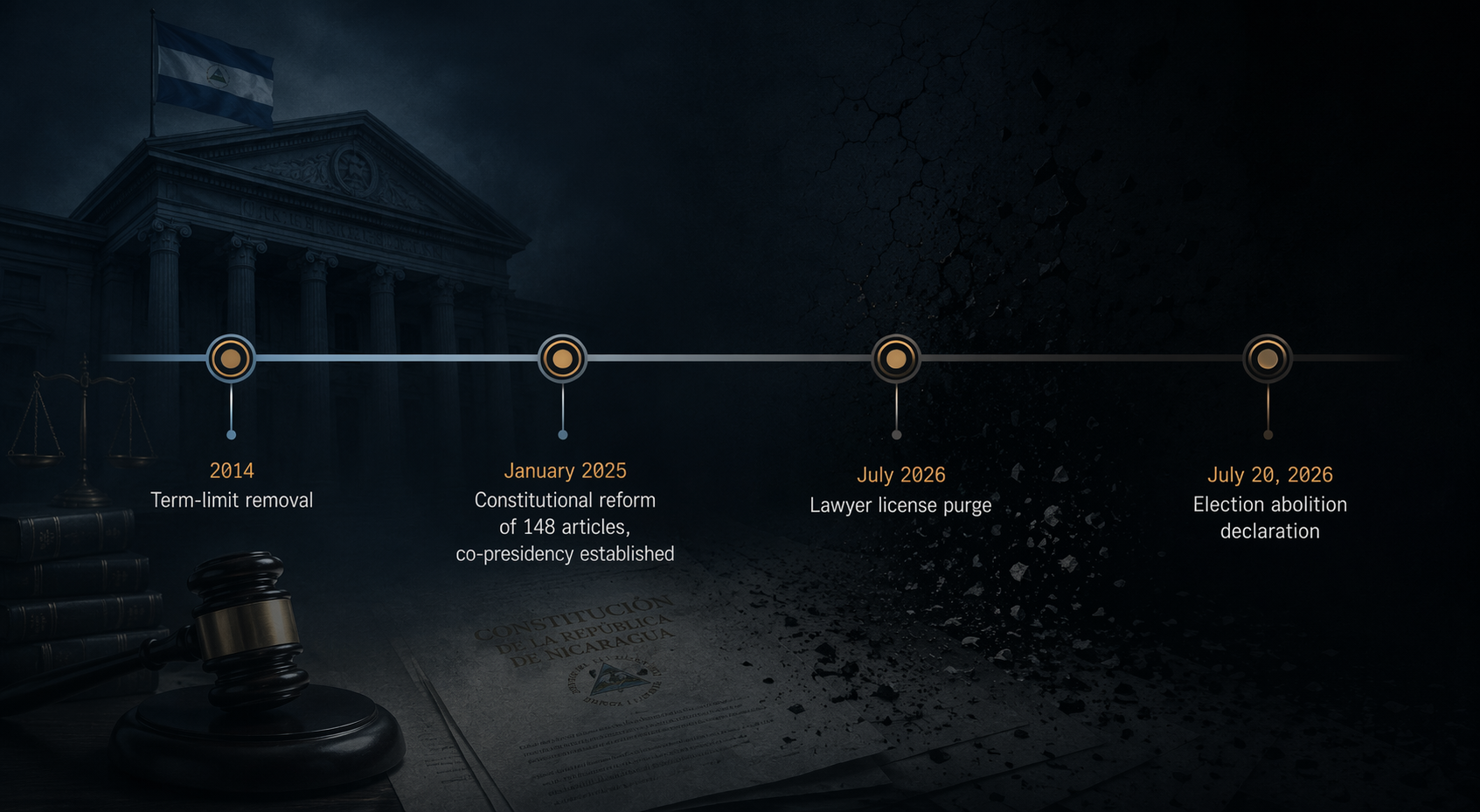
The announcement lands after the legal work was done
A functioning electoral system is not only a date on a calendar. It requires candidates who can organize, parties that can survive registration, courts that can hear challenges, electoral authorities not subordinated to incumbents, media that can report, civil society that can monitor, lawyers who can file, and citizens who remain citizens. By July 2026, each of those supporting structures had already been narrowed, subordinated, or attacked.
The legal chain is easier to see if the July announcement is read backward. In 2014, presidential term limits were eliminated. In January 2025, a constitutional reform amended 148 of Nicaragua’s 198 constitutional articles, created a co-presidency for Ortega and Rosario Murillo, extended presidential terms to six years, and gave the presidency power to “coordinate” the legislative, judicial, and electoral branches. [2] The July 2026 declaration did not invent that architecture. It named its destination.
The 2025 constitutional reform made subordination legible
The January 2025 reform is the load-bearing instrument. It did not merely adjust presidential tenure or rearrange institutional titles. By revising 148 of 198 articles, it remade the constitutional frame at scale. The reform’s creation of a formal Ortega-Murillo co-presidency converted what had been a political family arrangement into a constitutional office structure. The extension of the presidential term to six years lengthened the time between formal accountability moments. The new presidential power to “coordinate” the legislative, judicial, and electoral branches changed the relation among state organs in a way that is hard to reconcile with separation of powers. [2]
“Coordinate” is an administrative verb with a soft surface. In constitutional context, it does more work. A branch that must be coordinated by the presidency is not an equal branch exercising independent constitutional judgment; it becomes a component in an executive-managed system. That is why the word matters more than a louder decree might have. It gives domination a procedural vocabulary.
This is the legal grammar of autocratic consolidation. The formal constitution remains present, but the constitution’s internal safeguards are rewritten so that legality no longer restrains executive power. The Verfassungsblog analysis places Nicaragua in the comparative frame of “autocratic legalism,” the use of legal instruments and democratic procedures to dismantle democratic constraints from within. [2] That frame is useful precisely because it does not require pretending that legality has disappeared. The more unsettling point is that legality remains available as the method.
A court can still issue judgments. An electoral authority can still publish resolutions. A legislature can still vote. But once constitutional text places those institutions under presidential coordination, their acts no longer carry the same institutional meaning. They become paperwork downstream of executive power, not independent checks on it.
| Instrument or action | Legal significance |
|---|---|
| 2014 elimination of presidential term limits | Removed a basic temporal constraint on Ortega’s continued rule |
| January 2025 amendment of 148 of 198 constitutional articles | Rebuilt the constitutional framework rather than merely amending isolated provisions |
| Creation of the Ortega-Murillo co-presidency | Constitutionalized a dual executive arrangement centered on the ruling family |
| Six-year presidential term | Extended the period between formal electoral accountability moments |
| Presidential power to “coordinate” legislative, judicial, and electoral branches | Recast nominally separate institutions as components of an executive-managed system |
| July 20, 2026 election-abolition announcement | Declared the endpoint toward which the prior institutional design already pointed, while still awaiting identified enabling legislation |
Institutional control was not confined to courts
Court capture is often treated as the central legal story in democratic erosion, and for good reason. But Nicaragua’s sequence is broader. The Inter-American Dialogue describes the dictatorship’s structure through four linked pillars: opposition elimination, institutional control, social control, and international defiance. [3] The important legal point is that these pillars do not sit outside the constitutional story. They are the operating environment that makes the constitutional text effective.
Opposition elimination reduces the number of actors capable of contesting power. Institutional control determines which office receives, processes, or rejects challenges. Social control changes the cost of association, speech, and representation. International defiance signals that outside legal pressure will be resisted rather than absorbed. By the time election abolition is announced, these are not separate background conditions; they are the mechanisms by which an election would already have been emptied of ordinary democratic content.
The scale of institutional closure is not incidental. The available materials identify more than 5,600 NGOs, 58 media outlets, and 29 universities as closed, alongside more than 452 denationalized citizens through September 2024 and more than 261 expelled religious figures. [3] Each category removes a different kind of forum: association, reporting, education, nationality, pastoral and community protection. The cumulative effect is not only repression in the abstract. It is the removal of places where legal and political claims could be organized before they ever reached a courtroom or ballot.

The lawyer-license purge changes the legal problem
The July 2026 revocation of lawyers’ licenses deserves more than a passing mention. If the courts are controlled, the ordinary question is whether lawyers can still force some record into existence: a petition filed, an objection preserved, a detention challenged, a citizenship case documented, an administrative closure contested. When the professional registry itself is used to remove lawyers, the state is no longer only controlling the forum. It is controlling who may enter the forum at all.
The UW-Madison LADD analysis describes a purge of the legal profession through license revocations, reporting that the action may have affected hundreds or thousands of lawyers and citing estimates around 2,000 affected licenses. It also emphasizes the lack of notice and due process. [4] The exact count should be handled carefully: the available descriptions vary, and “around 2,000” should not be converted into a more precise number than the sources support. The legal significance, however, does not depend on mathematical neatness. Even at the lower end, revoking licenses without notice or due process attacks the professional capacity needed to challenge state action.
Professional licensing is one of the quieter instruments of state power. It looks clerical: a name appears in a registry, a credential remains valid, a signature is accepted, a filing is permitted. Remove the credential and a lawyer’s arguments may become procedurally invisible. Clients remain in danger, but their representative can no longer appear as counsel. A detained person may still have rights in text, while the lawyer who would invoke them has been administratively disabled.
That is why the purge marks a further stage in autocratic legalism. Earlier moves subordinated institutions that decide cases. This move strikes at the profession that brings cases. The distinction matters for constitutional analysis because rights without authorized advocates become harder to convert into filings, evidence, appeals, or international records. A controlled judiciary can still be forced to show its work. A purged bar reduces the number of people able to demand even that.
Citizenship, exile, and detention as legal incapacitation
The same logic appears in the treatment of citizenship and exile. Denationalization is not only punishment; it alters legal standing, identity, mobility, property relations, family security, and the ordinary premise that a state owes duties to its nationals. The research record identifies more than 452 citizens stripped of nationality through September 2024. [3] That figure is cumulative for the stated period and should not be treated as a current total unless updated materials support that claim.
Displacement adds another layer. Around 250,000 Nicaraguans have been forcibly displaced since 2018, while more than 46 political prisoners remained according to the available materials. [3] These numbers measure different injuries. Displacement removes people from the domestic field in which they might vote, organize, litigate, report, or teach. Political imprisonment leaves people inside the state’s coercive system but outside ordinary political participation. Both conditions degrade the practical environment in which an election could function as a contest for power.
Religious expulsion, university closure, media shutdown, NGO cancellation, denationalization, detention, and disbarment should not be collapsed into one undifferentiated list of abuses. They disable different legal capacities. Some remove monitors. Some remove educators. Some remove counsel. Some remove witnesses. Some remove defendants from public life. Together, they explain why the abolition of elections can be announced after much of the surrounding democratic infrastructure has already been procedurally stripped away.
The human-rights record supplies the consequence, not just the atmosphere
The institutional story should not become bloodless. The UN Group of Human Rights Experts on Nicaragua has found that serious violations in Nicaragua amount to crimes against humanity and has based its work on more than 1,900 interviews. [5] That evidentiary base matters because it ties the legal architecture to lived consequences: detention, exile, fear, loss of nationality, closure of civic space, and the narrowing of any domestic path to remedy.
International accountability has also moved beyond general condemnation. In December 2024, an Argentine federal judge issued international arrest warrants for Ortega and Murillo under universal jurisdiction. [3] A warrant issued abroad does not by itself reopen Nicaraguan courts, restore licenses, or recreate elections. Its significance is different: it records that when domestic institutions are subordinated, accountability claims may be displaced into foreign and international forums.
That displacement is itself evidence of institutional failure. A constitutional system that requires victims, exiles, and lawyers to look outside the country for any forum has not merely produced bad outcomes. It has lost the internal legal channels by which official power is supposed to be contested.
What the July 20 declaration clarifies
It remains important not to overstate the procedural record. The July 20 statement is an announcement, not, on the present materials, a completed statute or constitutional amendment abolishing elections. A regime that has repeatedly converted political control into legal instruments may still produce implementing text, but its content should not be guessed in advance.
The stronger conclusion is narrower and more serious. Ortega’s declaration completes the logic of the prior legal architecture. Once term limits are removed, constitutional text is rewritten at scale, the presidency is empowered to coordinate the legislature, judiciary, and electoral branch, opposition organizations are eliminated, citizenship is made revocable, civil society and media are closed, and lawyers’ licenses can be stripped without ordinary process, abolishing elections is not a departure from the system. It is the system speaking plainly.
References
- Reuters, AP, The New York Times, The Guardian, and Al Jazeera reporting on Ortega’s July 20, 2026 election-abolition announcement
- Nicaragua’s Constitutional Reform, Verfassungsblog
- The Shape of Dictatorship in Nicaragua: 2026, Inter-American Dialogue, June 2026
- Nicaragua Conducts a Purge of the Legal Profession by Revoking Lawyers’ Licenses, UW-Madison LADD, July 10, 2026
- UN Group of Human Rights Experts on Nicaragua press releases, United Nations, February and October 2025
Comments
Join the discussion with an anonymous comment.