
Daniel Ortega’s July 20, 2026 declaration that Nicaragua would no longer hold elections looked, from outside the country, like a sudden crossing of the final line. It was not sudden in the legal sense. The announcement was the visible last move in a constitutional sequence that had already made competitive elections dispensable under Nicaragua’s redesigned domestic order.[1][2]
That distinction matters for the legal implications of Nicaragua’s election abolition. If the question is whether the abolition is compatible with liberal constitutional democracy, the answer is plainly no. If the question is whether a Nicaraguan court, electoral authority, or other domestic institution still has a constitutional foothold from which to resist it, the answer is much more disturbing: the 2025 constitution had already removed the foothold.
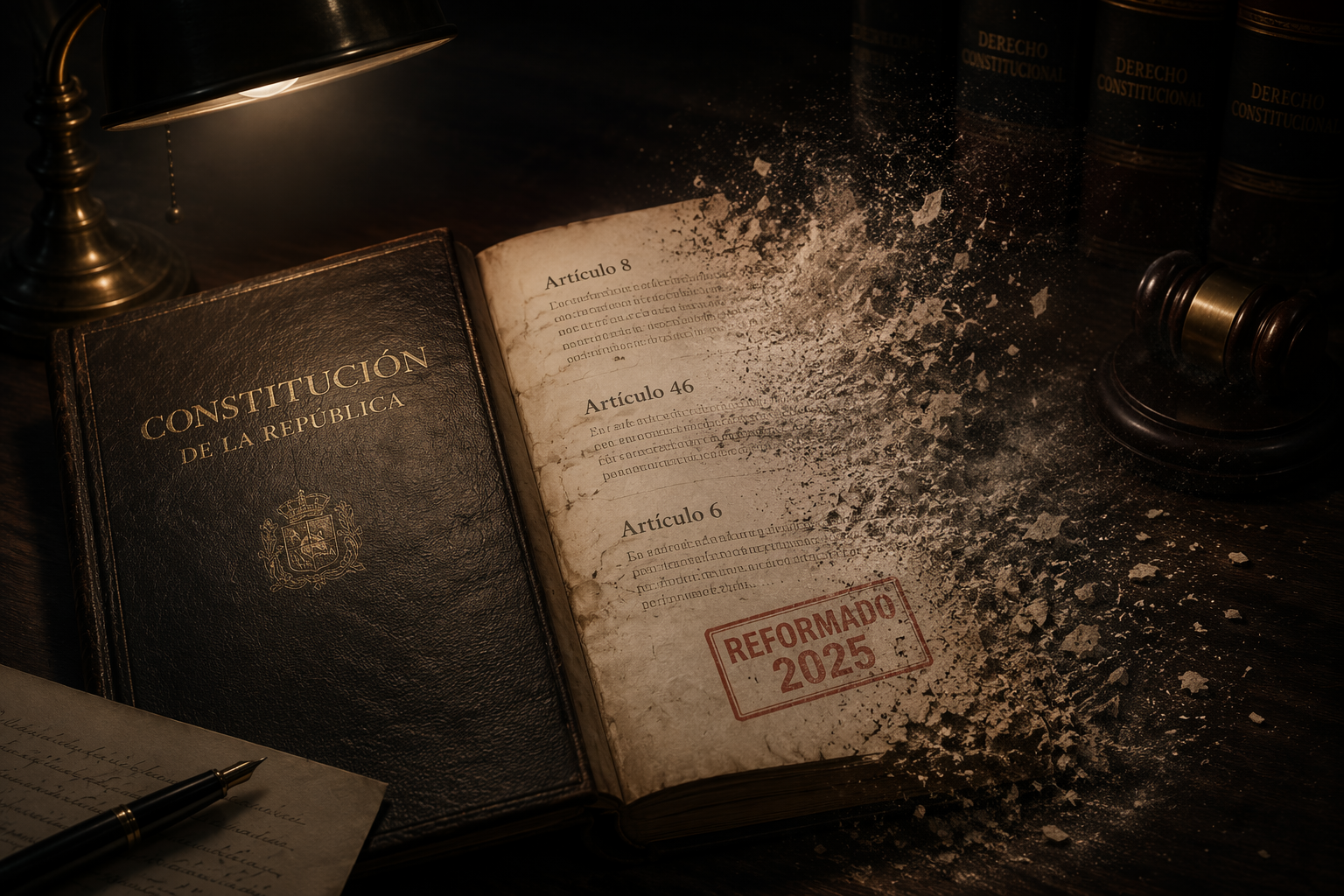
The operative event, then, was not only the July 2026 statement. It was the constitutional refitting that preceded it: a 2025 reform that amended 148 of Nicaragua’s 198 constitutional articles, eliminated 37 outright, and was processed as a “partial reform” rather than as the kind of constituent refounding that such a sweeping alteration would ordinarily imply.[3] That procedural choice is not a footnote. It is the hinge of the domestic legal story.
A constitution can preserve electoral words while changing the legal consequences attached to them. Nicaragua’s 2025 reform did something more aggressive: it rewrote the institutional grammar around elections so that competition, remedies, and checks no longer had enforceable domestic status. Article 8 subordinated the state’s branches and electoral bodies to the Presidency. Article 6 made pluralist party competition constitutionally incoherent. The repeal of Article 46 severed the domestic incorporation route for major human-rights treaties. Article 17 turned political exclusion into a constitutional mechanism. Articles 92 ter and 97 ter gave coercive auxiliaries a constitutional place.[4]
The 2025 Reform Was the Load-Bearing Event
The reform’s scale is the first legal warning. A text that changes nearly three quarters of a constitution and deletes dozens of provisions is difficult to treat as merely partial in constitutional substance, even if the governing majority labels it that way. Yet the “partial reform” route allowed the Ortega-Murillo government to avoid the legal and political consequences of acknowledging a full constitutional refounding.[3]
The consequence was not simply that the governing party gained more power. It was that Nicaragua’s domestic legal order was made to recognize that power as constitutional power. Once the constitution itself has been rewritten to subordinate institutions, define legitimate parties, and narrow remedies, later political acts no longer need to appear as emergency measures. They can be presented as applications of the text.
This is why the July 2026 abolition cannot be analyzed as if the old constitutional order were still standing in the background. The older vocabulary of elections, opposition parties, courts, and constitutional rights had been retained only where it could be made harmless, redirected, or emptied of enforceable content.
Article 8: Subordination Replaced Separation
Article 8 is the clause that explains why the domestic system has no ordinary institutional counterweight left. Under the 2025 constitution, the legislature, judiciary, and electoral bodies are subordinated to the “Presidency of the Republic.”[4] The important verb is “subordinated.” It does not merely signal political dominance. It rewrites the legal relationship among state organs.
In a constitutional system with horizontal accountability, the electoral authority can administer elections against executive preference, the legislature can legislate against executive preference, and the judiciary can review both. Nicaragua’s Article 8 moves in the opposite direction. It places the very bodies that would have to object to election abolition inside a hierarchy that points upward to the Presidency.
That design matters more than any later prediction about how a particular judge might behave. A domestic challenge to the abolition would have to pass through institutions whose constitutional position has already been altered. A court asked to defend electoral rights against the Presidency would not be deciding from an independent constitutional station; it would be deciding under a text that has placed the judiciary beneath the institution whose act is being challenged.[4]
The same problem applies to electoral administration. An electoral body cannot be an effective guardian of competitive elections when its constitutional status is subordinate to the political authority that has declared elections unnecessary. The legal defect is not only bias or capture, although those are real concerns. The deeper defect is that the constitution has ceased to assign the body an independent checking function.
That is the domestic legal logic of the July 2026 declaration. Once Article 8 collapses the separation of powers into presidential subordination, there is no internal institutional actor left with both the legal authority and constitutional independence to insist that elections must continue.
Article 6: Party Competition Became Constitutionally Incoherent
Article 6 performs a different kind of work. It does not abolish opposition parties by simply saying that only one named party may exist. Instead, it requires all political parties to declare a “revolutionary” character, entrenching what ConstitutionNet describes as a de jure one-party state.[4]
That requirement is more than ideological decoration. Party competition depends on the legal possibility that parties may offer rival constitutional projects, rival histories, and rival accounts of legitimacy. A rule requiring every party to share a revolutionary character narrows the identity of lawful politics before a campaign begins. It turns electoral pluralism into managed similarity.
The effect is especially severe because the clause operates at the level of constitutional eligibility. A party that rejects the governing revolutionary identity does not merely lose votes or face administrative harassment. It becomes difficult to square that party’s existence with the constitutional definition of what a lawful party is supposed to be.
This is where domestic election law loses its central premise. Elections are not only periodic voting events. They are legal competitions among actors who are allowed to disagree about the state. If the constitution itself requires parties to affirm a political identity compatible with the ruling project, then the later removal of elections does not destroy a functioning pluralist system. It formalizes the absence of one.
Freedom House’s 2025 country report had already characterized Nicaragua’s 2021 elections as sham elections and recorded the collapse of meaningful political competition before the 2026 declaration.[5] Article 6 gave that collapse a constitutional form. It made the party system not merely unfair but structurally incapable of performing the pluralist function elections require.
Article 46: The Domestic Treaty Hook Was Removed
The repeal of Article 46 is the remedial severance. Before the 2025 reform, Article 46 incorporated major human-rights instruments, including the Universal Declaration of Human Rights and the American Convention on Human Rights, into Nicaragua’s constitutional order.[3][4] Its repeal did not erase Nicaragua’s international obligations. It did something narrower and, for domestic litigants, immediately consequential: it removed the constitutional route by which those instruments could be invoked inside domestic law.
The distinction matters. International law may still condemn the abolition of elections. But a lawyer filing in a Nicaraguan court after the repeal of Article 46 no longer has the same domestic constitutional hook for saying that treaty-based political rights are part of the local constitutional text. The right may survive internationally while the domestic remedy disappears.
For election abolition, this is decisive. A claim grounded in free participation, representative government, or equal political rights would once have had a domestic incorporation route through Article 46. After repeal, the argument must confront a constitution that has both removed the incorporation clause and subordinated the adjudicator. The problem is therefore not only that courts may refuse relief. It is that the constitution has been rewritten to make the relief harder to ask for in domestic constitutional terms.
This is the quietest part of the abolition strategy and one of the most consequential. Election abolition can be announced in a sentence. Remedy abolition happens in clauses that determine which sources count, which forums may hear a claim, and which institutions must obey whom.
Article 17: Exclusion Became a Constitutional Tool
Article 17 adds a mechanism of political exclusion. The 2025 constitution created a permanent legal basis for denationalizing people labeled “traitors to the homeland.”[4] In an electoral system, citizenship is not an ornamental status. It is the legal condition for belonging to the political community that votes, organizes, runs, challenges, and returns.
The Bertelsmann Transformation Index’s 2026 country report records more than 450 people stripped of citizenship and more than 5,000 NGO shutdowns in Nicaragua’s broader crackdown.[6] Those figures describe coercive political conditions, not merely constitutional drafting choices. They are a necessary reminder that the legal architecture did not operate in a vacuum. It worked alongside exile, closure, fear, and administrative force.
Still, Article 17 matters because it constitutionalizes the exclusionary logic. A government that can remove citizenship from “traitors” can narrow the political community through a legal status decision rather than through an ordinary criminal conviction or electoral contest. The label does not need to persuade voters if it can first remove the person from the constitutional category of full political membership.
Articles 92 ter and 97 ter: Coercion Entered the Constitutional Frame
Articles 92 ter and 97 ter bring coercive auxiliaries into the same constitutional picture. The 2025 constitution legalized a “Patriotic Reserve Military Force” and “voluntary police” as state instruments.[4] These provisions should not be treated as separate from election abolition merely because they do not use electoral vocabulary.
Elections require more than ballot rules. They require an environment in which parties can assemble, journalists can report, lawyers can file, civic groups can monitor, and citizens can make choices without a state-backed shadow of retaliation. Constitutional recognition of auxiliary coercive forces changes the practical meaning of political participation, especially when paired with citizenship-stripping, NGO closures, and institutional subordination.
The point is not that these articles alone abolished elections. They made resistance to abolition more dangerous and less legally legible. When coercive forces are given a constitutional place, the line between legal order and political intimidation becomes harder for domestic actors to contest from within the system.
The Earlier Legal Prehistory
The 2025 constitution did not appear from nowhere. The earlier legal sequence matters, but mainly because it shows the direction of travel. Nicaragua had already removed presidential term limits in 2014, eliminating a basic temporal constraint on Ortega’s rule.[3] By the time the 2025 reform arrived, the system had already learned to treat constitutional amendment as a tool for converting incumbency into entitlement.
The 2021 sovereignty and foreign-agents laws also belong in the prehistory. The BTI 2026 report identifies these legal measures as part of the state’s constriction of civic and political space, including the campaign against NGOs and opposition actors.[6] Their significance for the election abolition is not that they supplied the final constitutional theory. It is that they helped drain the social and organizational field in which elections would have had to operate.
Freedom House’s 2025 assessment supplies the same cumulative picture from the political-rights side: sham elections, collapsed competition, and the absence of meaningful democratic participation before the formal abolition announcement.[5] These materials do not replace the article-by-article constitutional analysis. They explain why the clauses could operate effectively once enacted.
Domestic Legality Is Not the Same as Legitimacy
The hard legal conclusion is this: under the regime’s current domestic constitution, the July 2026 abolition of elections is not best understood as an unlawful surprise. It is the conclusion of a constitutional strategy that had already removed the legal necessity of competitive elections.
That conclusion is not an endorsement. Domestic legality under an autocratic constitution is a description of internal legal mechanics, not a judgment of democratic legitimacy. A constitution can be made to authorize the destruction of constitutional democracy. Nicaragua’s 2025 reform is an example of that problem in operative clauses rather than in theory alone.
The remedial consequences follow from the structure. A domestic court challenge would face Article 8’s subordination of the judiciary. A party-rights challenge would face Article 6’s revolutionary-party requirement. A treaty-incorporation argument would face the repeal of Article 46. A citizenship or participation claim would face Article 17’s exclusionary mechanism. A civic-space challenge would operate in an environment where auxiliary coercive forces have constitutional recognition.
| Provision | Domestic Legal Effect |
|---|---|
| Article 8 | Subordinates legislature, judiciary, and electoral bodies to the Presidency, removing horizontal accountability. |
| Article 6 | Requires parties to declare a revolutionary character, making pluralist party competition constitutionally incoherent. |
| Repeal of Article 46 | Removes the domestic constitutional incorporation route for major human-rights instruments. |
| Article 17 | Creates a constitutional mechanism for denationalizing people labeled traitors to the homeland. |
| Articles 92 ter and 97 ter | Constitutionalize auxiliary coercive forces as state instruments. |
A lawyer can still call the abolition anti-democratic, authoritarian, and incompatible with Nicaragua’s international commitments. But to call it simply “illegal” without specifying the legal order obscures the central domestic fact. The regime first changed the law that would have made abolition contestable.
The July 2026 Declaration, Read Precisely
Return now to the July 20 declaration. Its importance is not that Ortega discovered a new power in 2026. Its importance is that he could announce the end of elections after the constitution had already subordinated the institutions that might object, disciplined the party system that might compete, removed the treaty hook that might support a domestic rights claim, and legalized exclusionary and coercive mechanisms around political life.[1][2][4]
That is the domestic legal implication of Nicaragua’s election abolition. The announcement made explicit what the 2025 constitution had already done: it turned elections from a constitutional requirement into a dispensable ritual, and then dispensed with the ritual.
Internationally, the analysis is different. Obligations such as ICCPR Article 25 and ACHR Article 23 still frame the treaty-law consequences of abolishing political participation and representative elections. That separate question belongs to the companion analysis of Nicaragua’s election cancellation and its legal implications. Domestically, however, the July 2026 declaration was the formal conclusion of a legal order already redesigned to say yes.
References
- Ortega insists no more elections for Nicaragua, Al Jazeera, July 20, 2026.
- Nicaragua Ortega abolish elections, The New York Times, July 20, 2026.
- From Democracy to Dynastic Rule? The 2025 Constitutional Reform in Nicaragua, Verfassungsblog.
- Nicaragua: A New Absolutist Constitution, ConstitutionNet.
- Nicaragua: Freedom in the World 2025 Country Report, Freedom House, 2025.
- BTI 2026 Country Report: Nicaragua, Bertelsmann Transformation Index, 2026.
Comments
Join the discussion with an anonymous comment.