
Daniel Ortega’s July 20 statement that Nicaragua would have “never again” elections is the immediate event. The legal point is less sudden. The cancellation, as reported by Reuters, is the visible end of a sequence of domestic legal changes that had already narrowed candidacy, subordinated institutions, displaced treaty supremacy, and weakened any practical domestic forum for political-rights claims. The formal legislative mechanism for carrying out the election ban remains unspecified as of this writing, but the international-law breach is not difficult to identify: cancellation of competitive elections violates political participation guarantees under Article 23 of the American Convention on Human Rights, Article 25 of the International Covenant on Civil and Political Rights, and the democratic commitments reflected in the Inter-American Democratic Charter. The harder question is remedy, because Nicaragua has withdrawn from the OAS and has placed courts and electoral authorities under executive control, limiting the prospect of immediate compliance even where the legal violation is clear.[1]
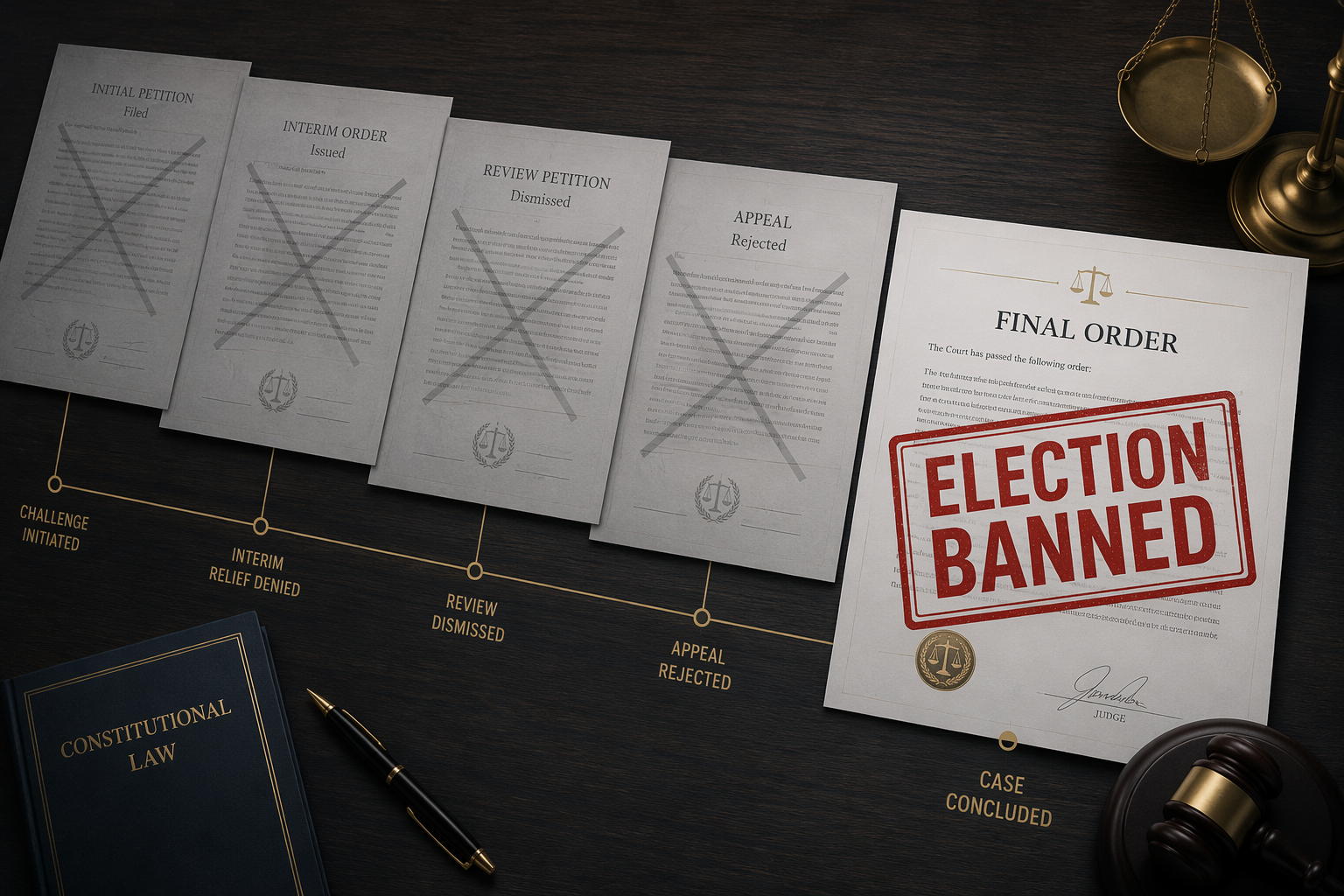
For lawyers assessing the legal implications of Nicaragua’s election ban, the central mistake would be to treat the ban as a single act detached from the legal architecture that preceded it. The relevant record begins well before July 2026: the 2020 Sovereignty Law, the 2025 constitutional reform, the repeal of treaty supremacy, the executive appointment of judges, and the January 2026 citizenship measure together explain why domestic political rights protections were disabled before the election calendar was extinguished.
The domestic legal path to cancellation
The 2020 Sovereignty Law is the first indispensable piece because it recast ordinary political opposition as a basis for exclusion. Human Rights Watch described the law as threatening free and fair elections by allowing authorities to bar people deemed to have supported sanctions, foreign interference, or actions against Nicaragua’s sovereignty. JURIST’s contemporaneous reporting likewise treated the law as a mechanism for excluding opposition figures before the 2021 electoral cycle.[2][3]
That matters under international law because political-rights restrictions are not open-ended. Article 23 of the American Convention permits regulation of political participation only on specified grounds such as age, nationality, residence, language, education, civil and mental capacity, or criminal sentencing by a competent court. A political-ideological exclusion based on alleged disloyalty to the state does not fit those grounds. Even before an election is canceled outright, a legal regime that permits authorities to decide who is sufficiently patriotic to run for office has already moved outside the permissible treaty framework.
The 2025 constitutional reform then converted that exclusionary logic into a structural problem. ConstitutionNet reported that the reform changed 148 of Nicaragua’s 198 constitutional articles through the partial reform procedure in Article 193. Among the changes were the elimination of separation of powers under Article 8, the creation of a co-presidency under Article 133, six-year terms under Article 135, executive appointment of judges under Article 136, and the repeal of the former Article 46, which had recognized the supremacy of international human rights treaties.[4]
Those amendments are not just constitutional background. They affect admissibility, exhaustion, and responsibility. When judges are appointed by the executive and separation of powers is abolished as a constitutional premise, a political-rights claimant is not merely facing a hostile court. The legal system has been redesigned so that the institution expected to review an election ban is subordinate to the political authority imposing it. Verfassungsblog’s analysis of the reform described the shift as one from democratic constitutionalism toward dynastic rule, while Reuters and JURIST reported the reform’s consolidation of power in early 2025.[5][6][7]
The repeal of treaty supremacy is especially important. A state cannot erase its international obligations by amending its constitution. But repeal can eliminate an internal route through which litigants might previously have invoked human rights treaties before domestic courts. In practical terms, that makes the exhaustion inquiry less formalistic: where the domestic legal order has removed the independence and hierarchy needed to adjudicate treaty rights, insistence on ordinary domestic remedies becomes difficult to defend.
The January 2026 citizenship measure adds a further layer. ConstitutionNet reported on the elimination of dual citizenship in February 2026, with the regime clarifying that the measure would not apply retroactively. That retroactivity caveat matters and should not be ignored. It does not, however, remove the measure from the political-rights analysis. Citizenship rules define who may belong to the political community and who may stand as a candidate; when adopted in a system already marked by candidacy exclusions and institutional subordination, they form part of the same legal environment that constricts participation.[8]
Why Article 23 is the central breach
Article 23 of the American Convention protects the right to take part in public affairs, to vote and be elected in genuine periodic elections, and to have access to public service under general conditions of equality. Its limitation clause is unusually concrete. States may regulate political rights only for reasons such as age, nationality, residence, language, education, civil and mental capacity, or sentencing by a competent court in criminal proceedings.
That text leaves little room for a ban on elections, and even less for ideological screening of candidates. The 2020 Sovereignty Law’s political-disloyalty categories were already outside Article 23’s permitted grounds. A 2026 cancellation goes further: it removes the electoral event through which the protected rights are exercised. Voters lose the act of choosing; candidates lose the act of standing; parties and civic organizations lose the public process through which political alternatives are tested. The violation is therefore not limited to opposition leaders formally excluded from a ballot. It reaches the electorate as a whole.
| Instrument | Protected obligation | Why the cancellation conflicts with it |
|---|---|---|
| American Convention on Human Rights, Article 23 | Participation in public affairs; voting and being elected in genuine periodic elections; equal access to public service | Election cancellation removes the periodic electoral mechanism and follows candidacy restrictions that fall outside Article 23’s permitted limitation grounds. |
| ICCPR, Article 25 | Every citizen’s right and opportunity to take part in public affairs, vote, be elected, and access public service without unreasonable restrictions | A general election ban is an unreasonable restriction because it prevents citizens from exercising the protected opportunity altogether. |
| Inter-American Democratic Charter | Representative democracy, periodic free and fair elections, pluralism, and separation of powers as essential elements of the inter-American democratic order | The ban follows constitutional changes that eliminated separation of powers and subordinated institutions needed to administer or review elections. |
The ICCPR analysis is similar but uses a different formulation. Article 25 protects the right and opportunity of every citizen, without unreasonable restrictions, to take part in public affairs, vote and be elected at genuine periodic elections, and access public service. A state may regulate electoral mechanics, but it may not abolish the meaningful opportunity itself. The 2026 cancellation therefore exceeds regulation and becomes deprivation.
The Inter-American Democratic Charter adds a structural vocabulary. Its importance is not that it substitutes for the American Convention, but that it identifies representative democracy, periodic free and fair elections, pluralism, and separation of powers as essential components of the regional legal order. Nicaragua’s 2025 reform matters here because it did not merely alter term length or governmental style; it removed the institutional conditions that make elections reviewable and politically meaningful.
Chavarría Morales makes the 2026 breach harder to characterize as novel
The most directly relevant Inter-American precedent is Chavarría Morales v. Nicaragua. In 2025, the Inter-American Court held Nicaragua internationally responsible for political-rights violations in the 2021 election context. Confidencial reported that the Court ordered $530,000 in reparations; that figure should be treated with the caution appropriate to secondary reporting and cross-checked against the official judgment as reflected in the OAS Annual Report 2025.[9][10]
The legal significance of Chavarría Morales is not the reparations amount. It is the continuity between the 2021 election cycle and the 2026 cancellation. The Court had already addressed Nicaragua’s election-related suppression of political rights. A later cancellation of elections does not present the Inter-American system with a wholly new species of claim. It is a more drastic form of interference with the same protected rights, occurring after the state had been placed on notice by prior litigation and judgment.
That matters for future petitions because the Court’s reasoning can help frame both individual and structural harms. Individual victims may include excluded candidates, opposition figures, voters denied a meaningful vote, and civil society actors targeted for participation-related activity. Structural harm arises because the electoral process itself has been removed or rendered noncompetitive through legal design. Chavarría Morales gives future claimants and the Commission a recent bridge between Nicaragua’s prior election manipulation and a later outright ban.
Yatama v. Nicaragua supplies the longer jurisprudential backdrop. In that 2005 judgment, the Inter-American Court addressed restrictions on political participation in Nicaragua, including the exclusionary effects of electoral rules on Indigenous and ethnic community political organization. Yatama remains important because it confirms that Nicaragua’s political-rights restrictions have long been justiciable under the American Convention.[11]
But Yatama should not carry more weight than it can bear. The 2026 cancellation follows a different legal architecture: a sovereignty law used to disqualify opposition, a constitutional overhaul that subordinates institutions, and an announced end to elections. Chavarría Morales is therefore the more immediate precedent. Yatama shows that the door to adjudication has long been open; Chavarría Morales shows that the Court has already walked through it in the recent Nicaraguan election context.
Domestic remedies and the exhaustion problem
Any serious remedy discussion must begin with domestic exhaustion, because the Inter-American system does not usually operate as a first-instance tribunal. The ordinary rule requires petitioners to pursue available and effective domestic remedies before bringing a case to the Inter-American Commission on Human Rights. The issue in Nicaragua is whether those remedies can still be described as available and effective after the 2025 constitutional reform.
The reform’s authorization of executive appointment of judges, together with the elimination of separation of powers, makes that description difficult. A court system structurally dependent on the authority responsible for canceling elections cannot be expected to provide independent review of that cancellation. The same point applies to electoral institutions. If the electoral branch is subordinated within a constitutional order that no longer preserves separation of powers, domestic review becomes less a remedy than a procedural obstacle.
This does not mean petitioners can ignore procedure. It means the evidentiary record should show why domestic remedies are ineffective or unavailable: legal texts, appointment rules, prior rulings, refusals to register candidacies, administrative silence, threats, detentions, denationalization measures, or other conduct that makes domestic review illusory. Under hostile conditions, documentation becomes part of the legal claim, not an afterthought.
The Advisory Opinion request may clarify the right to democracy, but it has not done so yet
Guatemala’s 2024 request for an advisory opinion before the Inter-American Court deserves attention because it asks the Court to address democracy as a justiciable right under the American Convention. Hearings were held in Brasília in March 2026, and commentators have described the request as potentially landmark for the inter-American system.[12]
The point should be kept bounded. The Court has not, on the materials available here, already issued a ruling that transforms the Inter-American Democratic Charter into a directly enforceable individual right to democracy in the broadest sense. If the Court recognizes a justiciable right to democracy, Nicaragua’s election cancellation could be framed not only as a set of individual Article 23 violations but also as a structural human rights violation affecting the constitutional conditions of participation. Until then, the firmer path remains Article 23, Article 25, existing political-rights jurisprudence, and the Charter’s role as an interpretive and institutional instrument.
What remedies remain, and what they can realistically do
The available remedies fall into several overlapping channels. None should be described as likely to force immediate restoration of elections. Each can still matter.
- Individual petitions before the IACHR can preserve claims by excluded candidates, voters, political parties, civil society actors, and others directly affected by the cancellation or by earlier exclusionary measures.
- IACHR monitoring and precautionary processes can document ongoing risks, establish a public record, and connect the election ban to prior findings on repression and institutional breakdown.
- OAS Permanent Council action and Inter-American Democratic Charter mechanisms can maintain diplomatic and institutional pressure, including through Article 20 procedures where there is an unconstitutional alteration of the democratic order.
- UN Human Rights Council mechanisms, including the Group of Human Rights Experts on Nicaragua, can support parallel documentation and accountability findings.
- Future transitional accountability processes may rely on the records generated now, particularly where domestic courts later regain independence or international cooperation becomes possible.
The enforcement caveat is substantial. Nicaragua’s withdrawal from the OAS became effective in the 2024-2025 period, and country assessments describe a system in which judicial independence has been dismantled and political pluralism severely restricted.[13][14] Those facts limit the immediate coercive effect of Commission reports, Court judgments, OAS resolutions, and Charter processes. A judgment may name a violation and order reparations; it may not produce compliance from a government that has already rejected the regional institutional framework.
That limitation is not a reason to treat the mechanisms as decorative. Inter-American decisions can settle contested legal characterizations, identify victims, preserve findings on institutional design, and prevent the state from recasting election cancellation as an internal constitutional choice beyond review. In future negotiations, sanctions analysis, asylum adjudication, universal or regional accountability processes, and transitional reform, the difference between a political allegation and an adjudicated or documented violation can be material.
The UN track has a related function. The Group of Human Rights Experts on Nicaragua has documented serious violations, including findings characterized in the research record as crimes against humanity. Those findings do not substitute for Inter-American political-rights adjudication, but they help place the election ban within a broader record of state conduct rather than a narrow electoral dispute.[15]
The legal consequence of canceling the vote
An election ban is democratically grave in ordinary language. In legal terms, its gravity lies in the way it disables several protected relationships at once: the relationship between voters and public power, between candidates and eligibility, between civil society and public participation, and between courts and the enforcement of rights. Nicaragua’s prior legal changes make the breach easier, not harder, to analyze. They show that the July 2026 announcement did not merely interrupt an electoral timetable; it completed a domestic legal sequence designed to remove the institutions through which political rights could be exercised or defended.
The result is a clear violation of international political-rights obligations with constrained remedies. Article 23 of the American Convention and Article 25 of the ICCPR are directly implicated by cancellation of genuine periodic elections. The Inter-American Democratic Charter supplies the institutional frame, especially where separation of powers and pluralism have been constitutionally dismantled. Chavarría Morales gives the Inter-American system recent Nicaragua-specific precedent; Yatama confirms the longer justiciability of political-rights restrictions. The available procedures are unlikely to compel immediate compliance, but they can still identify the breach, preserve evidence, and maintain legal continuity for a future moment when accountability is again practically available.
References
- Reuters, Nicaragua's Ortega says 'never again' for elections, July 20, 2026.
- Human Rights Watch, Nicaragua: Law Threatens Free, Fair Elections, December 2020.
- JURIST, Nicaragua Sovereignty Law reporting, December 2020.
- ConstitutionNet, Nicaragua: A New Absolutist Constitution, March 2025.
- Verfassungsblog, From Democracy to Dynastic Rule?, February 2025.
- Reuters, Nicaragua constitutional reform reporting, January 30, 2025.
- JURIST, Nicaragua constitutional reform reporting, February 2025.
- ConstitutionNet, Elimination of Dual Citizenship, February 2026.
- Confidencial, Chavarría Morales case reporting.
- OAS, Annual Report 2025.
- IACHR, Yatama v. Nicaragua, 2005.
- Verfassungsblog, The Question of Democracy Before the Inter-American Court.
- OAS/IACHR, OAS and IACHR press releases on Nicaragua.
- Bertelsmann Stiftung, BTI 2026 Nicaragua Country Report.
- UN Human Rights Council, UN Group of Experts reports on Nicaragua.
Comments
Join the discussion with an anonymous comment.