
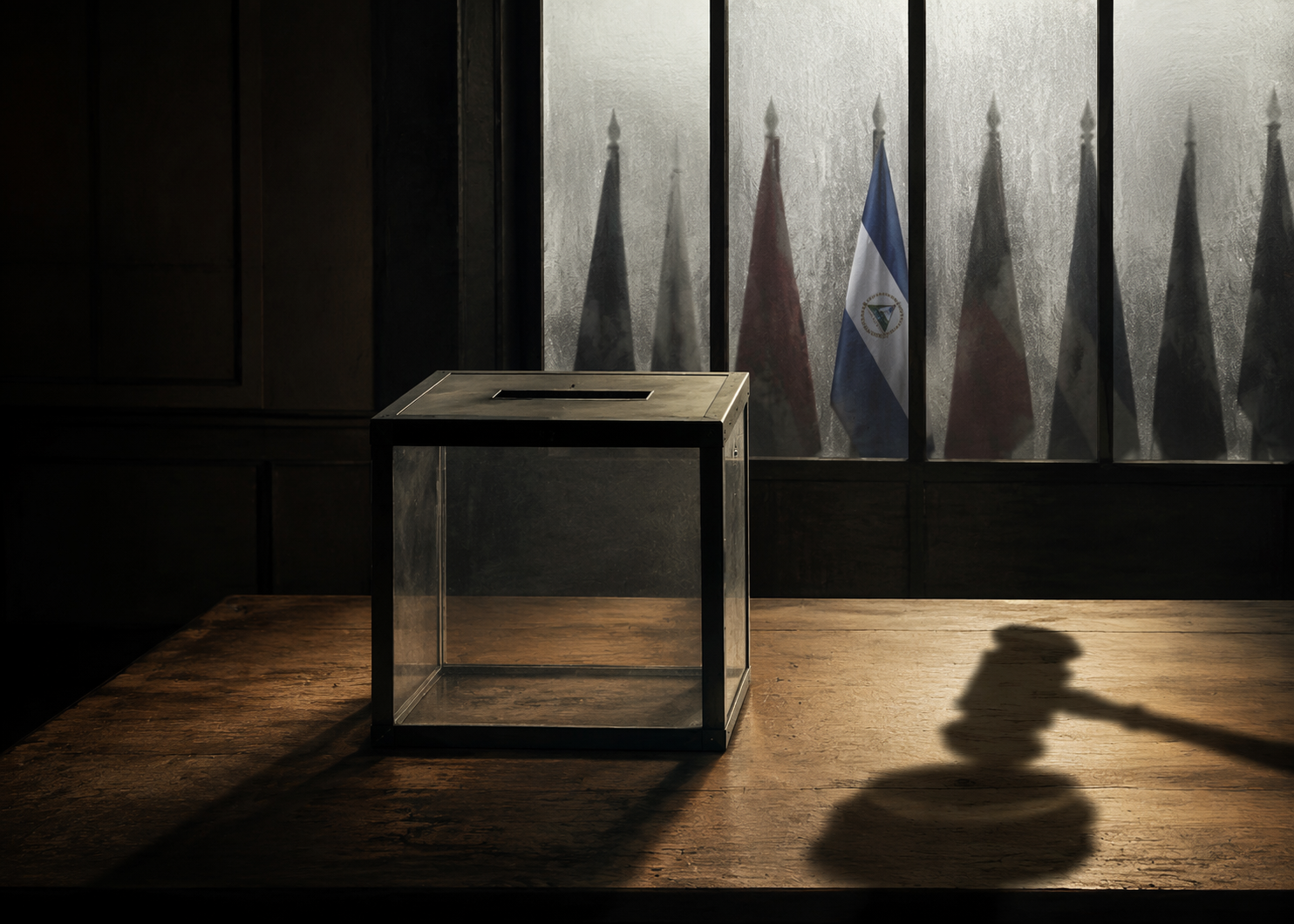
Nicaragua’s July 2026 announcement that it would hold no more elections is not legally interesting because it is theatrical. It is legally important because it makes explicit what the constitutional and institutional record had already been arranging: the removal of periodic political choice from a system still using the vocabulary of law. The immediate report was stark enough — Daniel Ortega cancelled the upcoming 2027 elections and said Nicaragua would no longer hold elections — but the legal implications of Nicaragua’s election cancellation begin before July 2026.[1]
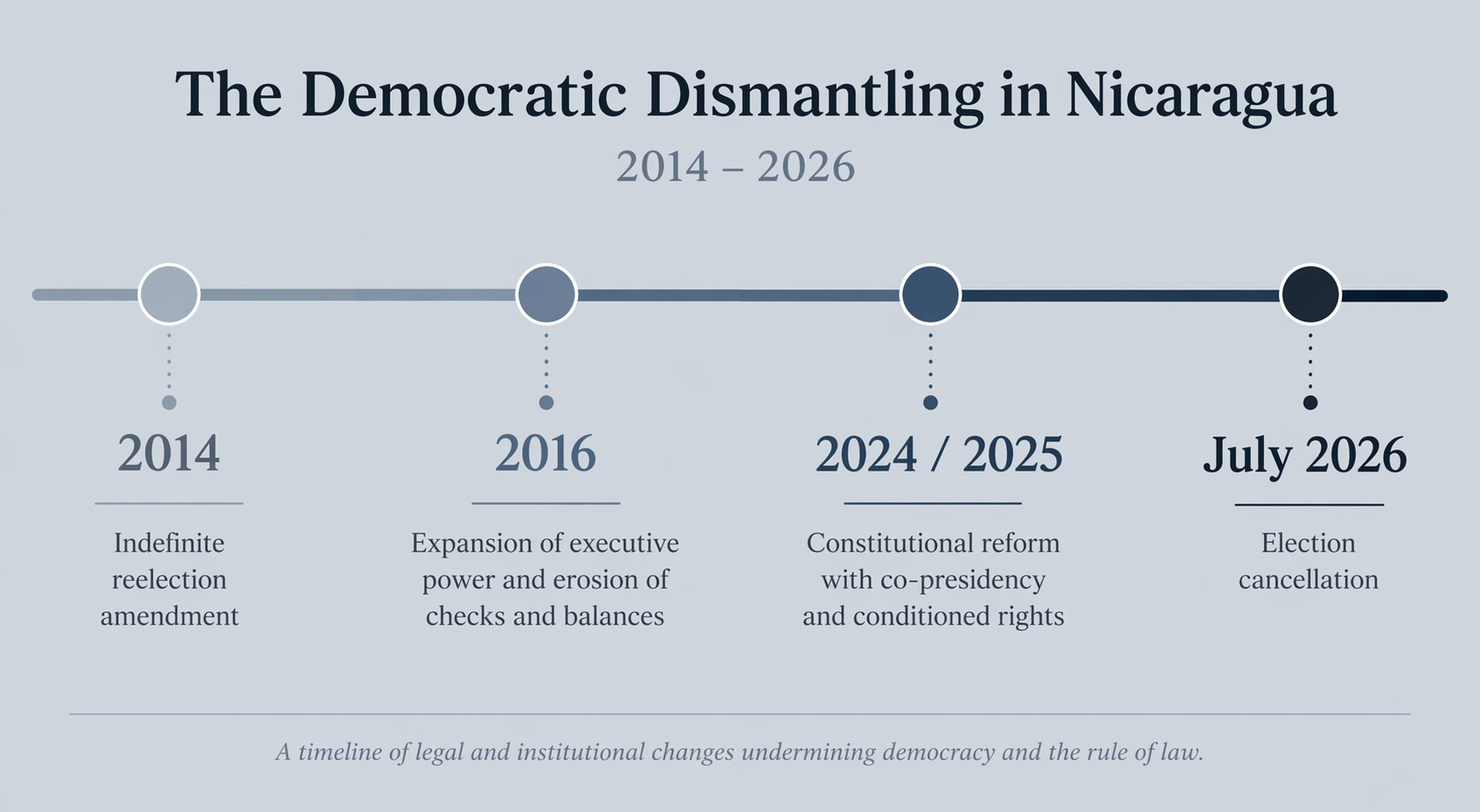
The cancellation sits at the end of a sequence. In 2014, constitutional changes enabled indefinite reelection. In the 2024/2025 reform cycle, the state was restructured around a co-presidency and rights were made conditional on “Fundamental Principles.” By July 2026, the remaining electoral interval was no longer being managed, narrowed, or captured; it was being abolished.[2]
That chronology matters. A missed election may violate a political-rights provision. A state structure that eliminates alternation, subordinates institutions, conditions rights, and then cancels future elections raises a broader legal problem: whether Nicaragua has crystallized breaches of political participation, representative democracy, pluralism, and separation of powers at the same time.
The treaty breach is not generic
The first legal point is almost austere: Nicaragua is not merely offending democratic expectations. It is colliding with specific texts.
Article 23 of the American Convention on Human Rights protects the rights of citizens to take part in public affairs, to vote and be elected in genuine periodic elections, and to have access to public service under general conditions of equality. Article 25 of the International Covenant on Civil and Political Rights uses a similar architecture: citizens must be able to participate in public affairs, vote and be elected at genuine periodic elections by universal and equal suffrage, and access public service on equal terms.
Cancelling all future elections does not merely burden those rights. It removes the ordinary legal event through which they are exercised. A voter cannot cast a ballot in a genuine periodic election that the state has abolished. An opposition candidate cannot stand for office where the office is no longer periodically contestable. A citizen cannot meaningfully access public functions under equal conditions when succession is detached from electoral competition.
The Inter-American Democratic Charter adds another layer. Article 3 identifies essential elements of representative democracy, including respect for human rights, access to and exercise of power under the rule of law, periodic free and fair elections, a pluralistic system of political parties and organizations, and separation of powers. Article 4 treats transparency, probity, responsible public administration, respect for social rights, and freedom of expression and of the press as fundamental components. Article 5 states that strengthening political parties and other political organizations is a priority for democracy.[3]
The Democratic Charter is sometimes treated in public debate as a political instrument, and it is that. But its language is not decorative. It supplies the Inter-American system’s own account of what representative democracy requires. A state that cancels future elections rejects the periodic-election element directly; a state that has already stripped party competition, conditioned rights, and subordinated institutions is also attacking the surrounding conditions that make elections more than ceremonies.
| Instrument | Relevant obligation | Effect of cancelling future elections |
|---|---|---|
| American Convention on Human Rights, Article 23 | Political participation, voting, election to office, and equal access to public service | Removes the periodic electoral mechanism through which citizens exercise those rights |
| ICCPR, Article 25 | Participation in public affairs and genuine periodic elections by universal and equal suffrage | Prevents citizens from voting or standing in future national electoral contests |
| Inter-American Democratic Charter, Articles 3-5 | Representative democracy, periodic free elections, pluralistic parties, separation of powers | Confirms a structural breach of the democratic conditions the regional system treats as essential |
Domestic incorporation strengthens the breach, not the remedy
The international-law analysis is reinforced by Nicaragua’s own constitutional structure. Article 46 of Nicaragua’s Constitution incorporates, among other instruments, the American Convention and the ICCPR into domestic law. That makes the election cancellation more than an external violation alleged by international bodies. On paper, it is also a breach of norms the Nicaraguan constitutional order has accepted as internally binding.[2]

That point should not be confused with an available domestic remedy. Incorporation tells us what the state has bound itself to respect. It does not prove that a court, prosecutor, electoral body, or administrative tribunal remains institutionally capable of enforcing those norms against the executive. The 2024/2025 reforms matter here because they did not simply change electoral rules; they reworked the place of rights inside the constitutional order by conditioning them on state-defined principles.[2]
A constitution can contain a treaty clause and still leave citizens without a forum. That is the uncomfortable legal position in Nicaragua: the texts are identifiable, the contradiction is direct, and the domestic machinery that might translate contradiction into remedy has been hollowed out.
The OAS withdrawal problem
Nicaragua’s withdrawal from the Organization of American States became formally effective on November 19, 2023.[4] That date is now central to the enforcement argument. If withdrawal ended the relevant regional obligations, the July 2026 cancellation would be legally serious but largely outside the most familiar Inter-American institutional pathways. If withdrawal did not extinguish those obligations, or was defective because of the democratic conditions in which it occurred, the cancellation remains within a continuing regional legal frame.
Advisory Opinion 26/20 gives the second argument its legal foundation. The Inter-American Court’s opinion has been read to mean that OAS withdrawal requires a “minimum democratic quality” and that human rights commitments under the American Convention may persist after withdrawal, including through customary international law.[4]
That is a powerful answer to a familiar authoritarian maneuver: exit the forum, then claim the forum has nothing more to say. If a government can dismantle democratic conditions, withdraw from the regional organization, and then complete the dismantling beyond review, withdrawal becomes not an act of sovereignty but a litigation strategy against accountability.
But the opinion does not solve the problem by itself. It is an advisory opinion, not a self-executing enforcement order against Nicaragua. The theory that a withdrawal lacking minimum democratic quality is legally invalid remains significant, but it has not been tested in a binding enforcement action against Nicaragua. Nor has it produced OAS action that reverses the practical effects of Nicaragua’s 2023 departure.[4]
That distinction is the hinge of the legal implications. Advisory Opinion 26/20 helps preserve the vocabulary of obligation after withdrawal. It does not, on the present record, restore access to a cooperative respondent state, reopen expelled monitoring channels, or create a police power for compliance.
What the institutional record shows
The enforcement picture is not blank. It is worse than blank: it contains findings, measures, and documentation that have repeatedly failed to obtain cooperation.
From 2018 to 2021, the Inter-American Commission on Human Rights issued 119 precautionary measures concerning Nicaragua, with near-zero compliance. Its Special Monitoring Mechanism for Nicaragua, MESENI, was expelled in 2018, yet continued documenting the closure of civic space. MESENI documentation records more than 5,400 civil society organization cancellations since 2018, including 1,600 in 2024 alone.[5]
Those figures are not a substitute for the treaty breach; they explain the conditions in which the breach becomes practically uncontestable inside the country. Political rights depend on more than a polling date. They require parties, lawyers, monitors, associations, media, and courts capable of carrying disputes from street-level intimidation into legal form. When civil society organizations are cancelled by the thousands, the ordinary witnesses and carriers of political-rights claims disappear from the public record.
Freedom House’s 2025 assessment placed Nicaragua at 9 out of 100, the lowest score in Central America and the second-lowest in the Western Hemisphere after Cuba.[6] That score does not prove an Article 23 or Article 25 violation by itself. It corroborates the institutional environment in which the cancellation occurred: a setting where competition, association, expression, and legal recourse had already been compressed to the point that future elections could be cancelled without meaningful domestic resistance through law.
The legal profession is part of that environment. In July 2026, Nicaraguan authorities stripped more than 2,000 lawyers of the ability to practice amid the broader crackdown on dissent.[7] For political-rights litigation, that is not a side issue. Rights need lawyers who can file, argue, preserve evidence, and protect clients from retaliation. Removing lawyers from practice narrows the remaining path between an injured citizen and any court, domestic or international.
What accountability can still do
The available consequences are therefore mostly declaratory, evidentiary, and indirect. International bodies can identify the breach, preserve the legal record, connect the cancellation to earlier constitutional changes, and support the factual basis for diplomatic measures or sanctions. They can also resist the claim that OAS withdrawal erased all regional human rights commitments.
That is not nothing. A clear legal record matters for targeted sanctions analysis, asylum and exile claims, diplomatic recognition questions, and future transitional proceedings. It matters whether a government is described as merely postponing an election, failing democratic expectations, or violating defined obligations to hold genuine periodic elections and preserve political participation.
Still, the strongest legal conclusions should not be mistaken for near-term enforcement. Nicaragua is not cooperating with the monitoring bodies most capable of developing the record. The Inter-American system faces the unresolved OAS-withdrawal question. Domestic incorporation has not translated into domestic protection. The cancellation is therefore a sharply identifiable breach with weak immediate compulsion.
For lawyers, that produces a narrow but important task. The cancellation should be pleaded and analyzed as a violation of Article 23 of the American Convention, Article 25 of the ICCPR, and Articles 3 through 5 of the Inter-American Democratic Charter. Advisory Opinion 26/20 should be used to contest the legal effect of withdrawal, while acknowledging that the argument remains untested against Nicaragua in an enforcement posture. Article 46 should be invoked as domestic incorporation, while recognizing that domestic remedies have been functionally foreclosed.
The July 2026 announcement did not create Nicaragua’s democratic collapse. It made the remaining legal question harder to avoid: when a state cancels the elections through which citizens exercise political rights, and then refuses the forums that might say so authoritatively, the law can still name the breach. It cannot, by naming it, make the ballot box reappear.
References
- Daniel Ortega cancels upcoming 2027 elections in Nicaragua — AP News, July 20, 2026
- Nicaragua's Electoral Counter-Reform — Verfassungsblog
- Inter-American Democratic Charter — OAS
- Nicaragua's OAS Raid and the Inter-American System — Verfassungsblog
- Nicaragua Civic Freedom Monitor — ICNL
- Freedom in the World 2025: Nicaragua — Freedom House
- Nicaragua strips lawyers from practicing in ongoing crackdown on dissent — ABC News/AP, July 2026
Comments
Join the discussion with an anonymous comment.