
Nicaragua’s July 2026 crisis did not arrive as a single announcement. It arrived as a collision. On July 20, Daniel Ortega reportedly declared that Nicaragua would have “never again” elections; in the same compressed July window, lawyers discovered that their ability to practice had been erased from the Supreme Court’s professional registry.[1][2] For anyone watching Nicaragua’s political future after the election ban, the registry matters as much as the ballot box.
The election declaration was the louder event. The lawyer purge is the one that shows how far the legal architecture has already been rebuilt. A state that cancels elections removes the ordinary route for changing power. A state that deletes lawyers from the registry removes many of the people through whom citizens can still challenge power, defend themselves in proceedings, or preserve a written record of abuse.
This is a news-and-analysis account of a still-developing rule-of-law collapse, not legal advice to affected Nicaraguan lawyers or clients. The available reporting does not establish a precise count of affected lawyers, nor does it show that individualized administrative proceedings were opened in each case. That uncertainty is not a minor evidentiary footnote. It is part of the injury: the lawyers were apparently made to disappear from the professional system without a public list, a served notice, or an identified decision-maker.
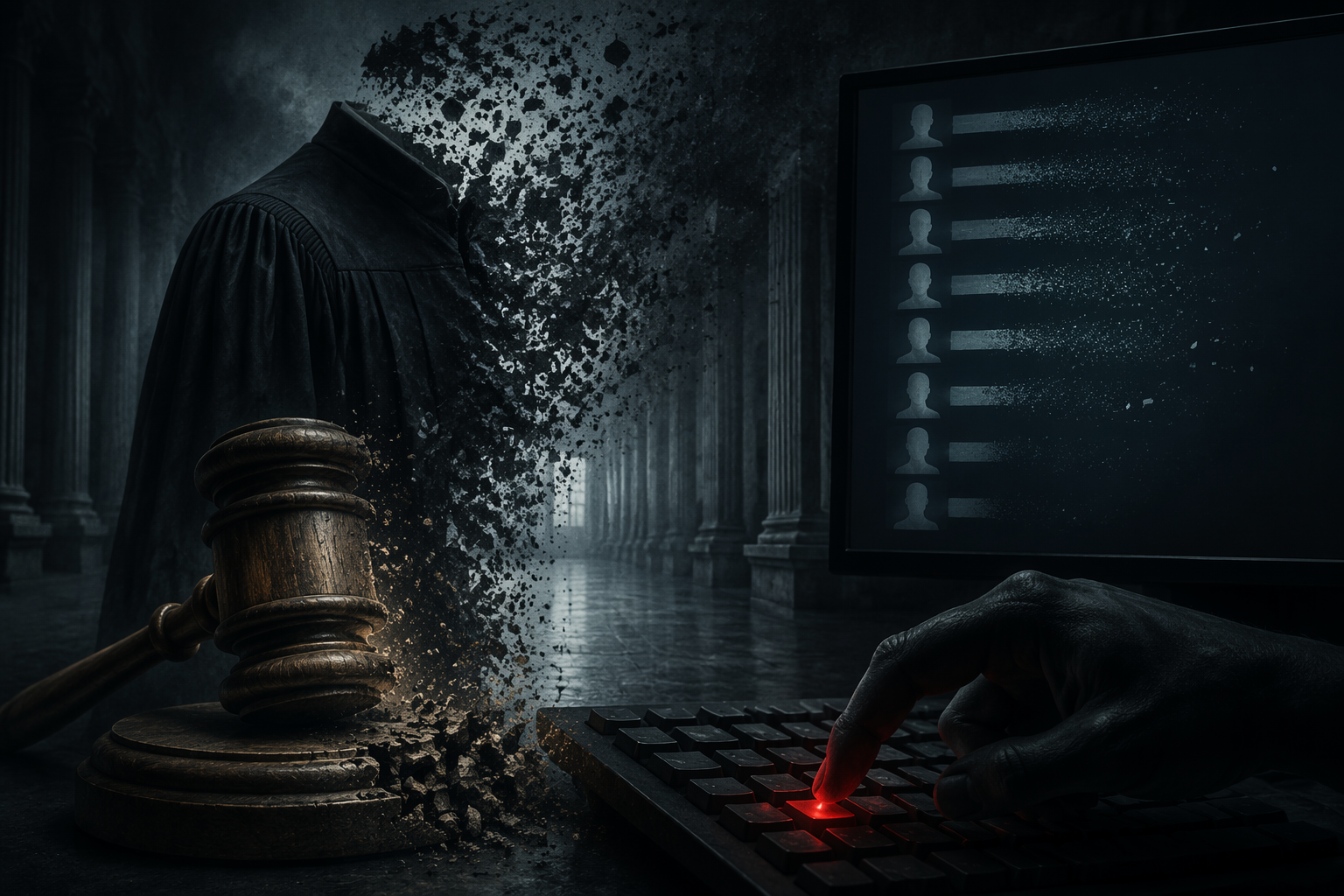
The purge happened through the registry
The most important fact is procedural. Reed Brody, a member of the UN Group of Human Rights Experts on Nicaragua, described lawyers being removed from the Supreme Court registry “without notification, legal basis, nor official explanation.” JURIST reported his description of the measure as a “silent purge” carried out with a “delete key.”[2]
That language is not metaphorical excess. For a lawyer, the registry is not an honor roll. It is the administrative gate through which courts, agencies, detention authorities, and clients recognize the right to act. If the credential no longer appears, the lawyer may be unable to file, appear, sign, certify, visit, or be heard. The state need not stage a public disciplinary trial if the clerk, the platform, or the court database no longer recognizes the name.
The reported scale is deliberately difficult to pin down. Lawyers and Democratic Decline, a University of Wisconsin Law School project, reported that the purge affects “at least hundreds, if not thousands” of lawyers, including exiled human rights defenders, former political prisoners, former Sandinista members, and even some government sympathizers.[3] The breadth matters because it weakens any claim that the measure is merely a conventional disciplinary response to particular misconduct. The absence of a public list or published grounds makes it impossible, on the present record, to test whether the removals were individualized at all.
There is a temptation, especially when numbers are uncertain, to wait for a verified total before treating the purge as structurally significant. That would mistake the form of the abuse. A disciplinary system operating under law can say who was charged, what rule was invoked, what evidence was considered, who decided, and what appeal exists. Here, the available accounts point in the opposite direction: credential loss without notice, without stated legal basis, and without official explanation.[2]
The registry purge was the last move in a longer institutional sequence
The July 2026 deletion of lawyers cannot be understood as a stray administrative measure. It came after the institution controlling the registry had already been brought under political pressure, and after constitutional change had reduced the independence of state branches that might otherwise restrain executive power.
| Moment | Institutional move | Why it matters for the lawyer purge |
|---|---|---|
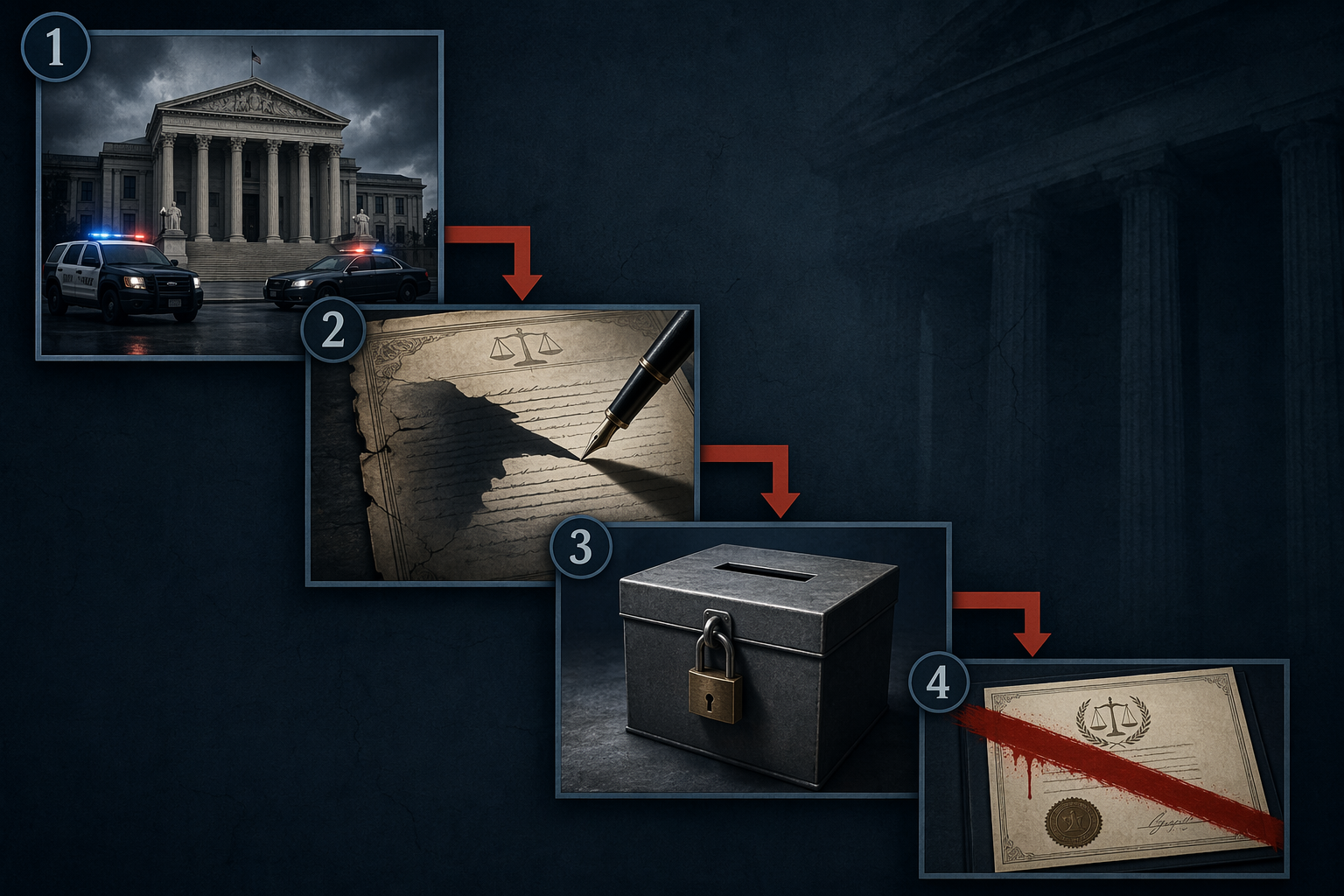
| November 2023 | Police takeover of the Supreme Court | The court that controls professional recognition was itself placed inside the dismantling sequence. |
| January 2025 | Constitutional reform subordinating state branches, including Article 8 making the presidency the coordinator of all branches | The formal separation between courts, electoral institutions, and the executive was weakened before the July 2026 measures. |
| July 2026 | Election cancellation and mass revocation of lawyer credentials | Electoral competition and independent legal intermediation were attacked in the same political moment. |
Verfassungsblog’s account of Nicaragua’s constitutional reform places the January 2025 changes in a sequence that followed the police takeover of the Supreme Court in late 2023 and preceded the July 2026 abolition of elections.[4] ConstitutionNet likewise describes the 2025 constitutional redesign as an “absolutist” framework tailored to the Ortega-Murillo system, including the subordination of state institutions to the presidency.[5]
That sequence matters more than any single slogan about dictatorship. If a government first controls the court, then rewrites the constitution to subordinate public institutions, then eliminates civil society and opposition channels, the deletion of lawyers becomes administratively simple. The question is no longer whether a bar council will independently test the grounds for discipline. The question is whether the body that holds the list will keep your name on it.
Nicaragua’s election abolition has its own treaty implications, addressed more directly in this analysis of the election ban and international law. The point here is narrower: the professional purge is not an appendix to the election story. It is the legal-profession version of the same project described in the site’s coverage of autocratic legalism and the legal architecture of election abolition. The state did not merely remove electoral choice. It narrowed the class of people able to contest state action through law.
What disappears when a lawyer’s name disappears
The immediate victim of a credential revocation is the lawyer, but the secondary victim is the client who can no longer reach the state through that lawyer. This is why professional discipline is never just an internal matter for the profession. A lawyer’s authority to appear is a citizen-facing public function.
In ordinary disciplinary systems, suspension or disbarment can be lawful. Lawyers can be removed for serious misconduct, and states may regulate who practices before their courts. But the safeguards are not ornamental. Notice tells the lawyer what they are accused of. A stated legal basis permits review. A hearing allows facts to be tested. A written decision creates a record. An appeal path prevents the registry from becoming a political instrument.
The reported Nicaraguan pattern removes those safeguards from view. On the present record, affected lawyers were not publicly identified through a transparent process; the grounds were not officially explained; and no confirmed individualized procedure has been shown in the available accounts.[2][3] That is why the missing notice is not a technicality. It is the difference between discipline and exclusion.
The range of affected lawyers also changes the analysis. Reporting that the removals reached exiled human rights defenders and former political prisoners is unsurprising in Nicaragua’s current climate. The inclusion of former Sandinista members and some government sympathizers, as reported by Lawyers and Democratic Decline, suggests something broader: a system in which professional standing depends less on a rule announced in advance than on a registry controlled by captured institutions.[3]
The legal standards are not abstract
International law does not require Nicaragua to maintain an unregulated legal profession. It does require that defense rights, public participation rights, and professional independence not be destroyed through arbitrary administrative acts. The standards identified by UN experts are practical yardsticks for what the July 2026 purge appears to have denied.[6]
ICCPR Article 14: the right to defense needs lawyers who can act
Article 14 of the International Covenant on Civil and Political Rights protects fair-trial rights, including legal defense. The reported purge strikes at that protection at the level of capacity. If a class of independent lawyers is removed from the registry without notice or explanation, the right to counsel is impaired before any individual defendant reaches a courtroom. The UN experts’ warning, as reported by ISHR, was that the action removed citizens’ right to legal defense under international standards and “effectively erased a crucial part of the legal profession.”[6]
ICCPR Article 25: public life includes access to public service
Article 25 is often discussed in election-ban analysis because it protects political participation. It also concerns access to public service on general terms of equality. When professional status before state courts can be withdrawn from an undefined group without public criteria, the issue is not only who may vote or run. It is who may perform a public-facing legal function without political clearance. In the July 2026 setting, that professional exclusion sits beside the declared end of elections, not behind it.[1][6]
UN Basic Principles on the Role of Lawyers: suspension requires process
The UN Basic Principles on the Role of Lawyers speak directly to the professional mechanics at issue here. They require that disciplinary proceedings against lawyers be brought before an impartial body and handled under fair procedures. That is the exact point at which the reported Nicaraguan purge fails the basic test: suspension or removal from practice, if that is what occurred, appears in the available accounts as a registry deletion rather than a visible proceeding.[2][6]
The American Convention frame
The American Convention on Human Rights supplies the regional frame for the same injury: fair process, judicial protection, political participation, and access to remedies cannot function when the professional intermediaries capable of invoking them are administratively disabled. The July 2026 purge should therefore be read together with the election ban and the 2025 constitutional reform, rather than as a separate occupational dispute.[5][6]
For readers tracking the domestic legal pathway, the constitutional background is developed in more detail in the analysis of Nicaragua’s 2025 constitutional reform and in the site’s account of the domestic legal logic of election abolition. Those questions matter, but the lawyer-purge question is more immediate: once the state has rewritten the rules, who remains authorized to challenge their application?
Why this changes the analysis of Nicaragua’s political future
Election abolition answers one question about Nicaragua’s political future: whether power will be contested through periodic voting. The lawyer purge answers another: whether citizens will retain institutional intermediaries capable of resisting the state between elections, after elections, or in the absence of elections.
That distinction matters for legal professionals outside Nicaragua. Authoritarian legal orders rarely begin by announcing that the right to defense has been abolished. They alter who may appear, which filings are accepted, which associations remain legal, which credentials are recognized, and which courts are competent to hear disputes. By the time the political announcement is made, the professional infrastructure that could have contested it may already have been thinned, frightened, exiled, or erased.
Nicaragua’s July 2026 events are still unfolding. There is not yet a verified public count of affected lawyers. There is not yet a confirmed map of any appeal route. There is not yet enough public information to say whether every affected lawyer was removed through the same administrative mechanism. Those limits should be stated plainly because precision is part of the rule-of-law standard being defended.
But the central sequence is already visible. The Supreme Court was brought into the dismantling process. The constitution was rewritten to subordinate state branches. Elections were declared finished. Lawyers were removed from the registry without the procedural markers that distinguish lawful discipline from political exclusion. When those acts are placed in order, the lawyer purge is not a side effect of the election ban. It is the professional-institutional counterpart to it.
A state that captures the court controlling the registry, rewrites the constitution to subordinate the branches, cancels elections, and deletes lawyers without process is doing more than repressing opponents. It is eliminating the legal intermediaries through whom citizens can still stand before power as something other than subjects.
References
- Nicaragua’s Ortega says there will be ‘never again’ elections — AP News, July 20, 2026. link
- UN rights experts decry mass revocation of lawyer credentials in Nicaragua — JURIST, July 2026. link
- Nicaragua conducts a purge of the legal profession by revoking lawyers’ licenses — UW Law School / Lawyers and Democratic Decline, July 10, 2026. link
- Nicaragua’s Constitutional Reform — Verfassungsblog. link
- Nicaragua’s new absolutist constitution is tailor-made — ConstitutionNet. link
- Nicaragua: UN experts speak of final blow to rule of law — ISHR. link
Comments
Join the discussion with an anonymous comment.