
The most legally important allegation in the Nagra materials is not that US prosecutors say an international gang network reached across borders. It is the narrower sequence they describe: gang-linked actors allegedly identified a Los Angeles family, information moved to a sitting Punjab police officer, false murder accusations in India became pressure on the family, and money was demanded to make the danger recede. In that version of the case, the badge is not background color. It is the tool that gives the alleged extortion its force.
That is why the charge against Punjab Police Inspector Gurinderjit Singh Nagra deserves more attention than the usual shorthand about global crime syndicates. The reported connection between Nitish Kaushal, gang allegations, and law enforcement sits inside the larger Operation Hard Ball indictment, but Nagra’s alleged role raises a different question: when can US federal law reach a foreign law enforcement officer accused of using official process abroad to extort people in the United States?
The answer prosecutors are testing is the Hobbs Act. According to press accounts of the federal case, Nagra was charged with attempted extortion under 18 U.S.C. § 1951 in connection with the Bhagwanpuria organized crime group, after allegedly conspiring to demand $400,000 from a Los Angeles family through false murder charges filed in India.[1][2] Those allegations remain allegations. Nagra has not been convicted, and the publicly available reporting does not replace the charging document itself.
The Alleged Extortion Was Built From Official Process
India Today reported that members of the Bhagwanpuria organized crime group identified targets in the United States and supplied information to Nagra, who was then serving as a station house officer in Punjab.[1] Prosecutors, as summarized in that account, alleged that Nagra used that information to file false murder charges against victims or their relatives in India.[1]
The alleged leverage did not depend on a street-level threat. It depended on the fear created when a criminal case is attached to a family name by someone with state authority. A person in Los Angeles may be thousands of miles away from a police station in Punjab, but relatives, property, travel, reputation, and family obligations can all sit within reach of a foreign criminal process. That is the practical bridge the indictment appears to rely on.
One reported detail makes the theory sharper. Nagra allegedly participated in a police press conference publicly accusing members of the victim’s family of murder, and later demanded payment to remove two of three family members from the case.[1] If proven, that is not merely corruption in the abstract. It is the conversion of public accusation into private bargaining value.
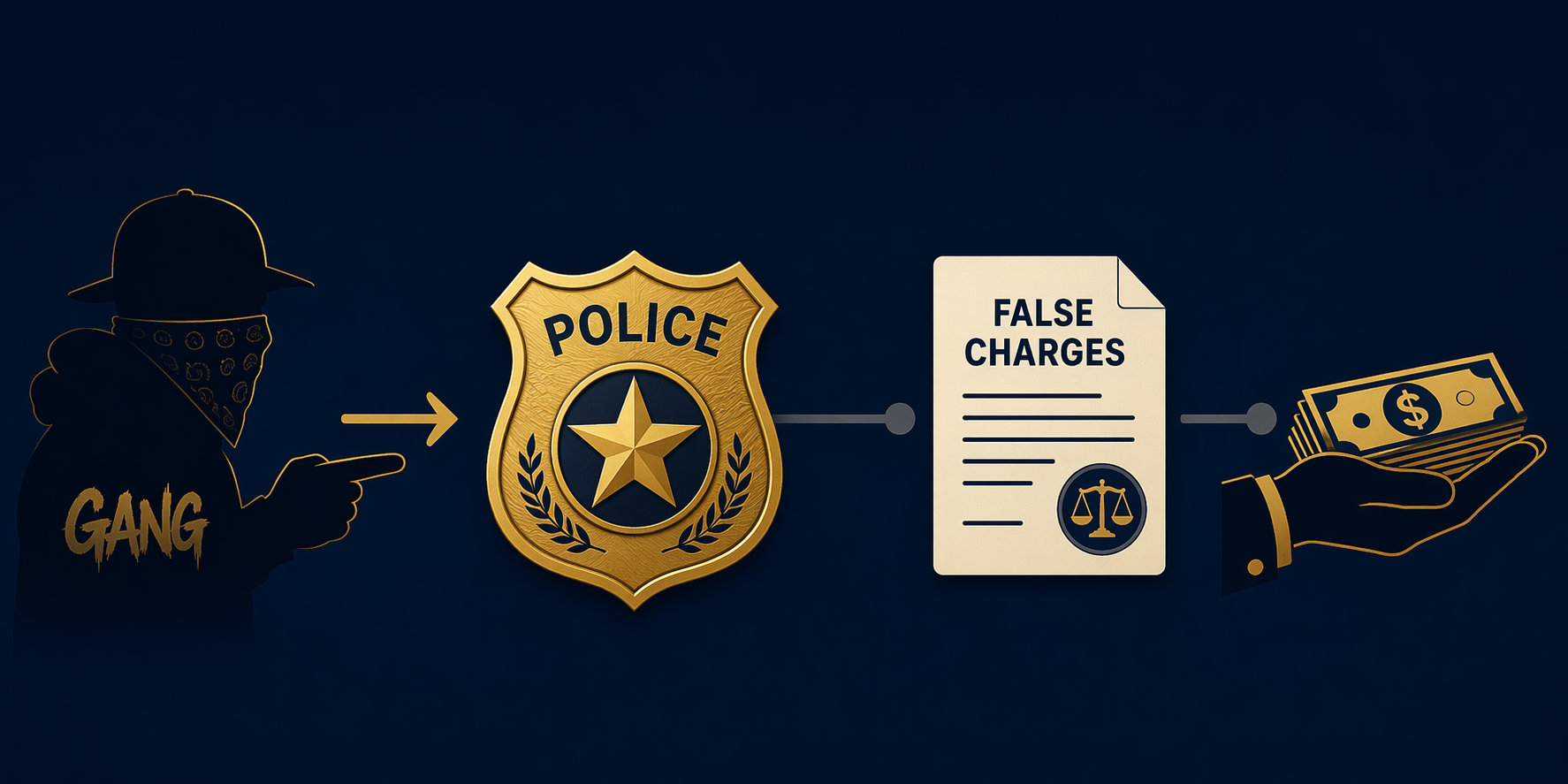
The reported model is simple enough to diagram, and that simplicity is part of its significance:
- Gang-linked actors allegedly identify a US-based family as a target.
- Information allegedly flows to a sitting police officer in Punjab.
- False murder charges and public accusations allegedly create pressure in India.
- Money is allegedly demanded to reduce or remove the official threat.
That sequence matters more than the labels attached to the gangs. Names such as Bhagwanpuria, Bishnoi, and Kaushal matter here only to the extent that they help prosecutors describe an enterprise and connect the alleged conduct abroad to US-facing extortion. The case does not become legally interesting because a gang is said to be transnational. It becomes legally interesting because prosecutors say a police officer’s official acts functioned as an enterprise asset.
India Today attributed to US prosecutors the allegation that the Bhagwanpuria group “systematically exploited corrupt Indian law enforcement as an institutional extortion tool.”[1] That phrasing should be handled carefully because it comes through journalistic reporting, not from a charging document reviewed here. Still, the concept explains the federal theory: law enforcement power is alleged to have become part of the extortion supply chain.
Why the Hobbs Act Gives Prosecutors a Path
The Hobbs Act is a commerce statute. It criminalizes robbery or extortion that affects interstate or foreign commerce, and federal prosecutors have long used that commerce hook to reach conduct that is not confined to one state. In the Nagra case, the reported charge is attempted extortion under 18 U.S.C. § 1951.[2]
That choice matters because the decisive question is not whether Nagra personally entered the United States. On the theory reported by FOX 11 and India Today, prosecutors are looking to the alleged target, the payment demand, the US-based family, and the broader enterprise charged in the Central District of California.[1][2] Physical presence is often powerful evidence in a criminal case, but it is not the only jurisdictional bridge federal law recognizes.

The reported facts give prosecutors three building blocks. First, the alleged victims were tied to Los Angeles. Second, the demand was for money from that US-facing family. Third, the alleged conduct was connected to a broader federal indictment involving a RICO enterprise said to have operations in the Central District of California.[1][2] If those links hold, the foreign location of the police acts does not by itself end the analysis.
That is not the same as saying the case is easy, settled, or bound to succeed. The public materials summarized so far do not show the full indictment language, the specific overt acts, the communications evidence, the payment mechanics, or the way prosecutors intend to prove the commerce effect. Those details will matter. A Hobbs Act label is not a substitute for evidence.
The unusual feature is the defendant’s alleged institutional position. US prosecutors often charge foreign actors when they direct fraud, cybercrime, sanctions evasion, or violence toward US victims or infrastructure. A sitting foreign police officer accused of using domestic criminal process as the extortion mechanism is a more specific and more sensitive posture. It puts the case close to questions of sovereignty and comity, even if the charge itself is framed through commerce and enterprise effects.
What Operation Hard Ball Adds, and What It Does Not
Operation Hard Ball supplies context, not the center of the analysis. FOX 11 described the operation as an international sweep in which 37 people were charged in connection with alleged Indian crime syndicates.[2] The same reporting places Nagra inside that broader prosecution, but the legal question presented by his charge is narrower than the sweep itself.
The Nitish Kaushal materials are useful mainly because they tie the fugitive-arrest timeline to the same federal operation. US Customs and Border Protection reported on July 18, 2026, that Border Patrol agents apprehended Kaushal near Alburgh, Vermont, and identified him as one of the FBI’s Most Wanted fugitives connected to the Operation Hard Ball indictment.[3] That confirms the breadth of the enforcement action, but it does not prove the Nagra allegations.
That distinction is important. A fugitive arrest, a RICO indictment, and an attempted-extortion charge against a police officer may appear in the same enforcement narrative, but they do different legal work. Kaushal’s arrest shows the operation’s reach. Nagra’s charge tests whether alleged foreign police corruption can be pleaded as part of a US-facing extortion enterprise.
FOX 11 also reported that after the indictment, Nagra was transferred to police lines in Punjab and that an internal inquiry was ordered.[2] That is a real consequence, but it should not be confused with adjudication. Administrative movement after a charge may signal institutional concern; it does not establish criminal liability.
The Boundary Line Compliance and Defense Counsel Should Watch
For defense lawyers and compliance professionals, the practical lesson is not that every foreign official who misuses office abroad is now exposed to US prosecution. The narrower signal is more useful: when alleged misuse of foreign law enforcement power is directed at US residents, tied to a payment demand, and pleaded as part of a US-indicted enterprise, federal prosecutors may try to bring the official inside a domestic extortion case.
That matters for lawyers advising diaspora communities. Families with business, property, immigration, or relatives abroad can be vulnerable to pressure that does not look like a conventional US threat. A criminal accusation overseas may function as leverage in the United States because the person expected to pay is here. The Nagra allegations put that cross-border pressure pattern into a federal criminal frame.
It also matters for multinational compliance teams that treat foreign police contact as a local issue unless a bribe payment, sanctions party, or procurement process appears. The alleged conduct here is different: the official act itself is the value-generating instrument. If prosecutors can sustain that model, corrupt law enforcement conduct abroad may be analyzed not only as local misconduct, but as a component of an extortion enterprise affecting US persons.
The open questions remain substantial. The public reporting does not provide the full charging language. It does not break down whether the $400,000 figure came from one demand or multiple alleged incidents. It does not show how prosecutors will prove Nagra’s knowledge of the US nexus, the communications trail, or the required commerce effect. Those are not footnotes. They are the issues on which an ambitious jurisdictional theory often succeeds or fails.
Still, the professional significance is already visible. This prosecution, if sustained, would mark a boundary line worth watching: corrupt foreign law enforcement conduct can become part of a US federal extortion case when official process abroad is allegedly used to pressure US residents for money.
References
- How US indictment exposes underbelly of gangster Bhagwanpuria and corrupt Punjab cops, India Today, 2026-07-14
- Operation Hard Ball: 37 charged as international sweep dismantles global Indian crime syndicates, FOX 11 Los Angeles
- US Border Patrol apprehends FBI’s Most Wanted in Alburgh, Vermont, U.S. Customs and Border Protection, 2026-07-18
Comments
Join the discussion with an anonymous comment.