
Nitish Kaushal became searchable as an FBI Most Wanted fugitive before most of the public had time to learn why he mattered. The FBI page listed him on July 15, 2026, identified him as an Indian national also known as “Lala,” and tied him to a RICO conspiracy rather than a standalone fugitive complaint.[1] Within roughly a day, U.S. Border Patrol agents in Alburgh, Vermont, had him in custody after a sequence that sounds dramatic because it is specific: an abandoned vehicle near the Canadian border, a resident’s security camera footage, a false New Jersey driver’s license, fingerprints, and a lion tattoo used to confirm identity, according to CBP’s account.[2]
Those details are useful, but only up to a point. They explain how Kaushal was found. They do not explain why a fugitive capture in rural Vermont belongs inside a Los Angeles racketeering case involving 37 defendants, three alleged transnational crime networks, and claims that imprisoned figures in India directed violent and drug-trafficking activity through contraband phones.[3]
Kaushal has been charged, not convicted. The indictment allegations described here remain allegations unless and until proved in court. That distinction matters especially in a case built around enterprise liability, where the prosecution’s theory depends not only on what one defendant allegedly did, but on how that conduct is attributed to a larger organization.
The Capture Was the Doorway, Not the Case
CBP’s public version of the arrest begins with a vehicle found near the U.S.-Canada border in Alburgh. Agents reviewed security footage from a nearby resident, found a man who allegedly presented a false New Jersey driver’s license, and then used biometric and identifying information to connect him to the FBI listing. CBP also reported that a lion tattoo helped confirm the identification.[2]
Local reporting added a courthouse consequence to the border narrative: Kaushal appeared in federal court in Burlington and was ordered detained without bail, according to Seven Days Vermont.[4] That is where the clean fugitive story ends and the harder procedural story begins. The arrest did not resolve the case. It brought one defendant physically inside the U.S. process.
The FBI listing identified the charge as RICO conspiracy.[1] Secondary reporting on the Los Angeles indictments places Kaushal more precisely: Defendant No. 7 in the Bhagwanpuria organized crime group indictment, with allegations tied to a July 2024 assault, restraint, kidnapping, and a $50,000 extortion demand connected to a stolen cocaine shipment.[5] Those allegations are the bridge between the border arrest and the broader racketeering theory.
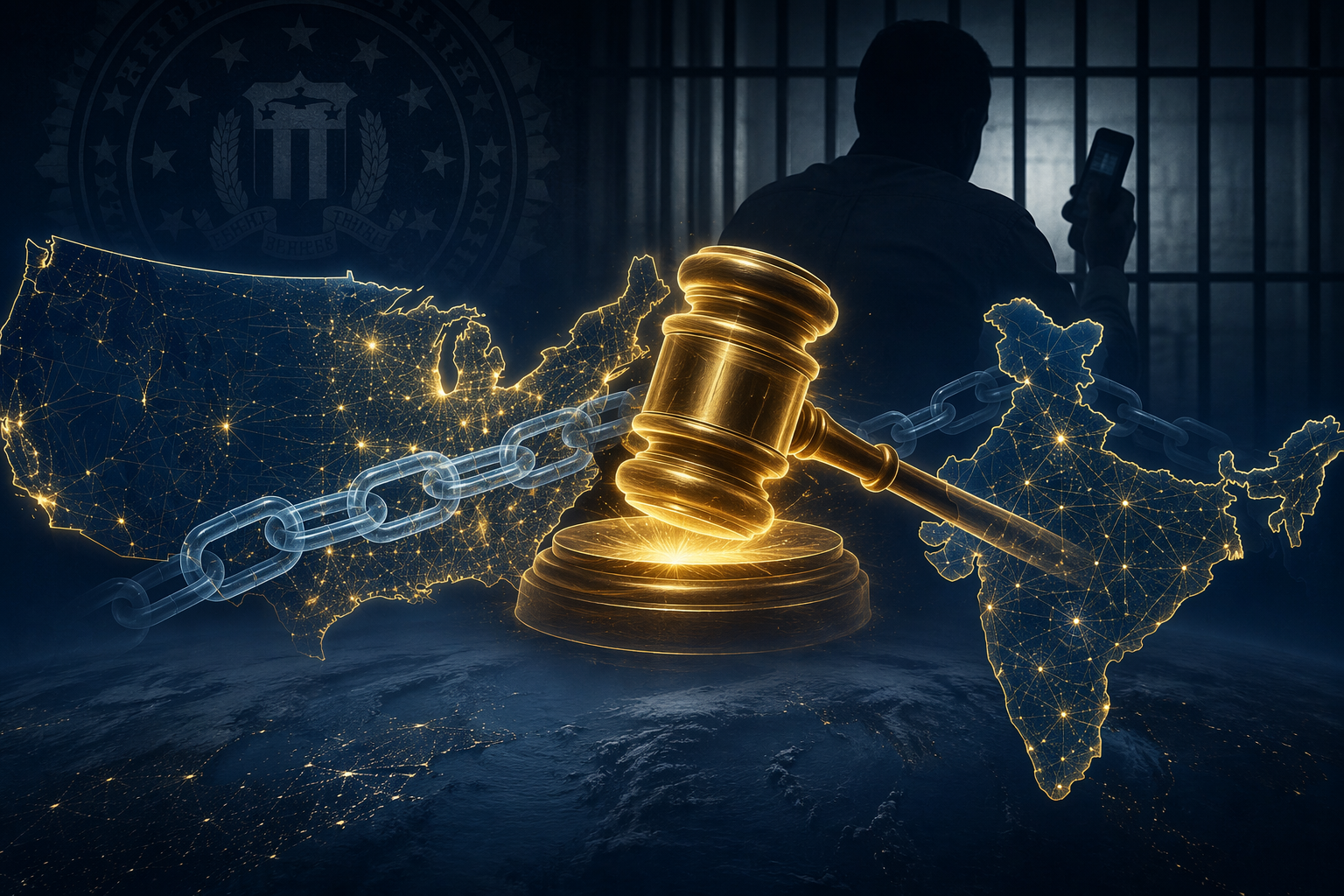
Operation Hard Ball Put Three Alleged Networks Into One Enforcement Frame
Operation Hard Ball was not announced as a single-defendant chase. FOX 11 Los Angeles reported that three RICO indictments were unsealed in Los Angeles between June 23 and July 1, 2026, charging 37 defendants across the Bishnoi enterprise, the Bhagwanpuria OCG, and the Dhanda network.[3] The same reporting described the operation as including 24 arrests, more than 50 search warrants, and an investigation that ran nearly three years undercover.[3]
That structure matters because it shows what prosecutors were trying to do. A kidnapping allegation can be charged as a kidnapping. An extortion demand can be charged as extortion. A drug shipment can be charged as a narcotics offense. RICO lets prosecutors ask a different question: whether those acts were part of the affairs of an enterprise, carried out through a pattern of racketeering activity, with defendants allegedly agreeing to participate in that structure.
In ordinary criminal pleading, defendants are often grouped by a shared transaction. In a RICO conspiracy, the grouping is more ambitious. Prosecutors try to connect people who may have performed different functions, in different places, at different times, by alleging that they knowingly joined or furthered an enterprise’s criminal objectives. That is why Kaushal’s placement as Defendant No. 7 in the Bhagwanpuria OCG indictment is more legally significant than his temporary status as a wanted fugitive.[5]
| Alleged network | What the operation frame does legally |
|---|---|
| Bishnoi enterprise | Treats alleged activity as part of an organized racketeering structure rather than isolated violent or drug offenses. |
| Bhagwanpuria OCG | Places Kaushal and other defendants inside an alleged enterprise theory tied to violence, extortion, and drug movement. |
| Dhanda network | Extends the operation beyond one alleged gang hierarchy into a broader enforcement action against related transnational activity. |
The public materials do not establish that the defendants committed the charged conduct. They show how prosecutors have chosen to plead it. That is the legally interesting part: Operation Hard Ball uses RICO not simply to increase the seriousness of the indictment, but to make organizational connection the central issue.
Why RICO Does More Work Than the Murder and Kidnapping Charges Alone
The target keyword around Kaushal—FBI Most Wanted, murder, kidnapping charges—captures the public hook, but it compresses the case in a misleading way. The charge identified on the FBI page is RICO conspiracy.[1] Reporting on the indictment says the conduct attributed to Kaushal includes July 2024 assault, restraint, kidnapping, and extortion allegations, but those acts appear in the public account as components of the Bhagwanpuria OCG case, not as a freestanding morality tale about one suspect.[5]
That difference changes the prosecution’s burden and the defense terrain. The government must do more than narrate a bad episode. It must connect the episode to an alleged enterprise and show the agreement required for conspiracy liability. For a defendant such as Kaushal, the practical fight may turn on attribution: what he allegedly knew, whom he allegedly coordinated with, and whether the charged conduct furthered the enterprise prosecutors describe.
RICO is useful to prosecutors in a distributed case because it supplies a vocabulary for hierarchy, continuity, and function. A person who allegedly transports drugs, a person who allegedly threatens a victim, and a person who allegedly passes messages may not look like participants in the same offense if the facts are clipped into separate transactions. The enterprise allegation is the government’s way of saying the transactions were not separate in the legally relevant sense.
That does not make the theory self-proving. A clean chart of defendants and roles can hide weak links as easily as it can reveal strong ones. In a 37-defendant case, the danger for the prosecution is over-inclusion; the danger for the public is assuming that placement inside an indictment equals proof of membership in an organization. The indictment begins the adversarial process. It does not finish it.

The Prison-Directed Enterprise Allegation Is the Load-Bearing Claim
The most consequential allegation in Operation Hard Ball is not that alleged criminal groups crossed borders. It is that leaders already in Indian custody allegedly continued to direct activity outside prison. FOX 11 reported that the operation centered on claims that Lawrence Bishnoi and Jaggu Bhagwanpuria directed murder-for-hire, drug trafficking, and extortion networks from Indian prisons using contraband cellphones.[3]
If that allegation can be proved, the contraband phone is not a colorful detail. It becomes the command channel. It is the evidentiary hinge between custody in India and alleged acts in North America: messages to intermediaries, instructions to move drugs, pressure on victims, recruitment, and coordination among people who may never have occupied the same room.
The public reporting gives examples of the kind of conduct prosecutors are trying to attribute. FOX 11 reported an allegation that Bhagwanpuria personally messaged an informant about a 20-kilogram cocaine shipment from Los Angeles to Vancouver.[3] The same reporting described a charge involving an alleged $400,000 extortion demand against a Punjab police officer.[3] Those are not findings. They are pleaded or reported allegations that illustrate why investigators would care about message provenance, device access, informant reliability, and chain of custody.
For prosecutors, a prison-directed model solves one narrative problem and creates several proof problems. It explains how an incarcerated figure could remain relevant to an alleged enterprise. But it also requires the government to attribute communications with care. Who possessed the device? Who sent the message? Was the recipient cooperating, undercover, or acting independently? Which alleged instruction produced which act? In a domestic street-gang case, those questions are already difficult. Add foreign custody, multilingual communications, border-crossing drug movement, and diaspora victims, and the procedure becomes the case.

Diaspora Targeting Gives the Case Its U.S. Nexus
The U.S. jurisdictional interest depends on more than foreign gang labels. The public accounts describe alleged conduct touching Los Angeles, Vancouver, California diaspora communities, and U.S.-based drug movement. The Indian Express reported on the Bhagwanpuria organization’s alleged use of social media recruitment and exploitation of the California diaspora, while also describing Bhagwanpuria’s organizational background and criminal-history allegations in India.[6]
Some of that history is useful only because it helps explain continuity. The Indian Express described Bhagwanpuria’s background, reported that he faced 128 FIRs in India, and linked the organization’s trajectory to events including the 2023 Goindwal Sahib jail massacre in which two of his gang members were killed.[6] Those facts should not be mistaken for proof in the Los Angeles case. They help explain why investigators and reporters treat the alleged network as persistent rather than newly improvised.
For U.S. prosecutors, the more important point is not biography. It is nexus. If the alleged enterprise moved narcotics through Los Angeles, targeted people in California, used U.S.-based operatives, or committed predicate acts affecting U.S. victims or markets, the case begins to look less like an imported foreign crime story and more like a domestic racketeering prosecution with foreign command nodes.
What the FBI Caught—and What It Did Not
Kaushal’s arrest gave prosecutors custody over a defendant alleged to sit inside the Bhagwanpuria OCG indictment. That is not a minor result. A fugitive outside U.S. custody can delay discovery fights, plea negotiations, cooperation possibilities, and trial scheduling. Once arrested and detained, the defendant becomes subject to the ordinary pressures and protections of federal criminal procedure.
But the arrest should not be described as dismantlement. The research materials state that Bishnoi and Bhagwanpuria remain in Indian custody, outside immediate U.S. arrest power.[3] If prosecutors’ theory depends heavily on prison-directed command, then the physical unavailability of alleged command figures is not a footnote. It is one of the central limits of the operation.
That limit affects case strategy. Prosecutors can proceed against arrested defendants, use cooperating witnesses if any emerge, rely on electronic communications where admissible, and build attribution through financial, travel, phone, and drug-movement evidence. What they cannot do merely by unsealing an indictment is convert alleged foreign prison command into U.S. courtroom presence. Extradition, cooperation with Indian authorities, and parallel foreign proceedings sit outside the clean geometry of the RICO chart.
The result is a case with two different kinds of success. The operational success is visible: a wanted defendant placed on the FBI list on July 15, 2026, was taken into custody near the Vermont border within roughly 24 hours, after a concrete identification sequence described by CBP and the FBI.[1][2] The legal success remains unfinished: prosecutors must prove that Kaushal’s alleged conduct belongs inside the charged enterprise, and they must test whether a RICO framework can produce durable disruption when alleged leaders remain beyond American arrest jurisdiction.
References
- Nitish Kaushal, FBI
- U.S. Border Patrol apprehends FBI's 'most wanted' in Alburgh, Vermont, U.S. Customs and Border Protection
- Operation Hard Ball: 37 charged as international sweep dismantles global Indian crime syndicates, FOX 11 Los Angeles
- FBI Most Wanted Suspect Captured in Alburgh, Seven Days Vermont
- Days after making FBI's 'Most Wanted' list, Indian-origin man is 'captured', The Indian Express
- From Bishnoi associate to FBI target: the rise of Jaggu Bhagwanpuria's global crime syndicate, The Indian Express
Comments
Join the discussion with an anonymous comment.