
The first mistake in reading NORAD airspace violation legal penalties is treating “airspace violation” as a single penalty ladder. The same flight event can raise criminal exposure, FAA certificate discipline, and civil penalties, but those tools do not matter equally for every operator. A certificated pilot who penetrates a temporary flight restriction is usually worried first about the certificate. A drone operator with no traditional pilot certificate may instead be facing a civil penalty file, even though the underlying restricted-airspace concern sounds similar.
The shared legal floor is 49 U.S.C. § 46307. It applies to anyone who “knowingly or willfully” violates regulations or orders concerning national defense airspace. The statute authorizes fines, imprisonment, or both, and, after a December 2025 amendment, a second or subsequent offense may carry imprisonment of up to 5 years rather than the earlier shorter maximum reflected in the prior text. That matters. It does not, by itself, tell counsel what the ordinary enforcement file will look like. [1]
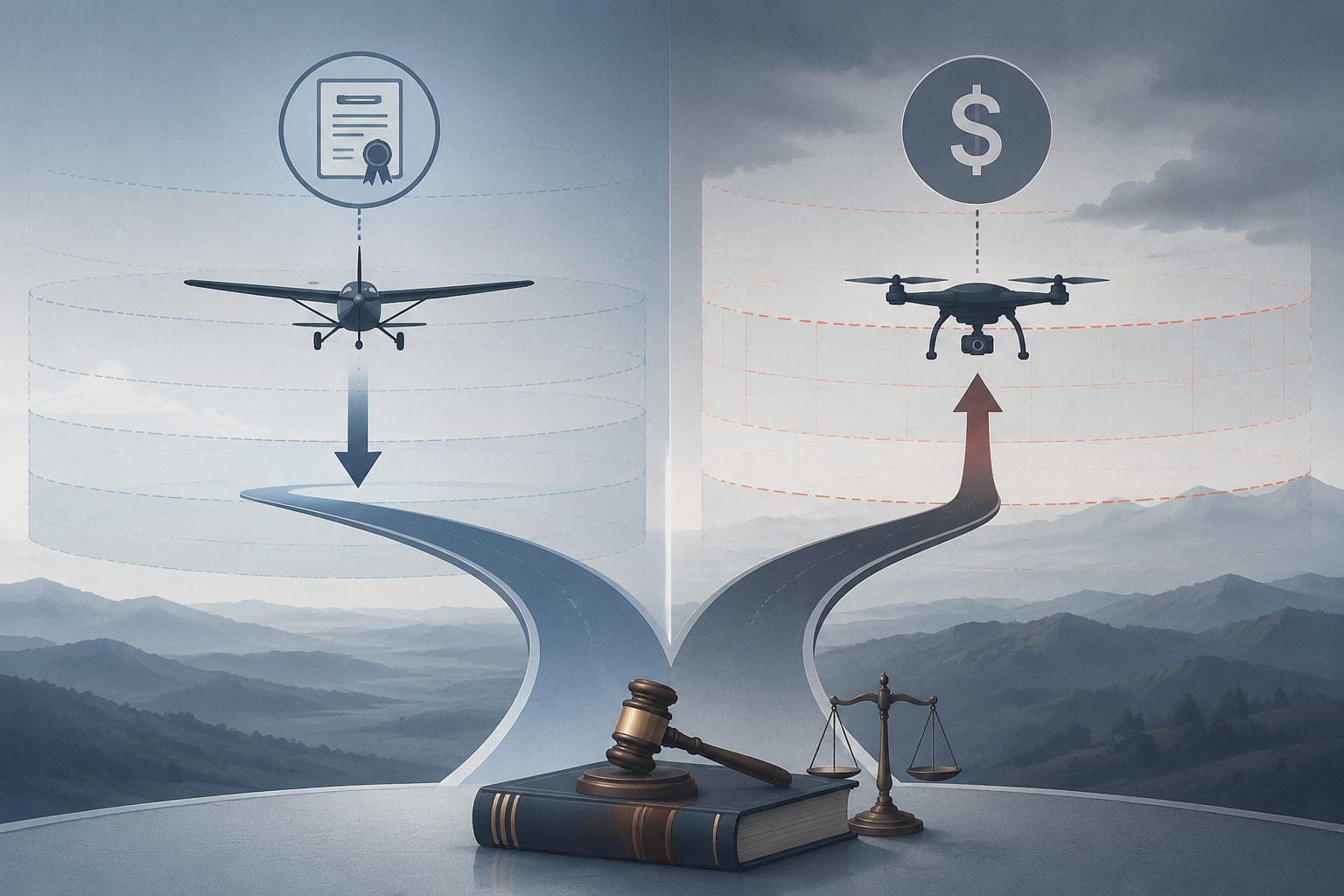
The same statute, different enforcement pressure points
For a lawyer triaging a NORAD-related airspace incident, the useful first cut is not dramatic. It is mechanical: identify the aircraft, identify the operator’s certification status, identify whether the event involved national defense airspace or a TFR, and separate criminal exposure from FAA administrative enforcement.
| Issue | Manned aircraft pilot | Drone operator |
|---|---|---|
| Shared criminal baseline | Potential exposure under § 46307 if the facts support knowing or willful entry into national defense airspace | Same statutory baseline; the aircraft being unmanned does not remove § 46307 from the analysis |
| Most practical FAA lever | Certificate action, commonly analyzed around suspension exposure for a simple TFR violation | Civil penalty action, especially where the operator lacks a certificate that would make suspension meaningful |
| Civil penalty framework | Possible, but not usually the center of gravity in a standard pilot-certificate case | Central enforcement route; non-individual civil penalties can reach $75,000 per violation under the FAA Reauthorization Act of 2024 |
| Immediate advisory question | What certificate action is the FAA likely to seek, and what facts aggravate or mitigate the deviation? | Who is the respondent, what statutory cap applies, and does the 2026 FAA posture make legal action likely? |
That table is necessarily compressed, but it captures the problem with using “penalties” as if the sanction were aircraft-neutral. The criminal statute speaks broadly. FAA enforcement practice then sorts the case into tools that fit the operator. A person with an FAA-issued certificate has something the agency can suspend or revoke. A drone operator may not.
For manned pilots, certificate discipline often carries the real weight
On the manned-aircraft side, legal exposure is not exhausted by the criminal statute, but the practical pressure point often sits elsewhere. FAA enforcement materials discussed by aviation-defense sources describe a 30-to-90-day certificate suspension baseline for a simple TFR violation. Those sources also stress that aggravating facts can move a case outside the “simple” category. [2][3]
The consequence is immediate for a pilot client. A suspension is not merely a paper sanction; it interrupts the legal ability to exercise certificate privileges. That makes the certificate case the file that has to be managed even where no prosecutor appears. Counsel still has to preserve the criminal analysis, especially where the government may argue knowing or willful conduct, but the ordinary FAA file is likely to be shaped by administrative certificate consequences.
This is also where statutory maximums can mislead a client. A pilot may ask about prison because the statute permits it. The more common near-term question in a routine TFR matter is what the FAA will do with the certificate. No DOJ frequency data for § 46307 prosecutions was found in the available sources, so it would be too strong to describe criminal cases as common or to quantify how rarely they occur. The safer point is narrower: the available enforcement materials put certificate action at the center of many manned-aircraft TFR analyses, while criminal referral remains fact-dependent.
For drones, the absence of a traditional pilot certificate does not mean low exposure
Drone cases invert the assumption many clients bring to the first call. If the operator has no manned-aircraft pilot certificate, the FAA may have less reason to start with suspension, but that does not leave the agency without leverage. Civil penalties become the obvious tool.
The FAA Reauthorization Act of 2024 created a civil penalty ceiling of $75,000 per violation for non-individuals that operate drones and violate certain drone-related requirements. Separately, the FAA’s 2025 civil penalty inflation adjustment listed a $1,875 amount for individuals in the relevant table. Those amounts should not be blended into one generic “drone fine.” The identity of the respondent matters: an individual recreational operator, a certificated remote pilot, and a business entity do not necessarily sit under the same number. [4][5]
The annual-adjustment point is not clerical. Civil penalty amounts are adjusted under the Federal Civil Penalties Inflation Adjustment Act framework, and the available sources provide the 2025 adjustment, not a verified 2026 table. A lawyer relying on a penalty cap in Q3 2026 should verify the current FAA and Federal Register amounts before putting a number in a demand letter, board memo, or client risk assessment. [4]
The FAA’s drone files show a civil-penalty posture, not just theoretical authority
The FAA’s 2025 drone enforcement announcement is useful because it moves the discussion away from statutory possibility and into administrative behavior. The agency said it had taken 18 enforcement actions against drone operators, with proposed civil penalties ranging from $1,771 to $36,770. The same announcement identified a policy shift for 2026: mandatory legal action for unsafe drone operations. [6]
Those 18 matters should not be overread as a complete universe of every unsafe drone incident. They are, however, strong evidence of the enforcement path the FAA chose to highlight. The agency did not present drone incursions as harmless educational mistakes. It presented them as legal-action matters with dollar amounts attached.
The Mar-a-Lago examples make the split especially visible. FAA materials and practitioner reporting identify drone incursions connected to that restricted environment, including a $20,371 civil penalty in one matter and a separate license revocation in another. The details matter because they show that “drone case” does not always mean one sanction type; a certificated respondent can still face certificate consequences, while an operator or entity can face monetary penalties. [6][7]
For counsel, the lesson is not that every drone incursion will produce a five-figure penalty. The FAA’s own 2025 examples ranged far below and above that point. The lesson is that an unmanned aircraft changes the enforcement architecture. The client who says “there is no pilot license to suspend” may be describing the reason the agency will look harder at civil penalties, not a reason the file is small.
Where the criminal statute still matters
Section 46307 should not disappear from the analysis merely because most practical questions are administrative. Its mental-state language—“knowingly or willfully”—is the hinge between an airspace mistake and potential criminal exposure. That standard applies without making a special exception for drones. The December 2025 amendment also makes repeat-offense exposure more serious by increasing the second-or-subsequent imprisonment maximum to 5 years. [1]
Still, statutory exposure and prosecution frequency are different things. The available sources did not identify published DOJ statistics showing how often § 46307 charges are brought. A careful enforcement memo should therefore avoid turning the statute into a prediction. It is a screening issue: are there facts showing knowing or willful entry, intentional disregard of restrictions, prior warnings, repeat conduct, or other circumstances that could make administrative treatment insufficient?
That screening issue belongs near the front of the matter, but it should not swallow the entire analysis. In many files, the immediate work will be responding to FAA investigative demands, preserving records, identifying the correct respondent, and evaluating the sanction path the agency is likely to use.
A triage sequence that does not confuse the penalty tracks
A clean first-pass review should separate questions that are often collapsed in public coverage. The point is not to produce a final defense strategy in the first hour. It is to stop the file from being mislabeled.
- Identify the aircraft. A manned aircraft and a drone may implicate the same restricted airspace, but the FAA’s practical sanction tools differ.
- Identify the operator and respondent. An individual drone operator, a business entity, a remote pilot certificate holder, and a manned-aircraft pilot present different enforcement targets.
- Determine whether the event involved national defense airspace, a TFR, or another restricted area. Do not assume every restriction carries the same statutory or administrative consequence.
- Screen for knowing or willful facts. The criminal statute depends on that mental-state threshold; mere incursion language is not enough to resolve it.
- Map the likely FAA tool. For a manned pilot, certificate suspension may be the central risk. For a drone operator without a meaningful certificate hook, civil penalties may be the main exposure.
- Verify the current penalty amounts. The available materials support the 2025 inflation-adjusted individual amount and the $75,000 non-individual cap, but 2026 amounts require current-source confirmation.
This ordering keeps the criminal question in view without letting it obscure the administrative file. It also prevents the opposite error: telling a drone client that the absence of a traditional pilot certificate lowers the stakes when the FAA’s civil-penalty authority and 2026 enforcement posture point in the other direction.
The practical distinction
NORAD airspace violation legal penalties are not lighter for drones simply because no one is sitting in the aircraft. They are differently structured. The shared criminal statute supplies a common baseline for knowing or willful violations of national defense airspace. The FAA enforcement file then turns on the operator: certificated pilots often face certificate discipline as the primary pressure point, while drone operators—especially those without a certificate that can realistically be suspended—face civil penalties and, under the FAA’s announced 2026 posture, mandatory legal action for unsafe operations. [1][6]
That difference is the advisory center of gravity. The statutory maximum is only the floor of the analysis. The real question is which enforcement mechanism the government can use against the person or entity in front of it, and what current penalty cap applies on the date the advice is given.
References
- 49 U.S. Code § 46307 - Violation of national defense airspace, Cornell Legal Information Institute.
- Defense Strategies for U.S. Airspace Violations, Ramos Law.
- TFR Violation Defense, Pilot Law Firm.
- Revisions to Civil Penalty Amounts 2025, Federal Register, December 30, 2024.
- Legal Enforcement Actions, Federal Aviation Administration.
- FAA Steps Up Drone Enforcement in 2025, Federal Aviation Administration.
- TFR Violation, Rupprecht Law.
Comments
Join the discussion with an anonymous comment.