
The procedural problem in the reported North Dakota switched-at-birth lawsuit is blunt. The alleged hospital error occurred on January 26, 1988. North Dakota’s medical malpractice limitations framework is reported to include a six-year statute of repose measured from the date of the act or omission, which would put the outside deadline in 1994 if the claim is treated as medical malpractice.[1][2] The DNA discovery reportedly came in December 2023, roughly twenty-nine years after that repose period would have closed. As of July 2026, no publicly reported dispositive ruling appears to have answered whether the claim survives.

That timeline matters more than the emotional force of the allegation. News reports describe two men alleging they were switched at birth at a North Dakota hospital in 1988, with the hospital raising statute-of-limitations and statute-of-repose defenses and seeking dismissal.[3][4] Those reports do not reproduce the full complaint or answer, and the pleadings have not been independently reviewed here. That uncertainty is not a footnote-level inconvenience. In a repose case, the exact label on the claim, the pleaded duty, and the statute the court applies can decide the case before any factfinder reaches the family history.
The ordinary discovery-rule instinct is understandable: if the plaintiffs could not have known about the alleged switch until DNA testing revealed it decades later, why should the clock have started in 1988? But a statute of repose is built to resist that instinct. A limitations period usually regulates how long a known or knowable claim may sit before filing. A repose period creates an outer boundary tied to the defendant’s act, often cutting off liability even if the injury remains undiscovered.
That is why this case is not just a late-discovery dispute. If North Dakota’s six-year medical malpractice repose period applies in a straightforward way, the December 2023 DNA result does not merely arrive late. It arrives after the legal life of the claim has already ended.
The Repose Statute Is the First Barrier, Not a Secondary Defense
The reported dates create the hospital’s cleanest argument. On the available facts, the alleged act occurred during a hospital stay in January 1988. Secondary summaries of North Dakota medical malpractice law identify a six-year repose limit running from the alleged negligent act or omission.[1][2] If that is the governing statute, the defense can argue that the court need not decide when the plaintiffs discovered the alleged switch, how reasonably they acted afterward, or whether the injury was inherently unknowable.
That is the hard edge of repose. It is not designed to produce the fairest result in every late-discovery case. It is designed to give defendants, insurers, record custodians, and courts a terminal date after which liability is not litigated. The more sympathetic the undiscovered injury, the more visible that design becomes.
A discovery rule may still matter if the applicable statute incorporates one, if the court interprets the repose language to preserve a latent-injury claim, or if the claim is not governed by the medical malpractice statute at all. But it is not enough to say the plaintiffs did not know. In a repose case, the harder question is whether North Dakota law permits the court to care, procedurally, that they did not know.
Why the Pleading Label Could Change the Map
The case turns partly on a classification question that public reporting has not resolved with the precision a court would require: is this a medical malpractice claim, or can it be pleaded and sustained as ordinary negligence?
If the alleged wrong is framed as negligent medical care during childbirth or neonatal hospitalization, the hospital will have a strong path into the medical malpractice statute and its repose period. If the wrong is framed instead as a nonmedical failure of identification, custody, discharge, or administrative handling, the plaintiffs may argue that the claim does not depend on professional medical judgment and therefore should not be forced into the medical malpractice framework.
That distinction is not cosmetic. Medical malpractice statutes often carry specialized filing deadlines, expert requirements, damages rules, and repose provisions. General negligence may carry a different limitations analysis and may avoid a healthcare-specific repose bar altogether. The same hospital setting can produce either kind of claim, depending on what duty the plaintiff says was breached and what the forum’s statute says about healthcare liability.
Without the complaint, it is unsafe to say the North Dakota plaintiffs have made that move or made it successfully. The better point is narrower: if the case remains classified as medical malpractice, the repose problem dominates; if a court accepts a general-negligence framing, the hospital’s strongest statutory defense may no longer fit as neatly.
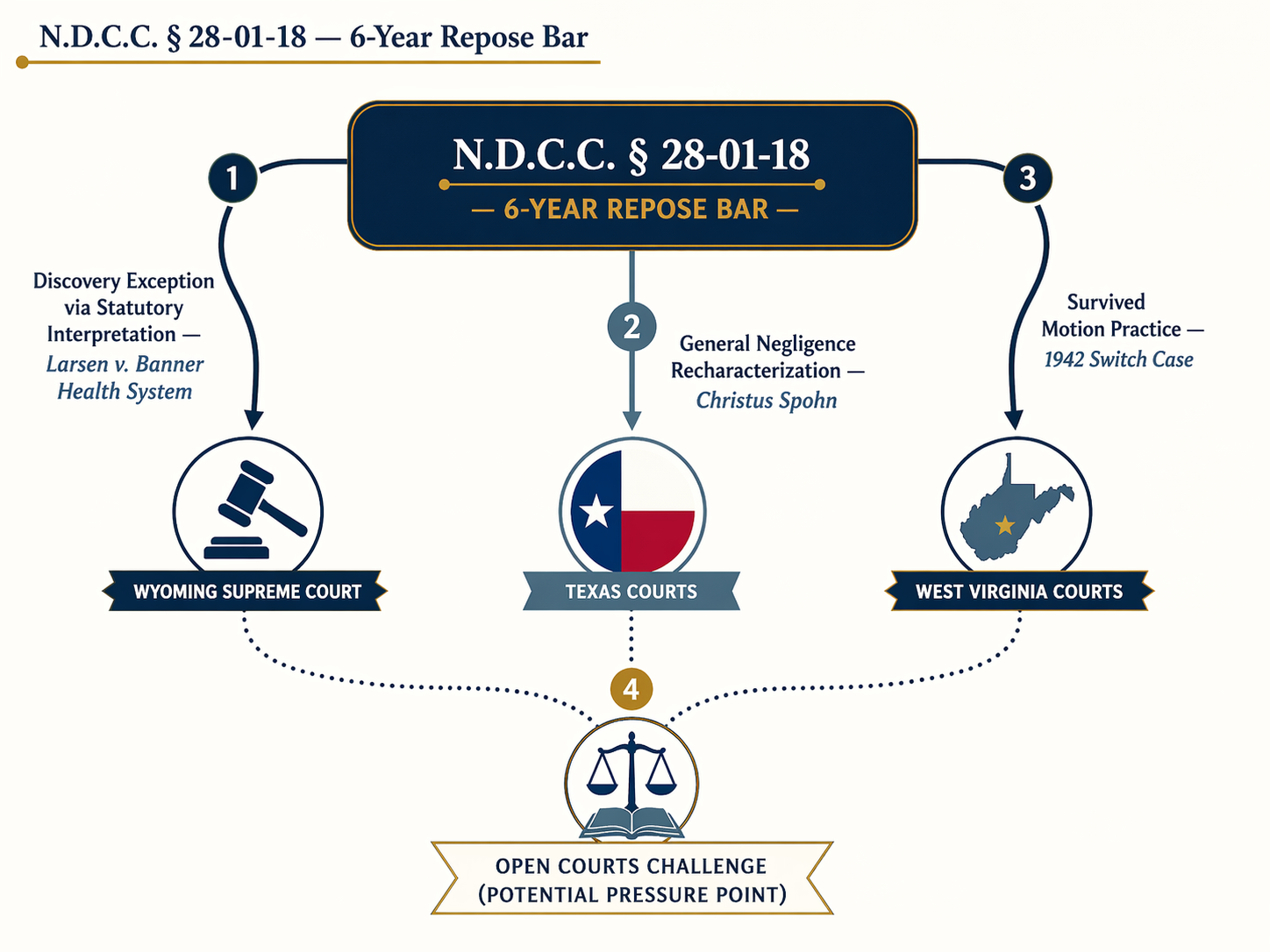
Three Survival Routes Suggested by Other Switched-at-Birth Cases
| Route | What It Tries To Do | Why It Matters in North Dakota |
|---|---|---|
| Larsen-style statutory interpretation | Read the medical malpractice statute to preserve a discovery-based claim despite old facts | It addresses the repose statute directly, but depends on statutory language and state-law interpretation |
| General negligence recharacterization | Avoid the healthcare-liability statute by defining the duty as nonmedical | It could move the case away from the six-year medical malpractice repose period |
| Open-courts or constitutional challenge | Argue that applying repose to an unknowable birth-switch claim denies a meaningful remedy | It can put pressure on strict repose, but is usually a difficult and state-specific argument |
These are not predictions. They are doctrinal routes that have appeared in analogous litigation. Each route has a different target. One asks the court to read the governing medical malpractice statute less harshly. One tries to avoid that statute. One challenges the consequences of applying it.
The Wyoming Route: Larsen v. Banner Health System
The closest appellate switched-at-birth analogue in the research record is Larsen v. Banner Health System, decided by the Wyoming Supreme Court in 2003.[5] The case matters because it did not treat the emotional improbability of discovery as a free-standing reason to disregard the statute. It worked through the statute.
In Larsen, the plaintiffs alleged a hospital birth switch and confronted a limitations and repose problem created by the passage of decades.[5] The Wyoming Supreme Court allowed the case to proceed by interpreting Wyoming’s statutory scheme to permit a discovery-rule exception in that context.[5] That makes Larsen more useful than a general statement that courts are sympathetic to switched-at-birth plaintiffs. It shows the kind of work a court must do if it is going to keep a decades-old claim alive while still claiming fidelity to the statute.
For North Dakota plaintiffs, a Larsen-style argument would need to identify language in North Dakota’s statute or controlling North Dakota precedent that allows a similar interpretation. The argument cannot simply import Wyoming’s result. Repose statutes are state-specific, and small textual differences can carry the whole case. If North Dakota’s statute is read as an absolute six-year cutoff from the act or omission, Larsen becomes persuasive background rather than binding machinery.
Still, Larsen is the most serious doctrinal model among the analogues because it engages the same basic problem: a switched-at-birth injury is not merely undiscovered; in any practical sense, it may be undiscoverable for decades. The litigation question is whether the legislature wrote a statute that leaves room for that fact to matter.
The Texas Route: Treat the Claim as General Negligence
The Texas Christus Spohn litigation points to a different route. In 2021, a Corpus Christi trial court allowed a switched-at-birth case to proceed more than fifty years later by treating the allegations as ordinary negligence rather than a healthcare liability claim.[6] That route does not soften the medical malpractice statute. It tries to step outside it.
For a North Dakota case, that distinction could be more practical than a broad attack on repose. A plaintiff might argue that correctly matching newborns to parents is not a matter of medical diagnosis, treatment, or professional judgment. It may be a custodial, identification, or administrative duty. If the court accepts that characterization, the hospital may still have limitations defenses, but the six-year medical malpractice repose statute may not control the case in the same way.
The difficulty is that birth-switch facts arise inside a medical facility at the moment of childbirth and neonatal care. Hospitals will usually argue that the claim is inseparable from healthcare services, especially when the alleged mistake occurred during admission, delivery, nursery care, or discharge. Plaintiffs will answer that the duty not to hand the wrong baby to the wrong family is understandable without expert medical testimony.
That is why the complaint’s wording matters. A court evaluating the issue will look less at the phrase “switched at birth” and more at the pleaded conduct: who allegedly controlled the infants, what process allegedly failed, whether medical judgment was involved, and which statutory definition governs healthcare liability in that jurisdiction.
The West Virginia Signal: Survival Is Possible, But Not Portable
The West Virginia switched-at-birth litigation involving an alleged 1942 birth switch is useful mainly as a caution against assuming that age alone ends every case. Reporting indicates that the suit was filed in 2020 and remained pending as of 2024.[7] That survival through motion practice is notable, but it does not establish what North Dakota law will do with a 1988 claim.
The value of the West Virginia example is modest and specific. It shows that courts do not always dispose of very old switched-at-birth claims at the first procedural opportunity. It does not prove that a six-year North Dakota medical malpractice repose statute can be avoided, and it does not substitute for the statutory interpretation that a North Dakota judge would have to perform.
The Constitutional Pressure Point
A constitutional open-courts argument is the most ambitious route. The basic contention would be that applying a repose statute to extinguish a claim before the plaintiffs could reasonably know it existed denies a meaningful remedy for a real injury. In a switched-at-birth case, that argument has unusual force as a matter of equity: ordinary diligence by an infant or a parent may not reveal a hospital switch, especially before consumer DNA testing made biological mismatches easier to detect.
But constitutional avoidance is not the same as constitutional victory. Courts often uphold repose statutes because legislatures may decide that old claims impose unacceptable burdens on proof, insurance, institutional memory, and finality. Those burdens are not imaginary in a 1988 case. Records may be incomplete, witnesses may be unavailable, practices may have changed, and the defendant is asked to litigate conduct from a different operational era.
The strongest version of the constitutional argument would not deny those burdens. It would focus on the unusual character of the injury: a claim allegedly extinguished before the plaintiffs had any realistic way to know the facts giving rise to it. Whether North Dakota law provides a receptive open-courts doctrine is a separate question, and the available materials do not support treating that route as more than a possible pressure point.
What the Public Record Still Does Not Answer
Several critical items remain uncertain because the available case-specific record is based on news accounts rather than the full pleadings. That is especially important in a limitations and repose fight, where a single statutory definition or pleaded duty can change the analysis.
- Whether the complaint expressly pleads medical malpractice, general negligence, emotional distress, constitutional theories, or some combination of claims.
- Whether the hospital’s answer relies only on ordinary limitations defenses or squarely invokes the six-year medical malpractice repose bar.
- Whether North Dakota precedent recognizes any statutory or constitutional exception relevant to inherently unknowable medical-facility injuries.
- Whether a court has ruled on a motion to dismiss or other dispositive motion; no such ruling has been publicly reported as of July 2026.
Those uncertainties should restrain the analysis. It is fair to say the reported facts create an existential repose problem. It is not fair to say the claim is already dead unless a court has applied the statute that way, nor is it fair to say the DNA discovery revives the claim unless North Dakota law permits that result.
For readers tracking the limitations side of these cases, the site’s statute-of-limitations analysis in switched-at-birth cases is the adjacent issue. The North Dakota dispute is narrower and harsher because repose asks whether the claim expired even before discovery. The procedural path from a DNA result to litigation is also covered in the site’s birth-switch DNA test to court explainer.
Where That Leaves the 1988 North Dakota Claim
If the North Dakota claim is treated as medical malpractice and the six-year repose statute is applied as an absolute outer deadline from January 26, 1988, the December 2023 DNA discovery is likely too late to matter. That is the hospital’s most direct procedural theory, and it is a serious one.
The claim is not analytically dead, however, merely because the alleged switch is old. Larsen shows one way a court can preserve a late-discovered switched-at-birth claim through statutory interpretation. Christus Spohn shows the practical importance of classifying the duty as ordinary negligence rather than healthcare liability. The West Virginia litigation shows that very old switched-at-birth cases can survive long enough for courts to engage with them, though it says little about North Dakota’s statute.
The decisive question is not whether the reported facts are morally disturbing. They are. The decisive question is whether plaintiffs can give a North Dakota court a legally recognized reason to avoid the medical malpractice repose bar: a Larsen-like reading of the statute, a general-negligence classification that bypasses it, or a state constitutional objection strong enough to overcome the legislature’s chosen cutoff.
References
- North Dakota Medical Malpractice Laws & Statute of Limitations, Nolo.
- North Dakota Medical Malpractice Laws, Gilman & Bedigian.
- 2 men switched at birth are suing a North Dakota hospital, AP News.
- Grafton hospital sued over alleged 1988 baby switch, Valley News Live.
- Larsen v. Banner Health System, 2003 WY 142, FindLaw, 2003.
- Texas Hospital Must Face Switched-at-Birth Case Over 50 Years Later, Courthouse News Service, 2021.
- Switched at birth: Catholic diocese sued, The Dominion Post.
Comments
Join the discussion with an anonymous comment.