
For a compliance file, the answer to whether legal sanctions prohibit North Korea’s uranium production and enrichment is not simply “yes.” The practical answer is that uranium enrichment and production are restricted through several legal layers that point in the same direction but do different work. UN Security Council resolutions create international obligations and designation pathways. US executive orders and statutes create domestic blocking and transaction authorities. OFAC regulations at 31 CFR Part 510 turn those authorities into administrable prohibitions, licenses, and compliance consequences. IAEA safeguards findings speak to verification and non-compliance, not sanctions enforcement.
The distinction matters because a memorandum that stops at “prohibited under UN sanctions” leaves too much unresolved. A bank still needs to know whether property is blocked, whether a service export is barred, whether a counterparty is designated, whether a license exists, and whether non-US obligations create a separate restraint. An exporter needs to know whether the issue is a goods control, a technology transfer, facilitation, or a sanctioned customer. A law firm needs to know whether it is analyzing a Security Council measure, a US jurisdictional hook, or both.
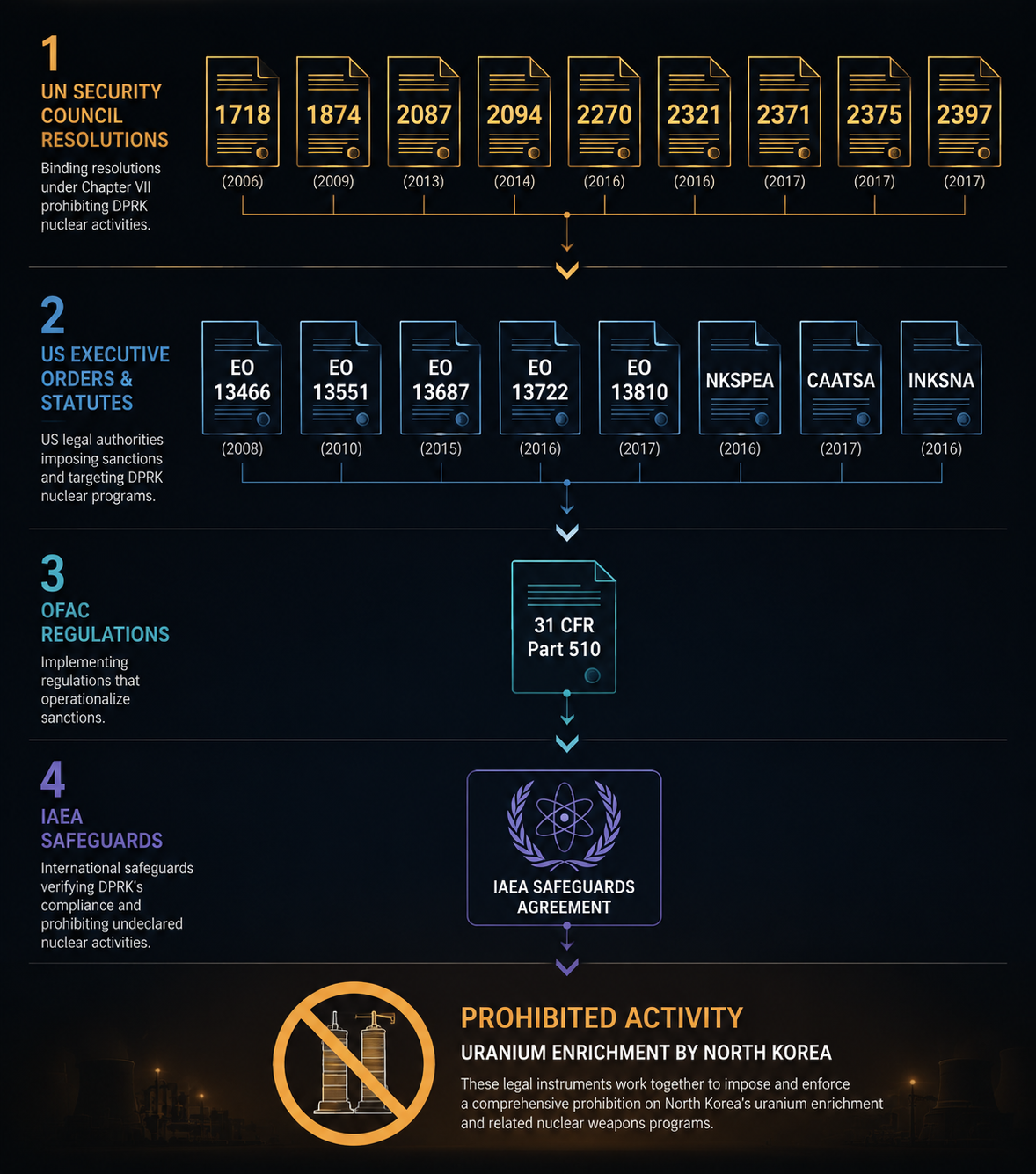
The Legal Stack, Separated by Function
The core instruments are best read as a stack of separate locks. They overlap, but they are not interchangeable. The UN framework runs through nine Security Council resolutions from UNSCR 1718 through UNSCR 2397; the US framework includes executive orders including 13466, 13551, 13570, 13687, 13722, and 13810, as well as statutes including the North Korea Sanctions and Policy Enhancement Act of 2016, CAATSA 2017, and INKSNA; OFAC administers the North Korea Sanctions Regulations at 31 CFR Part 510; and the IAEA maintains a safeguards position that North Korea is in further non-compliance with its NPT Safeguards Agreement, while acknowledging that the Agency has not been able to conduct enrichment-related verification in North Korea since 2009.[1][2][3]
| Layer | What it contributes | Why it cannot be collapsed into another layer |
|---|---|---|
| UN Security Council resolutions 1718 through 2397 | International prohibitions, asset-freeze and designation architecture, sectoral measures, and obligations for UN member states. | They bind states under the UN framework, but do not by themselves answer every domestic licensing, blocking, or services question for a US person or US nexus transaction.[1] |
| US executive orders and statutes | US legal authorities for blocking property, prohibiting transactions, targeting support to North Korea’s economy, and implementing congressional sanctions mandates. | They create US-specific consequences that may be broader, more detailed, or differently triggered than the UN measure that sits behind the same policy concern. |
| OFAC 31 CFR Part 510 | The working regulatory text for US sanctions administration, including prohibitions, definitions, licenses, exemptions, and enforcement-facing rules. | It is the place a transaction reviewer usually must end up, because broad policy statements do not decide whether a particular service, export, payment, or property interest is authorized.[2] |
| IAEA safeguards position | Verification record, non-compliance findings, and technical safeguards context for nuclear material and facilities. | The IAEA record supports the factual and safeguards analysis, but the Agency is not the body that administers UN or US sanctions penalties.[3] |
That division of labor is the central compliance point. The instruments reinforce each other, but no single instrument supersedes the others. A designation under one authority may be relevant to another system, but it is not a substitute for checking the operative list, regulation, license, and jurisdictional rule that governs the actual transaction.
Where the UN Resolutions Put Uranium Enrichment
The Security Council’s North Korea sanctions regime began with UNSCR 1718 in 2006 and expanded through UNSCR 1874, 2087, 2094, 2270, 2321, 2371, 2375, and 2397. The resolutions collectively form the UN-level framework for restrictions connected to North Korea’s nuclear, ballistic missile, and other WMD-related activities, along with broader economic and sectoral measures adopted as the program developed.[1]
UNSCR 2094, adopted in 2013, is a useful marker because it was the first Security Council resolution in this series to explicitly reference uranium enrichment activities. That does not mean earlier WMD-related measures were irrelevant to enrichment. It means the Council’s record became more administrable on that point: the conduct no longer had to be fitted only through more general nuclear or WMD language when explaining the sanctions basis.[1]
For practitioners, that distinction is not academic. If the question is whether the UN framework recognizes uranium enrichment as covered conduct, UNSCR 2094 is the clean citation. If the question is whether North Korea’s nuclear-related procurement, financing, or designated entities are restricted under the broader UN regime, the analysis cannot start and end with 2094. The earlier and later resolutions supply asset-freeze obligations, designation criteria, transport and procurement restrictions, and sectoral measures that may be the operative rule in a particular matter.
This is where generic descriptions of “UN sanctions” become risky. A UN prohibition can require a member state to act, but the compliance consequence for a private party usually arrives through implementing domestic law, a national sanctions list, a banking control, a customs rule, or a licensing system. The Security Council text is the top layer; it is not the whole file.
The US Layer Moves from Policy to Blocking and Transactions
The US framework is broader than a simple implementation note to the UN regime. Executive orders and statutes give the US government authorities to block property, prohibit categories of transactions, restrict exports of goods, services, and technology, and designate persons connected to North Korea’s weapons programs or wider economy. EO 13722, issued in 2016, is especially important because it implemented major elements of the North Korea Sanctions and Policy Enhancement Act and extended the sanctions architecture toward dealings with the North Korean economy, including transactions that could support uranium enrichment.
A US analysis therefore asks questions that the UN framework alone does not answer. Is a party on OFAC’s Specially Designated Nationals and Blocked Persons List? Is there blocked property or an interest in blocked property? Is a US person involved? Is the conduct an exportation or reexportation of services or technology? Is there facilitation by a US person of a transaction that would be prohibited if performed directly? Is a general license available, or is a specific license required?
Those questions become concrete in 31 CFR Part 510, OFAC’s North Korea Sanctions Regulations. Part 510 is where the operational language appears: definitions, prohibitions, licensing provisions, and the mechanics by which broad sanctions authorities are applied to particular conduct. For a transaction-review desk, this is closer to the point of decision than a policy statement about nonproliferation, because it tells the reviewer what is prohibited, what is blocked, what may be exempt, and what requires authorization.[2]
The practical effect is that uranium enrichment risk does not need to appear as a shipment labeled “centrifuge component” to become a sanctions problem. It may appear through software support, engineering services, dual-use equipment, financing, shipping, insurance, front companies, or technical assistance. The legal conclusion then turns on the applicable authority and facts, not on whether the word “uranium” appears in the commercial documents.
Why EO 13722 and Part 510 Matter in the Same File
EO 13722 matters because it supplies presidential authority and policy reach. NKSPEA matters because it reflects congressional direction and mandatory sanctions architecture. Part 510 matters because it is the codified regulatory layer that a compliance team can apply to a transaction. Treating them as duplicates invites mistakes in both directions: a reviewer may miss an OFAC licensing issue by stopping at the executive order, or overstate a prohibition by failing to read the regulation’s operative text.
The same caution applies to secondary and non-US exposure. A non-US company may not be directly subject to every US-person prohibition, but it can still face designation risk, correspondent account consequences, contractual fallout, export-control exposure, or bank de-risking if its conduct supports North Korea’s prohibited programs. That is a different legal analysis from saying the company is itself a US person bound by all primary sanctions.
The IAEA Record Is Verification Evidence, Not a Sanctions Code
The IAEA’s role sits beside the sanctions regimes rather than inside them. The Agency states that it has not been able to verify the completeness and correctness of North Korea’s initial nuclear declaration since 1993, considers North Korea in further non-compliance with its NPT Safeguards Agreement, and has been unable to conduct enrichment-related verification in the country since 2009.[3]
Those findings matter because they describe the verification environment. They do not themselves block a payment, designate a supplier, or create an OFAC license requirement. A safeguards conclusion may support a government’s nonproliferation judgment or provide factual context for sanctions policy, but enforcement authority still has to be found in the relevant UN, national, or regional legal instrument.
There is also a legal-status complication that should not be smoothed over. North Korea disputes the continuing force of its safeguards obligations after its NPT withdrawal, while the IAEA position is that the safeguards agreement remains in force.[3] A compliance assessment does not need to resolve the scholarly dispute to understand the practical consequence: the Agency lacks current access, and its record should be used as a verification and non-compliance source rather than as a standalone sanctions trigger.
Recent Disclosures Confirm Activity; They Do Not Create the Prohibition
North Korea’s public disclosures in September 2024 of centrifuge-related activity at Kangson and in June 2026 of a new enrichment plant at Yongbyon are compliance-relevant because they are admissions of activity that the existing framework already treats as prohibited. They should not be mistaken for the moment the legal issue began. The Security Council record, US authorities, OFAC regulations, and IAEA safeguards findings were already in place.
The June 2026 claim that nuclear materials production capacity had doubled should be handled more cautiously. The claim comes from North Korean state media and is not independently verified in the materials available here. It is relevant as a public assertion by the sanctioned state, not as an independently established production measurement.
That evidentiary ranking is important. A KCNA disclosure can be useful as an admission, a lead, or a risk indicator. It does not carry the same weight as OFAC regulatory text, a Security Council resolution, or an IAEA safeguards report. Compliance files should preserve those differences because the quality of the evidence affects how far the conclusion can responsibly go.
The Post-2017 Enforcement Problem
The UN framework has not been updated by a new Security Council sanctions resolution on North Korea since UNSCR 2397 in December 2017.[1] That does not make the earlier prohibitions expire. It does mean the formal Security Council framework is static while North Korea’s enrichment-related activity has continued to surface through public disclosures and external monitoring.
The monitoring environment became more fragmented after March 2024, when Russia vetoed renewal of the Panel of Experts mandate that had supported the 1718 Committee’s sanctions work. The 1718 Committee remains the institutional body for UN sanctions designations, but it lost the expert analytical support that had helped document evasion patterns and implementation problems.[4][5]
For compliance teams, that is not a reason to treat the UN regime as dormant. It is a reason to be more careful about source collection. Post-Panel monitoring may come through national authorities, G7 statements, the Multilateral Sanctions Monitoring Team or other enforcement-coordination efforts, naval or customs operations, think-tank analysis, and commercial intelligence. Those sources may be useful, but they do not all have the same legal effect.
How a Practitioner Should Read the Layers Together
A defensible sanctions analysis should not cite one layer and assume the rest follows. The better approach is to identify the legal function each layer performs in the matter at hand.
- Start with the conduct: enrichment, procurement, financing, shipping, technical services, software, insurance, legal services, or another form of support.
- Identify the parties and ownership interests: North Korean state entities, designated persons, front companies, vessels, banks, intermediaries, and beneficial owners.
- Check the UN layer for designation basis, member-state obligations, and the relevant UNSCR provisions, especially where uranium enrichment or WMD-related procurement is implicated.
- Check the US layer separately: executive-order authority, statutory mandates, OFAC listing status, 31 CFR Part 510 prohibitions, and licensing availability.
- Use IAEA material for verification context and safeguards status, without treating it as the enforcement rule that blocks a transaction.
- Document the source hierarchy: legal text first, regulator guidance and lists next, verified institutional reporting next, state media claims only for the limited evidentiary value they can support.
The most common error is not that professionals overlook North Korea risk entirely. It is that they move too quickly from a general sanctions label to a transaction conclusion. “North Korea,” “uranium,” and “UN sanctions” are not enough to decide whether a specific payment must be rejected, whether property must be blocked, whether a license can be requested, or whether a non-US person faces designation risk.
The framework remains legally layered and active. Its enforcement, evidence, and legal effect are distributed across separate regimes. A current file should therefore verify live designations, OFAC licensing rules, applicable export controls, domestic implementing measures, and jurisdiction-specific obligations directly rather than relying on a single shorthand citation to “North Korea sanctions.”
References
- UN Security Council Resolutions on North Korea, Arms Control Association
- North Korea Sanctions Regulations, 31 CFR Part 510, Electronic Code of Federal Regulations
- Fact Sheet on DPRK Nuclear Safeguards, International Atomic Energy Agency
- Russia’s Veto: Dismembering the UN Sanctions Regime on North Korea, Center for Strategic and International Studies
- Russia Ends North Korean Sanctions Panel, Arms Control Association
Comments
Join the discussion with an anonymous comment.