
The legal asylum process for North Korean defectors begins with a contradiction that ordinary refugee doctrine is poorly built to absorb. A person may flee a state whose prison camps, surveillance, collective punishment, and punishment for unauthorized departure are not seriously in doubt. Yet the first legal question in many Western files is not what North Korea did to them. It is whether South Korea has already made them a citizen.
That question matters because South Korea’s constitutional framework claims the Korean Peninsula as the territory of the Republic of Korea, and its settlement system treats North Koreans who arrive as citizens entitled to protection and integration support. By the end of 2025, South Korea had received 34,538 North Korean arrivals; women made up 72% of all arrivals and 88% of arrivals in 2025. The Hanawon system provides a 12-week orientation, housing subsidies, and vocational training, which makes South Korea not only the most established destination but also the destination many adjudicators treat as legally available protection.[1]
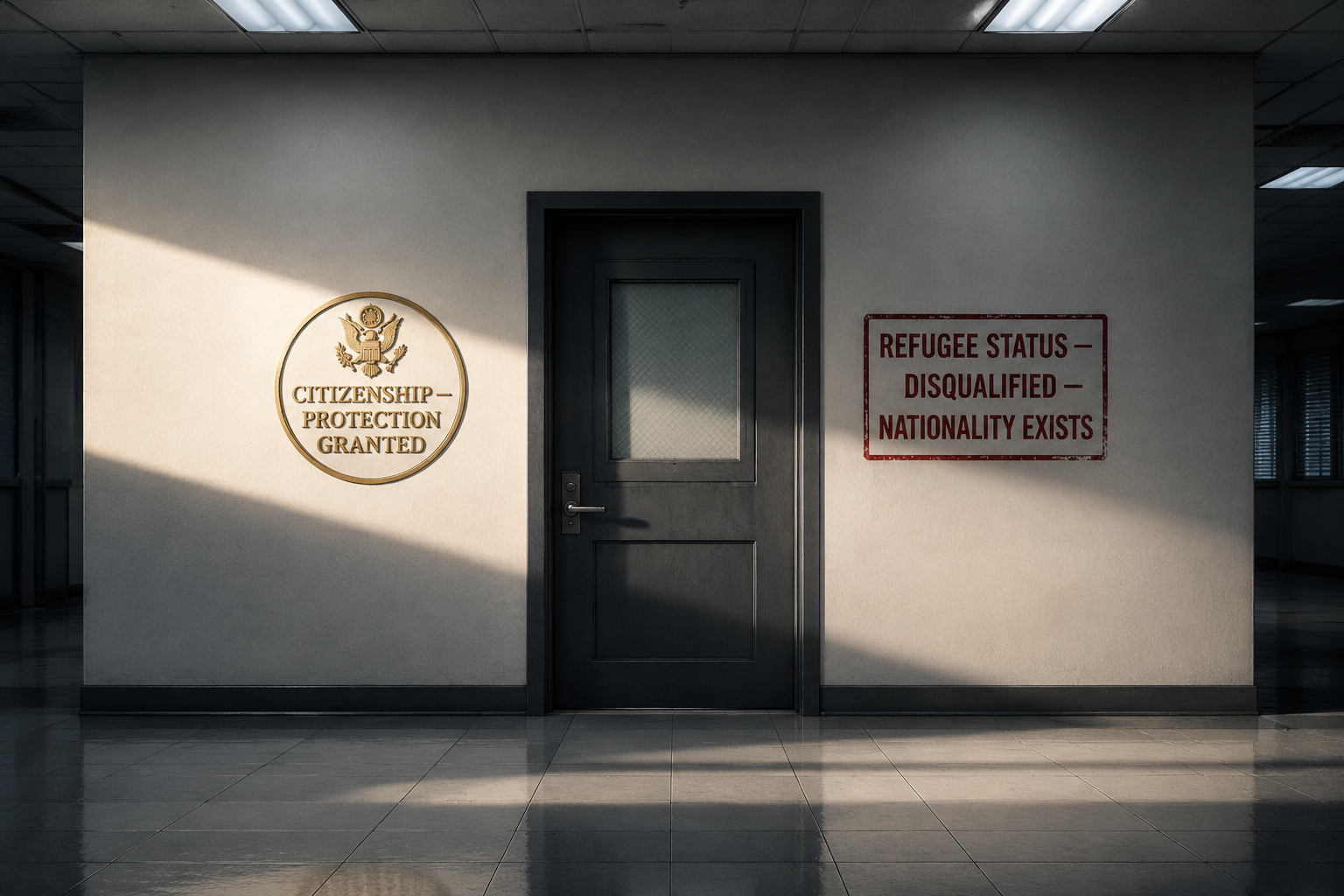
The scale contrast is stark. South Korea has processed tens of thousands of arrivals; the United States has admitted fewer than 200 North Korean refugees since the North Korean Human Rights Act opened a U.S. pathway in 2004.[2] That gap is not explained by a sudden dispute over whether North Koreans face danger. It is produced by the interaction between nationality, firm resettlement, diplomatic access, and the administrative patience required to remain in a U.S. pipeline while a faster South Korean route sits nearby.
When Citizenship Becomes the Bar
The 1951 Refugee Convention defines a refugee by reference to nationality. A person is outside the country of nationality and unable or unwilling, owing to a well-founded fear of persecution, to avail themselves of that country’s protection. For a stateless person, the reference point is former habitual residence. The definition has mercy in it, but it also has a gatekeeping premise: if another country of nationality can protect the person, refugee status is harder to establish.[3]
For most asylum applicants, nationality is a fact about the passport state they fled. For North Koreans, adjudicators may treat nationality as a legal overlay supplied by Seoul. South Korea’s position is generous in domestic protection terms: North Koreans are not merely a foreign refugee group to be screened case by case for admission. They are treated as members of the Korean national community, processed through a settlement framework, and given a formal place to restart their lives.[1]
That generosity has a second life in foreign asylum systems. If a decision-maker concludes that the applicant has South Korean nationality, or can obtain it as a matter of legal entitlement, the case can move away from North Korean persecution and toward a narrower question: why is South Korea not an available country of protection? The case file has not become easier because the facts are less serious. It has become harder because the relevant country has changed.
This is the legal singularity in North Korean protection work. South Korea’s framework is the strongest protection pathway in practice, but it also supplies the doctrinal reason other states can say the person is not a refugee for their purposes. A safety net becomes evidence of non-eligibility.
The U.S. Carve-Out Was Real, but Narrow
Congress saw the problem. Section 302 of the North Korean Human Rights Act provides that, for purposes of eligibility for U.S. refugee status or asylum, a North Korean national shall not be considered a South Korean national by operation of South Korea’s constitution. The statute also made North Koreans of humanitarian concern to the United States and authorized up to $20 million annually for humanitarian assistance.[4]
That language mattered. Without it, the South Korean citizenship premise could have swallowed many U.S. claims at the threshold. Section 302 told U.S. adjudicators not to treat theoretical South Korean nationality, standing alone, as an automatic bar. It did not, however, erase the separate doctrines of firm resettlement, dual nationality analysis, or the factual question whether an applicant had already used South Korean status in a way that changed the case.
The Board of Immigration Appeals drew that line in 2011 in Matter of K-R-Y- and K-C-S-. The Board held that the North Korean Human Rights Act does not prevent adjudicators from considering whether North Korean applicants have availed themselves of South Korean citizenship, and it treated prior use of South Korean status as relevant to firm resettlement and nationality analysis. Once that happened, the applicant’s burden could shift from proving fear of North Korea to explaining why protection in both North Korea and South Korea was unavailable.[5]
That is a different case. It asks for evidence many asylum applicants are not prepared to produce: records of South Korean recognition or non-recognition, proof of what benefits were accepted, explanation of travel documents, evidence of social or legal exclusion in South Korea, and a theory of persecution or unavailability of protection in a democratic state that formally recognizes them as citizens. The North Korean persecution claim remains morally central, but procedurally it may no longer be the decisive issue.

The U.S. Pipeline Shows What Narrow Eligibility Does in Practice
The best granular public window into the U.S. refugee pipeline remains the Government Accountability Office’s 2010 review. From October 2004 through March 2010, 238 North Korean refugee cases were opened for U.S. processing. Ninety-four North Korean refugees arrived in the United States, while 107 cases were withdrawn. GAO calculated a 45% withdrawal rate, with withdrawals often tied to the fact that South Korean resettlement was faster and offered more generous benefits.[2]
| U.S. processing measure | GAO finding |
|---|---|
| North Korean refugee cases opened, Oct. 2004-Mar. 2010 | 238 |
| Arrivals in the United States during the reviewed period | 94 |
| Withdrawn cases | 107 |
| Withdrawal rate | 45% |
| Average processing time, FY2006 | 133 days |
| Average processing time, FY2007 | 399 days |
| Average processing time, FY2008 | 314 days |
The processing-time data are as important as the admissions count. Average processing time rose from 133 days in fiscal year 2006 to 399 days in fiscal year 2007, then remained at 314 days in fiscal year 2008. GAO tied the increase in fiscal years 2007 and 2008 to one host country limiting U.S. government access to North Korean refugee applicants, which tripled processing times.[2]
For a lawyer reading an intake file, that is not merely delay in the abstract. It changes the applicant’s incentives. A person in hiding in a transit country must decide whether to wait for U.S. interviews, security checks, and host-country cooperation, or to take the South Korean route that is both faster and backed by a defined settlement system. The withdrawal statistics do not prove that applicants preferred South Korea in some clean expressive sense. They show that the U.S. process often required applicants to carry risk and uncertainty long enough for the alternative to become the rational choice.
This is how a statutory opening narrows without being formally repealed. Congress can say South Korean citizenship does not automatically bar U.S. eligibility. The Board can still require a searching inquiry into whether the applicant used South Korean citizenship or firmly resettled. A host country can restrict access. Processing time can lengthen. Applicants can withdraw. Each step is legally distinct; together, they produce a small admissions channel.
China Is the Choke Point, Not a Protection Forum
Most North Koreans who leave without authorization do not begin in a Western asylum office. They pass through China, where the legal classification is hostile from the start. Estimates of the undocumented North Korean population in China range from 50,000 to 200,000, a wide range that reflects the absence of independent verification and the risks of living without status.[6]
China does not recognize North Koreans as refugees. It treats them as illegal economic migrants and has repatriated them under a 1986 Mutual Cooperation Protocol with Pyongyang. Human rights reporting documented at least 600 forcible repatriations in 2023 and 260 in 2024, despite China’s obligations under the Refugee Convention and the Convention Against Torture.[6]
The legal effect is severe. If China recognized the refugee character of these cases, it would have to account for the risk North Koreans face after return, including punishment for illegal departure and suspected contact with foreign or religious actors. By denying refugee status at the classification stage, China prevents the non-refoulement analysis from doing its work. The case does not fail after a careful protection inquiry; it is diverted before that inquiry becomes available.
China’s role also affects Western processing. U.S. officials and other resettlement actors can only process applicants they can reach, interview, and move through host-country procedures. When a transit state restricts access, the applicant’s theoretical eligibility in another country may be irrelevant. Protection law has a geography problem: a right that cannot be accessed from the place where the person is hiding is not much of a remedy.
Western Outcomes Turn on the South Korean Citizenship Question
The United States is not the only system that has struggled with the South Korean nationality premise. The United Kingdom, Canada, and Germany show how much turns on whether an adjudicator treats South Korea as an available country of citizenship or safe protection. Their numbers should not be compared as if they come from one harmonized dataset; the time periods, legal categories, and counting methods differ. They are still useful because they reveal the diagnostic pattern.
The United Kingdom became the largest Western recipient of North Korean refugees, with roughly 680 accepted. In the 2006-2009 period, there were 665 applications and 350 grants, and the North Korean community in New Malden became the most visible marker of that route.[7]
Canada’s figures point in a different direction. From 2000 to 2009, Canada received 217 applications from North Koreans and granted 76, including 66 in 2009 alone. But since 2013, Canada has deported nearly 2,000 North Koreans on safe-third-country reasoning tied to South Korea, treating South Korean protection as a reason to deny or remove rather than as a distant theoretical possibility.[8]
Germany’s pattern is different again. It granted 191 North Korean claims from 2000 to 2003, but only 2 after 2003. As of 2008, 1,391 North Koreans were residing in Germany under non-humanitarian immigration status rather than through a refugee-recognition pathway.[8]
Those outcomes do not support a single claim that Western states uniformly reject North Koreans. The more precise point is that Western systems sort similar underlying danger through different answers to the same threshold issue. If South Korean nationality is treated as dispositive, the North Korean persecution evidence may never carry the case. If it is treated as relevant but not conclusive, the applicant may still have room to show why South Korea is not actually available or why prior South Korean contact did not amount to firm resettlement.
The Current U.S. Posture Is More Unstable Than the Statute Suggests
The North Korean Human Rights Act no longer supplies the same statutory footing it once did. The Act expired in 2022. The House passed H.R. 5959 in 2025 to reauthorize it, but Senate status remained uncertain as of mid-2026.[9]
That lapse sits on top of refugee-admissions volatility. The research record identifies a 2017 suspension of North Korean refugee admissions, a fiscal year 2025 refugee ceiling reduction to 7,500, and an indefinite visa-processing pause for nationals of 75 countries announced in January 2026.[9] These measures are not all North Korea-specific, and they should not be collapsed into one doctrine. But they matter to the file because they add another layer of uncertainty to a population whose U.S. pathway was already small, access-dependent, and vulnerable to delay.
As of July 2026, the cleanest legal description is not that North Korean defectors lack persecution claims. It is that they occupy a category where protection in one jurisdiction can become disqualification in another. South Korea’s citizenship and settlement system saves lives and also complicates refugee status elsewhere. The U.S. statutory carve-out recognized the problem and then encountered firm-resettlement doctrine, access constraints, and authorization gaps. China’s refusal to recognize refugee status keeps many applicants from ever reaching a meaningful protection forum.
That is the paradox the asylum file records in administrative form: persecution may be evident, but eligibility can be defeated by the existence, presumed availability, or prior use of a different state’s protection.
References
- Korea Hana Foundation North Korean Defectors Settlement Data, Korea Hana Foundation.
- Humanitarian Assistance: Status of North Korean Refugee Resettlement and Asylum in the United States, U.S. Government Accountability Office, June 24, 2010.
- Convention Relating to the Status of Refugees, UNHCR, 1951.
- 22 U.S. Code Chapter 85 - North Korean Human Rights, Legal Information Institute.
- Admitting North Korean Refugees to the United States: Obstacles and Opportunities, Brookings Institution.
- The North Korean Refugee Crisis: Human Rights and International Response, Council on Foreign Relations.
- North Korean asylum seekers, Right to Remain.
- North Korean Refugees in the United States and Other Countries, Crossing Borders.
- Another Failure to Reauthorize the North Korean Human Rights Act, Despite House Approval of the Bill?, Korea Economic Institute of America.
Comments
Join the discussion with an anonymous comment.