
The 2025 scorecard for North Sea oil drilling legal challenges looks, at first pass, like two claimant wins and one claimant loss. That is accurate, but too blunt to be useful. The better working rule is narrower: lifecycle climate assessment bites hardest at the final development-consent stage, where downstream Scope 3 emissions were left out; it is materially weaker at the exploration-licence stage, where a court accepts that production is not yet inevitable.
That distinction explains why the Scottish Court of Session quashed the Rosebank and Jackdaw development consents in January 2025, while the High Court later dismissed Oceana UK's challenge to exploration licences issued from the 33rd licensing round. It also explains why the Norwegian Supreme Court ruling matters, but does not simply become a stronger version of the UK cases.
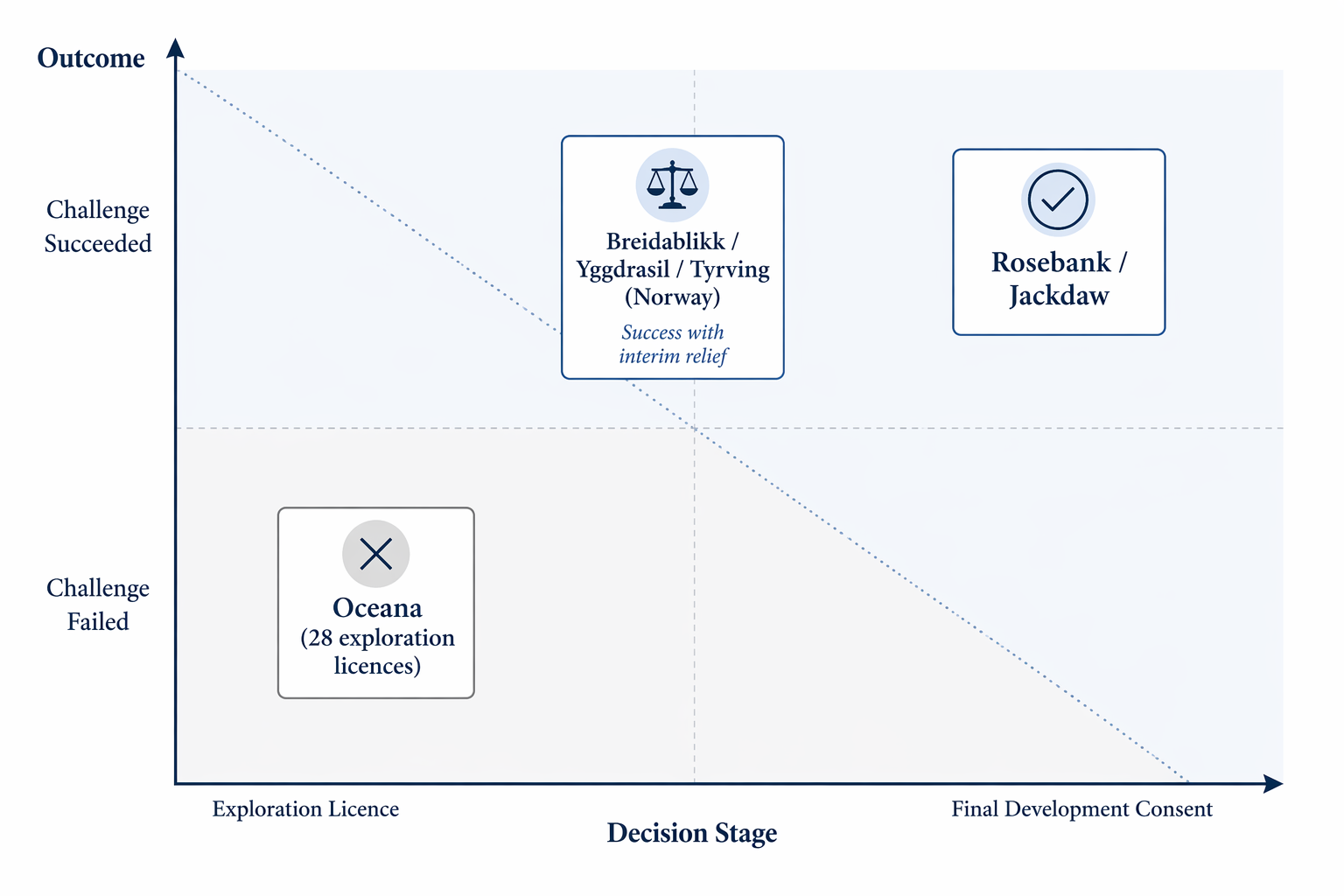
| Case | Decision challenged | Outcome | Why the result matters |
|---|---|---|---|
| Greenpeace/Uplift v. NSTA and Secretary of State | Final development consents for Rosebank and Jackdaw | Challenge succeeded; consents quashed with suspension | Finch applied because the final consent process omitted downstream emissions assessment. |
| Norwegian Supreme Court: Breidablikk, Yggdrasil, Tyrving | Approvals affecting three North Sea fields | Temporary ban reinstated | Interim relief gave assessment duties practical force under EEA effectiveness principles. |
| Oceana UK v. Secretary of State | Exploration licences granted in the 33rd licensing round | Challenge dismissed | The court accepted a staged assessment approach because exploration did not inevitably lead to production consent. |
The clean win: final consent without Scope 3 assessment
Rosebank and Jackdaw are the positive case for climate litigators because the challenged decisions were not preliminary signals, policy statements, or search permissions. They were development consents for specific North Sea oil and gas projects. On January 30, 2025, Lord Ericht held that the consents were unlawful because the environmental impact assessments had not assessed downstream emissions from burning the produced oil and gas, applying the UK Supreme Court's Finch judgment to the consent decisions before him.[1]
That matters because Finch is often invoked as if it were a general climate veto. Rosebank and Jackdaw show something more precise. Once the authority is deciding whether a defined project may proceed to development, downstream emissions can no longer be treated as too remote for assessment merely because they occur when the product is later used.
The developers' good-faith position did not save the consents. Lord Ericht rejected arguments that they had proceeded on the law as it then stood, saying they "knew or ought to have known that the law was uncertain."[2] For future projects, that point is less theatrical than it sounds. It reduces the comfort available to developers who press ahead during a period of legal uncertainty and then ask the court to treat that uncertainty as a reason to leave a defective consent untouched.
The remedy was still not a project-killing order. The court made a suspended quashing order, leaving the Secretary of State with discretion to reconsider the projects after lawful environmental assessment.[1][2] That is a real litigation win: the existing consents cannot simply be relied on. It is not the same thing as a permanent judicial ban on Rosebank or Jackdaw.
The failed challenge: exploration licences came too early
Oceana is the counterweight. On November 28, 2025, the High Court dismissed a challenge to 28 exploration licences granted in May 2024 in the 33rd licensing round.[3] The formal order followed on December 4, 2025.[4] The result is important not because the court rejected climate assessment as a topic, but because it rejected the proposed timing.
The government argued, and the court accepted, that exploration licences authorize search activities and do not inevitably lead to production consent.[3] On that basis, the Finch requirement was not extended to the initial licensing round. The court treated the assessment process as staged: more detailed cumulative and climate-impact analysis could be deferred to later decisions if a licensee sought production approval.[5]
For claimants, that is the most important adverse line in the 2025 UK cases. A licence that permits exploration may be commercially significant, politically contested, and environmentally consequential in a broad sense. But the legal question was whether the licensing decision itself had enough production consequence to require the same downstream-emissions assessment demanded at final development consent. The High Court's answer was no.
The practical lesson is not that exploration licences are immune from environmental challenge. It is that a Finch-style Scope 3 challenge has a weaker footing when the challenged act sits before the production decision and the statutory scheme allows further assessment before extraction is authorized.
The Norwegian ruling has teeth, but a different hook
The Norwegian Supreme Court ruling belongs in the same scorecard, but not in the same doctrinal box. In April 2025, the court reinstated a temporary ban on three North Sea fields — Breidablikk, Yggdrasil, and Tyrving — reversing the Borgarting Court of Appeal.[6] Secondary summaries describe the central point as an EEA-law effectiveness principle: national courts must be able to grant interim measures where likely environmental impact assessment breaches risk irreversible environmental harm.[6][7]
That is a more immediately protective remedy than the suspended quashing order in Rosebank and Jackdaw. The Scottish order preserved space for ministerial reconsideration after lawful assessment. The Norwegian interim relief, as summarized by Greenpeace and Climate Case Chart, stopped activity while the legality problem was addressed.[6][7]
The difference should not be blurred. The Norwegian case strengthens the broader proposition that North Sea courts can make climate assessment duties operational. It does not establish the UK rule for when Finch applies, and the available research here depends on public summaries rather than the original Norwegian-language court materials. Its safest use is comparative: it shows remedial seriousness, not a directly transposable UK consent-stage test.
Remedy is part of the scorecard, not an afterthought
A litigation scorecard that counts only wins and losses misses the most practical distinction. Rosebank and Jackdaw produced a suspended quashing order. The Norwegian case produced interim relief. Oceana produced dismissal. Those are not different rhetorical shades of the same outcome; they change who must act next.
- After Rosebank and Jackdaw, the government had to reconsider whether the projects could be approved after proper assessment.
- After the Norwegian ruling, the affected fields faced a temporary ban while the assessment issue remained live.
- After Oceana, the exploration licences survived because the court accepted that later consent stages could carry the heavier assessment burden.
For funders and litigators, remedy shapes leverage. A suspended quashing order can force a new environmental record without foreclosing approval. Interim relief can change project sequencing more sharply. A failed challenge at the licence stage may leave the claimant waiting for a later, more concrete decision point.
Regulators are already moving around the boundary
The litigation boundary did not stay inside judgments. On June 19, 2025, the UK issued tougher environmental guidance for new North Sea oil and gas drilling, requiring fuller treatment of Scope 3 emissions in environmental assessment after Finch.[8] That guidance is best understood as an administrative response to the final-consent problem: if downstream emissions must be assessed before development approval, regulators need a process for receiving and testing that material.
Shell then submitted a fresh environmental impact assessment for Jackdaw in September 2025. The BBC reported that the new material disclosed worst-case lifetime emissions of 35.8 million tonnes of CO2e, equivalent to 90% of Scotland's 2023 total.[9] Those numbers do not decide whether Jackdaw should be approved. They show what was missing from the earlier consent record.
The government also published the North Sea Future Plan on November 26, 2025, moving to end new exploration licences and citing Finch in the policy context.[10] Greenpeace UK described the plan as ending new oil and gas exploration in the UK.[11] That policy choice overlaps with the litigation, but it should not be mistaken for the Oceana holding. Oceana did not say new exploration licensing was good policy; it said the challenged licences were lawful under a staged assessment approach.
Industry conditions add another layer, though the evidentiary chain is thinner. Drilling Contractor, citing Offshore Energies UK's 2026 Business Outlook Report, reported that no exploration wells were drilled on the UK Continental Shelf in 2025, the first time on record.[12] That statistic is relevant to the atmosphere around licensing, but it does not prove that litigation alone caused the pause. It belongs in the background of regulatory behavior, not in the holding of any case.
Where the boundary remains open
The 2025 line is usable, but not final. Oceana is a High Court decision, not an appellate settlement of the staged-assessment principle. A future claimant may try to show that a particular early-stage licence has more concrete production consequences than the court accepted in that case. The stronger the legal or practical connection between the licence and later extraction, the harder it becomes to say that downstream effects can safely wait.
There is also a pending implementation question. As of July 19, 2026, final ministerial decisions on whether to re-approve Rosebank and Jackdaw under the new Scope 3 guidance had not been issued, after earlier reporting indicated that decisions were expected no earlier than autumn 2025.[8] The suspended quashing order therefore leaves a live administrative sequel: a lawful assessment may still be followed by approval, refusal, or further challenge.
The usable rule for legal strategists is therefore modest but sharp. Challenges are strongest when aimed at final development consent decisions that omit Scope 3 analysis. They are materially weaker when aimed at preliminary exploration licences under a staged assessment framework. The boundary remains open to appellate refinement, especially where an early licence can be shown to carry more concrete production consequences than an ordinary permission to search.
References
- UK must reconsider Shell and Equinor's North Sea gas, oil projects, court rules, Reuters, Jan. 30, 2025
- Climate Litigation: Scottish Court Quashes Consents For North Sea Oil And Gas Fields, Slaughter and May
- UK court dismisses challenge to issuing of oil and gas exploration licences, Reuters, Nov. 28, 2025
- High Court deems 28 oil and gas exploration licences lawful despite government ban, New Civil Engineer, Dec. 4, 2025
- Important decision issued regarding North Sea and Irish Sea oil and gas exploration licenses, Matrix Chambers
- Victory: Three oil fields in the North Sea declared illegal, Greenpeace International, Apr. 2025
- Greenpeace Nordic and Nature & Youth v. Energy Ministry, Climate Case Chart
- UK issues tougher environmental rules for new North Sea oil and gas drilling, Reuters, Jun. 19, 2025
- Potential emissions revealed for controversial Jackdaw gas field, BBC News, Sep. 2025
- North Sea Future Plan, GOV.UK, Nov. 26, 2025
- A historic victory: the end of new oil and gas exploration in the UK, Greenpeace UK
- OEUK: UK offshore energy sector needs policy support to unlock investment, Drilling Contractor
Comments
Join the discussion with an anonymous comment.