
The unsettling part of NPR’s false Alito retirement story is not that a Supreme Court reporter misheard something. It is that a “rookie mistake,” as Nina Totenberg later called it, became a finished 1,186-word article at one of the country’s most trusted newsrooms, published at 10:51 a.m. ET, retracted at 10:57 a.m., and corrected on air at 11:07 a.m. [1][3]
That compressed timeline matters for anyone searching, forwarding, or relying on Supreme Court legal news in real time. Six minutes can sound trivial from a distance. Inside a legal department, a chambers-adjacent group chat, a client alert workflow, or a morning editorial meeting, six minutes is enough time for a trusted alert to be copied, summarized, escalated, and treated as a premise.

Totenberg’s apology should not be waved away. On air, she called the error “the worst professional mistake of my more than 50 years in journalism” and said, “It was a rookie mistake.” [3] There is a particular humiliation in being wrong publicly after a career built on being the person other people trust when the Court moves. But the more important question is not whether the apology sounded sincere. It is how the report became publishable.
The Error Was Brief, But It Was Not Casual
A false push alert, a typo in a liveblog, or a garbled social post would have been bad enough. This was different. NPR’s public editor described a 1,186-word article, not a fragment. It had the shape and density of an institutional story: a major justice, a retirement frame, and enough surrounding material to look as though verification had already happened somewhere upstream. [1]
| Time | What Happened |
|---|---|
| 10:51 a.m. ET | NPR published the article reporting Justice Samuel Alito’s retirement. |
| 10:57 a.m. ET | NPR retracted the story. |
| 11:07 a.m. ET | NPR aired a correction. |
For legal readers, the polished form is part of the risk. A finished article carries cues that a quick correction notice does not erase from memory: the outlet’s name, the reporter’s byline, the assumption that editors have handled the scary parts, and the familiar rhythm of a major Court development being translated into consequences. The report’s short life online does not answer the workflow question. It sharpens it.
NPR’s public editor also noted that the false story remained available longer on some member-station sites after the central retraction. [1] That is not a moral failing by every station that touched the feed. It is a reminder that public-media distribution is not one page on one server in one newsroom. Once a story enters the system, the cleanup is also distributed.
How an Overheard Phrase Became a Retirement Report
The origin point, as reported by the Associated Press, was not a hidden source with direct knowledge of Alito’s plans. Totenberg heard a bystander outside the courtroom use the phrase “retirement announcement” and understood it to mean a new retirement announcement by Justice Alito. [2]
That distinction is everything. “Retirement announcement” is a phrase with context missing. It might refer to chatter, a prior event, speculation, a misunderstanding, or someone else’s interpretation. In the ordinary hierarchy of legal-news sourcing, an overheard phrase from a bystander is not the same thing as a statement from the Court, a justice, a chambers source, an official document, or a second reporter’s independent confirmation.
The story did not fail because one ambiguous phrase is inherently impossible to misread. It failed because the ambiguity apparently did not stay attached to the information as it moved. Somewhere between the overheard words and the published article, a weak signal acquired the status of an announcement.
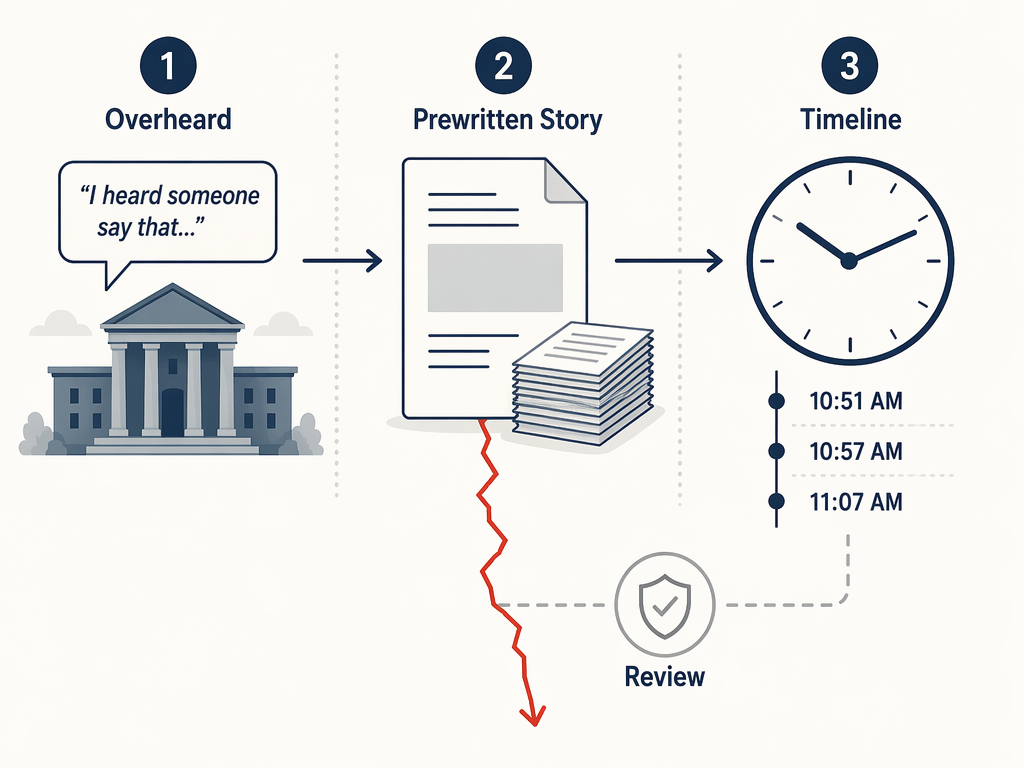
That is the procedural point legal readers should sit with. Verification systems are supposed to preserve the source label: heard directly, confirmed independently, seen in writing, announced officially, inferred from context, overheard from someone outside the decision chain. Once a newsroom treats “announcement” as the operative category, the rest of the machinery can begin to move as though the hardest work has already been done.
The Prewritten Story Was a Tool, and Then a Risk
Prewritten stories are not scandalous. Around the Supreme Court, they are part of the practical infrastructure of covering a term’s end. Retirement speculation is not idle gossip for many legal readers; it affects confirmation timelines, litigation strategy, client questions, advocacy calendars, and the political branches. Newsrooms prepare background, biography, doctrinal summaries, and likely consequence sections because when a real announcement comes, readers need more than a sentence.
But a prewritten retirement story changes the failure mode. It means the newsroom does not need to build a report from zero after the triggering fact is verified. The article already has weight, polish, and velocity. If the trigger is wrong, the prepared material can make the wrongness look more authoritative than a raw bulletin ever would.
That appears to be what made the Alito episode so jarring. The article’s length did not prove reporting depth on the live fact that mattered most. It proved that NPR had a retirement framework ready to receive that fact. For an ordinary reader, those two things are easy to confuse. For a newsroom, they must remain separate.
A prepared obituary, retirement analysis, or end-of-term explainer can be responsibly maintained for years. The control point is the activation step. Before publication, the newsroom has to ask a narrow question: what exactly happened today that permits this prepared article to leave draft status? In this case, the triggering event was not strong enough to carry the article that followed.
Reputation Became Part of the Verification Path
No serious account of this incident can ignore Totenberg’s standing. She is not interchangeable with a new assignment reporter handed the Court for a day. NPR Executive Editor Krishnadev Calamur told the public editor, “She’s the preeminent Supreme Court reporter in the courtroom,” and explained the newsroom’s reaction this way: “when Nina says here’s what happened, we do it.” [1]
That sentence is both understandable and alarming. Understandable, because beat reporting depends on accumulated judgment. Editors rely on reporters who know the room, the people, the rituals, and the meaning of small deviations. A Supreme Court correspondent with decades of experience is not merely transmitting words; she is interpreting an institution that often communicates through timing, silence, and carefully staged formality.
Alarming, because reputation is not a substitute for source classification. A veteran reporter may deserve faster internal response, more confidence in contextual reading, and a presumption that she knows what would be significant. She still does not turn an overheard bystander phrase into an official retirement announcement by force of résumé.
The difficult lesson is that institutional trust is productive until it becomes invisible. The same trust that lets a newsroom move quickly on a landmark scoop can also cause editors to skip the ordinary friction that would have exposed a weak link: Who said it? In what capacity? Did we hear it ourselves? Is there an official statement? Has anyone else confirmed it? What exactly are we claiming?
The Backstop Did Not Stop This One
NPR’s public editor reported that the newsroom had added an editorial backstop layer in 2024. In this episode, that layer did not catch the false Alito report because the story was treated as based on an “announcement” rather than a confidential source requiring that added review. [1]
That is the kind of process failure that should interest lawyers more than the public spectacle of apology. A safeguard designed around one risk category can miss a story if the story is placed in the wrong category. If a report is labeled as an announcement, it may travel through a different lane than a report attributed to a confidential source. The label becomes a gate key.
This is not unique to journalism. Legal organizations make the same mistake when a document marked “final” receives less scrutiny than a draft, when a client’s business-side characterization becomes the legal premise, or when an internal subject-line label quietly determines the review path. A process can exist on paper and still fail if the intake classification is wrong.
The Alito report therefore cannot be reduced to one person mishearing one phrase. The phrase mattered. The interpretation mattered. But the institutional passage mattered too: a prepared story, a trusted correspondent, a category assignment, publication authority, retraction, correction, and distributed cleanup.
What Legal Readers Should Change
The wrong lesson is to stop trusting NPR, Totenberg, or mainstream Supreme Court reporting wholesale. That reaction is emotionally satisfying and professionally useless. Legal work still depends on institutions that maintain beats, editors, archives, corrections, and accountability. The better lesson is to make trust tiered and time-sensitive.
A breaking Supreme Court alert should not carry the same operational status at minute three that it carries after the source basis is visible, other reporting aligns, and the Court or a named actor has supplied confirmation. The earliest version may be worth watching, but not yet worth building client advice around unless the underlying authority is clear.
- Treat “reported,” “announced,” “expected,” “confirmed,” and “according to sources” as different legal-news states, not stylistic variants.
- Before forwarding a breaking retirement or merits-development alert, look for the source basis: Court order, public statement, named official, reporter observation, confidential source, or secondary pickup.
- Separate the outlet’s general reliability from the specific claim’s verification path.
- Assume prewritten explainers can make a newly triggered report look more settled than the triggering fact actually is.
- Track correction behavior as part of trust, but do not let fast correction erase the need to understand how publication happened.
For legal teams, this can be operationalized without theatrical distrust. A first internal note can say, “NPR is reporting X; source basis not yet clear.” A second note can follow when the Court, the justice, another major outlet, or the original story supplies firmer sourcing. Client-facing advice can wait for the second note unless the report itself contains the necessary authority.
That distinction protects both speed and accuracy. It lets lawyers monitor real developments without laundering provisional reporting into settled fact. It also respects what good journalism does when it works: move quickly, disclose clearly, correct publicly, and preserve enough of a record for readers to judge the path.
Trust, With Time Stamps
The Alito retirement error matters because it exposed a trust architecture that legal professionals use every day without always naming it. Reporters trust ears and experience. Editors trust beat reporters. Newsrooms trust story templates and publication lanes. Readers trust institutional brands. Member stations trust central feeds. Each layer can be reasonable. Together, under deadline pressure, they can also transmit a mistaken premise with impressive efficiency.
Totenberg’s apology belongs in the record, and so does NPR’s quick retraction. But neither fully answers the professional question. The useful standard is narrower: in breaking Supreme Court coverage, trust should mature over time. At first publication, ask what the outlet says happened and how it knows. After correction or confirmation, ask what the institution reveals about its own path. Only then decide how much weight the report should bear.
References
- NPR retracts story about Alito retirement, NPR Public Editor, June 30, 2026.
- NPR retracts article that mistakenly reported Justice Alito's retirement, AP News.
- 'I am so, so sorry': NPR reporter explains SCOTUS retirement error, CNN.
Comments
Join the discussion with an anonymous comment.