
The hard compliance question in dismantling a nuclear aircraft carrier is not whether a defueled carrier is still impressive, complicated, or expensive. It is more basic: when a private yard cuts into a naval reactor compartment, packages low-level radioactive material, trains workers, writes procedures, and ships waste into civilian disposal infrastructure, whose radiological safety authority is final?
The apparent answer is the Navy’s Naval Nuclear Propulsion Program, usually called Naval Reactors. Executive Order 12344 and its codification assign Naval Reactors unusually broad responsibility for naval nuclear propulsion, including design, operation, maintenance, and disposal. The program’s own public materials describe a cradle-to-grave structure for naval nuclear propulsion work, with responsibility extending through disposal of reactor plants and related radioactive material.[1]
That answer becomes less complete once the work leaves the traditional naval shipyard model. The former USS Enterprise is not merely being handled inside a closed Navy ecosystem. The selected disposal approach routes a decommissioned, defueled nuclear-powered aircraft carrier toward commercial dismantlement, with low-level radioactive waste ultimately moving to a licensed disposal facility. That is where a statutory phrase such as “total responsibility” stops being a slogan and starts becoming an allocation problem.
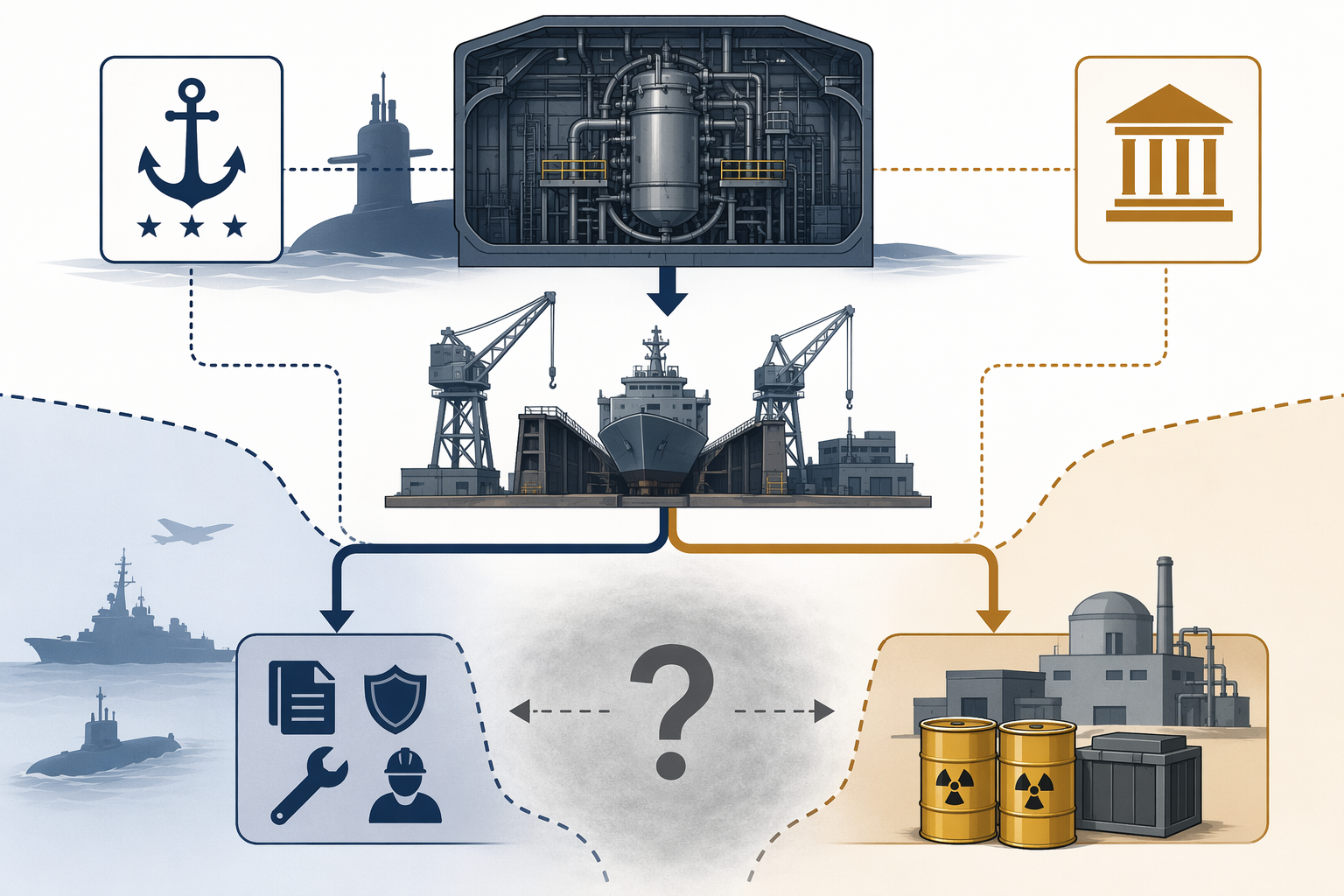
The Statutory Answer Starts With Naval Reactors
Naval Reactors is not just another Navy office with subject-matter expertise. Its legal position is unusually strong because the naval nuclear propulsion system was built around centralized federal control. The program’s public account emphasizes that one organization is responsible for the full life cycle of naval nuclear propulsion, from research and design through operation, maintenance, and disposal.[1]
For ordinary administrative-law purposes, that matters. A contractor does not satisfy a regulator by admiring institutional competence. It satisfies a regulator by following written requirements, maintaining records, training personnel, and being able to explain why a particular inspector, licensing condition, manual, or order applies. If Naval Reactors has final authority, the contractor’s procedures should point there. If the NRC or a state-regulated radioactive-waste system has authority over part of the operation, the contractor needs to know where that part begins.
The Navy’s claim, then, should not be dismissed as casual turf protection. The statutory architecture was designed precisely to avoid fragmented control over naval reactors. But it was not written with the modern Enterprise disposal model at its center: a commercial shipyard dismantling a defueled nuclear-powered aircraft carrier, removing and packaging material, and sending low-level radioactive waste into a civilian disposal stream.
The Commercial Model Changes the Compliance Posture
The Department of Energy and Navy environmental review for the ex-Enterprise considered disposal alternatives and selected a commercial dismantlement approach in the final environmental impact statement. Under that approach, the eight defueled reactor plants associated with ex-Enterprise are addressed through a commercial process rather than the historical method of removing reactor compartments and sending them to a federal disposal path.[2]
That choice makes the jurisdictional issue practical. A private yard must translate government responsibility into shop-floor controls. Someone has to decide what radiological work package governs a task, which qualifications workers need, what survey records are sufficient, who approves packaging, how deviations are reported, and which agency can take enforcement-relevant action if the process fails.
The EIS does not eliminate the problem by calling the material “defueled.” Defueling removes the nuclear fuel from the propulsion plants; it does not turn reactor compartments, contaminated systems, activated materials, or low-level radioactive waste into ordinary scrap. The legal question follows the remaining radiological material through the dismantlement process, not the spent fuel alone.
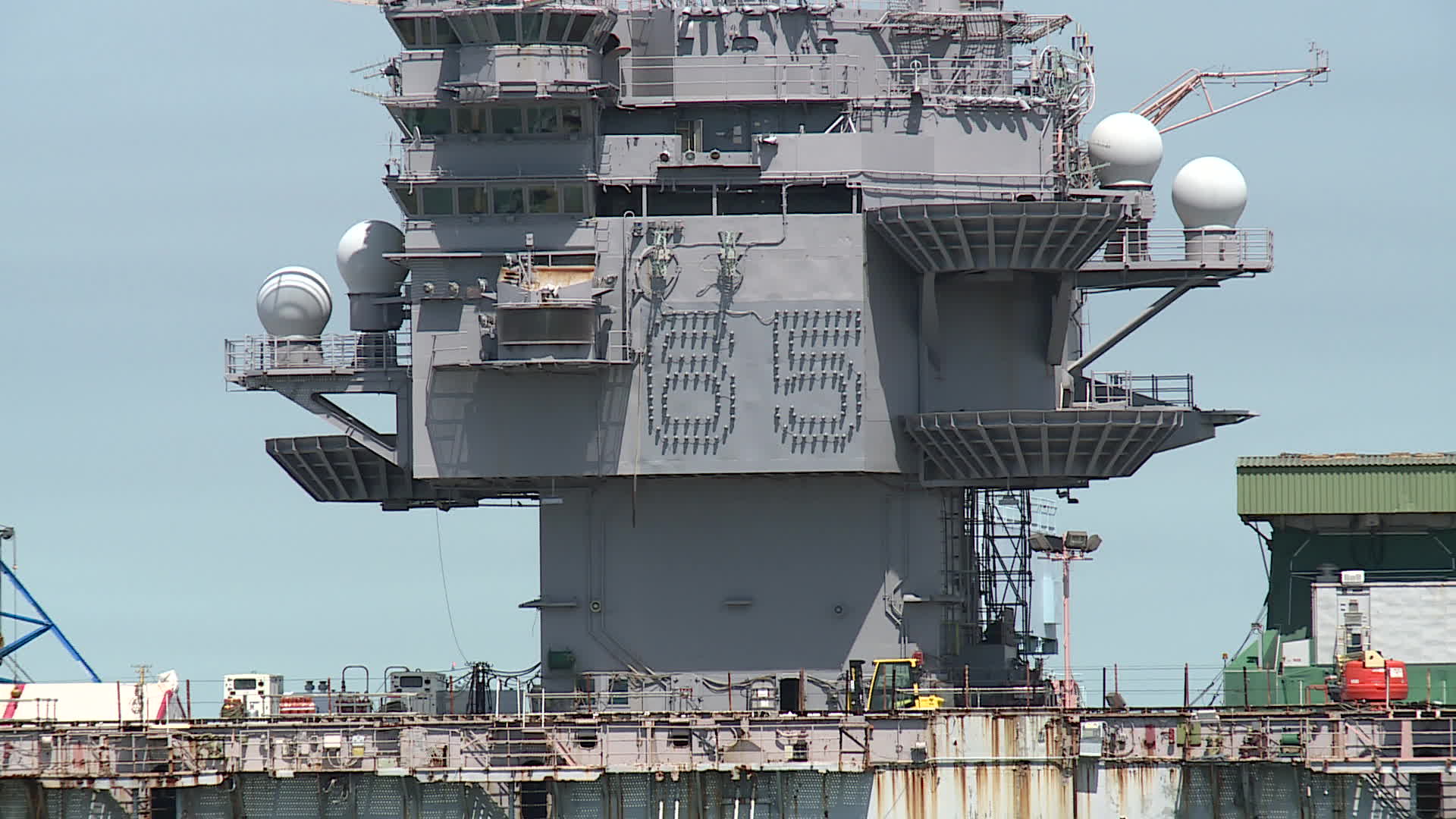
The disposal path also introduces a civilian interface. The available record identifies Waste Control Specialists in Andrews, Texas, as the destination for low-level radioactive waste from the reactor compartments. That kind of disposal facility exists in a regulatory world compatible with NRC and state radioactive-materials licensing, even if the Navy maintains that reactor-plant dismantlement remains within Naval Reactors’ authority.[2]
This is the point at which many public descriptions become too smooth. “Coordination” is not the same thing as a published boundary. A contractor can coordinate with multiple federal and state actors for years and still lack a public answer to a narrower question: whose radiological safety determination controls when Naval Reactors’ cradle-to-grave responsibility meets NRC-compatible licensed disposal?
The 2018 Navy-NRC Dispute Was Not Merely Academic
The most direct public sign that the line was contested came in 2018. USNI News reported that the Navy and civilian nuclear regulators were in a fight over who would monitor Enterprise dismantlement, framing the issue as a dispute between the Navy and the NRC over radiological oversight of the commercial disposal work.[3]
That source must be handled carefully. The full article is not fully accessible from the available record, so its detailed account of the dispute cannot be treated as if every underlying document is in hand. But the reported existence of the dispute is consistent with later Navy language that softened the issue into a plan to use NRC “requirements and advice,” rather than a public statement that the NRC had conceded jurisdiction or that the Navy had accepted NRC licensing control over the dismantlement work.[3]
That distinction matters. “Requirements and advice” is an odd phrase in a regulatory setting. Requirements bind because some authority makes them binding. Advice informs because the recipient chooses to accept it, or because accepting it helps satisfy another binding obligation. If the Navy uses NRC requirements as a matter of program design, that may be prudent. It is not the same as a published instrument saying the NRC has final radiological safety authority over commercial dismantlement of naval reactor components.
Nor does the available public record show the reverse in a clean way. It supports the conclusion that Naval Reactors has core authority over naval nuclear propulsion and disposal. It does not appear to contain a later statute, regulation, memorandum of understanding, license condition, order, or Federal Register notice that publicly maps the boundary between Naval Reactors and NRC authority for commercial dismantlement of a defueled nuclear-powered aircraft carrier.
That absence is not proof that no internal understanding exists. Federal agencies often operate under classified, controlled, or unpublished arrangements in sensitive programs. But a compliance officer at a private yard cannot cite institutional confidence in the same way counsel cites a statute, a regulation, a contract clause, or an inspection protocol. The public record matters because private actors are being asked to act inside it.
GAO Recommended a Path, Not a Jurisdictional Settlement
The Government Accountability Office’s 2018 report is important, but it should not be asked to do work it did not do. GAO analyzed disposal options for decommissioned nuclear-powered aircraft carriers and recommended that the Navy reevaluate alternatives, including a commercial approach. It addressed cost, schedule, technical, and disposal considerations; it did not resolve the legal boundary between Naval Reactors and the NRC for radiological safety oversight in a commercial shipyard.[4]
| Public material | What it helps establish | What it does not establish |
|---|---|---|
| Executive Order 12344 / 50 U.S.C. framework as reflected in Naval Reactors materials | Naval Reactors has broad cradle-to-grave responsibility for naval nuclear propulsion, including disposal. | A public boundary for NRC authority when a private yard dismantles naval reactor components. |
| DOE/EIS-0524 commercial dismantlement alternative | The Enterprise disposal path uses a commercial model and creates a waste stream moving into civilian disposal infrastructure. | A formal jurisdictional settlement between Naval Reactors and the NRC. |
| 2018 USNI reporting | The Navy-NRC oversight issue was reportedly an active dispute, not a law-review hypothetical. | A fully accessible public record of the agencies’ final legal positions. |
| GAO-18-523 | GAO evaluated disposal alternatives and helped support reconsideration of the commercial path. | Final radiological safety authority for commercial naval reactor dismantlement. |
This is a recurring problem in reading federal project documents. A recommendation to use a particular disposal model can be mistaken for a legal conclusion that all regulatory consequences of that model have been settled. The GAO report supports the proposition that commercial disposal became a serious and analyzable option. It does not answer which regulator signs the final radiological safety line when the Navy’s statutory program and civilian radioactive-waste controls overlap.
The cost material should be treated with the same restraint. GAO’s commercial estimates were developed in an earlier fiscal context, while later contract figures appear in a different budget and procurement environment. The available record notes a $554 million to $696 million commercial estimate in FY2019 terms and a later $418.5 million award figure in FY2026 reporting, but those numbers should not be compared as if they were normalized, inflation-adjusted measures of the same thing.[4]
Contractor Language Shows the Dual Exposure
The commercial teams’ own public language is revealing because contractors tend to describe the obligations they expect to live under. CVN Dismantlement Partners, the Holtec/APTIM team that competed for the Enterprise work, states publicly that its nuclear dismantling activities are conducted “in compliance with NRC and state regulations.”[5]
That sentence does not prove the NRC regulates every phase of naval reactor dismantlement. A contractor marketing page is not a jurisdictional instrument. But it does show that sophisticated private participants understand their work as touching NRC and state regulatory regimes, at least at the waste-management and disposal interface. That perception is unsurprising if low-level radioactive material must be packaged and shipped to a licensed disposal facility.
The practical exposure is not symmetrical. Naval Reactors may control the reactor-plant work. NRC-compatible disposal requirements may control the receiving facility and waste acceptance conditions. State regulatory requirements may attach to disposal operations. Transportation rules may govern shipment. The contractor in the middle is the entity that has to integrate these commands into a procedure that an employee can actually follow.
For counsel, the difficult question is not whether the contractor can comply with several sets of standards at once. Often it can. The question is what happens when those standards are not perfectly aligned, when an inspection finding turns on a disputed assumption, or when a procedure approved under one authority is later criticized under another. A well-run project can reduce those risks. It cannot erase the value of a public allocation of authority.
Recent Contract Developments Do Not Cure the Boundary Problem
The Enterprise disposal path has continued to move through procurement and litigation rather than through a published jurisdictional settlement. Forbes reported in July 2026 on continuing taxpayer costs associated with the retired Enterprise and the current dismantlement posture.[6] AL.com reported in April 2026 on a computer-related procurement issue that stalled Navy plans involving dismantlement in Mobile and discussed the Court of Federal Claims dispute over the award process.[7]
Those developments explain delay and contestation in the contract path. They do not establish that the Navy and NRC have issued a public instrument resolving final radiological safety authority. A procurement dispute may decide whether the government evaluated bids properly. It does not, without more, decide which regulator controls a low-level radioactive waste interface created by commercial naval reactor dismantlement.
The Navy has also institutionalized the carrier-disposal problem. In 2023, Breaking Defense reported the creation of PMS 368, a Navy program office focused on dismantling nuclear-powered aircraft carriers, and quoted Navy leadership describing a century-long workload ahead.[8] That development confirms the issue is not confined to a single hull. Enterprise is the first large test of a disposal pipeline that will have to function for future nuclear-powered carriers.
Program offices are useful. They create accountability, staffing, and managerial focus. But they are not jurisdictional maps. A dedicated Navy office may make the commercial dismantlement process more orderly; it does not by itself tell a private compliance manager when Naval Reactors’ authority ends, when NRC or state authority begins, and which determination controls if the two systems point in different directions.
Where the Boundary Appears to Sit
On the present public record, the most defensible description is a hybrid zone rather than a clean handoff. Naval Reactors appears to retain core authority over naval reactor plants and naval nuclear propulsion components, including disposal responsibilities assigned through the Executive Order 12344 framework and codified statutory structure.[1] The commercial disposal model, however, necessarily pushes low-level radioactive waste into civilian disposal infrastructure addressed in the Enterprise EIS and compatible with NRC and state-regulated systems.[2]
That does not mean two agencies are jointly regulating every cut, lift, survey, container, and shipment. It means the public materials do not draw a line with the specificity that commercial execution requires. The closer the work is to naval reactor components as such, the stronger the Navy’s authority appears. The closer the work moves toward waste acceptance, licensed disposal, and state-regulated radioactive-material systems, the less avoidable the civilian regulatory interface becomes.
A useful compliance map would answer at least five questions. Which written Naval Reactors requirements bind the yard? Which NRC or state requirements bind the yard directly, rather than through contract incorporation or waste acceptance criteria? Who inspects which activities? Who has enforcement authority for radiological safety failures before the waste reaches the disposal facility? And if the agencies disagree, whose determination controls?
The public record answers some of those questions in general terms and leaves others implied. It gives Naval Reactors a powerful statutory position. It shows a commercial dismantlement model. It shows reported agency friction in 2018. It shows contractors publicly acknowledging NRC and state compliance. It shows a Navy program office preparing for decades of work. It does not show a formal, published boundary assigning final radiological safety authority across the whole commercial naval reactor dismantlement process.
The Compliance Consequence
This is not an argument that Enterprise dismantlement is unsafe. The available materials do not support that conclusion, and a serious legal analysis should not imply it. The issue is administrative: a century-long carrier disposal pipeline is being built around a regulatory interface that remains less explicit than the contractors, waste handlers, and compliance officers working inside it should reasonably expect.
For nuclear aircraft carrier dismantling regulatory compliance, the working answer is therefore narrow. Naval Reactors appears to hold the core legal authority over naval reactor components and naval nuclear propulsion disposal. NRC and state-regulated systems become unavoidable at the low-level radioactive waste disposal interface. What is missing from the public record is a formal boundary that states, in operational terms, who has final radiological safety authority when commercial contractors perform the dismantlement work between those two systems.
References
- Green Book 2019 Edition, U.S. Department of Energy, 2019.
- Disposal of Decommissioned, Defueled Ex-Enterprise (CVN 65) and its Associated Naval Reactor Plants, U.S. Department of Energy.
- Navy Civilian Nuclear Regulators in Fight Over Who Monitors Enterprise Dismantling, USNI News, August 15, 2018.
- Nuclear Waste: Navy Should Reevaluate Alternative Disposal Options for Its Decommissioned Nuclear-Powered Aircraft Carriers, U.S. Government Accountability Office, 2018.
- CVN Dismantlement Partners, Holtec International.
- Retired Aircraft Carrier Is Still Costing American Taxpayers Millions, Forbes, July 16, 2026.
- ‘Just spinning’: How a computer glitch stalled Navy plans to dismantle a nuclear carrier in Mobile, AL.com, April 2026.
- New Navy office to dismantle nuclear carriers has a century of work ahead: Admiral, Breaking Defense, November 2023.
Comments
Join the discussion with an anonymous comment.