
The July 18, 2026, 1000 Islands Charity Poker Run produced the kind of fact pattern that makes a boating-law story travel quickly: a 50-foot turbine-powered Mystic catamaran lettered “XINSURANCE,” a reported 157 mph in a 30 mph zone near the Thousand Islands Bridge, a Florida operator, and an arrest on the St. Lawrence River. But the legally important word in the charge is not “speeding.” WWNY reported that operator J.J. Turk of Cocoa Beach, Florida, was charged under New York Navigation Law §45(1)(a), the reckless-operation prong, and also received five additional equipment-related citations.[1]
That classification matters. Under New York Navigation Law §45, reckless vessel operation and imprudent speed sit in neighboring statutory provisions, but they do not carry the same legal weight. One is treated as a misdemeanor. The other is a non-criminal violation. A reader looking for “1000 islands poker run speeding violation boating law” will miss the practical point if the incident is flattened into a generic speeding arrest.
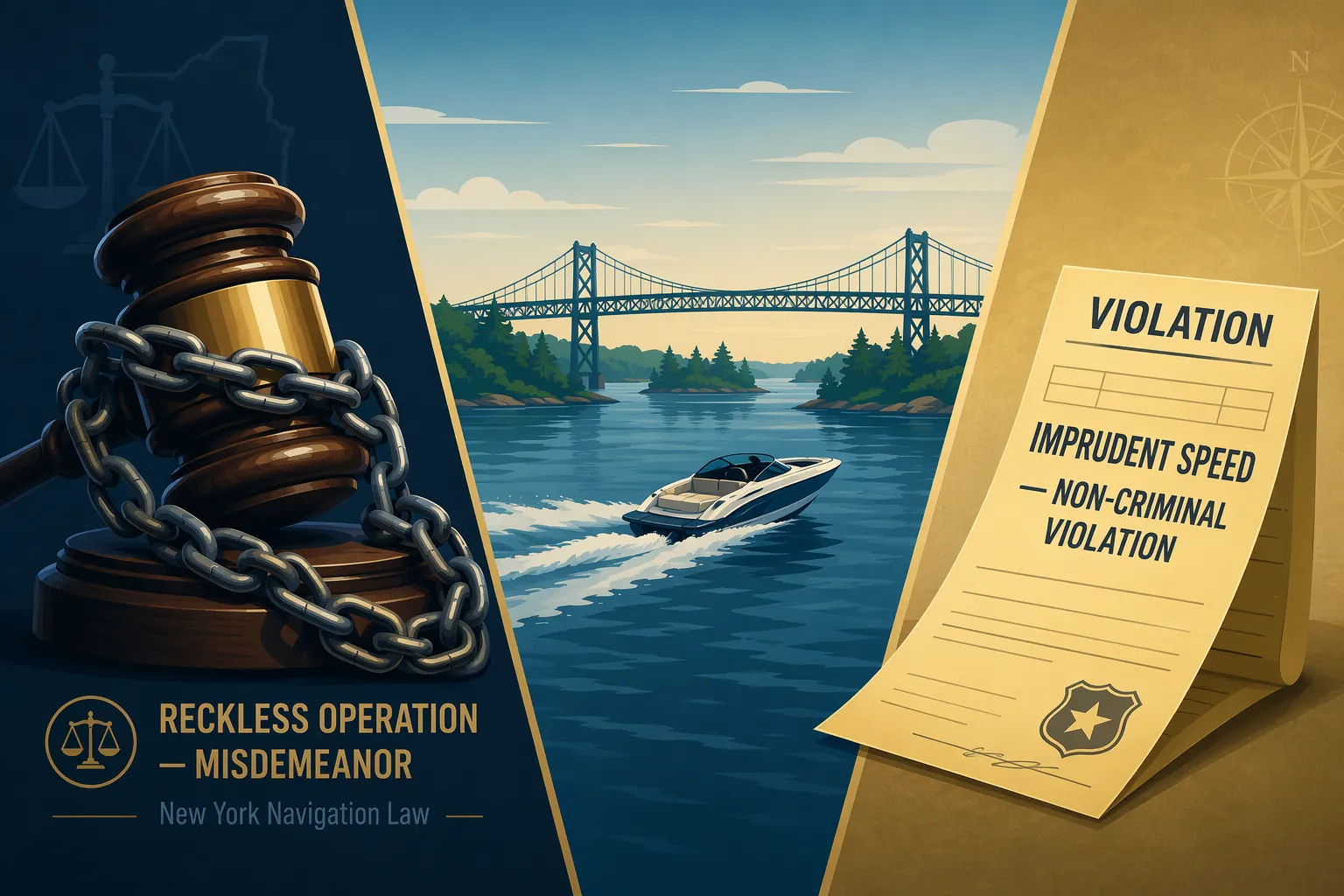
The statutory split inside Navigation Law §45
Section 45 does not simply say that a boat may not go too fast. It separates dangerous operation from imprudent speed. Subdivision (1)(a) prohibits operating a vessel “recklessly or at a rate of speed greater than will permit him to bring the vessel to a stop within the assured clear distance ahead.” Subdivision (1)(b) separately prohibits operating a vessel “at a speed greater than is reasonable and prudent under the conditions and having regard to the actual and potential hazards then existing.”[2]
Those provisions overlap in ordinary speech. In court administration, they do not. The reckless-operation prong reaches conduct framed as dangerous vessel operation. The imprudent-speed prong reaches speed that is unreasonable for the conditions, even where the state does not charge the operator with the misdemeanor version.
| Navigation Law §45 prong | Conduct described | Classification described in the source materials | Why it matters |
|---|---|---|---|
| §45(1)(a) | Reckless vessel operation, including operation at a rate of speed that prevents stopping within the assured clear distance ahead | Misdemeanor, punishable under §73-B | Creates criminal exposure and more serious downstream privilege consequences |
| §45(1)(b) | Speed greater than is reasonable and prudent under existing actual and potential hazards | Non-criminal violation, punishable under §73-C | Still enforceable, but not the same charge classification as reckless operation |
The distinction is not academic. The 1000 Islands arrest was reported as a §45(1)(a) charge, not merely an imprudent-speed citation.[1] That means the charging decision placed the incident on the misdemeanor side of the statute’s structure.
Why “speeding” is an incomplete label
A highway-style instinct can mislead here. A reader sees “157 mph in a 30 mph zone” and expects the legal category to be speed. On the water, §45 asks a more operational question: whether the vessel was run recklessly, whether it could be stopped within the assured clear distance ahead, whether the speed was reasonable and prudent for existing hazards, and which statutory prong the officer and prosecutor use.
The reported speed still matters. It is the fact that gives the charge its practical force. But speed is evidence inside a statutory framework, not the whole framework. A vessel could be cited for imprudent speed under §45(1)(b), or the same general conduct could be charged as reckless operation under §45(1)(a), depending on the alleged operation and available proof.
That is also why the five additional equipment-related citations should not be treated as decorative detail. They show how a single river stop can produce parallel enforcement tracks: an operation charge under §45 and separate compliance citations tied to vessel equipment.[1]
Penalty hooks: §73-B versus §73-C
The next sorting problem is the penalty statute. The available sources identify reckless operation under §45(1)(a) as punishable under Navigation Law §73-B, with a fine range of $250 to $500, imprisonment, or both. They identify imprudent speed under §45(1)(b) as punishable under §73-C as a non-criminal violation. The penalty range should be read with caution unless confirmed against the current official New York Navigation Law, because the available amount comes from a secondary statutory snippet rather than the official Senate publication.
Even with that verification caveat, the legal architecture is clear enough to analyze: §45 divides conduct first, and the penalty sections then attach different consequences to that classification. A misdemeanor charge brings criminal procedure, criminal-record concerns, and the prospect of jail exposure. A non-criminal violation remains meaningful, but it does not carry the same procedural or reputational freight.
For compliance professionals, the key point is that “charged after going too fast” and “charged with a speeding violation” are not interchangeable descriptions. The first may be true as a factual shorthand. The second may be wrong as a legal classification if the actual charge is §45(1)(a).
The poker run context helps, but it does not control the statute
The event context is not irrelevant. Speed on the Water reported that the 2026 1000 Islands Charity Poker Run drew 110 boats and nearly 140 sponsors, and that the event raised $437,300 for Make-A-Wish in 2025. The same report also said the organizer confirmed a lifetime ban for the team involved in the incident.[3]
Those facts explain why the arrest occurred inside a highly organized public boating event rather than in an ordinary weekend patrol stop. They do not change the statutory question. Charity status does not soften the text of §45. A poker-run format does not automatically make a high-speed pass legally privileged.
The event’s own safety plan reinforces the point. The published plan described layered safety protocols, including a mandatory drivers’ meeting.[4] The available accounts diverge on exactly what happened with that meeting: WWNY reported that a team member attended but was not aboard the boat, while Speed on the Water reported that the duo missed it entirely.[1][3] That discrepancy should be resolved before anyone relies on it for fault allocation. For statutory classification, however, the narrower point is enough: the event had formal safety procedures, and the reported enforcement action was not occurring in a rules-free setting.
The regatta or race exception is narrower than it sounds
Section 45 contains an exception for certain vessels competing in or practicing for a regatta or race over a specified course when the event has been authorized under Navigation Law §34.[2] That exception deserves attention because it is the first place a reader may look after seeing a poker-run arrest. It is also easy to overread.
The available sources do not support treating a charity poker run as automatically covered by the exception. The event materials characterize the run as a charity poker run with safety protocols, not as an authorized race under §34.[4] Speed on the Water’s event account likewise supplies charity-event context, not a statutory authorization record for a regatta or race.[3]
That distinction matters because the exception is not a general cultural pass for performance boating. It is tied to an authorized competitive event over a specified course. Unless the required authorization exists and the operator’s conduct falls within the exception’s terms, the ordinary §45 analysis remains in place.
Privilege suspension is where the misdemeanor classification becomes practical
The most practical consequence may not be the headline charge or even the fine. Navigation Law §45(7) authorizes a court to suspend a person’s privilege to operate a vessel in New York for three to twelve months after a first conviction under §45. For repeat offenses within eighteen months, the statute provides mandatory minimum suspension periods, including at least six months for a second offense within that window.[2]
That suspension regime changes the stakes for anyone who operates boats professionally, participates in organized events, or brings high-performance vessels into New York waters. The consequence is not limited to paying a citation and leaving the dock. A conviction can affect whether the operator may lawfully operate a vessel in the state during the suspension period.
For an out-of-state operator, the issue becomes more awkward, not less. WWNY identified Turk as a Florida resident.[1] New York cannot turn a Florida resident into a New York resident by charging him, but it can adjudicate alleged conduct on New York waters and impose consequences on New York vessel-operating privileges if the statute and court process support them. Any separate effect on another state’s licensing or boating records would require jurisdiction-specific analysis and should not be assumed from the New York charge alone.
What a court or clerk has to sort
After the patrol report and the news story, the remaining work is administrative and legal. The court has to process the misdemeanor charge separately from the equipment citations. The parties have to distinguish the charged statutory prong from the looser description of “speeding.” The clerk’s office has to record any conviction in a way that permits the correct penalty and suspension provisions to be applied.
- Confirm the exact charged subdivision, because §45(1)(a) and §45(1)(b) do different work.
- Separate the operation charge from equipment citations, even when all arise from the same stop.
- Check whether the charged offense is a misdemeanor or a non-criminal violation before describing penalty exposure.
- Review §45(7) for vessel-operating privilege consequences after conviction.
- Treat any regatta or race exception as a statutory authorization question, not an assumption based on event branding.
Those are not glamorous distinctions, but they are the distinctions that determine legal consequence. A 157 mph allegation explains public attention. The subdivision number explains the case.
A narrow reading is the safer reading
The available sources support a specific conclusion, not a broad one. They support that this reported 1000 Islands incident involved a §45(1)(a) reckless-operation charge, five additional equipment-related citations, a charity poker-run setting, a formal safety plan, and a possible privilege-suspension framework if conviction follows.[1][2][3][4] They do not support a claim that similar high-speed boating incidents are common, that all poker runs create the same enforcement profile, or that the regatta exception could never apply to any organized boating event.
For legal and compliance purposes, that narrower conclusion is enough. New York Navigation Law §45 treats reckless vessel operation and imprudent speed as different enforcement categories. In the 1000 Islands Poker Run speeding arrest, the reported charge landed on the misdemeanor side of that divide. That is why the matter is not just a fast-boat story; it is a charge-classification story with potential consequences for court handling, penalty exposure, and vessel-operating privileges.
References
- Boat clocked going 157 mph on St. Lawrence River during poker run; boater arrested, WWNY, July 21, 2026.
- New York Navigation Law §45, ypdcrime.com.
- Clouds With Silver Linings At The 1000 Islands Charity Poker Run, Speed on the Water.
- Safety Plan, 1000 Islands Charity Poker Run.
Comments
Join the discussion with an anonymous comment.