
The legal issues in the Obama Center contractor disputes are easiest to misread if they are treated as one unpaid-contractor story. They are not one case. The current record points to at least four overlapping fronts: a pending federal race-discrimination suit by II in One and Concrete Collective against Thornton Tomasetti, mechanic’s liens tied to unpaid or disputed balances, two subcontractor Chapter 11 bankruptcies, and a contested claim about whether the project’s endowment backstop fell short of a lease-related funding expectation.
Those fronts do not all assert the same legal theory, do not all name the same parties, and do not all seek the same remedy. What connects them is the project’s contracting architecture: the Obama Foundation at the owner level, Lakeside Alliance as construction manager, and roughly 475 subcontractors below that tier. FactCheck.org reported that the Foundation says it has no direct contracts with the subcontractors and no outstanding disputed charges with Lakeside Alliance; construction attorney Stan Martin, described as having more than 40 years of practice, told FactCheck.org that this is ordinary for major projects because the owner typically contracts with the general contractor, not with each subcontractor.[1]
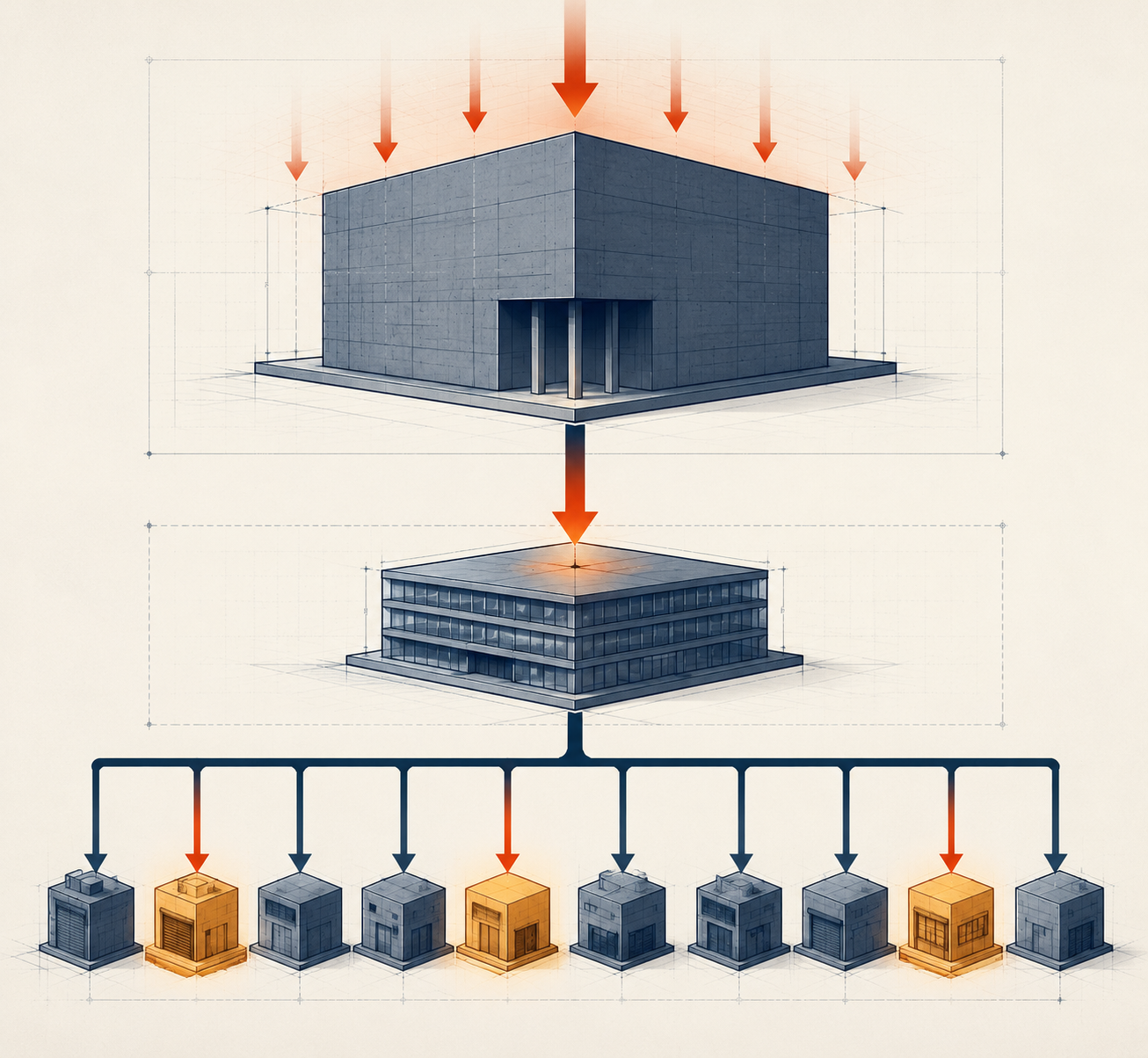
That point matters before any moral judgment is made. A no-direct-contract position can be legally routine and still leave subcontractors carrying the most immediate cash-flow damage when schedule, change-order, quality, or payment disputes move down the chain. The legal question is not simply whether someone was unpaid. It is who promised what to whom, which forum can hear the claim, and whether the disputed loss belongs in a contract claim, lien proceeding, bankruptcy case, or civil-rights lawsuit.
Four Disputes, Not One
| Legal front | Main parties or actors | Core theory or issue | Procedural posture |
|---|---|---|---|
| Federal discrimination suit | II in One / Concrete Collective v. Thornton Tomasetti | Alleged race discrimination under federal law, including a § 1981 theory tied to statements about performance and competence | Filed in January 2025 in the Northern District of Illinois; motion to dismiss pending |
| Mechanic’s liens | Subcontractors asserting unpaid or disputed balances | Lien rights under Illinois law, with the important limit that the project sits on a public-benefit leasehold | Liens reported in Cook County records, with amounts generally described in the tens or hundreds of thousands |
| Chapter 11 bankruptcies | Vision Painting & Decorating Services; Glass Management Services | Reorganization filings connected by the companies or their lawyers to project delays, defects, or downstream payment distress | Bankruptcy proceedings, including requests for information in at least one case |
| Endowment dispute | Obama Foundation, public commentators, and lease-related critics | Whether a claimed $470 million endowment target was required or functioned as a financial backstop | Contested public and contractual issue, not a subcontractor payment claim in the same posture as liens or lawsuits |
A table can make the dispute map look cleaner than the underlying record is. Some claims arise from work already performed. Some arise from alleged defective work. Some sit in public statements rather than pleadings. Some are advocacy-side estimates. And some facts cut against the broadest version of the story: Snopes and FactCheck.org both emphasized that most of the roughly 475 subcontractors have not publicly escalated disputes, and Snopes reported that at least one subcontractor, Air Design Systems, said it had no problems on the project.[1][2]
The Contract Chain Explains Why the Foundation Is Not the Defendant in Every Claim
The Foundation’s legal posture is straightforward: it says it has no direct legal agreements with subcontractors and no outstanding disputed charges with Lakeside Alliance.[1] In a conventional construction structure, that is not exotic. The owner’s contract is with the construction manager or general contractor; subcontractors contract with that middle tier or with lower-tier contractors. If payment, delay, or scope fights arise, the subcontractor usually starts with its own counterparty, not with the owner.
That does not end the story. Contract structures are not only paperwork; they are loss-allocation systems. They decide who has a direct invoice route, who has leverage through a lien, who must wait for change-order approval, and who must finance a dispute while payroll, material suppliers, and bonding obligations continue. On a project with public commitments to diverse participation, the structure also decides whether minority-owned subcontractors receive an opportunity with manageable risk or an opportunity paired with working-capital exposure they are less able to absorb.
That distinction is where much of the public commentary gets too loose. It is possible for the Foundation’s owner-liability position to be defensible and for subcontractors to have real unpaid-balance, delay, change-order, or discrimination claims elsewhere in the chain. It is also possible for a subcontractor to experience project-related financial distress without having a winning claim against the owner. The forum and the theory matter.
The $40.8 Million Discrimination Case Is the Sharpest Legal Dispute
The most legally developed dispute is the federal case filed in January 2025 in the Northern District of Illinois by II in One and Concrete Collective against engineering firm Thornton Tomasetti, docketed as No. 1:25-cv-00600.[3] The plaintiffs allege racial discrimination and seek $40.8 million, centering their case on statements they say damaged the Black-owned concrete subcontractor’s position on the project.[3][4]
The core allegation concerns a February 2024 memo that blamed “underperformance and inexperience of the concrete sub-contractor” and asserted that non-minority-owned firms could have performed the work, according to reports describing the complaint.[3][4] The plaintiffs frame that language as more than ordinary criticism of workmanship. Their theory, as reported, is that the memo reflects or advanced racial discrimination in violation of federal law, including a § 1981-style claim involving interference with the right to make and enforce contracts.[3][4]
Thornton Tomasetti has not simply denied racist intent in public. It moved to dismiss in March 2025, arguing that the challenged statements contained “no verifiable falsehood” and that quality concerns were supported by documented problems, including photos of a cracked slab and exposed rebar, according to reports on the filing.[4][5] The Obama Foundation has said it has “no reason to believe Thornton Tomasetti acted with racist intent.”[4]
That defense matters because construction disputes often begin as performance disputes, and performance disputes can become reputationally catastrophic when the criticized contractor is also participating in a diversity-focused procurement program. The plaintiffs’ burden is not merely to show that the memo hurt them or that the project was difficult. The live legal issue is whether the alleged conduct plausibly states a federal race-discrimination claim and whether the statements and surrounding conduct can support liability. The motion to dismiss has not been ruled on, so the record does not support treating either side’s account as established fact.[3][4][5]
Why the February 2024 memo carries so much weight
The memo is important because it sits at the intersection of quality control, project delay, and racialized competence. A statement that a subcontractor underperformed can be routine project documentation. A statement that non-minority-owned firms could have done the work, if pleaded and contextualized as discriminatory treatment, can take the dispute into civil-rights territory. The difference is not semantic; it changes the legal forum, the available theories, and the kind of proof that matters.
That is also why the case should not be folded into every other unpaid-contractor claim. A lien claimant does not need to prove racial bias. A bankrupt subcontractor does not necessarily have a discrimination claim. A contractor negotiating change orders may never file suit. The II in One / Concrete Collective case is narrower and more serious than a generalized complaint about cost overruns because it asks a federal court to evaluate alleged race discrimination, not merely project accounting.
Liens Turn Payment Distress Into Property-Backed Leverage
Mechanic’s liens are a different tool. They are not a finding that the owner committed wrongdoing, and they are not proof that the claimant will recover the full amount. They are a statutory device that can give contractors and subcontractors security for labor or materials supplied to improve property, subject to notice, timing, priority, and enforcement rules. The Illinois Mechanics Lien Act governs those rights in Illinois.[6]
Reports describe Obama Center-related mechanic’s liens filed with the Cook County Clerk’s Office in amounts ranging from about $75,000 to about $400,000.[2] Those numbers are significant to the affected firms, but they are not the same kind of claim as the $40.8 million federal discrimination suit. A lien generally pressures payment or settlement by attaching an interest connected to the improved property; it does not by itself resolve disputed scope, delay responsibility, or defective-work allegations.
The Obama Center property adds a further wrinkle. Snopes and FactCheck.org reported that the site involves a public-benefit leasehold under a 99-year lease, and the lien analysis therefore concerns the leasehold interest rather than the underlying parkland.[1][2] That is not a minor technicality. A lien against a fee-simple private development and a lien against a leasehold tied to public land do not carry the same practical enforcement posture, even when the unpaid subcontractor’s cash-flow problem feels the same.
For lawyers, this is where the payment dispute becomes less headline-friendly and more consequential. The lien claimant is trying to convert a receivable into leverage. The owner or upstream contractor may dispute the balance, the scope, or the claimant’s compliance with lien prerequisites. The public may hear only “unpaid contractor.” The litigation file will ask a narrower set of questions: what work was done, what contract governed it, what notices were served, what interest can be encumbered, and whether the amount is valid under Illinois law.[6][7]
Change Orders Can Keep a Claim Large Without Making It a Lawsuit
Adamson Plumbing illustrates another category: a large unresolved claim that had not, as reported, become a lawsuit. The Real Deal Chicago reported in June 2026 that Adamson had a roughly $4 million claim tied to more than 100 change orders and was still negotiating.[8] That posture is easy to overlook because litigation filings are more visible than unresolved project administration. But on a major construction job, change orders can be where the real financing pressure accumulates.
A change-order dispute is often a dispute about time, sequence, drawings, coordination, field conditions, or added scope. The subcontractor may have already supplied labor or materials. The upstream party may agree that some change occurred but dispute price, causation, documentation, or responsibility. While that argument continues, the subcontractor is effectively lending money to the project through its balance sheet.
This is one reason the public estimate offered by Omar Shareef of the African American Contractors Association needs careful labeling. Fox News and The Real Deal reported Shareef’s estimate that about 10 subcontractors represented roughly $100 million in total outstanding claims, including the $40.8 million lawsuit, and that many subcontractors were constrained by nondisclosure agreements.[8][9] That is an advocacy-side figure, not an independently adjudicated amount. It may be useful as a signal of perceived distress among a subset of contractors; it should not be treated as a court-confirmed debt.
Bankruptcy Is a Symptom, a Forum, and Sometimes a Discovery Tool
The two reported Chapter 11 cases belong in the same map, but not in the same bucket as liens. Fox News reported that Vision Painting & Decorating Services entered bankruptcy, with attorney Greg Stern saying the bankruptcy was “obviously” due to schedule delays connected to the Obama Center project.[9] That statement is a lawyer’s account of causation, not a judicial finding, but it indicates how at least one subcontractor attributed its distress.
Glass Management Services presents a different bankruptcy-related angle. Fox News reported that Glass Management claimed harm from Concrete Collective’s alleged defective work and sought a Rule 2004 examination into whether Lakeside Alliance knew about defects before hiring GMS.[9] Rule 2004 examinations can be broad investigative tools in bankruptcy, so the request is not the same as winning a merits determination. Still, it shows how alleged defects by one trade can become alleged losses for another trade downstream.
The bankruptcies also show why construction risk is rarely confined to the party whose work is first disputed. If concrete work is delayed or challenged, later trades may wait, resequence, remobilize, or incur idle labor and material costs. If those costs are not paid quickly, a small or mid-sized subcontractor may have fewer financing options than the entities above it. Chapter 11 then becomes both a shield against creditors and a forum for probing what happened upstream.
The DEI Promise Makes the Risk Allocation Harder to Dismiss
The project’s public diversity commitments are not a separate cause of action by themselves, at least on the record described here. But they affect how the disputes should be understood. FactCheck.org reported that the project had goals of roughly 50% diverse subcontracts.[1] When a project deliberately brings minority-owned firms into a high-profile construction program, the legal structure deciding who absorbs delay and payment risk becomes part of the practical outcome of that program.
That does not prove systemic discrimination. It also does not require pretending that a neutral contract chain has neutral effects once claims start moving. A minority-owned subcontractor that must finance disputed work for months, litigate a civil-rights claim, negotiate more than 100 change orders, or use bankruptcy to investigate upstream conduct is not experiencing diversity participation as a press release. It is experiencing it as working-capital risk.
This is the uncomfortable legal point. The same architecture that helps an owner manage a massive project through one construction-manager relationship can push the evidentiary and financing burden downward. The structure may be standard. The result can still be harsh for the smaller firms the program was designed to include.
The Endowment Issue Is Related, but It Is Not a Subcontractor Claim
The contested endowment-fund issue belongs late in the analysis because it is not the same kind of dispute as a lien, a change-order claim, or the II in One / Concrete Collective lawsuit. Fox News reported that only $1 million had been deposited as of 2021 toward what critics described as a $470 million endowment goal, and cited NYU law professor Richard Epstein’s analysis of the endowment as a financial backstop.[10] The Foundation disputes that the lease specified a dollar target.[10]
That contested $470 million figure should therefore not be folded into the unpaid-subcontractor totals. If a lease or public-benefit arrangement required a particular endowment, that would raise governance, lease-compliance, and financial-security questions. It would not automatically prove that any particular subcontractor is owed money, that a lien is valid, or that Thornton Tomasetti discriminated against Concrete Collective.
Still, the issue has relevance because financial backstops matter most when project distress appears elsewhere. A large endowment can reassure public stakeholders that long-term obligations will be met. A disputed or underfunded backstop can sharpen concern that the project’s formal promises and practical protections are not aligned. The current record supports treating the endowment issue as adjacent to the contractor disputes, not as proof of them.
What the Record Supports
The strongest version of the record is not that the Obama Foundation directly failed to pay every complaining subcontractor. The stronger, more precise account is that a standard multi-tier construction structure placed most direct legal and administrative friction below the owner level. When disputes emerged, subcontractors had to pursue different routes: a federal discrimination suit against an engineering firm, statutory liens against a leasehold interest, change-order negotiations, and bankruptcy proceedings.
Counter-evidence also matters. Most of the roughly 475 subcontractors have not publicly escalated claims, and at least one subcontractor reported no problems.[1][2] That prevents a responsible account from declaring the entire project a proven payment failure. It also prevents the opposite mistake: using the majority’s silence to erase the legal significance of the minority of firms now in court, lien records, negotiations, or bankruptcy.
The pending $40.8 million discrimination case remains unresolved. The lien amounts are not judgments. The bankruptcy filings do not by themselves assign fault. The $100 million outstanding-claims estimate is an advocacy-side figure. The $470 million endowment issue is contested. Taken together, however, the materials show a coherent legal pattern: a defensible owner-liability position can coexist with a project structure that concentrates cash-flow and litigation burdens on subcontractors, including minority-owned firms the project publicly aimed to support.
References
- Explaining What We Know About the Obama Presidential Center Contractor Disputes, FactCheck.org, 2026/07
- Claims Obama hasn't paid Black contractors who worked on library are missing key context, Snopes, 2026/06/19
- Obama Presidential Center subcontractor sues over cost overruns, Chicago Tribune, 2025/01/30
- Obama Presidential Center subcontractor sues Thornton Tomasetti for racial discrimination, ArchPaper, 2025/02
- Obama Center subcontractor alleges racial discrimination in lawsuit, Crain's Chicago Business
- Illinois Mechanics Lien Act, ILGA.gov, 770 ILCS 60/
- Illinois Mechanics Lien Guide & FAQs, Levelset
- Unpaid contractors cloud Obama Center's finish line, The Real Deal Chicago, 2026/06/12
- Obama Presidential Center subcontractors claim millions still unpaid, Fox News, 2026/06
- Obama Presidential Center endowment sits at $1M of $470M goal as costs soar, Fox News, 2026
Comments
Join the discussion with an anonymous comment.