
The legal end of the Trump administration’s national-security offshore wind ban arrived without a new merits opinion. On June 10, 2026, the government voluntarily dismissed its appeal from Judge Patti Saris’s December 8, 2025 order vacating the federal wind-energy authorization pause, leaving the district court’s APA ruling in place and ending the administration’s effort to revive the broad moratorium through appellate review.[1]
That exit matters because the case was never only about whether an administration may treat offshore infrastructure as a national-security problem. Courts do not need much instruction on executive discretion in that neighborhood. The problem was more basic: after agencies had issued leases, permits, and project-specific approvals, the government could not make a sweeping reversal hold together as reasoned agency action.

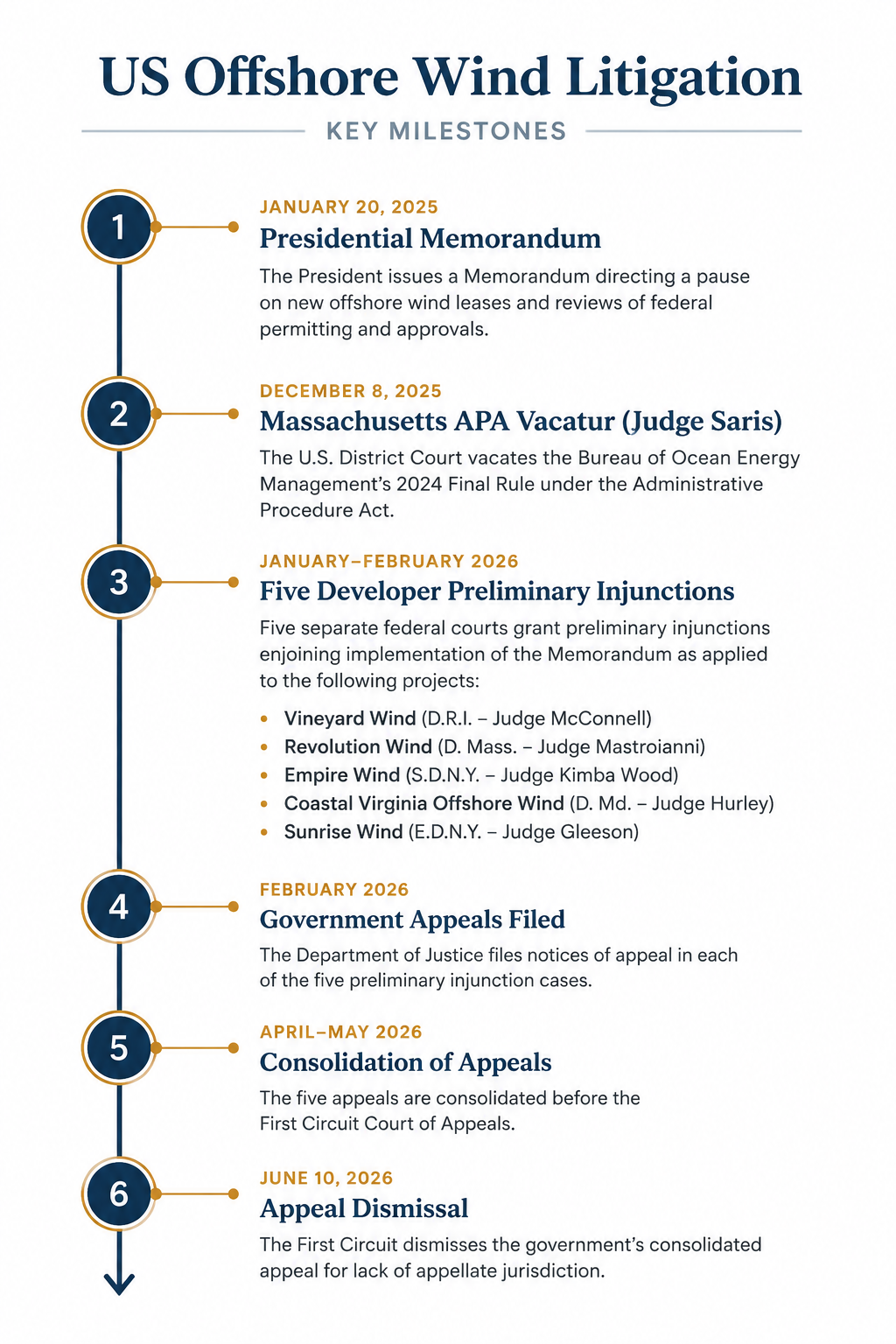
By June, the administration had lost on two levels. The Massachusetts APA case knocked out the systemwide authorization pause. Then, in January and February 2026, five separate developers obtained project-specific preliminary injunctions that tested the same national-security theory against individual records, existing leases, and prior agency findings.[1][2]
The Caveat That Became the Problem
The vulnerability was visible in the January 20, 2025 presidential memorandum itself. The memorandum invoked Section 12(a) of the Outer Continental Shelf Lands Act to withdraw all Outer Continental Shelf areas from wind leasing, but it also included a limiting sentence: the withdrawal “does not affect rights under existing leases.”[3]
That caveat was not decorative. It was the part of the order that tried to separate future leasing discretion from already-conferred property and regulatory interests. For future lease sales, the executive could claim a broad OCSLA withdrawal authority. For projects already holding leases and approvals, the government had to explain what agency action was being taken, under what statute, on what record, and with what treatment of reliance interests.
The later litigation turned that sentence into a recurring point of friction. States and developers did not have to argue that offshore wind approvals were immune from reconsideration. They could instead ask a narrower and more uncomfortable question: if existing lease rights were supposedly untouched, why did the Department of the Interior and related agencies proceed as though existing projects could be frozen in bulk?
The State Case Put the Pause on an APA Record
The first decisive ruling came from the coalition case filed by 17 states and the District of Columbia. The coalition included Arizona, California, Colorado, Connecticut, Delaware, Illinois, Maine, Maryland, Massachusetts, Michigan, Minnesota, New Jersey, New Mexico, New York, Oregon, Rhode Island, Washington, and D.C.[1]
The forum choice did real work. A multi-state APA challenge in Massachusetts kept the focus on agency process rather than on a single turbine array, a single interconnection schedule, or a single developer’s financing problem. The states challenged the federal pause as reviewable agency action, and Judge Saris treated the agencies’ compliance with the presidential directive as something that still required independent reasoning.
On December 8, 2025, Judge Saris vacated the “Wind Order” as arbitrary and capricious under the Administrative Procedure Act, concluding that federal agencies had failed to give a reasoned explanation for halting wind-energy authorizations and had acted on the presidential directive without supplying their own agency analysis.[1][2]
That holding did not require the court to decide that offshore wind is good policy or that national-security concerns are trivial. It required the government to do what agencies ordinarily must do when they change course: identify the decision, explain the basis for it, account for important aspects of the problem, and avoid treating a political instruction as a substitute for administrative reasoning.
For counsel reading the order, the important point was not just vacatur. It was the court’s refusal to let the agencies collapse presidential preference, agency judgment, and statutory authority into one undifferentiated act. The memorandum may have come from the White House, but implementation belonged to agencies with records, prior approvals, statutory duties, and litigable obligations.
The Developer Cases Made the Record Project-Specific
The project suits then did something the state case could not fully do. They forced courts to compare the national-security rationale against individual approval histories. Vineyard Wind, Revolution Wind, Empire Wind, Coastal Virginia Offshore Wind-Commercial, and Sunrise Wind all obtained preliminary injunctions in January and February 2026.[4]
Those injunctions mattered because each developer came to court with more than a policy objection. Each had a project record. That record included lease-backed expectations, prior federal reviews, and agency decisions that had already addressed navigation, environmental, defense, and operational issues to varying degrees. A generalized security assertion had to meet those records where they stood.
| Litigation Track | What the Courts Tested | Why It Mattered |
|---|---|---|
| State APA case | Whether the federal authorization pause had a reasoned agency explanation | It attacked the moratorium as a systemwide agency action. |
| Developer injunction cases | Whether suspensions could be justified against project-specific approvals and lease interests | They made the government defend the ban against concrete records. |
| Lease and due process arguments | Whether agencies could impair existing rights without adequate authority and procedure | They turned the January 20 caveat into a litigation constraint. |
The sharpest example came in Sunrise Wind LLC v. Burgum. The court noted that “purportedly new classified information does not constitute a sufficient explanation” where the agency had previously concluded that the same project posed no risk.[4]
That sentence is easy to overread. The courts were not holding that classified defense information can never justify a changed agency position. Nor were they publishing the underlying defense assessment. The exact text of the classified Department of Defense material was not public; analysis depends on court descriptions after in camera review and on public agency statements. The legal defect was the gap between prior no-risk conclusions and later project suspensions, not the mere existence of secrecy.
Public reporting on the injunctions also emphasized that courts were looking at a history of radar and defense-review mitigation, including prior Defense Department clearinghouse approvals or no-objection conclusions for offshore wind projects.[5] That history made the government’s burden more particular. It had to explain why the same or similar concerns, previously handled through review and mitigation, now required stopping already-approved projects.
APA, OCSLA, and Due Process Worked Together

The litigation campaign did not succeed because one doctrine carried the whole structure. It succeeded because the doctrines reinforced one another.
The APA supplied the central discipline: agencies had to explain themselves. A national-security label did not erase ordinary arbitrary-and-capricious review where the agencies were implementing a pause, changing position, and affecting regulated parties. The December 2025 ruling made that point at the program level, and the 2026 injunctions repeated it in more granular form.[1][4]
OCSLA supplied the boundary problem. Section 12(a) gave the President a tool for withdrawing areas from future leasing, but the January memorandum said existing lease rights were not affected.[3] Once agencies moved against existing projects, the dispute shifted from broad withdrawal authority to the statutory and contractual consequences of impairing lease-backed rights.
Due Process supplied the pressure point for timing and reliance. Developers were not complaining about abstract uncertainty. They were facing halted construction, suspended approvals, financing consequences, and changed agency positions after years of federal review. Preliminary injunction practice is unforgiving in that posture because the government must defend its action quickly, on a record, while the plaintiff identifies concrete harm.
Taken together, the claims narrowed the government’s room to maneuver. If the administration argued presidential withdrawal authority, plaintiffs pointed to existing leases. If agencies invoked security concerns, plaintiffs pointed to prior agency conclusions and the absence of an adequate explanation. If the government leaned on secrecy, courts asked whether secrecy filled the reasoning gap or merely hid it.
The Classified Record Did Not Become a Blank Check
The national-security justification deserved careful treatment because courts often do defer when classified material is genuinely at issue. The administration’s difficulty was that deference still needs an agency decision capable of review. In these cases, the public record showed prior approvals and prior no-risk or mitigation-based conclusions; the later suspensions required an explanation for the change.
The unreleased Department of Defense material therefore sits in a limited evidentiary position. It may have contained information the public cannot evaluate. But the opinions and public reporting available as of July 19, 2026 describe courts as rejecting the proposition that classified information, invoked after earlier project clearances, automatically supplied the missing rationale.[4][5]
That distinction is the legal hinge. Courts did not require public disclosure of every defense concern. They required the government to connect the concern to the agency action, the prior record, and the rights being affected. Secrecy could protect information; it could not write the agency memorandum after the fact.
Congress and Settlements Changed the Government’s Risk Calculation
The court losses were not the only pressure on the administration. In December 2025, Amendment 4 to the SPEED Act was drafted to shield administration offshore wind actions from the bill’s own permitting-streamlining provisions.[6] That kind of carveout is not a judicial holding, and it should not be mistaken for one. But it is a useful signal: even on the legislative side, the offshore wind actions were being treated as legally exposed enough to require special handling.
By spring 2026, the administration was also moving into a settlement and lease-unwinding posture. TotalEnergies accepted an approximately $928 million lease buyout in March 2026, while Bluepoint Wind and Golden State Wind agreements totaled approximately $900 million combined.[7][8]
Those figures do not prove that the government believed it would lose every remaining fight. Settlement economics rarely speak that cleanly. They do show, however, that the administration was no longer merely defending the ban as a durable national-security measure. It was also managing exposure, buying back positions, and reshaping the lease landscape outside the original litigation theory.
The states challenged the buyouts as unlawful in June 2026.[7] That challenge belongs to the next chapter of the dispute, not the completed reversal of the authorization pause. As of the captured record, it underscored the same underlying tension: the January memorandum had promised not to affect existing lease rights, while subsequent federal conduct increasingly revolved around what would happen to those very rights.
Why the Appeal Was No Longer Worth Carrying
By the time the government dismissed its appeal on June 10, 2026, the legal posture had changed from a single adverse district court order to a pattern. The broad pause had been vacated under the APA. Five developers had secured preliminary injunctions. Courts had questioned the fit between classified assertions and prior approvals. The lease caveat in the original memorandum had become a recurring constraint rather than a shield.[1][4]
Continuing the appeal would have required the government to defend more than a policy preference. It would have had to persuade an appellate court that agencies implementing the moratorium had supplied enough independent reasoning, that the treatment of existing leaseholders could be reconciled with the memorandum’s own caveat, and that the national-security record explained the reversal rather than merely announcing it.
That is why the legal implications of Trump’s national-security ban on offshore wind are procedural before they are ideological. The reversal did not rest on a judicial endorsement of renewable energy. It rested on the administration’s failure to translate a presidential national-security gesture into agency decisions that could survive ordinary review.
The June 10 dismissal closed the appeal from Judge Saris’s December order. The June 2026 buyout challenges remained part of the continuing fight over lease rights and federal authority, but developments after July 19, 2026 are outside this record.[1][7]
References
- Federal Court Vacates Wind Energy Authorization Pause, Harvard Environmental & Energy Law Program, December 16, 2025, updated June 10, 2026.
- Federal judge throws out Trump order blocking development of wind energy, AP News, December 8, 2025.
- Temporary Withdrawal of All Areas on the Outer Continental Shelf from Offshore Wind Leasing and Review of the Federal Government’s Leasing and Permitting Practices for Wind Projects, The White House, January 20, 2025.
- The legal weaknesses in Trump’s war on offshore wind, Harvard Salata Institute, February 10, 2026.
- Judges aren’t buying claims that wind farms threaten national security, Bulletin of the Atomic Scientists, March 22, 2026.
- SPEED Act: Key Takeaways for Project Developers, Downey Brand, January 9, 2026.
- Trump Administration Abandons Fight Against Wind Energy, Inside Climate News, June 15, 2026.
- Offshore wind tracker, The New Bedford Light.
Comments
Join the discussion with an anonymous comment.