
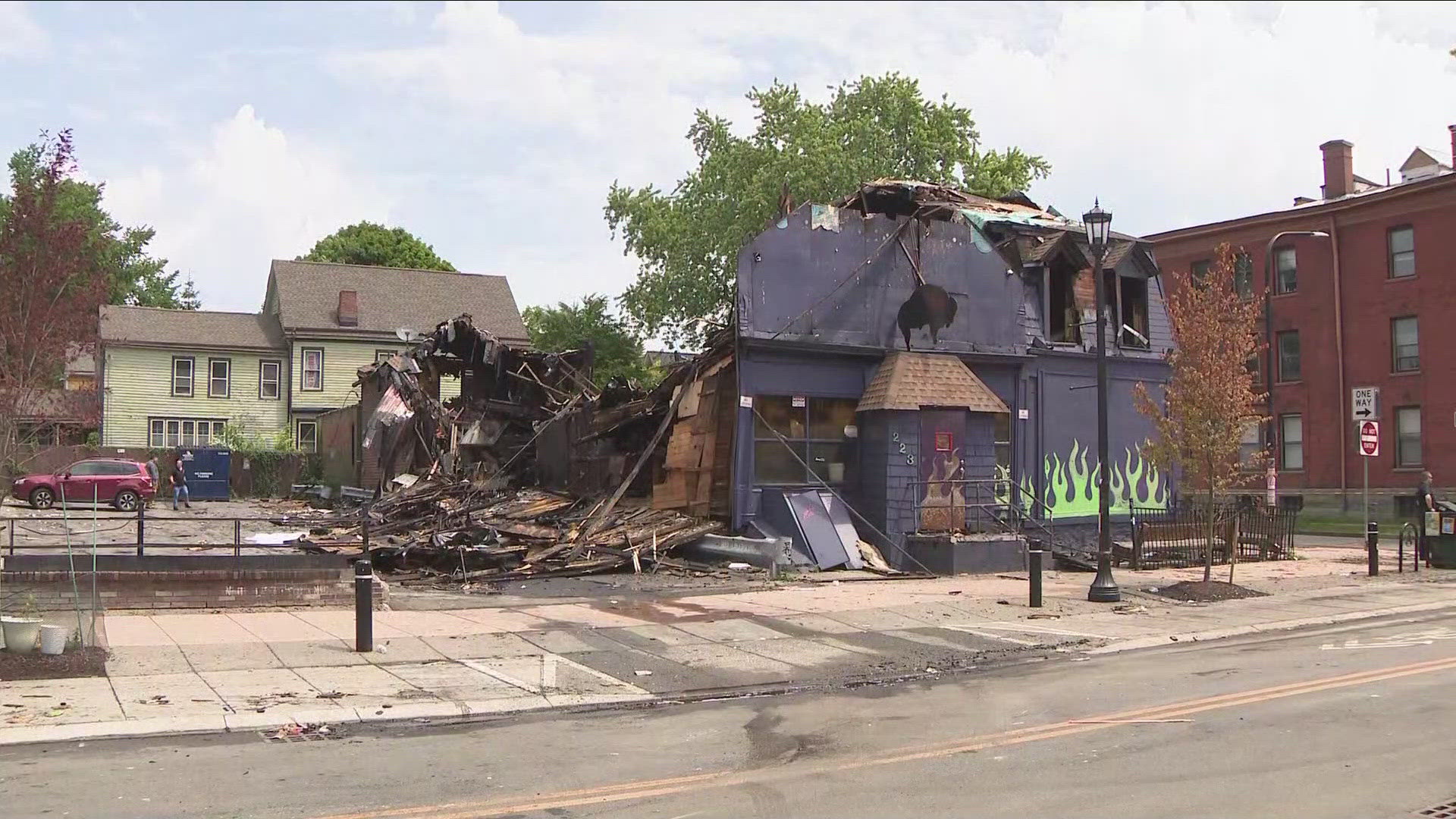
John W. Burns’s July 20, 2026 guilty plea did not end the Old Pink arson case so much as expose the machinery underneath it. Before U.S. District Judge Richard J. Arcara in the Western District of New York, Burns waived indictment and pleaded guilty to federal arson tied to the June 17, 2024 fire that destroyed The Old Pink, the 55-year-old Allentown dive bar at 223 Allen Street in Buffalo. Local reports describe the plea as a straight-up guilty plea, with no publicly disclosed plea agreement, and sentencing was reported as scheduled for Oct. 27, 2026, subject to the court’s calendar.[1][2][3]
That posture matters. Burns, reported by WKBW and WBEN as 42, is now inside 18 U.S.C. § 844(i), the federal arson statute covering malicious damage or destruction by fire or explosive of property used in interstate or foreign commerce. Because no bodily injury resulted, the statutory range reported for the offense is a five-year mandatory minimum and up to 20 years in prison.[4]
The federal case turned on commerce, not notoriety
A single bar fire can feel local in every ordinary sense. The patrons are local, the firefighters are local, the loss is counted on a particular block, and the ruined walls are somebody’s daily landmark. Section 844(i) asks a different threshold question: was the damaged property used in interstate or foreign commerce or in an activity affecting interstate or foreign commerce?
For The Old Pink, the reported jurisdictional bridge was out-of-state patronage. The bar served patrons from outside New York, which prosecutors treated as the interstate-commerce nexus for federal arson jurisdiction.[1][4] That may sound thin to a lay reader expecting federal involvement to require a broader public danger or some special national interest. In courthouse terms, it is the element doing the work. The case did not become federal because Buffalo cared about the building, or because the fire drew news cameras, or because the dollar loss was high. It became federal because the government alleged that the property fell within the commerce language Congress wrote into § 844(i).
That distinction is more than academic. Once § 844(i) attached, the sentencing floor attached with it. A state arson prosecution would have moved through a different charging and sentencing architecture. This one moved through federal court with a mandatory minimum already built into the statute.
What burned on June 17, 2024
The fire broke out in the early morning hours of June 17, 2024, at The Old Pink, also known as The Old Pink Buffalo or Mulligan’s Brick Bar, in Buffalo’s Allentown neighborhood. Reports described the fire as consuming the structure and leaving the remaining walls unsafe enough to require emergency demolition.[1][2][3]
The building’s destruction was not treated as a close-call accidental fire for long. The Buffalo Fire Marshal ruled the fire arson on Aug. 1, 2024, and the reported property damage exceeded $2 million.[1] The legal filings and news accounts do not need nostalgia to make that significant. A 55-year-old bar disappeared, the physical site had to be taken down, and the people around it were left with the practical aftermath before the federal case had fully taken shape.
Why a guilty plea made sense on this record
The reported evidence against Burns was not one thing. It was a set of different proof types that, together, made trial a poor gamble. That is often the difference between a defensible indictment and a plea calendar that moves quickly once the defendant has seen the discovery.
The physical evidence began with a blue propane plumber’s torch recovered at the scene. Reports state that Burns identified the torch in surveillance footage.[1][3] A recovered object does not, by itself, prove who started a fire or with what state of mind. Its force comes from connection: location, identification, and fit with the origin theory. Here, the torch gave the government something concrete to place alongside video and communications.
The video evidence did a different job. Two separate surveillance feeds reportedly placed Burns near the fire’s point of origin.[1][3] That matters because arson cases frequently turn on opportunity and proximity before they ever reach motive. Two feeds reduce the room for arguing that a single camera angle was misleading, incomplete, or misidentified.
Witness identifications added the human layer. They did not replace the cameras; they reinforced them. A jury hearing only from a witness might worry about memory. A jury seeing only video might be asked to doubt identity. The reported case gave prosecutors both categories.[1][3]
Then came the text messages. Before the fire, Burns allegedly sent messages saying “Guerrilla mode on” and “Guerrilla BuffL9 is a go.” Afterward, he allegedly sent messages asking to be bailed out.[1][3] Communications like that are rarely as tidy as a confession, and they would still have to be argued in context. But in a federal arson case, they can be devastating because they give prosecutors language that sounds preparatory before the event and consciousness-of-trouble after it.
Taken separately, each proof category leaves room for litigation. A torch can be challenged, a camera angle parsed, a witness cross-examined, and a text thread contextualized. Taken together, they created the kind of record that makes a straight-up guilty plea understandable even without a disclosed cooperation agreement or negotiated sentencing recommendation.
The Essex St. Pub charge belongs in the margin, not the center
The available reporting also identifies a separate Aug. 13, 2024 arson at the Essex St. Pub parking lot, charged federally against Burns.[3] That allegation is relevant, but it should not be folded into the Old Pink plea as though the procedural posture were fully resolved in the public record. The reported Old Pink guilty plea stands on its own statutory and evidentiary footing.
At sentencing, separately charged conduct can matter in ways that do not require it to be the offense of conviction, depending on what is admitted, proven, or otherwise properly considered. The Essex St. Pub matter may therefore have significance as alleged pattern evidence or as part of the broader supervision and charging picture. The public record available here does not justify treating it as if it has already been resolved through the same plea.
Mental health treatment and supervision did not erase the statutory floor
Burns’s pretrial history was not clean. After his initial arrest, reported by WKBW as Sept. 6, 2024, he was released to an inpatient mental health treatment facility. WBEN reported that he was removed from that program, placed on home incarceration at his parents’ home, later violated bail conditions, and was remanded to U.S. Marshals custody.[1][3]
That history may matter to Judge Arcara at sentencing. It may matter to the defense’s mitigation presentation, to the government’s view of risk, and to the court’s assessment of compliance while on release. But it does not move the case out of § 844(i). Once the guilty plea was entered to the federal arson offense, the five-year minimum became the baseline consequence below which ordinary sentencing discretion cannot go absent a legally available mechanism not disclosed in the public reports.
What remains for sentencing
The reported sentencing date is Oct. 27, 2026, before Judge Arcara.[1][2][3] Court dates move, and the public reporting does not supply a presentence report, guideline calculation, or final position from either side. What can be said now is narrower and more useful: Burns faces a statutory range beginning at five years and ending at 20 years because the offense involved property damage by fire under § 844(i) and no bodily injury was reported.[4]
Within that range, the court will still have decisions to make. The judge can consider the advisory guidelines, the nature of the offense, the damage, Burns’s history and characteristics, his conduct while on release, any unresolved or separately charged conduct properly before the court, and the statutory sentencing factors. But probation is not a realistic endpoint for this conviction. The mandatory minimum is not a suggestion in the background; it is the first hard edge of the sentencing range.
That is the practical lesson of the Old Pink prosecution. Federal jurisdiction came from the commerce element, not from the emotional weight of losing a neighborhood institution. The guilty plea was pressured by a proof package that combined object evidence, video placement, witnesses, and text messages. The sentence has not been imposed, but the discretion available at sentencing is already bounded by the statute Burns admitted violating.
References
- Man pleads guilty to arson that destroyed The Old Pink — WKBW — July 20, 2026 —
- Buffalo man pleads guilty to Old Pink arson — Spectrum News 1 — July 20, 2026 —
- John Burns pleads guilty in Old Pink arson case — WBEN / Audacy — July 20, 2026 —
- 18 U.S. Code § 844 - Penalties — Cornell Legal Information Institute —
Comments
Join the discussion with an anonymous comment.